


Markets in crisis do what they always do: they throw everything overboard.
That is exactly when the best opportunities are created. The investors who profit most from geopolitical shocks are usually the ones who anticipated the structural shifts, and positioned accordingly.
Moments like this tend to do two things at once. They create immediate winners as capital rushes toward safety, scarcity, and strategic relevance. But they also create forced selling in high-quality businesses caught in the panic, setting up some of the most attractive rebound opportunities once conditions stabilize.
Rather than chase headlines, the goal is to identify where the earnings power, balance sheet strength, and structural tailwinds are likely to show up over the next 6 to 18 months. Some names benefit directly from conflict-driven shifts in defense, energy, logistics, and industrial policy. Others are being punished for fear that is likely temporary, not permanent.

Key Takeaways
The current geopolitical shock is creating two distinct opportunity buckets: immediate beneficiaries and contrarian recovery plays.
The clearest near-term winners are in defense, cybersecurity, LNG, critical minerals, and select industrial infrastructure.
The more asymmetric setups may be in travel, shipping, housing, REITs, and select emerging markets where fear has created valuation dislocations.
The best opportunities are not in low-quality speculation. They are in durable businesses with strong balance sheets, real demand visibility, and identifiable catalysts.
Part I: Immediate Beneficiaries
The Conventional and the Under-the-Radar
Let’s be precise about what “immediate beneficiary” means. It does not mean stocks that already spiked 30% on the news. It means a) businesses whose earnings will structurally improve over the next 6–18 months because of conditions the conflict has created or accelerated and b) with high enough quality to hold through any near-term volatility.
The most obvious themes today are defense, AI-enabled military software, cybersecurity, LNG infrastructure, and critical minerals. But as always, the key is to stay selective. Not every company inside a strong theme is worth owning. Quality still matters.
Defense, AI Warfare, and Cybersecurity
Every geopolitical conflict creates procurement cycles. What makes this cycle different is the degree to which software, AI decision systems, drones, and cyber capabilities are moving from optional to essential.
PLTR 0.00%↑ stands out here. Palantir remains one of the most important software names tied to modern defense infrastructure. Its positioning across government analytics, battlefield intelligence, and AI-enabled operational systems gives it a unique strategic edge. The deeper the world moves into data-driven warfare and national security digitization, the more relevant the platform becomes. This remains one of the highest-conviction long-duration names in the space.
CRWD 0.00%↑ also belongs in this conversation. Kinetic conflict is almost always accompanied by cyber escalation. CrowdStrike gives exposure to that layer through a recurring-revenue, cloud-native business model that is less cyclical than traditional defense hardware and increasingly critical in state-sponsored threat environments.
RTX 0.00%↑ is one of the clearest direct beneficiaries on the hardware side. Missile systems, air defense, and advanced munitions all move higher on procurement priority lists when geopolitical tensions rise.
AVAV 0.00%↑ is the more focused drone warfare expression. AeroVironment offers direct exposure to the shift toward lower-cost, highly precise unmanned systems that are playing a larger role in modern conflict. For investors who want a purer drone-related angle, this is one of the more compelling listed vehicles.
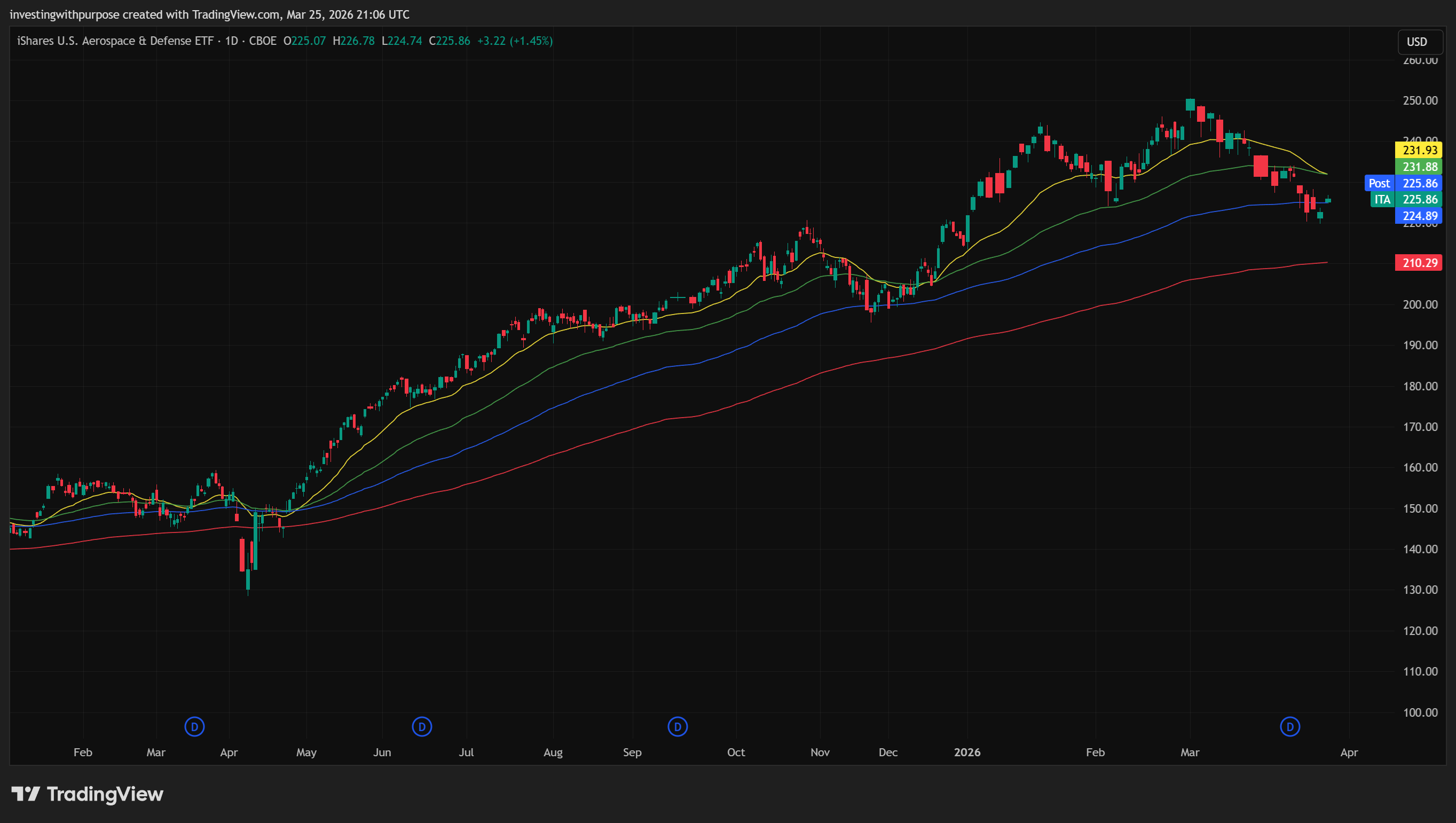
ITA 0.00%↑ ETF is always a solid option
Energy, LNG, and Infrastructure
Energy remains one of the most important transmission channels in any Middle East shock. If supply disruption persists or shipping routes remain threatened, the pricing response in oil and gas can ripple through nearly every asset class.
LNG 0.00%↑ is one of the cleanest listed ways to express that. Cheniere is already a dominant U.S. LNG exporter, and any sustained pressure on global energy flows only increases the strategic value of its infrastructure. It is not just a commodity trade. It is a toll-road-style asset base linked to global energy security.
GTLS 0.00%↑ is a more under-the-radar way to play the same ecosystem. Chart Industries supplies the equipment that makes LNG infrastructure possible. That means exposure not only to today’s energy stress, but also to the capex cycle needed to expand future export capacity.
GOLD 0.00%↑ deserves mention as well. In environments defined by geopolitical stress, inflation uncertainty, and dollar volatility, gold often regains its role as a reserve asset. Barrick gives exposure through a major producer with scale and operational discipline rather than pure spot-price speculation.
Critical Minerals: The Underappreciated Theme
This may be one of the most important themes in the entire piece, and something we’ve covered before.
Critical minerals are no longer just an EV or clean energy story. They sit at the heart of defense systems, industrial policy, advanced electronics, grid infrastructure, and AI-related supply chains. When geopolitical fragmentation rises, secure access to these materials becomes a strategic issue rather than a simple commodity issue.
MP 0.00%↑ is one of the most important names to watch. MP Materials is effectively a cornerstone asset in the effort to build a more independent U.S. rare earth supply chain. If Western governments continue to push for domestic processing, magnet manufacturing, and resource security, the long-term optionality here remains meaningful.
USAR 0.00%↑ is the more speculative version of that theme, but still worth noting for investors comfortable with higher-risk strategic-material plays.
$LYC (ASX) offers international exposure through Lynas, one of the most credible non-Chinese rare earth operators. It is one of the cleaner ways to express the idea that Western supply chain diversification is still early.
CAT 0.00%↑ belongs here too, even if it is not a miner. Every critical mineral project, reshoring buildout, or extraction push requires equipment, and Caterpillar remains one of the highest-quality industrial compounders tied to that capex cycle.
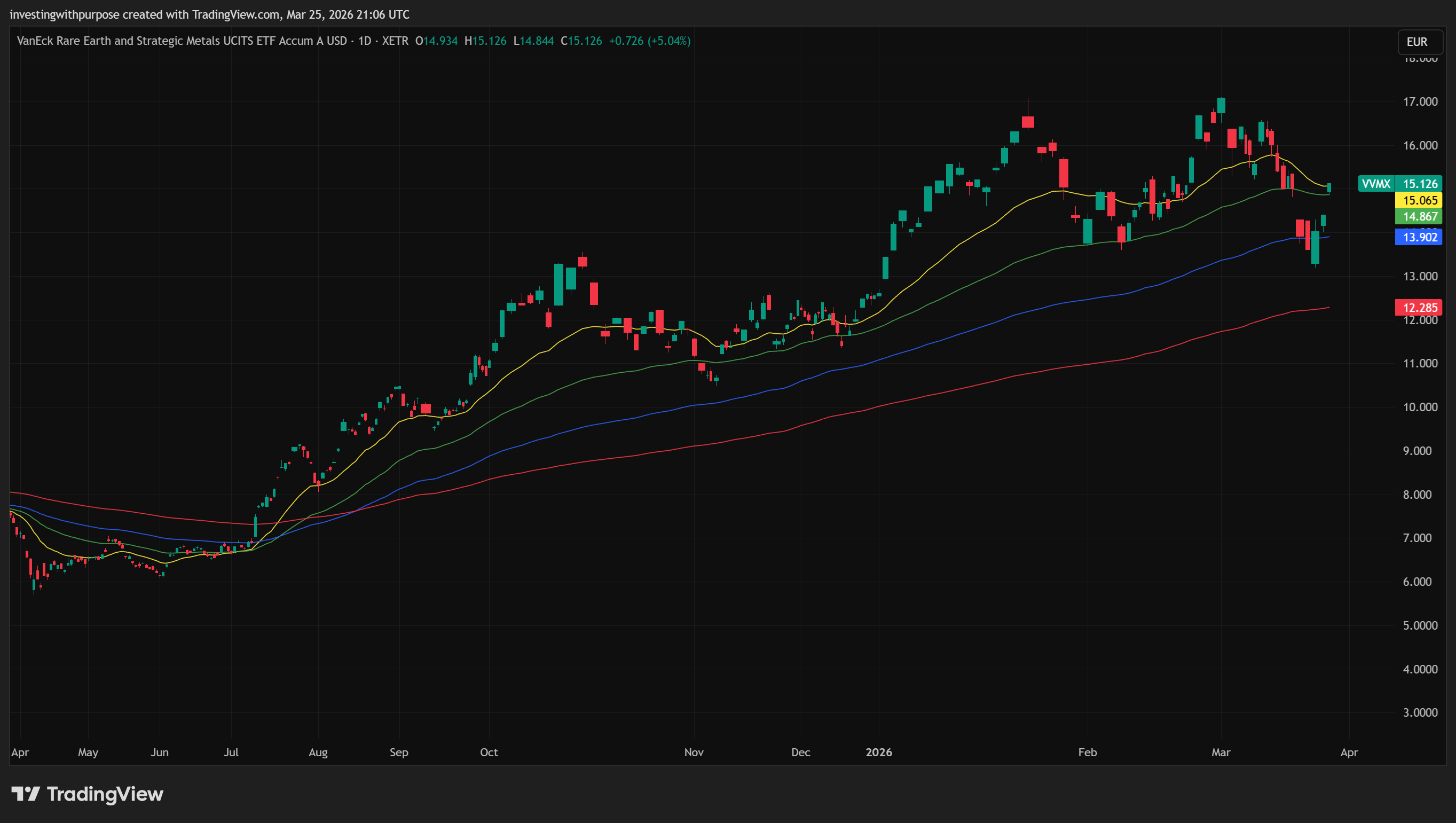
$VVMX (VanEck Rare Earth and Strategic Metals UCITS ETF) is a solid option for diversified exposure
Rare Earths Are the New Energy Chokepoint

Rare earth materials sit behind some of the most important technologies of the modern economy.
Part II: Contrarian Recovery Plays
Buy the Stress, Own the Rebound
This is the harder side of the opportunity set, but arguably the more asymmetric one.
When markets panic, they do not always distinguish between temporary disruption and permanent impairment. That is how high-quality operators in travel, housing, and other cyclical sectors can get repriced well below what their normalized earnings power suggests.
That is where the rebound bucket starts to matter.
Travel, Airlines, and Cruise
The market often reacts to geopolitical stress by immediately selling travel-related names. Sometimes that is justified. Sometimes it is not.
If demand destruction is temporary and trips are delayed rather than cancelled outright, then what looks like weakness today can become a setup for powerful earnings normalization later.
RCL 0.00%↑ stands out as one of the highest-quality cruise operators. The company has strong brand positioning, premium demand exposure, and a visible growth runway through fleet and destination expansion. If macro fear continues to pressure the stock without materially impairing forward demand, that becomes interesting.
VIK 0.00%↑ is another standout. Viking’s affluent customer base tends to be more resilient, and its operating profile has been unusually strong. This is not a mass-market demand story. That matters in volatile environments.
DAL 0.00%↑ remains one of the more financially disciplined airline operators. Delta’s premium strategy and stronger positioning relative to weaker peers make it a better-quality recovery candidate if international routes normalize and fuel pressures ease.
$WIZZ is a more aggressive contrarian expression. Wizz Air has meaningful exposure to disruption in Europe and surrounding travel flows, but it also has one of the stronger low-cost models in the region. If oil falls and operational conditions improve, the margin recovery could be sharp.
BKNG 0.00%↑ may be one of the highest-quality names in the entire travel bucket. Asset-light, high-margin, and globally diversified, Booking can participate in travel normalization without taking the same capital intensity risk as airlines or cruise operators.

Global Shipping: A Rare Two-Way Setup
Shipping is interesting because it can benefit in both disruption and normalization, just through different mechanisms.
Route disruptions increase voyage times, tighten effective capacity, and can support freight rates. Normalization, on the other hand, can revive volumes and unlock sentiment recovery. Either way, select operators can work.
MATX 0.00%↑ is the higher-quality way to express the shipping angle. Matson offers exposure to Pacific trade flows through a much more disciplined operating model, with stronger earnings visibility than many of the more volatile container names. If disruption reshapes routes or pricing without permanently impairing demand, MATX 0.00%↑ looks like the kind of operator that can benefit while still fitting the article’s emphasis on balance sheet quality and durability.
FRO 0.00%↑ gives exposure through crude tanker markets, where longer voyage paths and rerouted energy flows can support earnings.
$HAFNI (Oslo) offers another differentiated international angle through product tankers, with potential upside if refined product dislocations persist.
Housing, REITs, and Rate-Sensitive Assets
This bucket matters for a different reason. It is less about war and more about what comes after the shock.
If growth weakens while inflation remains unstable, central banks are forced into an increasingly narrow path. Any credible move toward lower rates or easing expectations could sharply reprice beaten-down rate-sensitive equities.
WELL 0.00%↑ is arguably the highest-quality REIT setup here. Welltower combines secular demographic demand with significant operational scale and strategic capital deployment. It is not a simple rate-cut trade. It is a quality real asset platform that becomes even more attractive if rates fall.
RKT 0.00%↑ is the more direct housing-rate expression. If mortgage activity begins to recover, the operating leverage in that model can be significant.
$VNA offers one of the more interesting European setups. Vonovia has been heavily repriced in the rate shock, but the underlying housing assets remain real, scarce, and income-producing. If financing pressure eases, the disconnect between valuation and underlying asset value becomes harder to ignore.
$RMV gives exposure through a more asset-light platform model. Rightmove is effectively a toll collector on U.K. housing activity, making it a cleaner way to express normalization in property transactions.
Part III: Emerging Markets
The Most Overlooked Asymmetry
Emerging markets are often treated as collateral damage when the USD is strong, oil is volatile, and geopolitical stress rises. But that blanket selling can create opportunities, especially where local fundamentals remain intact and valuations are already compressed.
This is not a call to buy emerging markets indiscriminately. It is a call to focus on quality and catalyst.
MELI 0.00%↑ remains one of the best emerging market growth businesses available on a U.S. exchange. MercadoLibre is still building across ecommerce, payments, and financial infrastructure in Latin America, with multiple long-duration growth levers still in place. Among EM names, this remains one of the clearest quality leaders.
BABA 0.00%↑ is the more controversial value-oriented setup. The company still has enormous scale and optionality, but investor sentiment continues to reflect geopolitical and regulatory risk. That discount is exactly why some investors stay interested.
GREK 0.00%↑ is an ETF, but it deserves mention because flow-driven re-ratings can matter. If Greece continues to benefit from institutional reclassification and improving macro perceptions, the ETF can serve as a simple vehicle for that trade.
EWZ 0.00%↑ is the broader Brazil expression. Political developments, valuation compression, commodity exposure, and real-rate dynamics all make it a market worth watching for a potential sentiment turn.
Two portfolios for one moment. Build both.
The world is genuinely in crisis. The Iran war is the defining geopolitical event of 2026, reshaping energy markets, supply chains, currency flows, and military doctrine simultaneously. That creates dislocations. And dislocations, for disciplined investors, are not problems to avoid. They are the source of the best returns.
The immediate playbook is clear: defense operators with AI-enabled platforms (Palantir, CrowdStrike, RTX), US LNG exporters (Cheniere), critical mineral producers with government backstops (MP Materials, Lynas), and Caterpillar as the industrial infrastructure compounder that benefits from every extraction and reshoring project underway. For gold exposure, Barrick remains the operationally disciplined choice.
The contrarian playbook is where the real asymmetry lives. Royal Caribbean and Viking in cruise, Delta in airlines, Booking Holdings as the asset-light OTA, MATX and Frontline in shipping, Welltower in REITs, and MercadoLibre as the highest-quality emerging market growth story on any exchange. Add Vonovia for European rate-cut exposure and the GREK ETF for the mechanical Greek MSCI upgrade trade.
The thread connecting every name on this list: balance sheet quality, genuine competitive advantage, and a specific, identifiable catalyst. We’ve removed the speculative, the overleveraged, and the merely cheap. What remains are businesses that will still be compounding shareholder value in five years regardless of what happens in the Strait of Hormuz next week.
The window to position ahead of the crowd is measured in weeks, not months. Ceasefire rumours moved these stocks 5–8% in a single session. The full resolution move will be far larger and far faster.
Thank you for reading.
This article is for informational and educational purposes only and reflects personal opinion, not individualized investment advice. Nothing here should be interpreted as a recommendation to buy, sell, or hold any security. All investments involve risk, including the potential loss of principal. Market conditions can change quickly, and past performance does not guarantee future results.