


Adobe ADBE 0.00%↑ entered late 2026 in a very different place than it left 2025.
After a strong rally into year-end that met our upside targets, the stock rolled over hard, resetting both price and sentiment. What looked like a valuation compression story last fall has since evolved into something more nuanced: a top-tier compounder with improving AI positioning, a repaired balance sheet narrative, and a trend that remains technically broken despite better fundamentals.
Our last analysis from November 2025 accurately projected targets that ADBE met later in December (see it below).
Adobe: AI Narrative Reset. SEMR Acquisition. Strong Fundamentals. Trend Still Broken.

Adobe is back in M&A mode. After the failed $20B Figma deal, the company just announced a definitive agreement to acquire Semrush for $1.9B in cash, a strategic bet on AI-driven generative engine optimization and marketing analytics.
Since then, the technical story has shifted significantly. It started 2026 with a massive downshoot and hasn’t stabilized since.
This update revisits where the stock was, what has changed since, and how to approach ADBE now with discipline rather than conviction.
Where We Were, and What Actually Happened
When we last published on Adobe in late November 2025, ADBE was trading in the low $320s after a prolonged drawdown. The thesis then was clear: fundamentals were strong, valuation had compressed sharply, but the trend was still broken. The Semrush acquisition helped reset the AI narrative, yet the chart argued for patience rather than aggression.
That patience was rewarded briefly.
Adobe rallied strongly into late December 2025, pushing into the mid-$340s and tagging the upper end of our tactical bounce targets. That move validated the short-term setup: downside pressure had exhausted, sentiment was washed out, and price responded once selling momentum cooled.
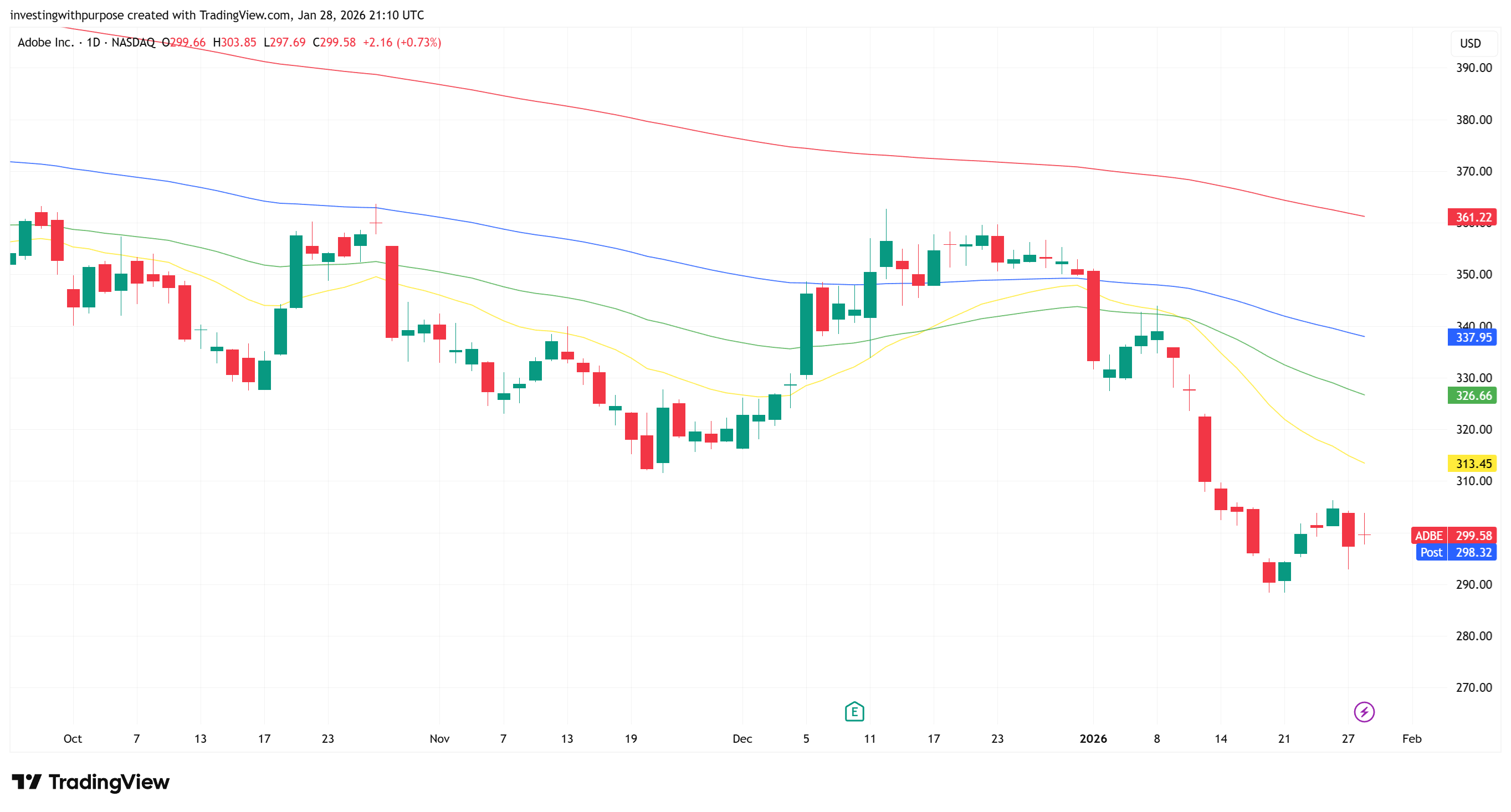
But as 2026 began, the stock failed to build on that strength. The rally stalled, lower highs formed, and January opened with renewed selling pressure. By late January, ADBE had round-tripped much of the bounce and is now trading around $298–301, back near the lower end of the broader consolidation zone.
This update is about what has actually changed, what hasn’t, and how to approach Adobe now as a risk-managed opportunity.
What’s Changed Since November
Semrush Deal Progressed With Manageable Friction
Since announcing the Semrush acquisition in November, the process has moved forward but not without noise:
On December 29, 2025, Semrush filed a definitive proxy for a February 3, 2026 shareholder vote.
In mid-January, three lawsuits were filed alleging disclosure deficiencies in the proxy.
Semrush responded with supplemental disclosures, detailing board deliberations, valuation comparables, outreach to alternative bidders, and Adobe’s revised offer terms.
This is important context, but not a thesis breaker.
These lawsuits are typical for public-company M&A and, critically, do not change the economics or strategic logic of the deal. The transaction remains modest relative to Adobe’s scale, easily funded, and low risk to the balance sheet. The additional disclosures reduce closing risk rather than increase it.
From an investment standpoint, the takeaway is simple: Semrush is still coming, and the path to close remains intact.
The AI Narrative Is Clearer Than It Was
Firefly’s original problem was not generation, it was monetization visibility.
Semrush directly addresses that gap. It adds:
Real-time intent data
AI-driven GEO / SEO measurement
Feedback loops between content creation and performance
This turns Firefly from a creative tool into a measurable revenue system inside Experience Cloud. That does not mean instant revenue acceleration — but it does mean Adobe now has a clearer path to prove AI ROI to enterprise customers.
Fundamentally, this was the missing link in late 2025. That gap has narrowed.
Updated Technical Read: January 2026
The new charts refine the prior technical thesis.
Daily Structure
Price is now consolidating just below $300, after failing to hold the late-December highs and decisively below the November bounce zone and well beneath all major daily moving averages. The breakdown below $311–$312 invalidated the prior tactical long thesis and confirmed downside continuation.
Momentum is stretched but not reversing. RSI is oversold, but there is no confirmed trend change.
Intraday Structure (5m / 30m / 1h)
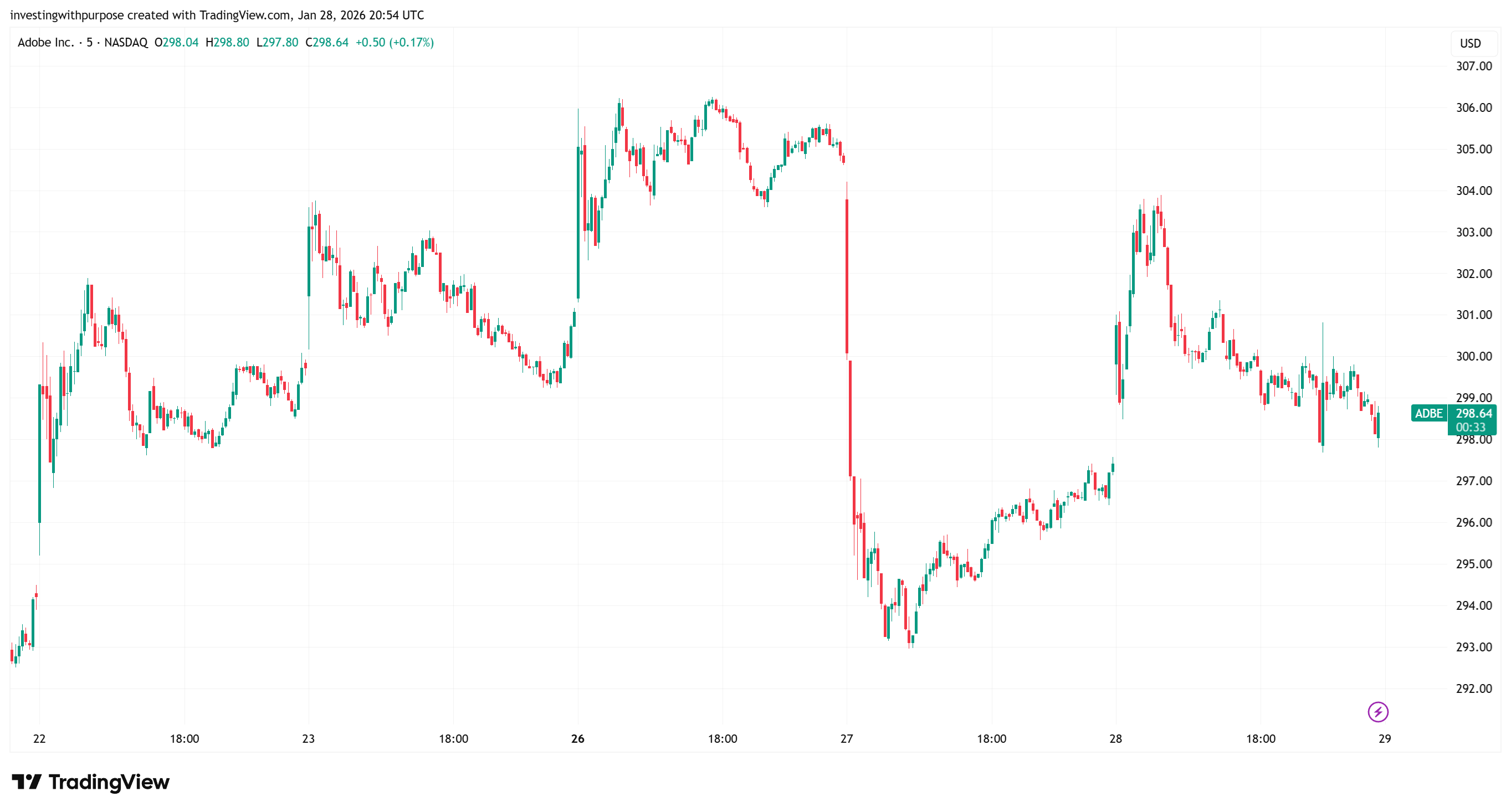
Price is coiling between $296 and $303.
Repeated failures near $302–304 confirm supply overhead.
Short-term structure shows overlapping waves, not impulsive moves — classic consolidation behavior.
Elliott / Pattern Context
The December rally completed a corrective sequence.
The January pullback retraced that move cleanly, without panic or acceleration.
Current price action fits a basement-building phase, not a breakdown continuation.
In short: the trend is not bullish, but the downside momentum has materially slowed.
Updated Trade Plan (January 2026)
Bias
Cautious long bias only at defined levels. No interest in chasing strength.
Primary Long Entry Zone
$295–300, on pullbacks that hold above $295 with higher intraday lows.
Otherwise, $295-285
Confirmation Entry
Add only on a daily close above $305, confirming acceptance above the EMA cluster.
Invalidation
Daily close below $290.
A break of $290 shifts risk toward $275–280 and invalidates the base thesis.
Targets
Target 1: $315–320
Target 2: $335–340
Stretch (trend repair): $360, only if $340 is reclaimed and held
Positioning Guidance
This is not a full-size trend trade.
Size smaller, scale out early, and respect resistance.
Longer-term investors should still favor accumulation on weakness, not breakout chasing.
Bottom Line
Adobe today is not the same stock it was a year ago, but it is also not yet the stock bulls want it to be.
Fundamentals remain elite.
The Semrush acquisition meaningfully improves AI monetization visibility.
Valuation is still compelling.
But the chart is honest: the long-term trend is still under repair.
That creates opportunity for patient investors and disciplined traders, but only if risk is controlled and expectations are realistic.
This is how quality compounders reprice: slowly, unevenly, and with plenty of false starts. Adobe is no longer broken. It just isn’t healed yet.
This analysis is for educational and informational purposes only and reflects personal opinions based on publicly available information. It is not investment advice, a recommendation, or an offer to buy or sell any security.