


AeroVironment reported its fiscal first quarter, ended August 1, after Wednesday’s close. Revenue was a record $480.5 million, adjusted earnings of $0.59 beat a consensus most feeds put between $0.22 and $0.30, funded backlog hit a record $1.5 billion, and guidance was held.
Split the quarter into the 2 segments the company reports and it stops looking like one business having a good quarter.
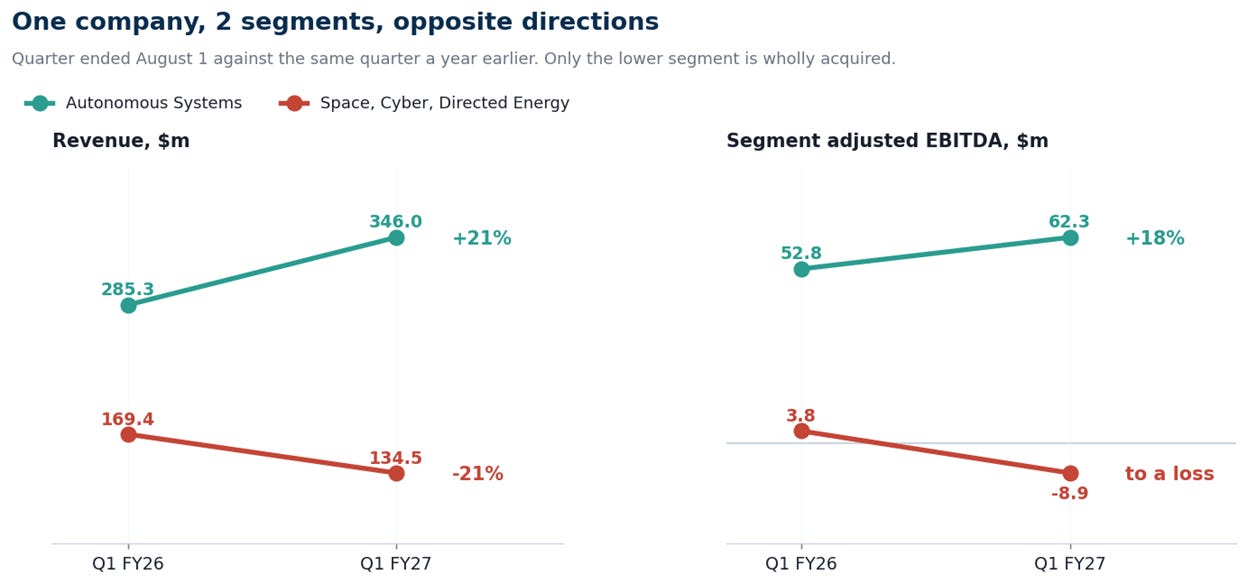
Autonomous Systems, 72% of revenue, grew 21.3% to $346.0 million and earned $62.3 million of segment adjusted EBITDA, an 18.0% margin. Space, Cyber and Directed Energy, the other 28%, shrank 20.6% to $134.5 million and lost $8.9 million.
Consolidated revenue rose 5.7%, the average of a business compounding and a business contracting, describing neither.

Key Takeaways
Segment adjusted EBITDA fell 5.6% even as revenue rose. Autonomous Systems added $9.5 million; the other gave back $12.7 million.
Space, Cyber and Directed Energy has lost money in 3 of the 5 quarters since it arrived, and lost $2.6 million across fiscal 2026 on $618.8 million of revenue.
Guidance implies GAAP earnings of $0.21 to $0.53 a share against adjusted earnings of $3.02 to $3.34. At $140.80 those are 381 times and 44 times.
The auditor issued an adverse opinion on internal control over financial reporting at April 30, while giving the accounts a clean one.
Prices are the Wednesday September 9 close, the last completed session, hours before the results. Thursday is pre-open as this is written, with the stock indicated roughly 5% to 7% higher.
Which Segment Is Which
It matters what sits in each segment, and the answer isn’t tidy.
Autonomous Systems holds what AeroVironment built, Switchblade and Puma and JUMP 20, but also the air and missile defense, electronic warfare and undersea units that came with BlueHalo, plus ESAero, bought for $177.9 million in March. Its growth isn’t purely organic and the company doesn’t say how much isn’t. Within it, uncrewed aircraft did the work, up 71% to $120 million, while precision strike managed 8%.
Space, Cyber and Directed Energy is different: every dollar was acquired, and AeroVironment had essentially none of it before May 2025. Both halves fell, space and directed energy down 28% to $51 million, cyber and mission solutions down 16% to $83 million.
What That Segment Has Delivered
BlueHalo closed on May 1, 2025. Announced at $4.1 billion in November 2024, the stock fell before completion, so the consideration recorded was $3.53 billion, or $3.48 billion net of cash acquired: 17,425,849 shares at $151.52 plus settlement of BlueHalo’s debt. That purchase was split across both segments, so the price doesn’t attach to the shrinking one alone.
Since then it has posted adjusted EBITDA margins of 2.2%, then -3.8%, -1.3%, 1.0% and -6.6%, and lost $2.6 million across the full fiscal year on $618.8 million of revenue. In the April quarter, seasonally the strongest, it turned $149.2 million into $1.4 million while Autonomous Systems was converting at 28.2%.
Much of the decline is mechanical rather than collapsing demand. In January the government issued a stop-work order, later a termination for convenience, on BADGER antenna work under the Space Force’s Satellite Communication Augmentation Resource program, and that revenue stopped.
Then the accounting. AeroVironment wrote down goodwill in its Space unit and reported a third-quarter net loss of $156.6 million. On June 22 it filed an amended report restating that loss to $243.8 million: the carrying value used in the impairment test had omitted goodwill arising from acquired deferred tax assets and liabilities, understating the write-down by $89.4 million. The restated impairment was $240.7 million, and every dollar sits in this segment.
The amendment said why. The error “originated from a material weakness” in controls over the goodwill impairment analysis: the company “did not have a properly designed control requiring preparation and review of a reconciliation of goodwill by reporting unit.” A second one came in with the acquisition: BlueHalo “did not design and maintain effective information technology general controls” for systems feeding its financial reporting.
Deloitte’s report dated June 29 “expressed an adverse opinion on the Company’s internal control over financial reporting because of material weaknesses”, while giving the accounts an unqualified opinion. In the quarterly report filed September 10, management concluded disclosure controls “were not effective as of August 1, 2026”, remediation ongoing. Nobody says the numbers are wrong. They say the machinery producing them has already failed once.
And Then It Won the Laser
Here’s what stops this being a simple story.
On September 2 the Army awarded AeroVironment $464.8 million to produce LOCUST X3 laser systems under the Enduring High Energy Laser program. The Army calls it its first ever production contract for a high-energy laser weapon, and AeroVironment quotes engagement costs below $5 a shot. It belongs to the segment that just lost money, follows a $52 million first international LOCUST order booked in the quarter, and landed after the quarter ended, so the record $1.5 billion backlog excludes it.
So the bear case and the bull case are the same segment: terminated space work, a $240.7 million write-down and the control failures on one side, the largest award of its kind on the other.
The 66% Fall Wasn’t Just About BlueHalo
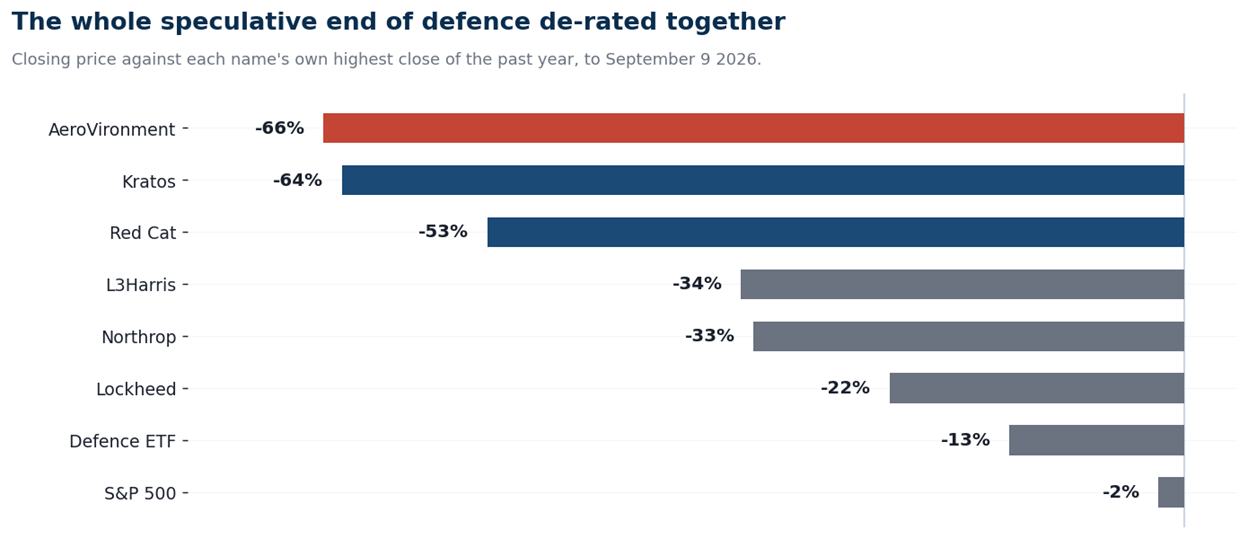
AeroVironment closed Wednesday 65.6% below its highest close of the past year, which is tempting to read as the market’s judgment on the acquisition.
The peer group makes that hard to sustain. Kratos fell 64.2% over the same period without making a comparable purchase, and Red Cat 53.2%, while Lockheed fell 22.5%, Northrop 32.9% and the defence sector fund only 13.3%. On daily closing returns since June 1, AeroVironment correlates 0.79 with Kratos and 0.42 with Lockheed.
That doesn’t prove the acquisition contributed nothing. It does show a large common factor moving the expensive end of defense, so buying this because it’s “66% off” is betting on a sector dislocation more than a company-specific one.
2 Sets of Books
At $140.80 the equity is worth $7.16 billion. Add $730.1 million of long-term debt and $120.8 million of leases, which I’m including in enterprise value, take off $580.2 million of cash and short-term investments, and you get $7.43 billion, or 3.4 times guided revenue and 23.6 times guided adjusted EBITDA.
The earnings multiple depends which earnings you accept. Guidance is net income of $10 million to $27 million, $0.21 to $0.53 a diluted share, against adjusted earnings of $3.02 to $3.34. At the midpoints that’s 381 times GAAP and 44 times adjusted.
The adjusted number strips out $0.69 a share of intangible amortization and purchase accounting, plus $0.04 of acquisition costs. It asks investors to look past recurring acquisition accounting while the acquired businesses inside Space, Cyber and Directed Energy are shrinking.
The balance sheet frames the same thing. Goodwill and intangibles are $3.38 billion of $5.73 billion of assets, 59% of everything the company owns, and tangible equity is $1.02 billion. After the impairment, retained earnings stand at $4.1 million against $4.40 billion of paid-in capital.
The Ramp Is Not Hidden
Guidance was maintained, and the shape it implies is steep, but management says so out loud: 45% of revenue to the first half and 55% to the second, adjusted EBITDA roughly 33% and 67%, adjusted earnings 30% and 70%.
So the arithmetic is the company’s own. With $480.5 million banked, revenue of $2.125 billion to $2.225 billion needs $548 million to $582 million each remaining quarter, and adjusted EBITDA $84 million to $91 million against the $53.4 million just delivered.
That shape is normal here: last year’s April quarter produced $140.1 million of adjusted EBITDA against $56.6 million in the July quarter. The question isn’t whether a ramp is required, because management says it is. It’s whether the segment running at negative margin can turn LOCUST volume into the second-half profitability the guidance assumes. One quiet detail: the $3.18 adjusted midpoint sits under the $3.22 the street carried into the print.
The Case Against Me
The drone franchise is genuinely good: 21% growth, 18% margins, uncrewed aircraft up 71%, bookings of $0.7 billion at a 1.4 book-to-bill.
The stronger argument is that the weak segment is absorbing a terminated program while directed energy ramps behind it. On that reading the margin trough is the setup rather than the warning, and the $464.8 million award is exactly what it predicts. Excluding leases, debt less cash and investments is about $150 million, so there’s time to find out. Going into the print, all 20 analysts covering the stock rated it hold or better, with a mean target of $225.77.
My reservation is that we’re 5 quarters past the close, the segment’s revenue is lower than when it arrived, its margin is the worst it has been, and the acquisition-related control weaknesses still aren’t fixed.
