


The operating numbers are strong and the fourth-quarter guidance is stronger. What matters to an owner is what that growth is worth per share, once conditional warrants and cash conversion are counted.
AMD reported third-quarter results after the close on Tuesday 3 November and filed its 10-Q on Wednesday morning. The business is executing. The harder question is how much of it accrues to the shares you already hold, and the answer involves warrants issued a year ago and in February, not anything granted this week.
The Quarter
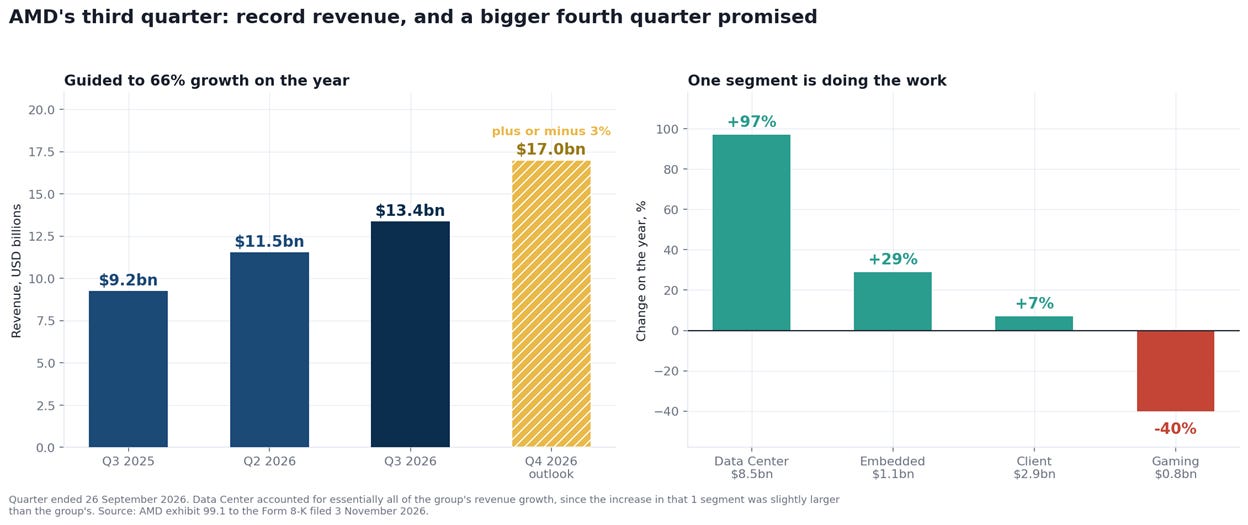
Revenue was $13.38bn, up 45% on the year and 16% on the quarter. GAAP operating income more than doubled to $2.83bn, lifting the operating margin from 14% to 21%. On AMD’s adjusted basis, operating income rose 75% to $3.92bn and earnings per share rose 74% to $2.09.
For the fourth quarter AMD guides to revenue of about $17bn, plus or minus 3%, roughly 66% growth on the year and 27% sequentially. Alongside it, non-GAAP gross margin is guided to about 55%, a point below the 56% delivered in the third quarter, so the revenue step comes with slightly thinner margins.
One segment is doing all of it. Data Center revenue was a record $8.5bn, up 97%, which AMD attributes to both EPYC server processors and the Instinct MI450 launch; the release doesn’t split accelerators from CPUs, so it isn’t purely an AI number. That increase alone was slightly larger than the group’s. Embedded rose 29% to $1.1bn on aerospace, defense, automotive and industrial demand. Client grew 7% to $2.9bn on Ryzen mobile processors, a respectable result obscured by Gaming falling 40% to $773m on lower semi-custom and graphics sales; they report as one segment, down 8%.
So this is an accelerating AI infrastructure business attached to a consumer business that’s shrinking. The release names Anthropic, Meta, Microsoft, OpenAI and Oracle Cloud Infrastructure as running workloads on its new Helios rack-scale systems.
The 320 Million Shares
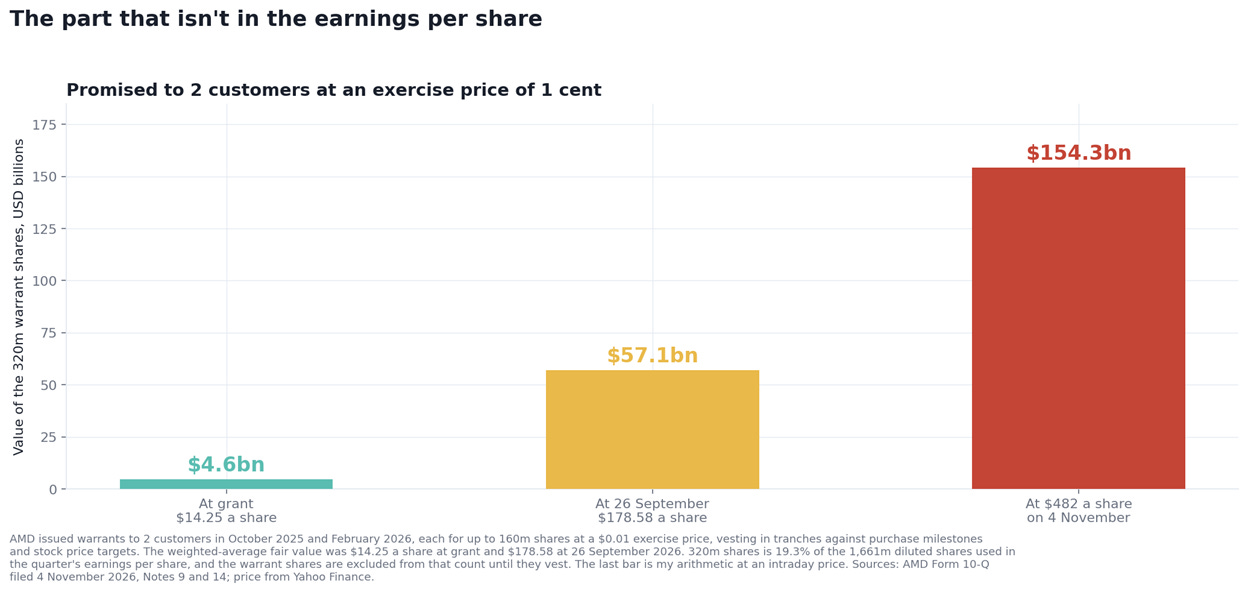
AMD issued performance warrants to OpenAI in October 2025 and to Meta in February 2026, each for up to 160 million shares at $0.01. That’s 320 million in total. Neither is new this week; what’s new is what they’re now worth.
The bargain is specific. Each counterparty signed a binding commitment to buy the initial 1 gigawatt equivalent of Instinct GPU products, and the first tranche vests on delivery of that gigawatt. Under the originally disclosed terms, full vesting requires each customer to purchase 6 gigawatts of eligible products, alongside the applicable market and other conditions: stock price thresholds escalating to $600 a share for the final tranche, plus technical and commercial conditions before exercise. The OpenAI warrant runs to October 2030 and the Meta warrant to February 2031.
AMD had 1,640 million shares outstanding at the quarter end. Issuing all 320 million, holding everything else constant, would lift that to 1,960 million, leaving the warrant holders with roughly 16.3% of the enlarged company. That’s an illustrative maximum assuming conditions are met that so far have not been.
The accounting runs along 3 tracks that are easy to conflate. Because the warrants are consideration payable to a customer, the grant-date fair value of shares probable of vesting is recorded as a reduction of revenue as qualifying sales are booked, and AMD does not add that back, so both the $13.38bn of revenue and the 56% adjusted gross margin are already net of it. The resulting liability is then remeasured each quarter within other income, and the reconciliation excludes $1,097m of that, worth $0.66 a share. The cash flow statement’s $1,179m non-cash add-back overlaps with the same remeasurement rather than being a separate charge.
That remeasurement is the largest positive adjustment between GAAP earnings of $1.46 and adjusted earnings of $2.09, but it’s materially offset: the reconciliation also strips out amortization of acquisition-related intangibles and stock-based compensation, and applies a $1,073m tax adjustment, so a pre-tax item of $1,097m doesn’t map onto the $0.63 gap.
Keep the valuations apart. The weighted-average grant-date fair value, which drives the revenue charge, was $14.25. AMD’s estimated fair value at 26 September was $178.58, which it attributes to updated probabilities and, on its statement that most market conditions had been met, largely its closing share price. The recognized liability was $1.2bn, covering only the portion attributable to revenue booked so far.
None of those shares are in the earnings per share. The filing is explicit that as of 26 September no warrant shares had vested, become exercisable, been exercised, forfeited or expired, so they stay out of the basic and diluted counts until every vesting condition is satisfied. Reported EPS is correct under the accounting rules; it simply doesn’t include shares that may be issued later.
Of the roughly $4.6bn of grant-date fair value, $4.5bn is still unrecognised and will reduce revenue in future periods as qualifying customer sales are booked. AMD doesn’t disclose the timing, which depends on when those purchases occur, so I wouldn’t assume it lands mainly in the fourth quarter. It’s also the same economic bargain as the eventual share issuance rather than a second, separate cost; the revenue deduction is how the accounting recognises the price of the incentive over time.
How To Think About That
Dilution alone doesn’t tell you whether value was created or destroyed. AMD bought anchor demand for a product line it needed to establish against a dominant competitor, plus 2 binding gigawatt commitments from credible buyers. It gave up a claim on up to 16.3% of the enlarged company at a penny a share.
Because tranches depend on both purchase milestones and escalating stock price thresholds, the largest slices transfer in the outcomes where the business compounds. That doesn’t make them worthless if the stock falls: the $0.01 exercise price means they keep value across a wide range of prices. A higher share price raises what the fixed 320 million shares are worth without changing the maximum percentage.
Whether the trade was a good one turns on something not yet measurable: how much of the Data Center ramp depended on these agreements, and how durable the revenue proves after the milestones. AMD repurchased 1.1 million shares for $221m over the first 9 months, with $9.2bn of authority unused, so buybacks aren’t offsetting the potential issuance in any meaningful way.
Record Profit, Less Cash
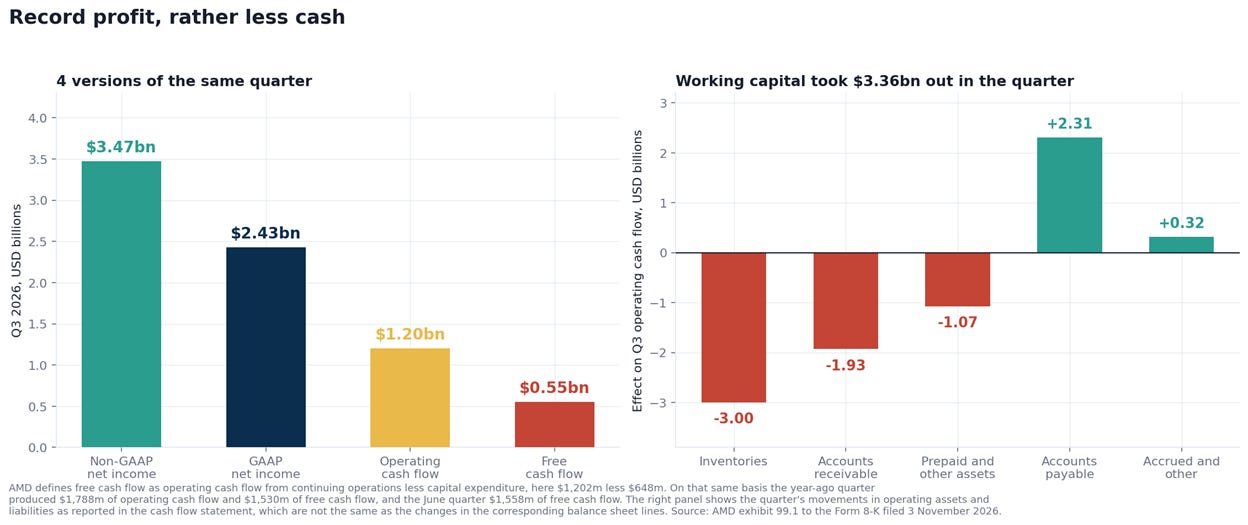
Adjusted net income was $3.47bn. GAAP net income was $2.43bn. Operating cash flow from continuing operations was $1.20bn, against $1.79bn in the same quarter last year, in a period when revenue grew 45%. After $648m of capital spending, AMD’s own free cash flow measure was $554m, against $1.53bn a year ago and $1.56bn in the June quarter. As a share of revenue that’s 4%, down from 17%.
The quarter’s cash flow statement shows where it went. Inventories absorbed $3.00bn, receivables $1.93bn and prepaid and other assets $1.07bn. Against that, payables provided $2.31bn of financing and accrued liabilities $0.32bn, so movements in operating assets and liabilities took about $3.36bn out of operating cash flow. Inventories on the balance sheet now stand at $11.5bn against $7.9bn at the December year end, though balance-sheet changes and cash-flow movements aren’t the same measure.
Over 9 months the picture is less stark: $6.52bn of operating cash flow against $1.85bn of capital spending, so $4.68bn of free cash flow and a 13% margin.
Management gives its own account in the 10-Q, attributing the 9-month inventory build primarily to the continued ramp of Data Center products on advanced process nodes, the receivables increase primarily to higher revenue, and the prepaid increase primarily to prepayments on supply agreements. That’s a coherent description of a company building ahead of demand.
What it doesn’t yet demonstrate is conversion. Receivables rising isn’t a warning in itself when revenue grew 45%; what matters is whether they rise faster than sales and how long collection takes. Watch receivables and inventory against revenue rather than in absolute dollars, inventory turning into shipped product at the guided margin, and free cash flow recovering toward the low-to-mid-teens margins of earlier quarters. Sustaining this growth may also mean funding working capital rather than releasing it.
What Would Change The View
Whether the fourth quarter lands. $17bn is a 27% sequential step, at a guided margin a point below the third quarter’s. Hitting it with inventories at $11.5bn would support the build-ahead reading; missing it would not.
Whether cash conversion follows revenue. Watch operating cash flow against adjusted net income over the next 2 quarters, and specifically whether receivables start converting rather than growing.
The warrant tranches. These move through stages: a purchase milestone and a market condition to vest, then technical and commercial conditions before exercisability, then inclusion in the share count, then issuance on exercise. Delivery of the first gigawatt satisfies that tranche’s purchase milestone, not every condition attached to it. AMD said most market conditions had been met as of 26 September but didn’t identify which individual thresholds were satisfied, and no warrant shares had vested or become exercisable at that date.
Gaming. Down 40% on lower semi-custom and graphics sales, it removes some of the diversification that used to cushion AMD’s cyclicality. Client, by contrast, grew 7%, so the 8% decline in the combined segment is a Gaming problem rather than a consumer one.
Bottom Line
This was a strong quarter from a company executing well against a larger rival. A 27% sequential revenue step at a 55% gross margin would take AMD past a $68bn annualized run rate, and management is guiding to it with 2 binding gigawatt commitments behind the Data Center ramp. If you own AMD for the infrastructure build, the operating evidence went your way.
The qualification is that AMD has pre-sold a share of its own success. Up to 320 million shares sit outside the earnings per share you’re quoted, and on the illustrative maximum they would represent about 16.3% of the enlarged company. That isn’t hidden; it’s set out in Notes 2, 13 and 14 of the 10-Q and in the 8-Ks of October 2025 and February 2026. The case therefore rests on whether the incremental earnings and cash these agreements help generate are large enough to justify the larger potential share base, which revenue growth alone can’t settle.
What would give me greater conviction is narrow and checkable: free cash flow margin recovering toward the mid-teens it managed earlier this year, receivables converting rather than compounding, and the gigawatt milestones arriving through revenue that persists after the associated tranche has vested. Until then the operating case is clearly improving while the per-share case depends on terms that are fixed, disclosed and not yet in the share count.
Sources: AMD third-quarter 2026 results, exhibit 99.1 to the Form 8-K filed 3 November 2026; the Form 10-Q for the quarter ended 26 September 2026 filed 4 November 2026, Notes 2, 13 and 14; and the Form 8-Ks filed 6 October 2025 and 24 February 2026, the latter covering the agreement dated 23 February, describing the OpenAI and Meta warrants. Share-count arithmetic is mine, using the 1,640 million shares outstanding at the quarter end and holding all other changes constant.
This is research and commentary, not personal investment advice. The author may hold positions in names discussed.