


Anthropic ANT 0.00%↑ completed the largest stock market listing on record last week, raising $93.5 billion, and two days later its shares were trading about 20% below the price of the first trade.
The swings make headlines, but the more lasting story sits in the prospectus. Anthropic’s sales have grown roughly 45 times in 18 months, and to keep pace it has committed to around $900 billion of computing power, most of it booked years before anyone can know whether customers will use it. Today, we’re going to explore what that commitment means for the business, and why it matters more than the first days of trading.
Key Points
Quarterly revenue reached $16.96 billion in September 2026, about 45 times the level of 6 quarters earlier.
Most of the $104 billion loss for the first 9 months of 2026 is an accounting charge. The business brought in $6.6 billion of cash from operations over the same period.
Computing power is the pressure point. Its cost rose 77% last quarter while revenue rose 47%, the company’s adjusted operating margin fell from 19% to 15%, and it expects more margin pressure in the near term.
Anthropic has about $900.9 billion of commitments for compute and infrastructure, stretching to 2045, plus an estimated $150 billion to $175 billion more outside that total.
Amazon and Google are shareholders, suppliers and sales partners all at once, and public shareholders get very little say over the company.
The IPO and the First 2 Days
Anthropic priced its shares at $83 on the evening of 18 November, above the $70 to $78 range it had shown to large investors, according to its pricing announcement. When the deal closed on 20 November, its banks had bought all 147 million extra shares they held an option on. That took the offering to 1.127 billion shares and about $93.5 billion, the biggest initial public offering, or IPO, on record, well ahead of SpaceX’s SPCX 0.00%↑ in June.
Anthropic itself received about $91.6 billion before fees, while the rest went to existing shareholders selling shares.
Trading began shortly before midday on 19 November. The first trade came in at $111.50, 34% above the offer, and the shares closed the day at $97.17. On 20 November they fell 8.5% to $88.91, after dipping to $83.05, just 5 cents above the offer price. After 2 sessions, buyers at the offer were up 7%. Buyers of the first trade were down about 20%. At the 20 November close Anthropic was worth about $1.19 trillion.
Anthropic didn’t fall alone. The Nasdaq Composite, an index weighted towards technology companies, dropped 5.3% and the S&P 500 lost 3.7%, in a sell-off led by chip and AI stocks.
The gap between those 2 groups of buyers shows how much the entry price matters in a new listing, but says little about the business. For that, the better guide is the prospectus, the document a company must file with US regulators before selling shares. The question running through it is whether Anthropic can turn remarkable demand into lasting profits when it pays for computing capacity long before it knows what revenue that capacity will bring in.
Demand and Revenue Growth
Founded in 2021 by researchers who left OpenAI, Anthropic sells Claude, a family of AI models that write, summarise, analyze, answer questions and increasingly write software code. Businesses pay usage fees to build Claude into their own products, charged by how much text the models process. Individuals and companies also pay monthly subscriptions.
Anthropic’s quarterly revenue, as reported in the filing:
March 2025: $376 million
June 2025: $787 million
September 2025: $1.38 billion
December 2025: $2.04 billion
March 2026: $4.73 billion
June 2026: $11.56 billion
September 2026: $16.96 billion
IF you look at growth rates, you would see that the latest quarter’s 47% growth was actually a slowdown, following 144% in the June quarter.
More than 11,900 customers each generated at least $100,000 of revenue over the past 12 months, up from about 950 a year earlier.
Another revealing measure is net revenue retention. It compares what existing customers spent in the latest 3 months with what the same customers spent a year earlier. Mature software companies often report net revenue retention around 110% to 120%, whereas Anthropic reports about 900%, meaning those customers now spend roughly 9 times as much. The figure leaves out people on the fixed-price Claude Pro, Max and Ultra plans, so it describes usage-based spending rather than the whole company.
The $81 Billion Run-Rate
The widely quoted $81 billion a year figure is run-rate revenue, an estimate of annual sales based on recent activity rather than sales actually recorded. It takes usage fees from the most recent 28 days, multiplies them by 13, and adds a year of subscription income. Resting on a single month, it rose by $10 billion in October alone. The filing says run-rate revenue isn’t revenue, and that it, the customer counts and retention rest on unverified internal data.
The $104 Billion Loss
Anthropic reported a $104 billion net loss for the first 9 months of 2026, on revenue of about $33 billion.
Most of it involved no cash. Before the listing, many early investors held convertible notes and similar instruments, which are loans or agreements that turn into shares at a later date. Accounting rules require the company to revalue these every quarter. As Anthropic’s valuation climbed, the value of what it owed those investors climbed with it, and each increase was recorded as a loss. That charge came to $94.3 billion, about 91% of the total.
Cash tells a different story. Anthropic brought in $6.6 billion from its operations over the same 9 months, against $2.0 billion of cash used a year earlier. That isn’t free cash flow, since it leaves out spending on its own data centres, but it shows how little the loss says about the running business.
Operating profit, what a company earns from its products after day-to-day costs, was $974 million in the June quarter, the first on record. In September it slipped to a $567 million loss, even though revenue grew 47%. Most of that reversal came from a $1.96 billion non-cash charge for Anthropic’s donation matching programme, under which it matches employees’ charitable pledges with shares. Without that charge, September would have shown a higher operating profit than June.
The company also reports an adjusted measure that leaves out share-based pay and one-off items like this charge. On that basis operating profit rose from $2.2 billion to $2.5 billion, but the adjusted margin fell from 19% to 15%. A smaller share of each dollar of revenue turned into profit.
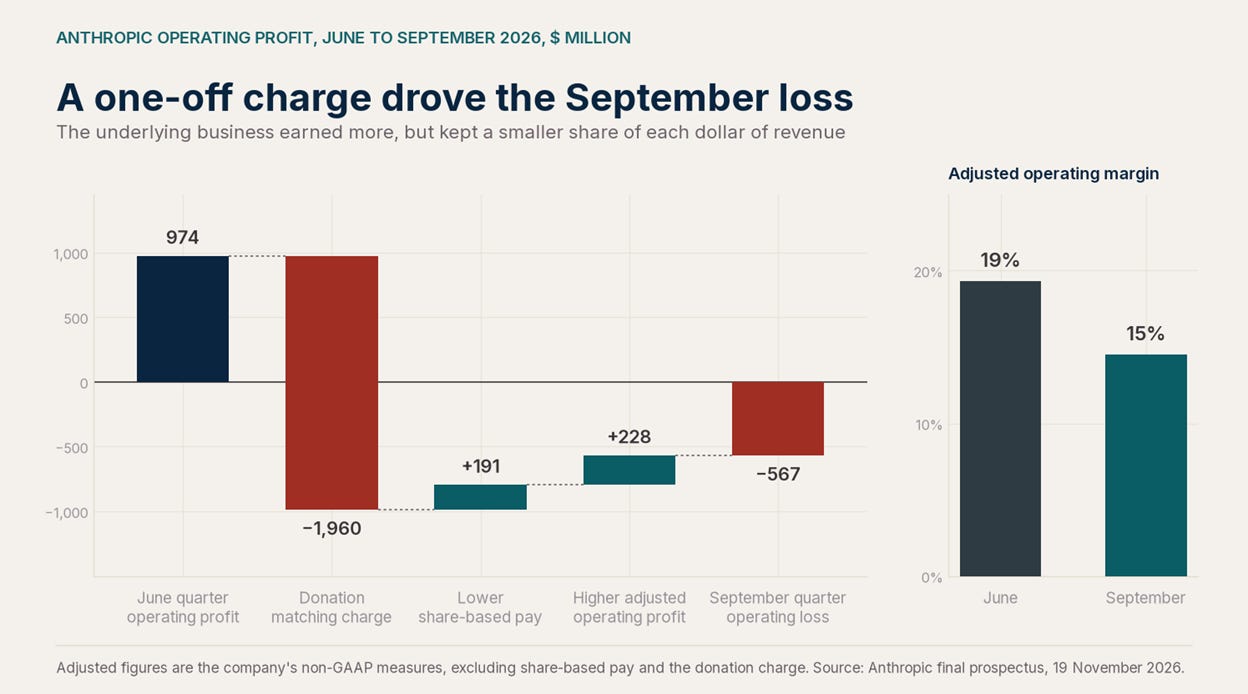
That shrinking margin is where the cost of compute shows up.
The Real Pressure Point: Compute
Running AI models takes a vast amount of computing power, or “compute.” In practice it means renting time on huge numbers of specialised chips in data centres, both to build new models and to answer every customer request. It’s Anthropic’s biggest cost, more than half of its operating expenses last quarter.
The majority of that capacity is booked under multi-year contracts signed 12 to 18 months before it becomes available. In the short run that makes compute behave like a fixed cost. When a large block of new capacity arrives, the bills start straight away, whether or not revenue has caught up. When demand runs ahead of the contracted supply, Anthropic rents extra capacity at short notice, which the filing says “currently costs significantly more.”
Both happened in the September quarter, as the prospectus discussion of results sets out:
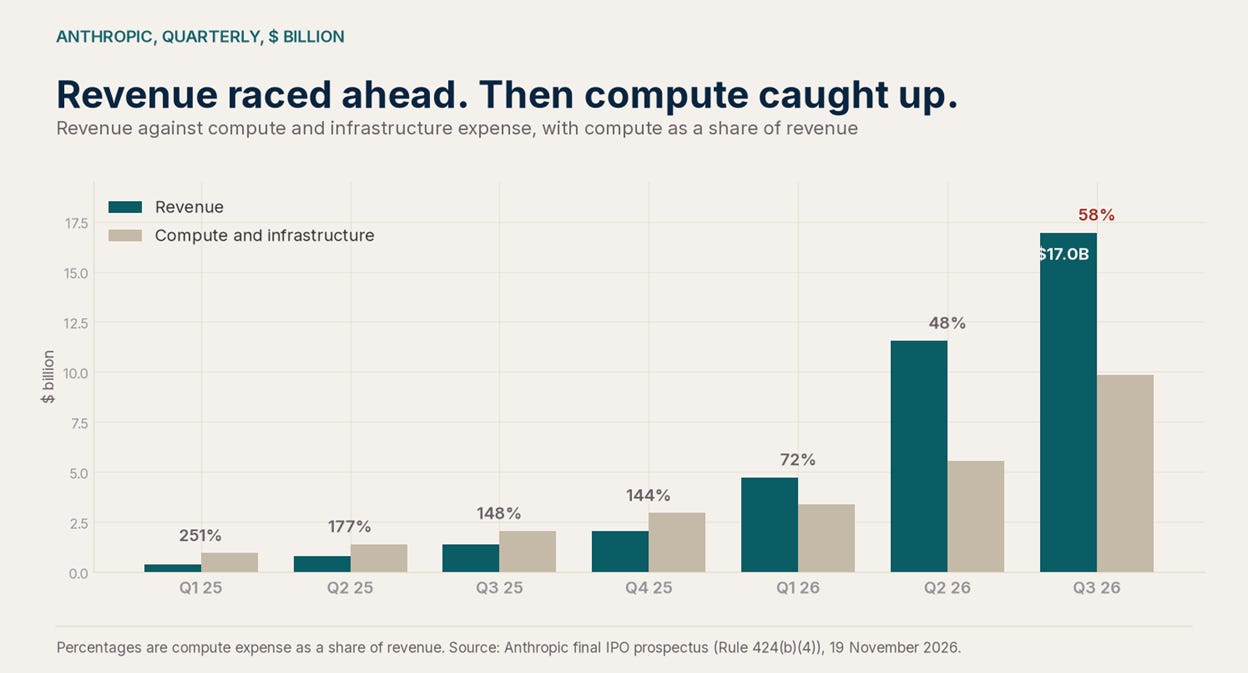
Compute and infrastructure costs rose from $5.56 billion to $9.86 billion, up 77%, while revenue rose 47%
Compute rose from 48% of revenue to 58%
$5.0 billion of the compute bill was for short-term capacity
Price cuts and discounts offset about $600 million of the revenue gain from higher usage
That $5.0 billion is the full cost of short-notice capacity in one quarter, not just the premium paid for it. Even so, it’s more than Anthropic’s entire revenue for 2025, about $4.6 billion, and a measure of how fast demand outran the supply booked a year earlier.
The filing says plainly that this reduced revenue per dollar of compute compared with the June quarter. It also says the company expects its use of short-term compute to keep increasing in the near term, and that this will squeeze its operating margin.
A typical software company pays very little to serve each additional customer, so most new revenue turns into profit. Anthropic works more like an airline that ordered its aircraft years in advance. When the planes are full, the profits are large. When they aren’t, the lease payments still fall due. And when the planes are overbooked, it charters extra seats at a premium.
The $900 Billion Commitment
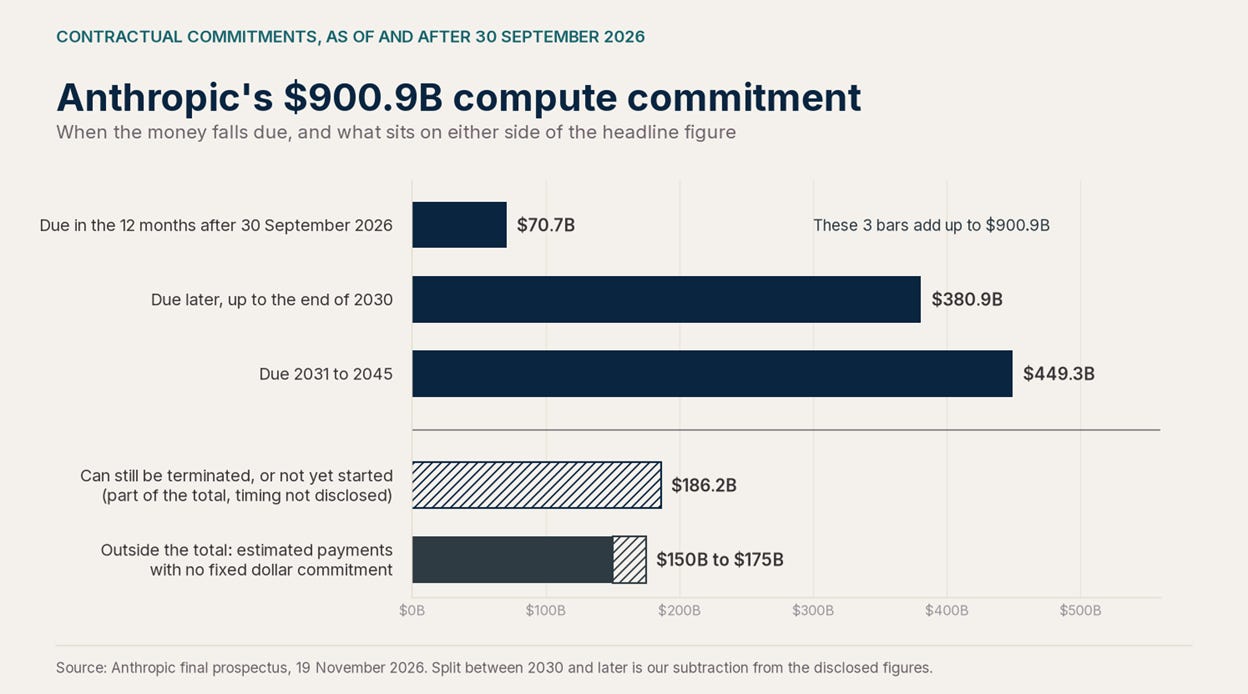
Including agreements signed after 30 September, Anthropic reports about $900.9 billion of contractual commitments, substantially all for compute and infrastructure. Around $70.7 billion falls due in the 12 months after 30 September, $451.6 billion before the end of 2030, and almost all the rest between 2031 and 2045.
The headline figure needs 2 qualifications. About $186.2 billion of it relates to deals that can still be terminated, or that only start once conditions are met, such as the supplier securing financing, sites or regulatory approval. In the other direction, the total leaves out other compute arrangements with no fixed dollar commitment. Anthropic estimates payments under those at a further $150 billion to $175 billion.
So the $900.9 billion isn’t a debt due tomorrow, and it isn’t the complete bill either. It’s a schedule of capacity that Anthropic has chosen to lock in while demand, prices and the technology itself are all changing quickly.
The IPO gives Anthropic substantial financial flexibility. It held $131.8 billion in cash and short-term investments at the end of September, before the deal. On top of that, the prospectus estimates net proceeds of about $117 billion from the IPO and a $26 billion private placement, both completed on 20 November, with the extra shares included. The bigger question is whether the capacity it has bought will earn enough revenue, at good enough margins, to justify its cost. September gave an early reading: revenue grew 47%, but the adjusted margin slipped 4 points.
Amazon, Google and the Supply Chain
Amazon owns about 14.5% of Anthropic and Google about 13.3%, by our calculation from the final prospectus share counts after the 147 million extra shares. The prospectus itself prints 14.6% and 13.4%, calculated before them. Neither stake carries any voting rights. Both also sell Anthropic large amounts of computing power, through Amazon Web Services and Google Cloud, and both resell Claude to their own cloud customers. Anthropic books those sales at the full price, before Amazon or Google take their cut.
Alongside the IPO, Anthropic sold $26 billion of shares at $83 to 7 companies named in the filing: Google, Nvidia, AMD, Broadcom, Micron, Microsoft and TSMC. Between them they make the chips, memory and cloud capacity Anthropic runs on.
That can work well for everyone, but it makes it harder to separate independent demand for Anthropic from the interests of companies that supply it, resell it and own part of it.
Who Controls Anthropic
Anthropic is a public benefit corporation, so its board must weigh a stated public purpose, the responsible development of advanced AI, alongside shareholder returns. Voting follows from that:
A single Class F share, held by an entity owned by the 7 co-founders, carries 50.1% of all shareholder votes
A single Class T share, held by a body called the Long-Term Benefit Trust, gives the trust the right to elect a majority of the board
Class A shares, the type sold to the public, vote on what’s left, which gives them very little influence
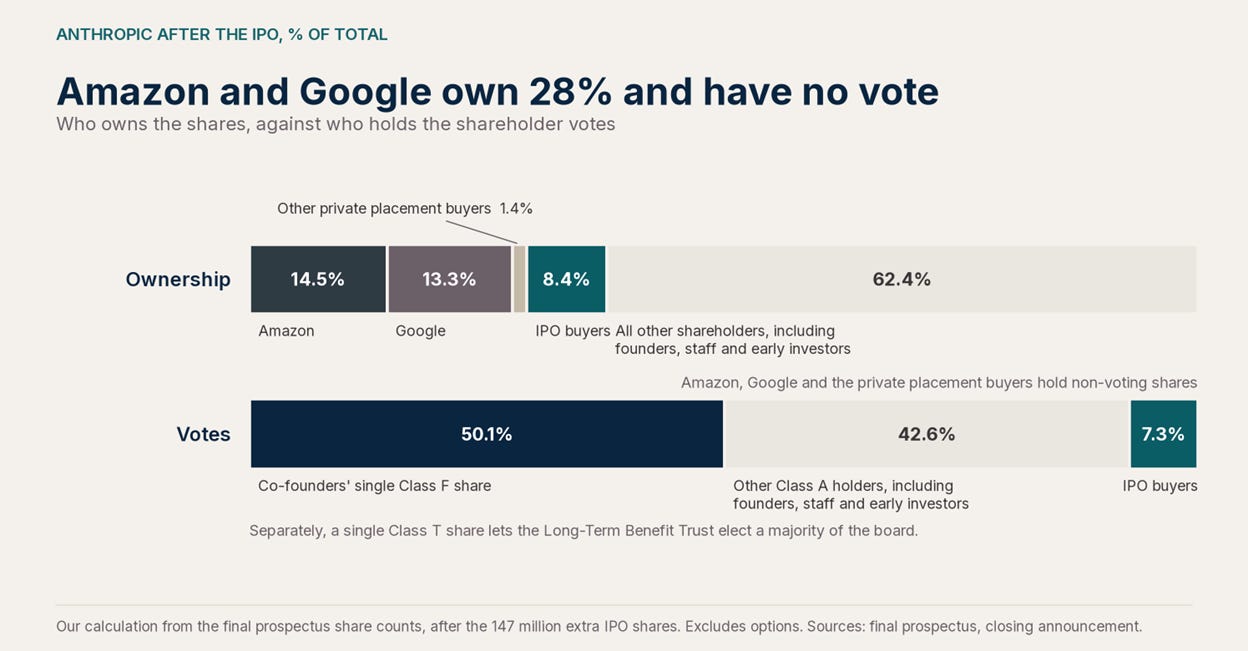
The filing warns that its safety processes “have previously resulted in, and may in the future result in, slower decision-making and product releases.” Public shareholders are buying a company that may, by design, choose caution over speed.
Why the Economics Could Improve
The long-run trend is the first reason the numbers could improve. Compute fell from 251% of revenue in early 2025 to 48% by the June 2026 quarter, and one quarter at 58% doesn’t erase that. Its Anthropic Direct programme, which leases chips directly and places them in dedicated facilities run on its behalf, is meant to replace that short-term capacity with cheaper long-term supply. Management expects the benefits over the long term, not straight away.
Then there’s efficiency. The filing says Opus 5.5 cut customers’ cost per task by about 40% compared with the version before it, through a combination of lower prices and improved efficiency. Cheaper tasks can stimulate demand, but they don’t guarantee higher company-wide margins. Last quarter, rising infrastructure costs pulled the adjusted margin down even as the models became more efficient. These are ways the economics could improve, not evidence that they will.
What to Watch
Compute as a share of revenue: A move back toward 50% would suggest September’s spike was temporary. A sustained reading above 60% would raise questions about how well new capacity is being used. These are our markers, not company guidance.
Short-term compute spending: The $5.0 billion figure is the clearest sign of whether demand is outrunning the contracted supply, and at what cost.
Prices against usage: Usage needs to keep growing faster than prices fall.
Reliance on big customers: The 5 largest customers made up about 25% of revenue in the first 9 months of 2026, and many aren’t tied to long-term contracts.
Bottom Line
Anthropic has completed the largest IPO on record and raised a great deal of new capital. Its first 2 sessions also showed that heavy demand for a new listing can sit alongside sharp swings in the share price. Neither answers the main question.
The demand is real, and most of the headline loss is an accounting effect. The company has secured computing capacity years ahead in an industry where the prices of AI services are under pressure and the technology changes quickly. If revenue keeps filling that capacity at good margins, those commitments could prove far-sighted. If demand disappoints, much of the $900 billion becomes an expensive long-term burden, even allowing for the part that can still be terminated.
The first public quarter will be the first real test. Amazon and Alphabet own close to 28% between them, and how much that stake means for their own shareholders is the subject of the next piece.
Sources and Method
Company figures come from Anthropic’s final prospectus, filed with the SEC under Rule 424(b)(4) on 19 November 2026, and its pricing announcement of 18 November. The 2026 results are unaudited. Adjusted operating income and margin are the company’s own non-GAAP measures. Final deal size and proceeds are from Anthropic’s closing announcement of 20 November. Growth rates and the commitment split are our calculations. Market value and ownership use the 13.37 billion shares outstanding after the offering, private placement and extra shares, excluding options and other potential dilution. Share prices for 19 and 20 November are from Yahoo Finance, matched against Forbes, Fortune and CNBC. Index moves are closing data for 20 November.
All content provided is for informational and educational purposes only and does not constitute investment advice, a recommendation, or an offer to buy or sell any security. The trade plans, levels, and scenarios discussed are illustrative frameworks based on market structure and are not guarantees of performance. Markets involve risk, and losses are possible. Past performance is not indicative of future results. Each reader is responsible for their own investment decisions, position sizing, and risk management.