


AppLovin (APP) helps advertisers find customers by choosing which advertisements to show against the advertiser’s campaign goals. In the third quarter its revenue grew 55%. The number of app installations it delivered grew 2%.
Both come from the same page of Wednesday’s Form 10-Q, and the gap is the investment question. AppLovin earned far more per installation than a year ago; whether that’s durable or a one-off step up decides what the shares are worth.

The quarter was strong. Revenue of $2.185bn, up 55%. Net income of $1.439bn, up 72%. A net margin of 65.9%, an adjusted EBITDA margin of 84.3%, free cash flow of $1.418bn.
The stock closed at $271.75 on Wednesday, up 10.69%, the last regular-session close before earnings, which landed after it. On Thursday morning Nasdaq quoted $326.20 at 7:09 New York time, up 20.04%, in a pre-market session that had traded under 500,000 shares. That’s the post-results price I use in the scenarios below.
Either way the shares are well down: against the 22 December 2025 intraday high of $738.01, Wednesday’s close was 63% lower and $326.20 is 56% lower. On 30 October they hit $225.19.
AppLovin earned 55% more per installation
The company attributes its revenue growth to 2 measures and quantifies both: for the third quarter, net revenue per installation rose 55% while the volume of installations rose 2%.
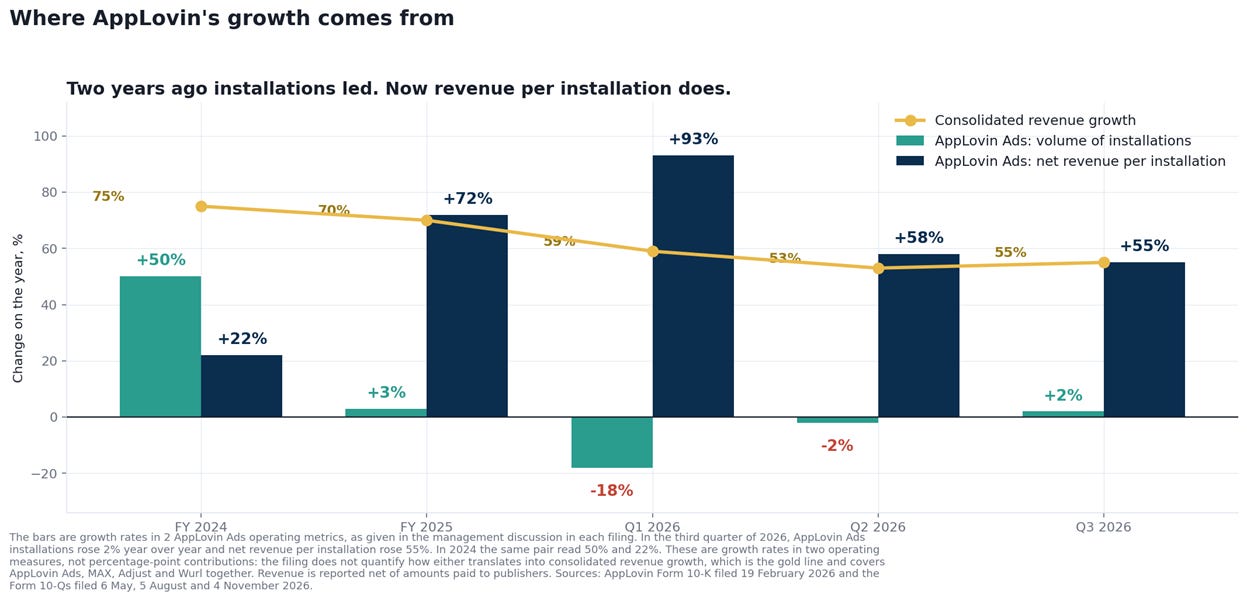
The balance has shifted. In 2024, installations grew 50% and revenue per installation 22%; by 2025 those were 3% and 72%. The 9-month figure for 2026 is starker than the quarter: revenue per installation up 68%, installations down 7%.
Be careful what you read into this. Installations count one outcome, and say nothing directly about impressions served, advertiser spending or the share AppLovin keeps of it. Both measures describe AppLovin Ads, not the group. Multiplying 1.55 by 1.02 gives 58.1% against 55% reported, but those are rounded figures and the filing offers no reconciliation to group revenue. The decomposition tells you direction, not mechanism.
What management says is behind it
On Wednesday’s call, Adam Foroughi said the gaming business “grew nearly 50% year-over-year, reaccelerating right alongside the rollout” of a new generation of advertising models. Chief financial officer Matt Stumpf said revenue “exceeded the high end of our guidance by approximately $100 million, primarily driven by the core mobile gaming business,” crediting model improvements. He put consumer advertiser spending up double digits sequentially and triple digits on the year. Foroughi called the rollout partial, with “the transition still in front of us,” and repeated a long-term expectation, separate from quarterly guidance, that the business can compound at roughly 30% a year.
The economics are simple. If better targeting helps an advertiser find customers worth more to it, that advertiser can spend more and still hit its return target, and AppLovin’s revenue rises with it.
What you can’t do from outside is separate the causes. Better models, a change in advertiser mix, higher bidding and any shift in AppLovin’s share of spending are all possible contributors, and all land in the same line. No take rate is disclosed. So the bull case rests on management’s account of model improvement: plausible, consistent with the beat, not independently verifiable.
Hold 2 things alongside it. AppLovin Ads revenue is booked net: the 10-Q says the company acts as an agent and reports revenue after deducting what it pays publishers, so the 89% gross margin isn’t comparable with a business booking gross billings. And consumer advertising on the web involves no app installation, so it isn’t obvious how that revenue sits inside a per-installation measure.
The guide
Fourth-quarter guidance is $2.365bn to $2.395bn of revenue. Against a fourth quarter of 2025 that produced $1.658bn, the midpoint implies 43.6% growth, 8.9% sequentially, at a guided 84% to 85% margin.
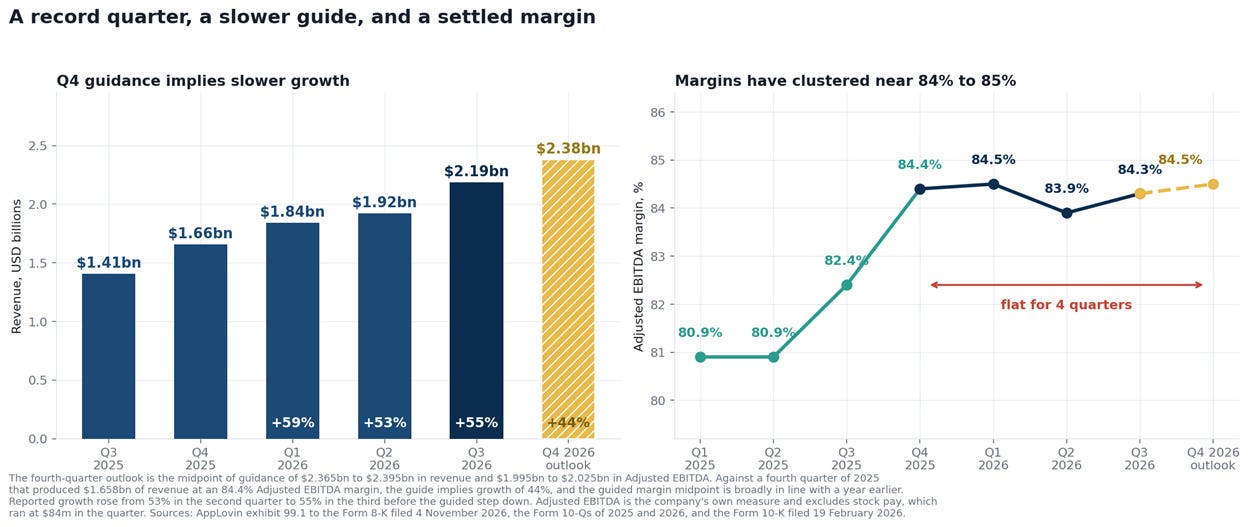
Margins have settled rather than stalled: adjusted EBITDA margin climbed from 80.9% through 2025, then clustered at 84.5%, 83.9% and 84.3%, with 84.5% guided, while the year-over-year comparison still improved from 82.4% to 84.3%.
The guidance record is mixed, but the scale differs. Third-quarter revenue beat the midpoint by 5.5% and adjusted EBITDA by 6.8%. Second-quarter revenue of $1.924bn landed inside its guided range, and adjusted EBITDA of $1.6138bn fell short of its $1.615bn floor: a narrow miss of $1.2m, or 0.07%. My valuation below assumes they meet the midpoint.
Costs and cash
Revenue grew 55%. Datacenter costs grew 38%. Personnel costs grew 6%. Income tax expense rose 65%. Other expenses fell 67%.
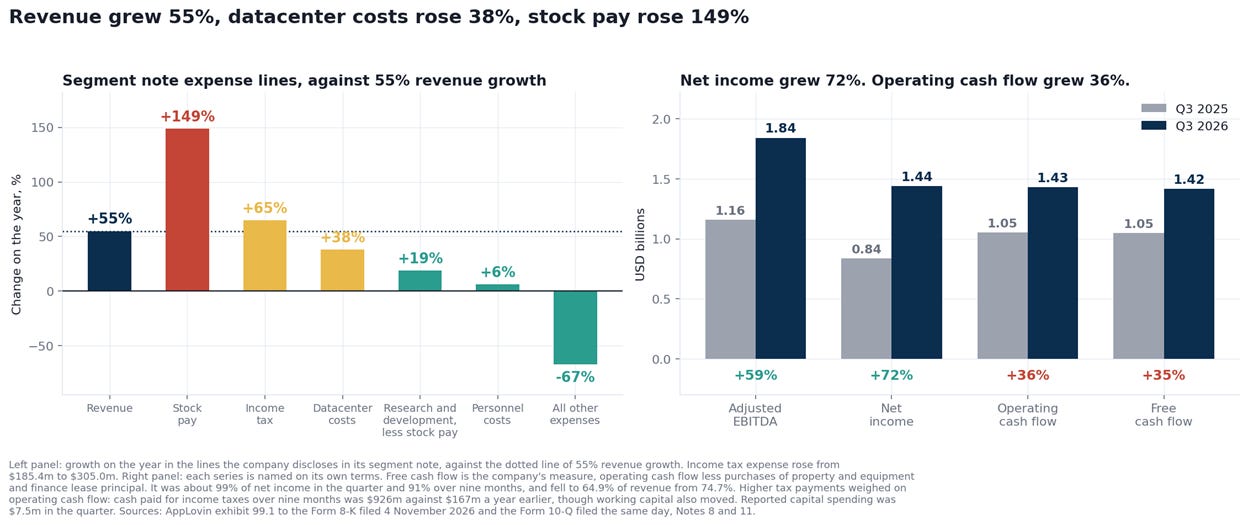
Stock-based compensation rose fastest, up 149% to $84.2m in the quarter and $253m over 9 months against $127m. Most sits in research and development, $68m of the $102m line.
Reported capital spending is very low, $7.5m for the quarter, because cloud computing is an operating cost. AppLovin committed to a minimum of $1.3bn with a cloud provider over 3 years from August 2024 and had paid $1.1bn by September, ahead of a straight-line pace through a term ending 2027. It also finance-leases servers and networking equipment.
Cash converted well: free cash flow was about 99% of net income in the quarter and 91% over 9 months, though it fell to 64.9% of revenue from 74.7%. Higher tax payments were part of why it trailed profit, with $926m of cash taxes over 9 months against $167m; working capital moved too, so I won’t claim tax explains the gap. Receivables grew 49% on the year against revenue growth of 55%, and receivables to quarterly revenue eased from 1.14 to 1.09: an observation about the balance, not proof about collections.
Other income included a $46.9m unrealized gain on private fund holdings, excluded from adjusted EBITDA and equivalent to about $0.14 per diluted share before tax.
Buying its own stock
AppLovin retired 7,329,450 shares over 9 months. The statement of stockholders’ equity shows charges of $2.921bn, or $398 per share retired.
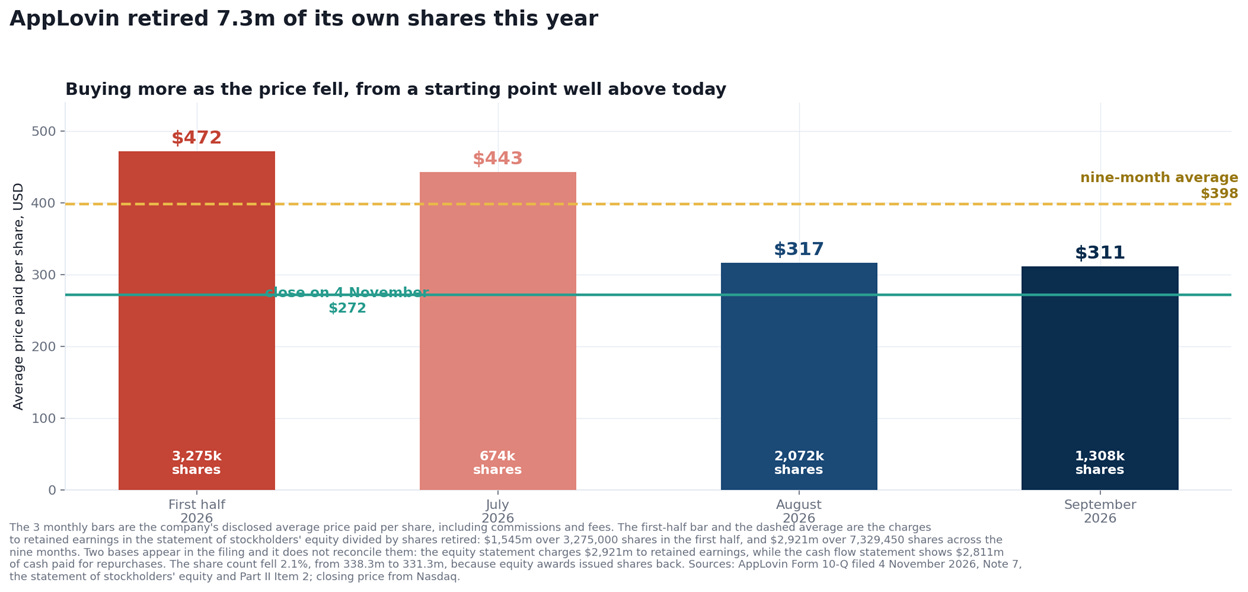
They bought 674,000 shares in July at $443, then leaned in as the price fell: 2.07m in August at $317 and 1.31m in September at $311, against about $472 in the first half. A reasonable pattern against a falling price. The share count fell 2.1%, from 338.3m to 331.3m, so each net share removed cost about $418: equity awards issued 473,000 shares gross, 135,000 withheld for tax. Authority was nearly exhausted at $394m before the board added $3.2bn in October.
Governance and litigation
On 29 October, holders of approximately 67% of the voting power approved converting the company from Delaware to Nevada by written consent, with no meeting. Foroughi and Herald Chen, with related trusts, hold all the Class B stock, 20 votes a share, voted under an agreement, against an economic stake of 9.8%. AppLovin is a controlled company under Nasdaq rules. An information statement will be mailed, and the conversion takes effect no earlier than 20 calendar days after that.
A complaint filed on 16 September alleges misstatements about the pace of improvement in the advertising models and the timeline for an advertisement generation product, over a class period from 12 February to 5 August 2026. An earlier 2025 complaint and 2 derivative suits remain. AppLovin says the allegations lack merit, has accrued nothing, and cannot estimate a range of possible loss. They’re unproven, and separate from the operating record.
What I’d do
Valuing this on 5 November, looking to the end of 2027.
