


BMW, Mercedes-Benz and Volkswagen all look statistically cheap. The multiple won’t tell you which one to own, and the car divisions tell a very different story from the groups.
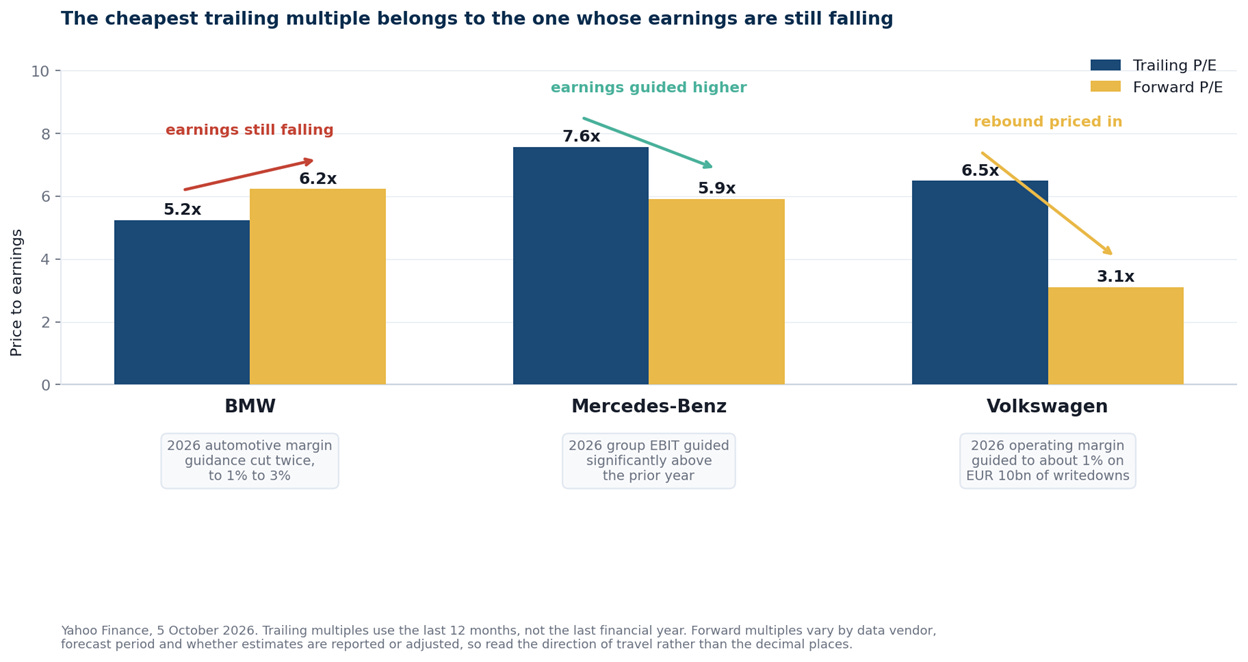
BMW trades at 5.2x trailing earnings. Mercedes-Benz at 7.6x. Volkswagen at 6.5x. All 3 sit below half of book value, within a few points of 52-week lows, and carry yields between 7.8% and 8.8%. On a screen, this looks like a shelf of bargains with BMW at the front.
The screen is the wrong place to start. Every one of those numbers is distorted by something, and fixing the distortions changes the ranking.
5 Things Worth Knowing
1. Trailing multiples here divide today’s price by the last 12 months, a period already overtaken by events. BMW’s forward multiple sits above its trailing one, which only happens when earnings are expected to fall.
2. BMW cut its automotive margin guidance on 16 June, from a 4% to 6% corridor down to 1% to 3%, and confirmed that range in July. Second-quarter automotive EBIT was €629m, a 2.3% margin, with tariffs costing 1.25 points and Chinese joint-venture depreciation another 1.2.
3. Mercedes grew group EBIT 22% in the second quarter, but its car division went the other way: Cars adjusted EBIT fell 26% to €909m, a 4.0% margin against 5.1% a year earlier. The group number improved on financial services, vans and consolidation items, not cars.
4. At division level across the first half, the 3 sit closer together than their multiples suggest: BMW’s automotive segment made 3.6%, Mercedes Cars about 4.0%, Volkswagen’s Brand Group Core 4.9%.
5. Returns on equity have collapsed since 2023, from 12.6% to 7.6% at BMW and 15.5% to 5.5% at Mercedes. Volkswagen’s peaked at 9.4% and is now 3.9%. That explains the discounts to book better than any multiple.
Why the Multiple Misleads
A P/E has 2 parts, and almost all the movement here has been in the bottom one, which is also the part most distorted by one-offs.
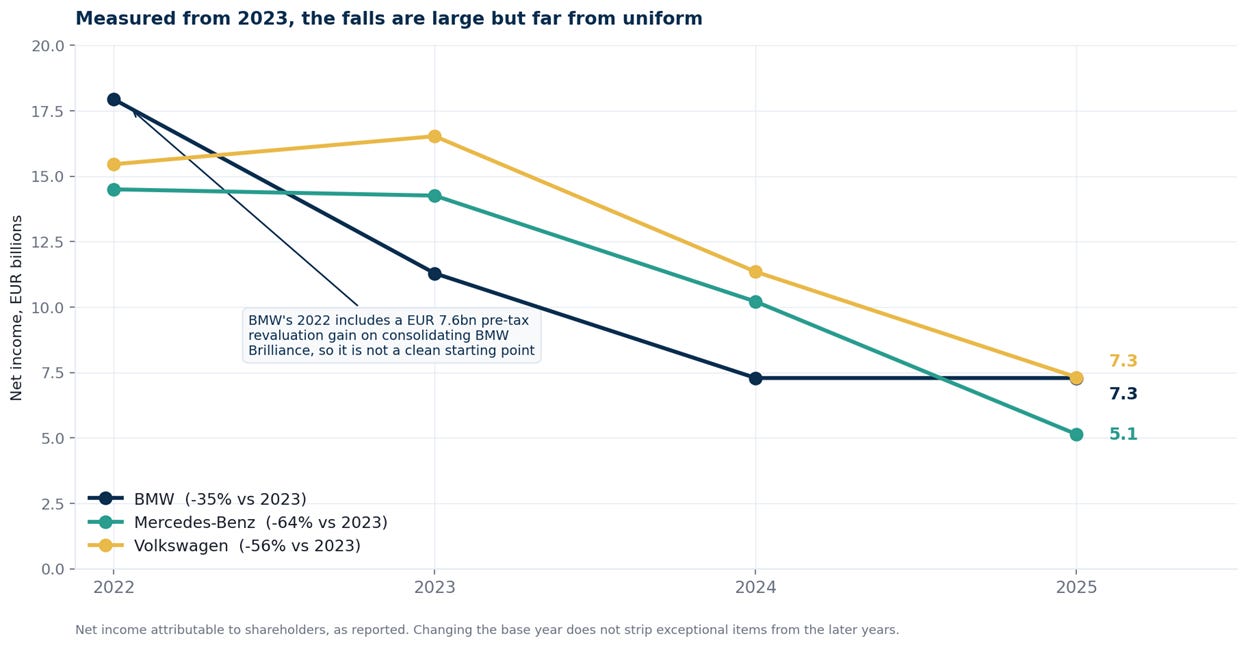
BMW’s 2022 profit of €17.9bn looks like the start of a catastrophic slide to €7.3bn. But that year included a €7.6bn pre-tax revaluation gain from consolidating the BMW Brilliance joint venture, booked in the financial result rather than earned from selling cars. The after-tax effect is smaller than that headline, so I won’t put a number on the adjustment. What matters is that 2022 isn’t a clean base.
Measure all 3 from 2023 instead, which is free of that particular distortion and is Volkswagen’s actual peak, and the order changes: BMW is down 35%, Volkswagen 56%, Mercedes 64%. These are still reported figures, and later years carry exceptional items of their own, but the company with the cheapest trailing multiple has had the shallowest reported decline of the 3.
What the Car Businesses Actually Earn
Group numbers hide more than they show, because all 3 run large financial services arms whose earnings move independently of cars.
Across the first half of 2026, BMW’s automotive segment made a 3.6% EBIT margin. Mercedes-Benz Cars ran at 4.1% in the first quarter and 4.0% in the second on an adjusted return-on-sales basis. Volkswagen’s Brand Group Core, which holds its volume car brands, made a 4.9% operating margin, within a group operating margin of 3.8%, or 4.3% before special items.
Those figures aren’t defined identically: a reported segment EBIT margin at BMW, an adjusted return on sales at Mercedes, an operating margin at Volkswagen, with different segment boundaries at each. Treat them as the same order of magnitude, not a ranking. What they establish is that all 3 car operations run in the low single digits against the 8% or better they once treated as normal, and that no group headline should be read without checking the division underneath. Volkswagen’s own finance chief called a 3.8% group margin too low.
The causes are shared. German deliveries in China fell between 30% and 41% year-on-year in the second quarter, against a market Volkswagen describes as down about 20%, so the market contracted and the German marques lost share inside it. Tariffs cost BMW 1.25 margin points in the quarter alone, and electrification meant heavy spending into demand that arrived slower than planned.
The Case Against Each
BMW. The guidance cut is real and the second quarter was poor, but the cash position is less alarming than the profit line. First-half automotive free cash flow of €1,290m was down 45%, yet full-year guidance of more than €2.5bn requires only about €1.21bn in the second half, less than the first half produced. Whether conditions allow it is another matter, and BMW has flagged restructuring charges for the period. Automotive net financial assets stood at €42.6bn at the end of June, above the entire €32.6bn market value, and down €1.7bn over the half. Deutsche Bank, still rating the stock a buy, cut its target from €90 to €78 on 29 September and to €71 within the week.
Mercedes. First-half group EBIT fell 3.1%, net profit 6.3% and industrial free cash flow 29.9%. Second-quarter industrial free cash flow of €1.1bn included about €0.4bn from selling down part of the Daimler Truck stake; excluding those proceeds it was nearer €0.7bn, still carrying restructuring and other exceptional items. Against that, it holds €30.4bn of net industrial liquidity against a €37.9bn market value, completed a €2bn buyback in June, and is the only 1 guiding full-year group EBIT above the prior year.
Volkswagen. Reported profit is being destroyed by writedowns while the cash position held: Automotive Division net cash flow of €3.166bn in the first half, against an outflow of €1.350bn a year earlier, and net liquidity of €32.75bn at 30 June. That liquidity is close to the group’s entire €34.0bn market value. The September warning took reported 2026 operating margin to no more than 1% on about €10bn of special items, with roughly 4% indicated excluding them.
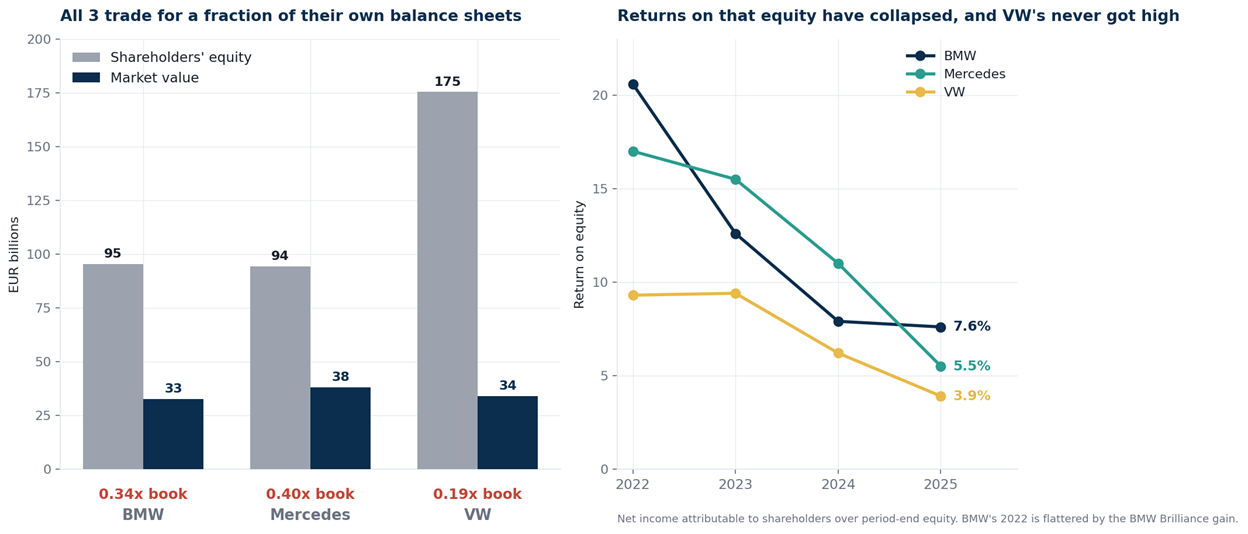
Below book is where most readers stop. It’s where the real question starts. Paying 34 cents for a euro of BMW equity, 40 at Mercedes and 19 at Volkswagen only matters if that equity can earn a return, and on net income over period-end equity all 3 have fallen hard since 2023. Volkswagen is the instructive one: its returns were modest even in the good years, peaking at 9.4%. Its discount to book is not purely cyclical.
The Volkswagen Arithmetic
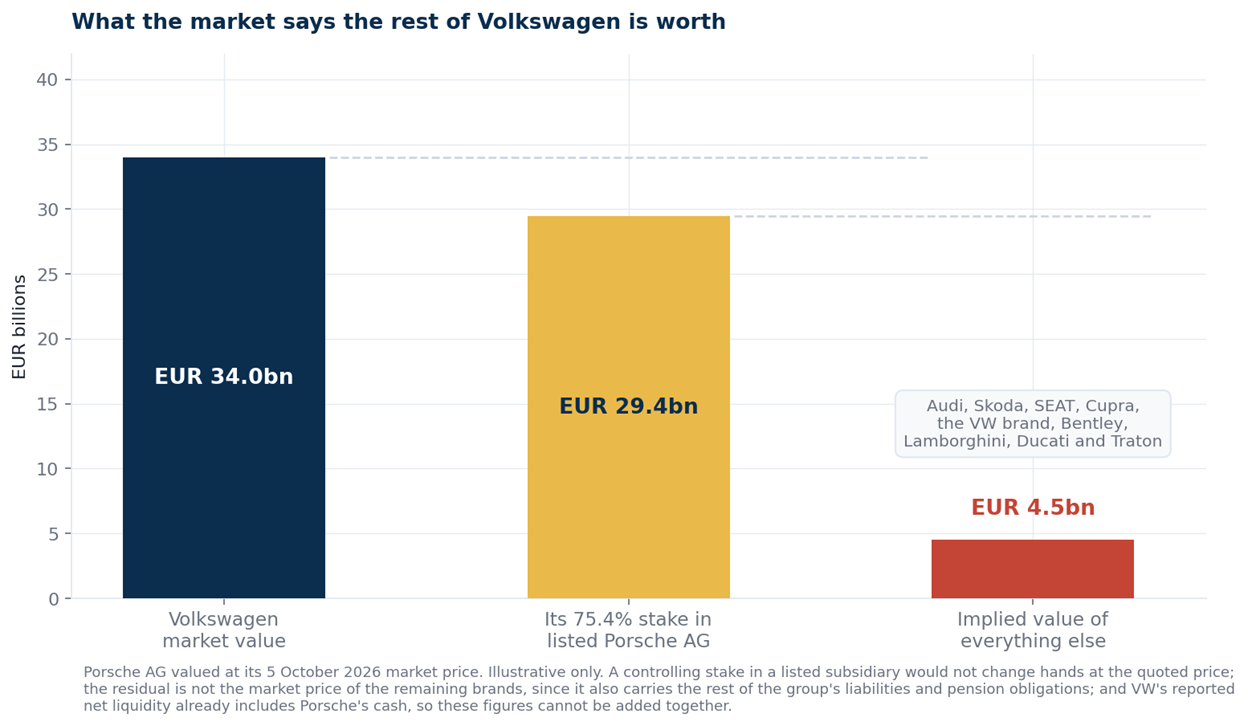
Volkswagen’s 75.4% stake in listed Porsche AG is worth about €29.4bn, against a market value of just under €34.0bn for the whole group. That leaves roughly €4.5bn implied for Audi, Skoda, SEAT, Cupra, the Volkswagen brand, Bentley, Lamborghini, Ducati and Traton.
Hold that loosely. A controlling stake in a listed subsidiary would not change hands at the screen price, and the residual isn’t the market’s price for those brands either, since it carries the rest of the group’s liabilities and pension obligations. Volkswagen’s reported net liquidity also already includes Porsche’s cash, so the stake and the liquidity can’t be added together. The figure signals very low expectations. It’s not a valuation.
The Dividend Question
At these prices you’re paid to wait, and the question is whether the payment survives.
All 3 yields sit well above their own 5-year averages of 5.4% to 6.0%. That’s consistent with the market expecting lower distributions, and equally consistent with investors demanding more for the risk. It’s a reason to check the arithmetic, not evidence of a cut.
So check it. BMW’s stated policy is to pay out 30% to 40% of net income. Applied to forward consensus earnings of €8.75, that implies a dividend between €2.60 and €3.50, against €4.40 today, a reduction of 20% to 40%. That holds only if the estimate and the policy both hold, but it’s the arithmetic behind the 8.1% headline yield.
Mercedes screens better than BMW on the same test, with a €3.50 dividend against forward earnings of €6.75. Both forward figures are Yahoo Finance consensus at 5 October 2026 on an unstated basis, which limits how far either calculation can be pushed, and I haven’t run it on Volkswagen, whose forward estimate I wouldn’t rely on. Mercedes’ recent capacity to fund distributions leaned partly on an asset sale, and a completed buyback evidences past capacity rather than future commitment.
Where the Prices Sit
Over the past year BMW has ranged from €52.36 to €97.92, Mercedes €39.41 to €62.34, Volkswagen €67.02 to €109.15. Each trades 21% to 26% below its 200-day average, which establishes a broken trend and nothing more. Volkswagen is the only 1 at a genuine 5-year low; the other 2 sit around 7% above their 2022 lows. Consensus targets of €71, €56 and €104 are well above spot, and moving fast.
Where I Come Out
I prefer Mercedes of the 3, and I’m not buying it yet. Those are separate judgments.
The preference rests on 3 things: it’s the only one guiding full-year group profit higher, its dividend looks better covered than BMW’s on current forward estimates, and €30.4bn of net industrial liquidity against a €37.9bn market value is a substantial buffer, though BMW’s cushion on its own measure is larger still relative to market value. What holds me back is a car division still deteriorating, at 4.1% then 4.0%, and half-year cash generation down 30% with an asset sale inside the quarterly figure. The condition that would change it is checkable: a Cars adjusted margin that stops falling, with the third quarter the first chance to show it.
The other 2 need different things. Volkswagen needs the writedowns finished and returns on its very large equity base shown to be sustainable and capable of improving from 3.9%. At 19 cents on the euro of book, the bar isn’t a particular headline return, it’s whether the return that persists justifies the price. BMW needs the second-half cash guidance met and the dividend question settled.
Size any of them as cyclicals. The dividends are an output of earnings, and earnings are the thing in motion.
Bottom Line
A trailing multiple ranks these 3 accurately on its own terms. It’s simply a poor basis for choosing between them. Change the base year and the earnings declines reorder; look underneath the groups and 3 car operations in the low single digits look more alike than multiples of 5x, 6.5x and 7.6x suggest.
Cheapness isn’t one test here. It’s 3: whether the car business can earn again, whether the dividend is funded, and whether the assets can produce a return worth owning them for.
Mercedes comes closest on the second, which is why it’s my preference and why I’d still wait for its car margin to stop falling. Volkswagen’s long record of modest returns is reason for caution on the third, not proof it fails. And BMW is where the headline and the underlying numbers diverge most, which is usually where the work is worth doing.
This is research and commentary, not personal investment advice. The author may hold positions in names discussed.