


Buy Airbus. Sell Boeing if you hold it, and don’t short it.

Boeing reported before the US open on Tuesday 27 October and fell 10.7% that session, from $188.31 to $168.18, on 47m shares against an average near 7m. Airbus published 9-month results at 17:45 Paris time on Wednesday 28 October, after the Euronext close, so its €191.92 close predates them.
The sell-off tracked the production and cash outlook set out on the call, where Kelly Ortberg said stabilizing the 737 at 47 a month is “taking us longer than we had expected” and will run into next year.
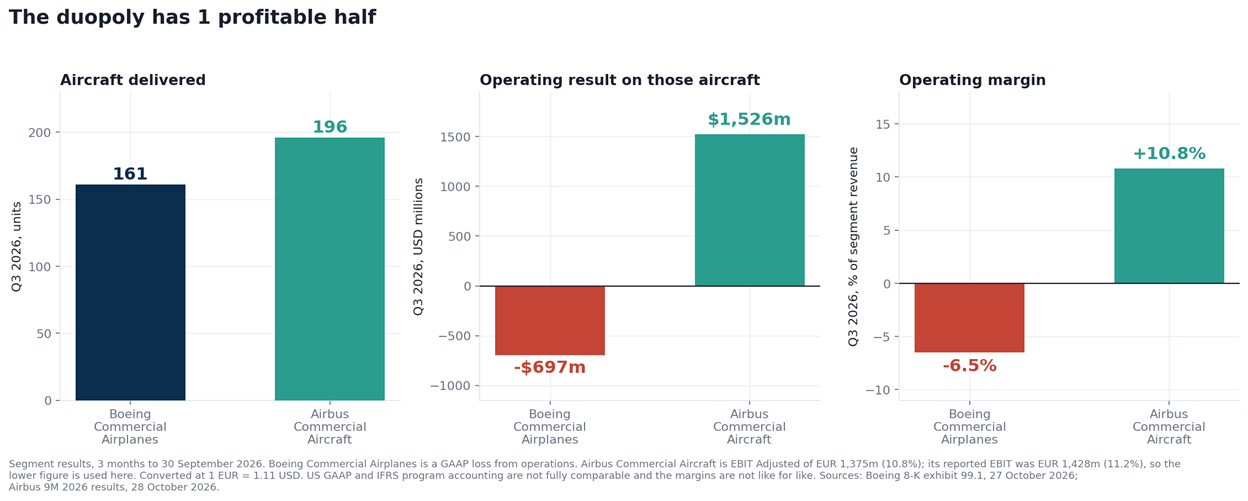
The Gap That Starts Everything
Boeing Commercial Airplanes delivered 161 aircraft on $10.7bn of revenue and lost $697m from operations, a reported segment margin of minus 6.5%. Airbus Commercial Aircraft delivered 196 on €12.8bn and reported EBIT of €1,428m, an 11.2% margin. On the adjusted measure Airbus leads with, it’s €1,375m and 10.8%.
Take either figure and the gap is wide, though less precise than it looks. Boeing reports under US GAAP and Airbus under IFRS, and different accounting policies, development-cost treatment and aircraft mix limit direct comparability. What the numbers establish is that one segment was solidly profitable and the other wasn’t. They say nothing about any individual aircraft, since a segment result also carries development spending, overhead and revisions to program cost estimates.
What Boeing’s Quarter Contained
Group operating earnings of $354m include a $252m gain on the sale of an equity method investment, the HRL Laboratories stake, booked inside Defense. Without it Boeing earned $102m on $24.2bn, a 0.4% margin.
The rest of the bridge is arithmetic. $354m of operating earnings, plus $96m of other income, less $573m of interest and debt expense, plus a $7m tax benefit, is the $116m net loss. A further $87m of mandatory convertible preferred dividends takes it to the $203m loss attributable to common holders.
Boeing’s recurring profit is in services. Global Services earned $1,019m on $5.6bn, an 18.3% margin, and it’s a genuinely good business. Defense earned $492m against $114m, but the 10-Q attributes $252m of that $378m improvement to the disposal gain and $135m to lower net unfavorable cumulative contract catch-ups. Across 9 months Defense earned a reported 3.1% margin on $23.0bn, or about 2.0% excluding the HRL gain, before any further contract adjustments.
The Trailing Multiple Is A Disposal
Screens put Boeing near 17 times trailing earnings. Rebuild it from the filings instead.
Earnings attributable to Boeing common shareholders were $8,134m in the fourth quarter of 2025 and a loss of $823m across the first 9 months of 2026, so $7,311m over the 4 quarters to September. Against the September quarter’s 792.7m diluted shares that’s about $9.22, or 18.2 times the $168.18 close. Not 17. Call it an estimate: a trailing figure built on one quarter’s share count isn’t a formally calculated diluted EPS.
That fourth quarter contained the Digital Aviation Solutions disposal, which Boeing says added $11.83 per share on 803.8m diluted shares, about $9,509m. Strip it out and trailing earnings to common are a loss near $2,198m, roughly $2.77 a share, reconstructed from a rounded per-share disclosure. The decimal isn’t the finding. The finding is that disposal-adjusted trailing earnings are negative, so there’s no trailing multiple to quote.
Airbus’s Headline Had Help Too
Airbus grew 9-month net income 36% to €3,587m. Reported EBIT rose 35%. Adjusted EBIT rose 8%. The difference is the adjustment comparison: last year carried €781m of negative adjustments, this year €55m of positive ones.
That isn’t purely cosmetic. This year’s adjustments include €235m of integration costs for the former Spirit AeroSystems work packages, a real industrial cost that the adjusted figure excludes, alongside a €270m currency and balance sheet revaluation gain that isn’t industrial at all. Reported growth got an easier comparison, adjusted growth was slower, and some of what’s excluded is a genuine cost of building aircraft.
The quarter itself went backwards. Group revenue fell 2%, group adjusted EBIT 9%, Commercial Aircraft adjusted EBIT 12% and Helicopters adjusted EBIT 17%. Defense and Space improved 19%. Deliveries were 196 against 201.
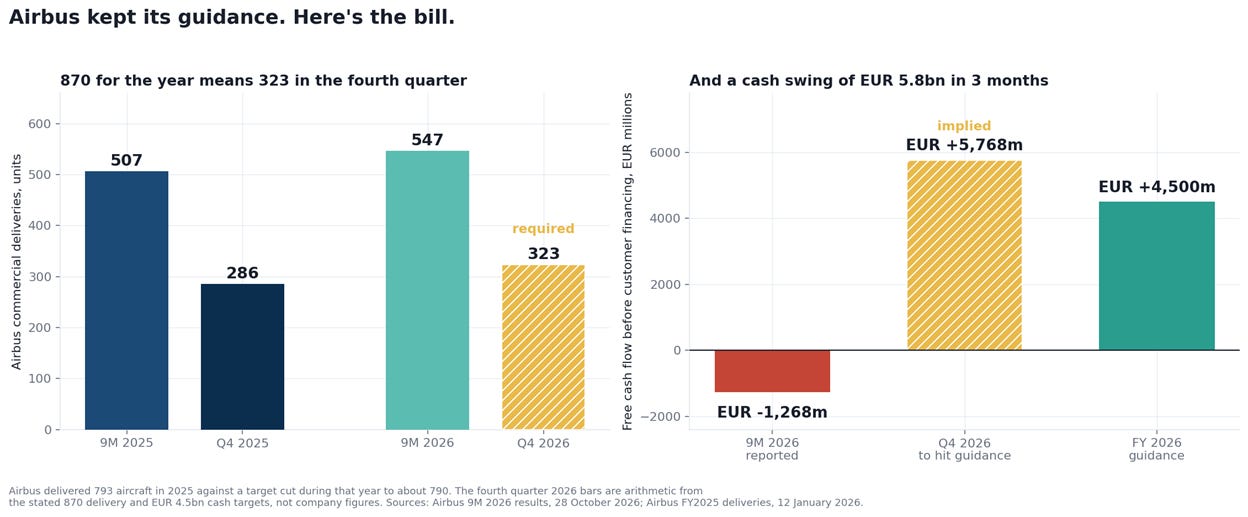
Both Companies Published A Target
Airbus kept its 2026 guidance: about 870 deliveries, €7.5bn of adjusted EBIT and €4.5bn of free cash flow before customer financing. Having delivered 547 in 9 months, it needs 323 in the fourth quarter, against 196 in the third and 286 in the final quarter of 2025. Cash before customer financing is minus €1,268m so far, so the target implies about €5.8bn in a quarter. That’s the central risk in owning Airbus, not a closing caveat. Airbus also cut its 2025 target during that year, from about 820 to roughly 790, before finishing at 793.
Boeing publishes targets too. On the call Ortberg put free cash flow at about $2bn for 2026, about $3bn in 2027, about $6bn in 2028 and $10bn in 2029, with 2027 carrying roughly $1bn of additional capital spending and the plan assuming 777X certification by the middle of 2027. The 2029 figure rests on 737 output in the mid to high 50s a month and the 787 near 12.
The question is whether the timetable holds. The opening milestone on that path, holding 47 a month, moved into 2027 during the quarter being reported, and 737 deliveries for 2026 are now expected below 500.
On Boeing’s own numbers, $10bn in 2029 implies a 7.5% cash flow yield on today’s $133bn of market value, before the preferred converts. That’s a statement about the target, not about fair value, which also turns on the odds of getting there, the cash generated in between, the debt and whatever multiple the market applies in 2029. Nor is free cash flow a distribution: 2026’s $2bn is the business generating 1.5% of market value, and 2027’s $3bn 2.3%. You’re underwriting 2028 at the earliest.
One qualification on the cash. Boeing’s 9-month operating cash flow of $2,681m included an $8,113m inflow from advances and progress billings against a $6,733m outflow into inventories, both from the cash flow statement. Customer advances are a normal way to fund an aerospace ramp; their timing matters to the path as much as margins do.
Pricing The Margin Instead
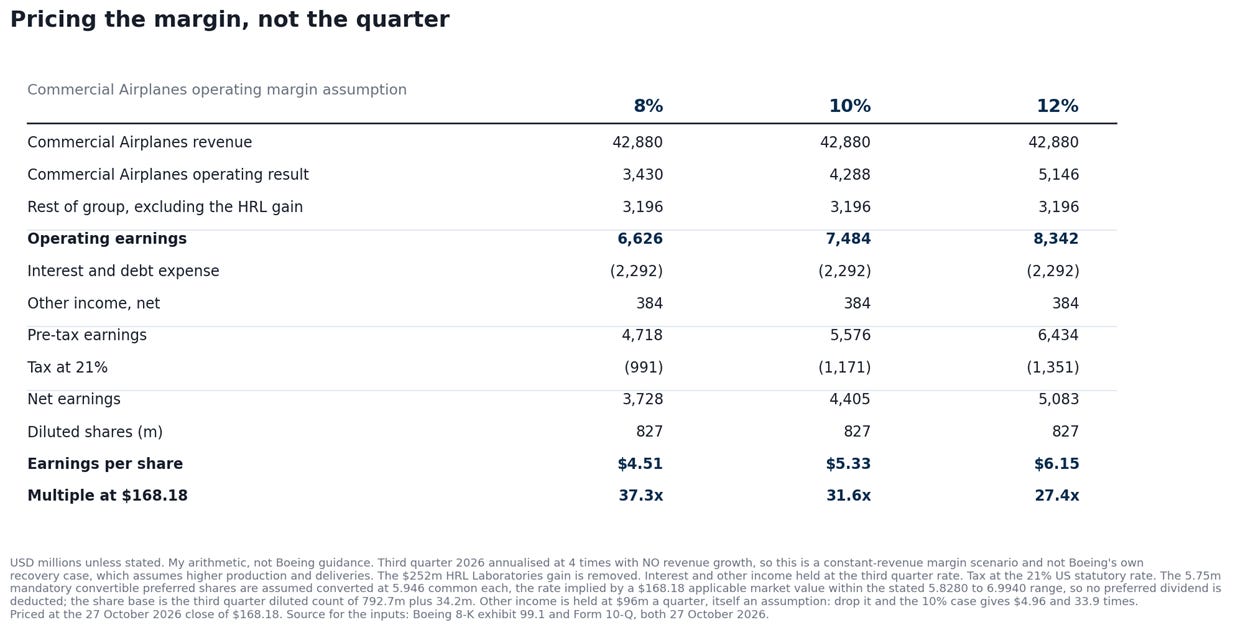
Hold revenue flat and move only the commercial margin. Take the quarter’s $354m, add back the $697m commercial loss, insert Commercial Airplanes at a 10% margin on its own $10.7bn, remove the HRL gain, and quarterly operating earnings are $1,871m. From there, ($1,871m plus $96m of other income less $573m of interest) times 4, taxed at 21%, over about 827m shares with the preferred converted, gives $5.33 a share and 31.6 times. At a 12% margin, better than Airbus manages today, 27.4 times. At 8%, 37.3 times.
That $96m of other income is an assumption, not a given: the same line was $276m a year earlier, and dropping it takes the 10% case to $4.96 and 33.9 times. This is a constant-revenue margin scenario, not Boeing’s recovery case, which assumes more aircraft as well as better margins. The conclusion is narrow: margin recovery on its own doesn’t make the shares cheap. The cash targets would, if you believe them 3 years out.
What You Pay For Airbus
Cheaper than Boeing is no reason to own anything, so price Airbus alone.
At €191.92 the equity is €151.9bn, and net cash of €7.0bn puts the business near €145bn, about 19 times this year’s guided €7.5bn of adjusted EBIT. Against guided free cash flow of €4.5bn the starting yield is 3.0%, which on its own is no reason to buy anything. The dividend yields about 1.65%.
So the return has to come from that €4.5bn growing, and Airbus has committed to the machine that would do it: the A320 family from the 428 delivered in 9 months, about 47 a month, to 70-75 by the end of 2027, the A350 to 12 in 2028 and the A220 to 13, against a backlog of 9,310 aircraft. Land those rates near the current margin and cash generation moves well above €4.5bn by 2028. Miss them and you’ve paid 19 times EBIT for slow growth, with a 1.65% dividend while you wait.
2 exposures sit outside the accounts and both land here. Airbus prices aircraft in dollars while paying much of its cost base in euros, which is part of what the €270m revaluation adjustment reflects. And the guidance holds only for tariffs as they apply today.
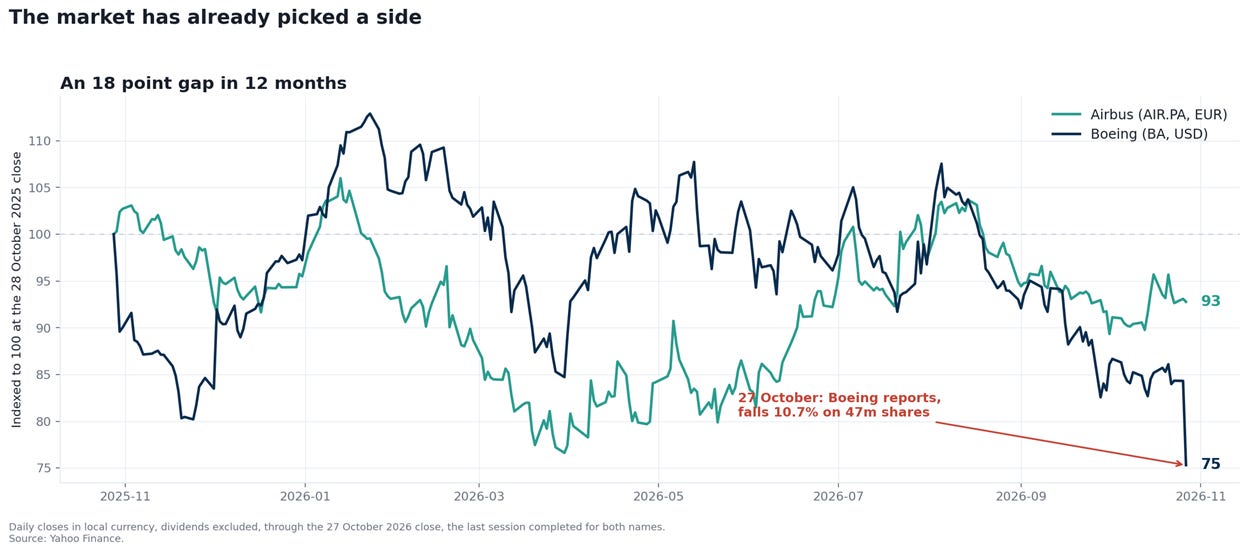
The Price
Over 12 months Boeing is down 24.7% and Airbus 7.6%, price only, no dividends. Computed from Yahoo daily closes with Wilder smoothing, through 27 October for Boeing and 28 October for Airbus, RSI(14) reads 25.3 and 47.6; Boeing sits below its 20-day, 50-day and 200-day averages, Airbus above its 20-day and 200-day. The one reading here that bears on timing is that Boeing hadn’t closed below $180 at any point in 2026 before Tuesday, so there’s no recent trading to lean on beneath it.
Bottom Line
The case for Airbus is that you pay about 19 times guided EBIT for the half of this duopoly that turns a decade of backlog into an 11% margin, holds net cash and pays a dividend. At a 3.0% starting cash yield that isn’t a bargain, and the return depends on the ramp lifting it through 2027 and 2028. The case against is specific and dateable: the full fourth quarter has to deliver 323 aircraft and about €5.8bn of cash.
The case against Boeing is no longer that it’s statistically expensive. If it reaches $10bn in 2029, that’s a 7.5% cash flow yield on today’s market value, and from $168 Boeing would be the better investment. What you’re buying is the probability of that path rather than the number itself. Halve it for execution risk and you’re underwriting something near 4%, which is roughly where Airbus starts today without the 3 year wait. The quarter just reported moved the opening milestone a year to the right, and this company has moved milestones before.
So take this as a clear preference rather than a conviction trade: own Airbus over a horizon long enough for the rates to land, which means 2027 into 2028, and don’t own Boeing until the 737 proves 47.
Sell means sell, not short. Borrow costs and a backlog that can produce a certification or a fleet order on any morning make a short a poor use of risk, and that’s a judgement about the setup rather than anything read off an oscillator.
I’d change my mind on Boeing if the 737 holds 47 a month across a full quarter and 2027 cash tracks toward $3bn without leaning on advances. I’d change my mind on Airbus if fourth-quarter deliveries run below about 280, which would put the year near 827 against a target of 870. The monthly delivery releases will flag that risk early, though they can’t settle it until December’s deliveries are in.
This is research and commentary, not personal investment advice. The author may hold positions in names discussed.