


Broadcom reported one of its strongest quarters on record on September 2. Revenue of $29.6 billion, up 86%. AI semiconductor revenue of $16.7 billion, up 221%. A 67.9% operating margin and $13.7 billion of free cash flow, 46% of revenue. On the call it said it can see $115 billion of AI revenue in fiscal 2027 and $230 billion in fiscal 2028.
The stock fell 2.7% the next day, while the S&P 500 rose 1.1% and Nvidia rose 1.8%.
A week earlier Marvell had beaten, raised its outlook for 2 fiscal years, and fallen 10.3%. Broadcom now sits 27.7% below its June high and Marvell 32.2% below its own.
The growth is not in dispute. What’s being priced is what each company gave up to get it.
Key Takeaways
Broadcom’s semiconductor segment grew 127% and its software segment 29%. Software fell from 42.5% of revenue to 29.6% in a year, and gross margin fell 210 basis points sequentially to 75% on that mix.
Operating margin went the other way, rising about 240 basis points to 67.9% as scale absorbed the dilution. Operating income rose 92% to a record $20.1 billion.
On August 19 Marvell granted Google a warrant over 58.97 million shares, 6.7% of those outstanding. 97.7% of it is performance-based, and full performance vesting requires $120 billion of cumulative qualifying Google revenue, 10 times Marvell’s guided year.
Marvell’s non-GAAP operating margin is 36.6%. Broadcom’s is 67.9%. On forward guided revenue both trade near 16.4 times.
Prices are the Friday September 4 close, the last completed session.
Both Beat. Both Fell.
Marvell went first, after the close on August 27. Revenue of $2.739 billion, up 37%, a company record. Data centre revenue of $2.171 billion, 79% of the total, up 46%. Non-GAAP earnings of $0.94 a share against $0.33 on a GAAP basis. It raised fiscal 2027 revenue to $12 billion from $11.5 billion and fiscal 2028 to $18 billion, and guided the October quarter to $3.15 billion, 52% growth against 37% just delivered.
The stock fell 10.3% the next session. Be careful attributing all of that to the print: the sector fund fell 3.5% and Nvidia 4.6% the same day. The sector move alone was roughly a third the size of Marvell’s decline.
Broadcom’s reaction is the cleaner signal. It fell 2.7% on September 3 while the market rose, close to 4 points of underperformance with no sector excuse available.
Then on Friday Marvell rose 7.1% to $223.55. Mostly a sector day too, with the semiconductor index up 3.5% and AMD up 4.7%, on 21.2 million shares against a 20-session average of 24.4 million. Lighter buying than the selling it followed.
What Broadcom Is Paying
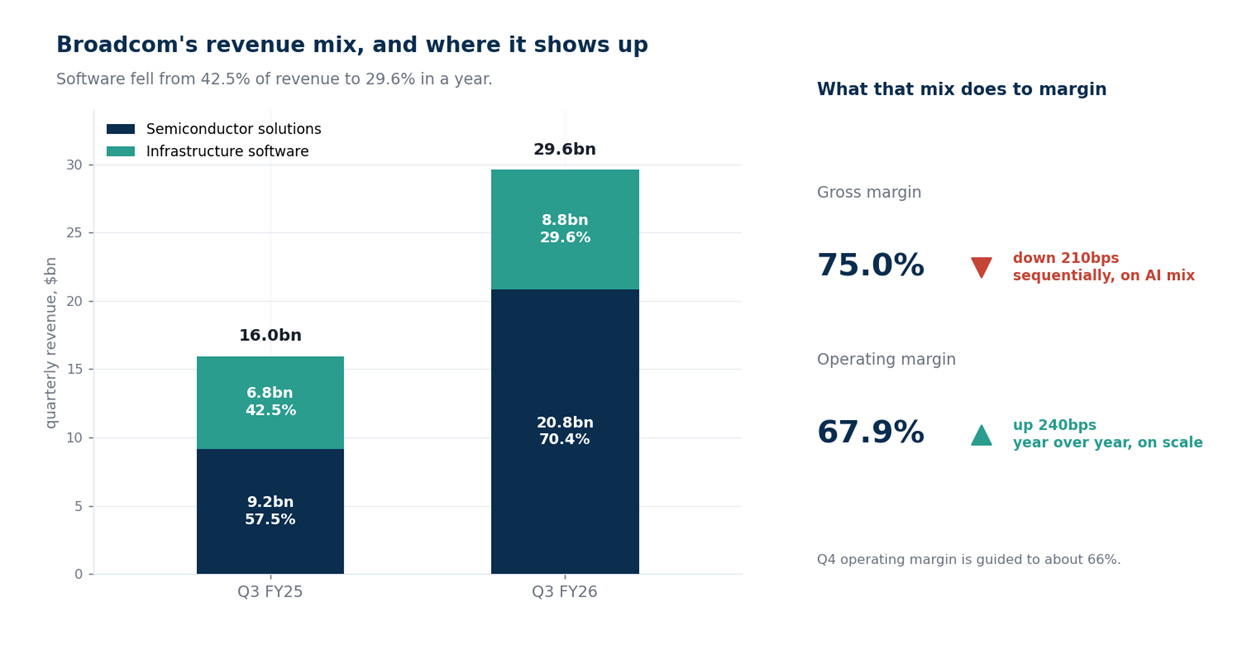
Broadcom has 2 businesses. Semiconductor solutions did $20.839 billion against $9.166 billion a year ago, up 127%. Infrastructure software, largely VMware, did $8.752 billion against $6.786 billion, up 29%.
So software has gone from 42.5% of revenue to 29.6% in 4 quarters. Not because it shrank: it grew 29%, and is being diluted by a semiconductor business growing 4 times faster.
The 2 halves don’t earn the same way, and you see it in the gross line. Consolidated gross margin came in at 75%, down 210 basis points sequentially, which the company attributes to AI mix. AI semiconductor revenue carries a lower gross margin than software on average, so as accelerators take a larger share of the mix they pull the consolidated figure down.
Now the part that complicates the bear case: operating margin didn’t follow it down. It rose about 240 basis points year over year to 67.9%, and operating income rose 92% to a record $20.1 billion. Scale is absorbing the dilution faster than the mix creates it. The fourth quarter is guided to about 66%, on revenue up another 18%.
So the honest statement isn’t that margins are falling. It’s that Broadcom is accepting a structurally lower-margin mix in exchange for volume, and operating leverage is currently masking the cost. An investor who paid a software multiple is watching the software proportion fall by a third in a year. That’s a change in the thing being valued while you hold it, whether or not the operating margin shows it.
What Marvell Paid
Marvell’s cost is explicit, and it isn’t in the income statement.
On August 19 Marvell disclosed an expanded custom-silicon relationship with Google, covering inference accelerators, storage and network interface controllers, memory interface controllers and near-memory compute attached to Google’s tensor processing unit ecosystem.
The price was a warrant: Google can buy up to 58.97 million Marvell shares at $206.58, exercisable to August 2033. At that strike, exercising all 58.97 million shares for cash would imply an aggregate exercise price near $12.2 billion, though the warrant also permits cashless exercise. Against 876.9 million shares outstanding the cover is 6.7%. Marvell closed Friday at $223.55, so the strike is already 8% in the money.
Look at the vesting. A total of 1,360,867 shares vest on time over the first year, in 4 quarterly instalments of roughly 340,000. The other 57.61 million, which is 97.7% of the warrant, are performance-based: they vest in 240 tranches, 1 for every $500 million of custom-product revenue Marvell records from Google, to the end of fiscal 2033.
Full performance vesting therefore requires $120 billion of cumulative Google revenue. Marvell’s entire guided fiscal 2027 revenue is $12 billion. The warrant is calibrated to 10 times a full year of everything Marvell sells.
That tells you how large Marvell thinks this can be, and about bargaining power: it put real equity behind the relationship to secure Google’s long-term custom-silicon business. On the day it was disclosed Marvell rose 9.9% and Broadcom fell 4.6%, because Google had broadened its supplier base beyond Broadcom, which holds long-term agreements to develop Google’s future accelerators and supply components for its AI racks as late as 2031.
The Gap Between Them
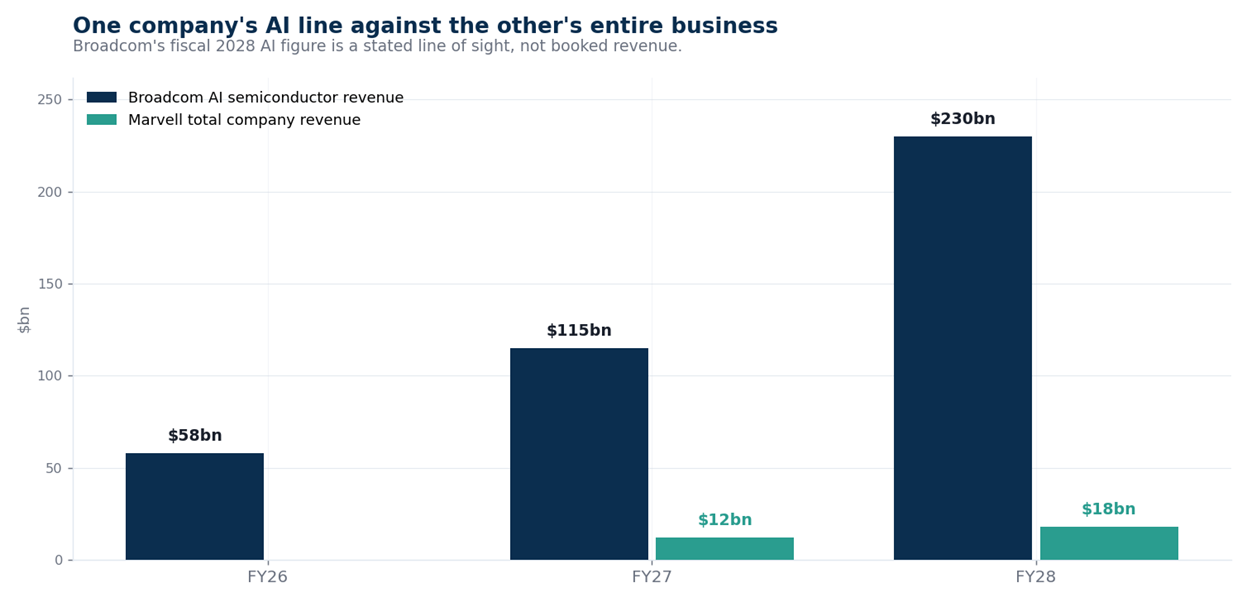
These get discussed as rivals. The numbers side by side make that struggle.
Broadcom’s AI revenue in the fiscal third quarter alone was $16.7 billion, 1.4 times Marvell’s guided revenue for a year. Its guided fiscal fourth quarter, about $34.8 billion, is nearly 3 times Marvell’s guided year. Its fiscal 2028 line of sight is $230 billion against Marvell’s $18 billion of total revenue.
The profitability gap is wider. Marvell’s non-GAAP operating margin was 36.6%, and 16.8% on a GAAP basis. Broadcom’s was 67.9%.
What “Line of Sight” Carries
Broadcom’s $115 billion and $230 billion rest on what it called secured supply and conservative deployment assumptions. That’s real demand backed by secured supply, and I’m not waving it away.
But look at whose spending they describe. Broadcom named 6 custom accelerator customers, and Hock Tan said Anthropic is on track to become the largest in 2027 and stay there into 2028. Google and OpenAI are others.
Google funds capital spending from one of the largest cash-generating businesses in existence. Anthropic and OpenAI fund themselves by raising capital. Their demand is real; whether it converts on schedule depends on rounds not yet raised.
The market has built machinery for that gap, and Broadcom is inside it. In June, Apollo led a $35 billion financing with Blackstone and a group of banks to fund more than 1 gigawatt of Anthropic compute, under an arrangement meant to enable over 20 gigawatts for frontier AI labs through 2028. That cuts both ways: evidence the demand is bankable, and evidence that external capital is an integral part of the funding model. That isn’t a prediction of failure. It’s an observation that the visibility rests on someone else’s capital plan.
The Case Against Me
The strongest counter is valuation.
Broadcom’s enterprise value is about $1,738 billion against roughly $105.9 billion of fiscal 2026 revenue, the 3 reported quarters plus the guided fourth, or 16.4 times. Marvell’s is about $197 billion against $12 billion guided, which is also 16.4 times. The market pays the same multiple of next year’s revenue for a company earning 36.6% operating margins as for one earning 67.9% at 9 times the scale.
On revenue multiples alone Broadcom’s profitability makes the identical pricing hard to ignore, though Marvell’s faster growth complicates the comparison and both could be wrong in the same direction. The sell side leans the same way: Broadcom’s average target is $533 against $357.90, with 3 holds and no sells among 49 analysts; Marvell’s is $285 against $223.55.
The mix argument also has a ceiling. If Broadcom does $230 billion of AI revenue in 2028, the software percentage will be a footnote nobody remembers.
The Setup
Broadcom is in the weekly plan I publish and Marvell isn’t, so I’ll say which is which.
1. This weekend’s plan cut Broadcom to Breakdown and its status to avoid. The reclaim is now above $373.55, invalidation $342.33, first objective $380.62. Note where those come from: $373.55 is the 20-day exponential average and $342.33 is Thursday’s intraday low. At $357.90 the stock sits between them, below its 20, 50 and 200-day averages of $373.55, $382.84 and $368.11.
2. Check the geometry first. Buying $373.55 with invalidation at $342.33 risks $31.22 to make $7.07, about 0.23 to 1. The status is avoid and the geometry is most of the reason.
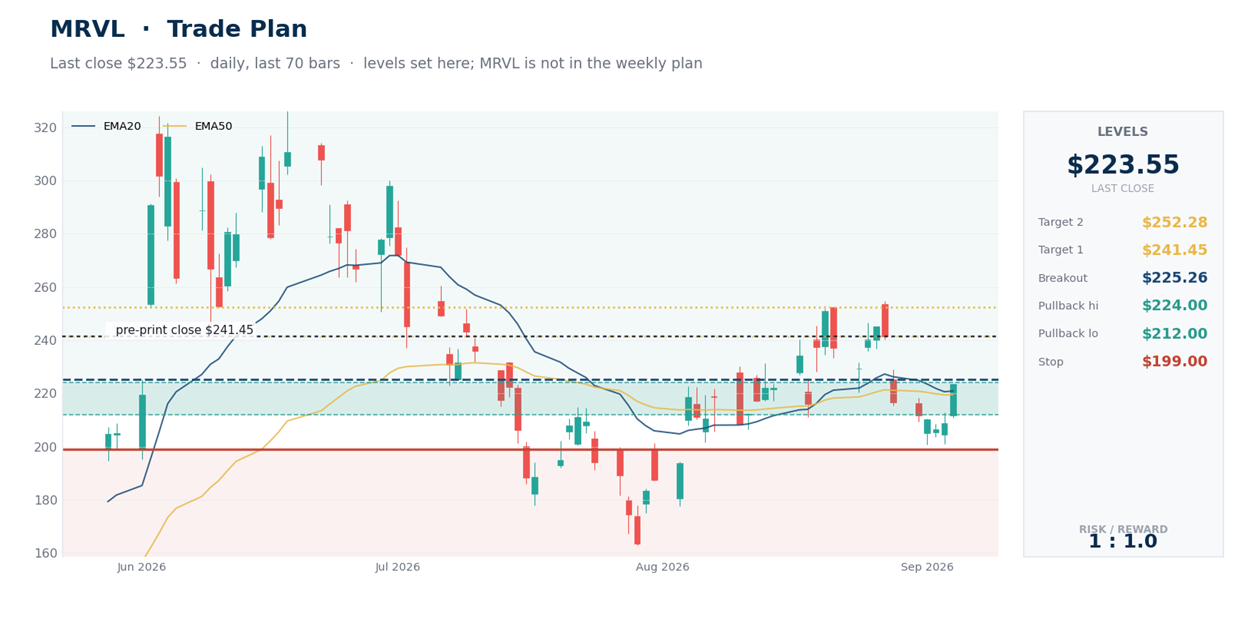
3. Marvell’s levels are mine. It gapped from $241.45 to open at $225.26 on August 28 and hasn’t closed it. Friday’s $223.55 sits just under the lower edge.
4. The zone is $212 to $224, bracketing both exponential averages and Friday’s close, so the stock is already inside it. Invalidation is a close below $199, under the September 1 low of $200.62. From the middle that risks about $19, or 1.2 average daily ranges, and pays 1.2 to 1 at the $241.45 gap fill and 1.8 to 1 at the upper band.
5. Buying strength above $225.26 instead risks $26.26 to make $27.02, about 1 to 1. The pullback pays better than the chase, though not by much. Marvell’s October 6 investor day is meant to quantify the Google opportunity.
Bottom Line
Both delivered. Broadcom’s was one of its strongest quarters on record; Marvell raised its outlook for 2 years in one release.
Both stocks are about 30% below their highs, and the market appears increasingly focused not on whether the AI revenue arrives but on what winning it costs. Broadcom is paying in mix: the high-margin half is under 30% of revenue, and it shows at the gross line while scale protects the operating line. Marvell paid in equity, handing a customer an option over 6.7% of itself, calibrated to 10 times its current year’s revenue.
Neither is a bad business. But growth bought at a price is not the same asset as growth that arrives free, and the market has started charging for the difference.
This is research and commentary, not personal investment advice. Levels are illustrative; size positions to your own risk tolerance and time horizon. The author may hold positions in names discussed.