


CrowdStrike CRWD 0.00%↑ reported Wednesday after the close and was marked up 9.5% in Thursday’s pre-market. Palo Alto Networks PANW 0.00%↑ reports Tuesday, and the number it’s guided to is a faster one: revenue up roughly 32% against CrowdStrike’s 26%.
Those 2 figures aren’t the same kind of thing, and Palo Alto publishes the arithmetic that shows why. Strip out CyberArk and Chronosphere from its most recent quarter and revenue grew about 14%. Acquired growth is real revenue. It just isn’t evidence about how well a company sells. Fiscal 2027 is when Palo Alto has promised to start showing more clearly which is which.

Key Takeaways
CrowdStrike added $332.8 million of net new recurring revenue, a record, up 51% on the year, and raised its full-year outlook for that measure by 630 basis points.
Palo Alto’s last reported quarter showed 31% revenue growth. Excluding the 2 acquisitions it discloses, the rate was about 14%.
Its own organic figures confirm the method: next-generation recurring revenue grew 28% against a 60% headline, and obligations 22% against 36%.
The 2 growth engines are the same size. Each added 6.0% to its base in its latest quarter. CrowdStrike’s is accelerating at 51%; Palo Alto’s organic engine grew 18%.
CrowdStrike trades at 117 times implied fiscal 2027 free cash flow against 68 times Palo Alto’s guided fiscal 2026 adjusted figure, which is about 2.4 times larger.
Prices are the Wednesday August 26 close, the last completed session: $189.18 for CrowdStrike, $339.31 for Palo Alto. Thursday pre-market at about 8:10 was $207.15 and $356.50.
What CrowdStrike Proved
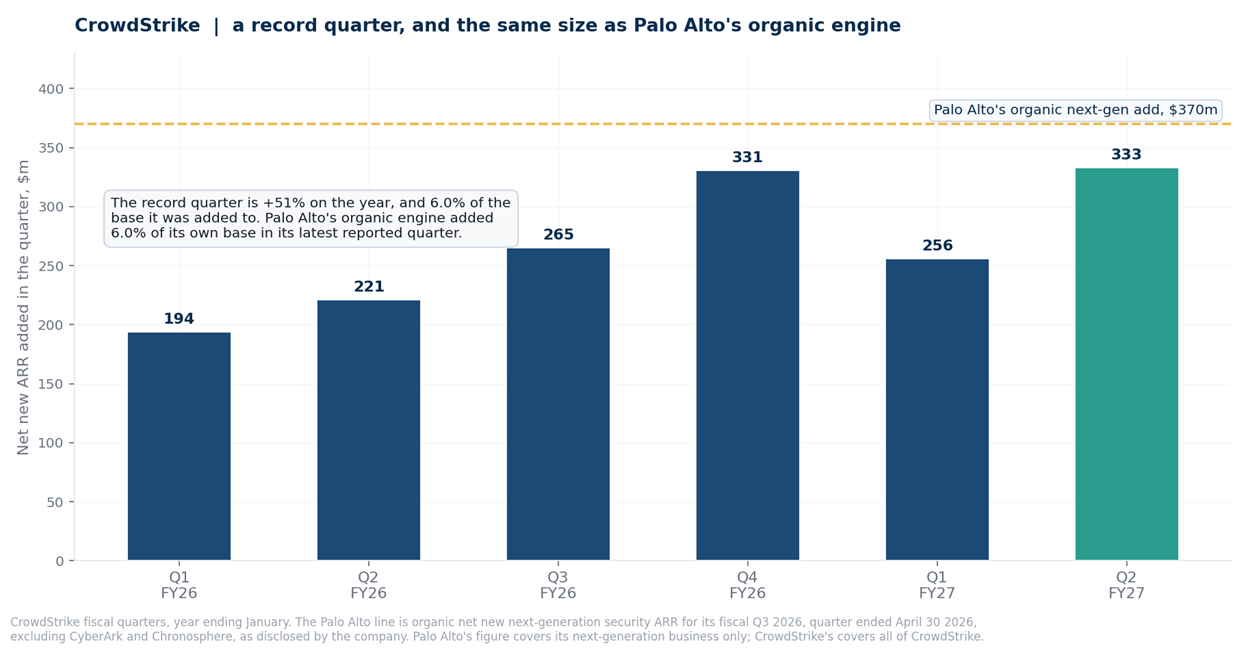
Revenue rose 26% to $1.47 billion and recurring revenue reached $5.84 billion, up 25%. Both fine, neither surprising. The number that moved the stock is the one in between: net new recurring revenue of $332.8 million, the most the company has ever added in a quarter, and 51% more than the same quarter a year ago.
That figure is the hardest one in software to manufacture. It’s the quarter’s incremental recurring revenue, net of expansion, contraction and churn, and it can’t be flattered by a long tail of old contracts. CrowdStrike has taken it from $194 million to $333 million across 6 quarters, a company that has finished digesting the 2024 outage and gone back to winning. Management raised the full-year outlook for that measure by 630 basis points, to 34% growth at the midpoint, and lifted revenue guidance to $5.99 billion to $6.01 billion.
The rest supports it. Non-GAAP operating income grew 46% to $371.6 million, a 25% margin, and operating cash flow rose 59%. Falcon Flex, which lets customers draw down across modules, now carries $2.29 billion of recurring revenue, roughly double a year ago, and 51% of subscription customers run 6 or more modules. CrowdStrike buys companies too. SGNL, announced in January and closed in February, carried about $637 million of recorded consideration. CyberArk alone carried $21.1 billion, roughly 33 times as much.
What Palo Alto Will Report
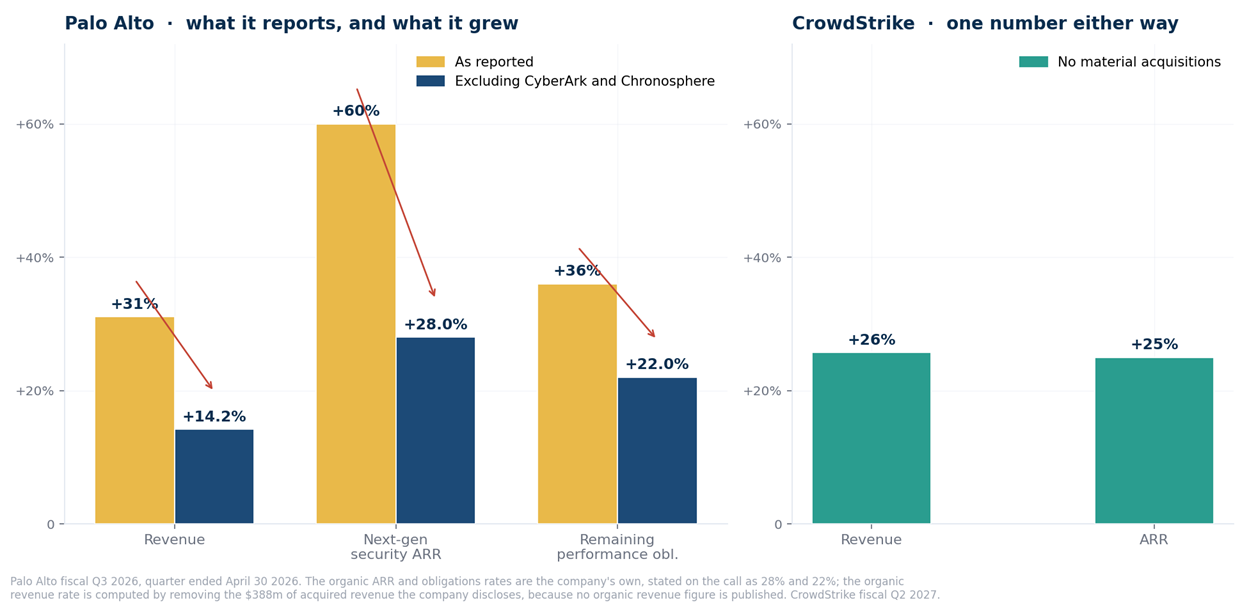
Palo Alto closed Chronosphere on January 29 and CyberArk on February 11. The quarter it reports Tuesday, ended July 31, is the first full one with both inside the numbers, which is why the guided rate steps up to 32% when the full year is guided to 24%.
Palo Alto discloses what the acquisitions contributed to each headline metric, so the organic rate is a subtraction anyone can do. Last quarter revenue was $3.002 billion against $2.289 billion a year earlier, up 31%, and $388 million of it came from the 2 deals. Take that out and the rate is 14.2%. On the other 2 lines Palo Alto publishes the organic rate itself: next-generation recurring revenue grew 28% rather than the 60% headline, and contracted future obligations grew 22% rather than 36%.
That makes the revenue line testable. The finance chief said it out loud: “Excluding the impact of CyberArk and Chronosphere, NGS ARR was $6.5 billion, up 28% year over year,” and gave 22% for obligations. Run my subtraction against those 2 and it returns 27.9% and 22.7%, close on figures the company rounds before publishing, which licenses using it on revenue, where no organic rate is given and the inputs are exact.
So the number likely to lead every write-up on Tuesday is 32%. The context that matters is that the quarter before it grew 31% on the headline and about 14% once the disclosed acquisition revenue comes out. Palo Alto doesn’t guide an organic revenue rate, so Tuesday is where you find out whether that engine accelerated. The 2 deals behind the gap were announced at a combined $28 billion and recorded at closing at about $24 billion.
The Engines Are the Same Size
Here’s the fair version, and it cuts against the easy read.
Palo Alto’s organic next-generation business added $370 million of recurring revenue last quarter. CrowdStrike added $332.8 million. Palo Alto’s is bigger. Run each as a rate against the base it was added to and they’re identical: 6.0% and 6.0%. Those are different quarters, though, and matched on the calendar Palo Alto is ahead. Across February to April, CrowdStrike added 4.9% of its base, its weakest quarter of the year seasonally, against Palo Alto’s 6.0%.
The difference is the direction. CrowdStrike’s incremental recurring revenue is 51% larger than a year ago. Palo Alto’s organic addition is 18% larger. One engine is accelerating and the other is growing steadily, and over a few years that gap compounds into something enormous. That, and not the headline rate, is what CrowdStrike’s premium is actually buying.
One caveat. Palo Alto’s next-generation figure covers its growth business only, with an older firewall estate attached that grows slowly. CrowdStrike’s covers everything. So the like-for-like is engine against engine, not company against company. And no organic split is perfectly clean once a company sells what it bought alongside what it built.
What You Pay for the Difference
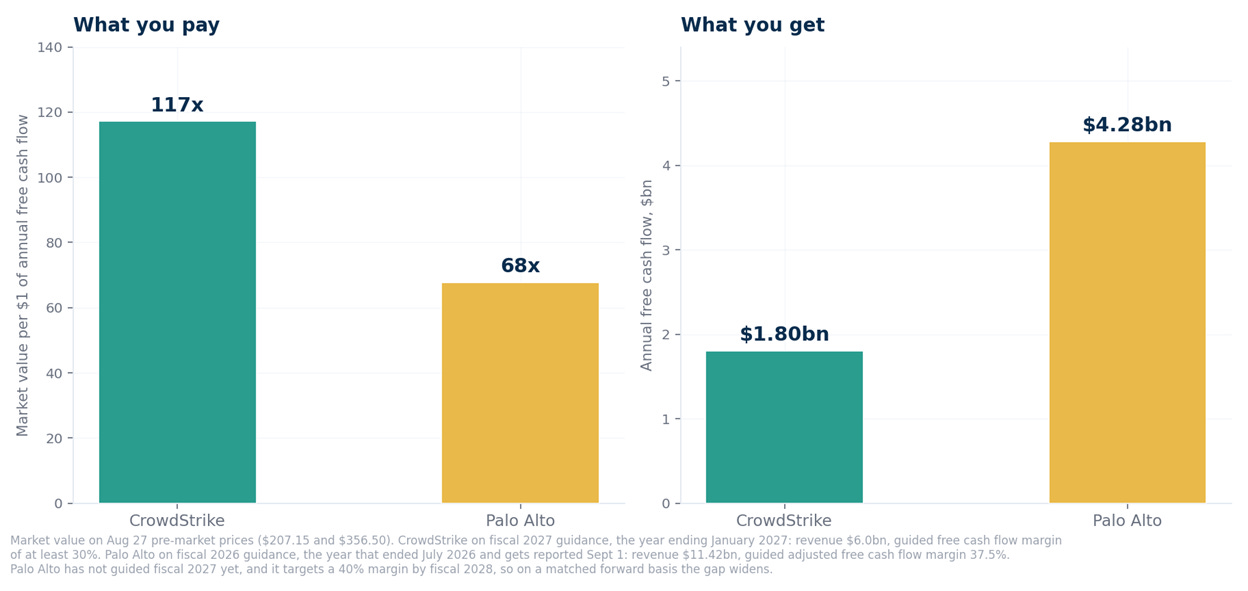
At Thursday’s pre-market price CrowdStrike is worth about $211 billion. Against its own fiscal 2027 guidance that’s 35 times revenue, 165 times adjusted earnings, and 117 times the free cash flow its at-least-30% margin framework implies.
Palo Alto is worth about $291 billion, and against fiscal 2026 guidance that’s just over 25 times revenue, 94 times adjusted earnings and 68 times its guided adjusted free cash flow: $4.28 billion against CrowdStrike’s implied $1.80 billion. Neither is a reported annual figure yet. And the comparison flatters CrowdStrike, because Palo Alto’s fiscal 2026 ended in July while CrowdStrike’s fiscal 2027 runs to next January. Palo Alto targets a 40% cash margin by fiscal 2028, so matched forward the gap is wider.
One adjustment runs the other way. CyberArk was paid for substantially in stock: across the quarter it closed in, Palo Alto’s share count went from 703 million to 813 million, up 15.6%. Per share, the growth is worse than the revenue line suggests. That’s the cost of buying rather than building, and the part the 32% headline hides most completely.
Tuesday
The report itself is close to settled. Consensus and guidance agree on about $3.35 billion of revenue and $0.96 to $0.98 of adjusted earnings, and the $8.90 billion to $8.95 billion of recurring revenue was set when the quarter closed on July 31.
The event is the fiscal 2027 guide, and there’s a specific bar. Palo Alto has told investors it targets $20 billion of next-generation recurring revenue by fiscal 2030. From a fiscal 2026 exit near $8.93 billion, hitting that requires compounding at 22.4% a year. That makes the guide a burden-of-proof number, not a pass or fail. Below 22.4% and the later years have to carry more; above it and fiscal 2027 starts ahead of the straight line. Neither settles the target, since growth needn’t arrive evenly.
The second thing is quieter and matters more. Palo Alto has said it intends to provide segment revenue for Network Security, Cortex and Identity beginning in fiscal 2027. It hasn’t said they arrive Tuesday, so watch first whether they do. Right now the consolidated figure makes it impossible to see whether the firewall business is healthy or melting under an acquired growth story. That’s the real asymmetry here: not that Palo Alto is cheap, but that the reason it’s cheap is about to become checkable.
Which points somewhere. CrowdStrike earned its move: organic reacceleration is the hardest thing here to fake, and the quarterly addition is 72% larger than 6 quarters ago. But at 117 times cash the premium is fully paid, and chasing the gap is paying for information the market already has. Palo Alto is the higher-variance side, priced at a discount that Tuesday either justifies or removes.
The Setup
Both stocks trade as one thing: they bottomed on the same 3 days in June, peaked within a session of each other in August, and Palo Alto rose 5% on Thursday’s pre-market on somebody else’s results.
Palo Alto closed at $339.31, about 15% below its August 13 high of $398.88. The pre-market at $356.50 sits almost exactly on the 20-day exponential average at $355.73 and the Ichimoku baseline at $353.71, the level it broke down through. Average true range is $15.22, roughly 4.5%, and an earnings move is usually larger.
