


CVS had plenty to celebrate Wednesday morning. Adjusted EPS of $2.09 beat the ~$1.65 expected, revenue rose 5.4%, and management raised its outlook. It also confirmed plans to separate the pharmacy chain from Aetna and Caremark, without a single cost, debt, or dividend figure.
Yet price went from $91.41 to $79.96.
Peers rose the same day. Elevance gained 4.9%, Cigna 3.4% and UNH 0.00%↑ 1.2%, helped partly by the post-election policy expectations, according to 24/7 Wall St.
That shows a CVS-specific selloff.
Start with the guidance. CVS has earned $7.24 of adjusted EPS through September and now guides to at least $8.20 for the year. That leaves $0.96 for Q4 at the floor, below last year’s $1.09 and the $1.24 analysts expect. It’s a floor, not formal Q4 guidance, but it shows management keeping plenty of caution in reserve.

Key Takeaways
The business is recovering. Aetna’s adjusted operating income nearly tripled, the stores earned more income on less revenue, and leverage fell to 3.13x from 4.01x.
The guidance points to a soft Q4, to about $0.96 of adjusted EPS (below last year’s and analyst expectations).
Peers rose while CVS lost 12.5%. The cautious Q4 outlook, expectations for a 2027 earnings trough in Health Services and the lack of financial details around the split all added to the uncertainty.
Management guided Health Services to “trough earnings” of at least $7B next year, with 340B income declining. Aetna and the stores are recovering, but the segment CVS keeps faces a down year.
The split adds uncertainty, not value, for now. Completion is targeted for the first half of 2028, and there are still no figures for costs, the debt split or the dividend split. Until there are, the market won’t pay for it.
Cheaper, but not ready. CVS now trades in line with Cigna, but the daily trend has broken. There’s no optimal entry yet.
About CVS and the Break-Up
Behind the pharmacy, CVS 0.00%↑ is also Aetna, an insurer with about 26M medical members, and Caremark, a pharmacy benefit manager (which is the middleman that negotiates drug prices for employers and health plans).
CVS’ pitch back in 2018 when they launched the $78B Aetna deal was that owning all the pharmacy, the insurance, and the PBM would lower costs.
Now, CVS is splitting the segments.
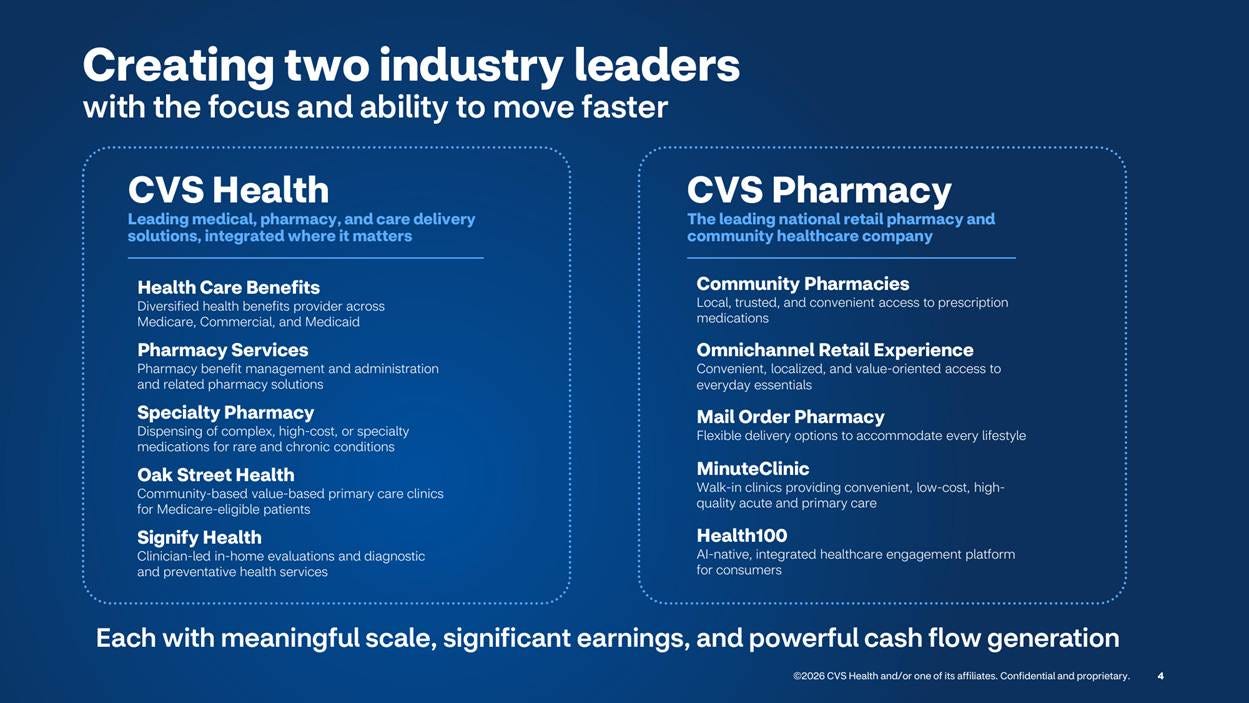
Source: CVS Health Investor Update, 4 November 2026.
CVS Health will keep Aetna, Caremark, Specialty Pharmacy, Oak Street Health and Signify.
CVS puts these segments’ 2026 revenue at about $320B.
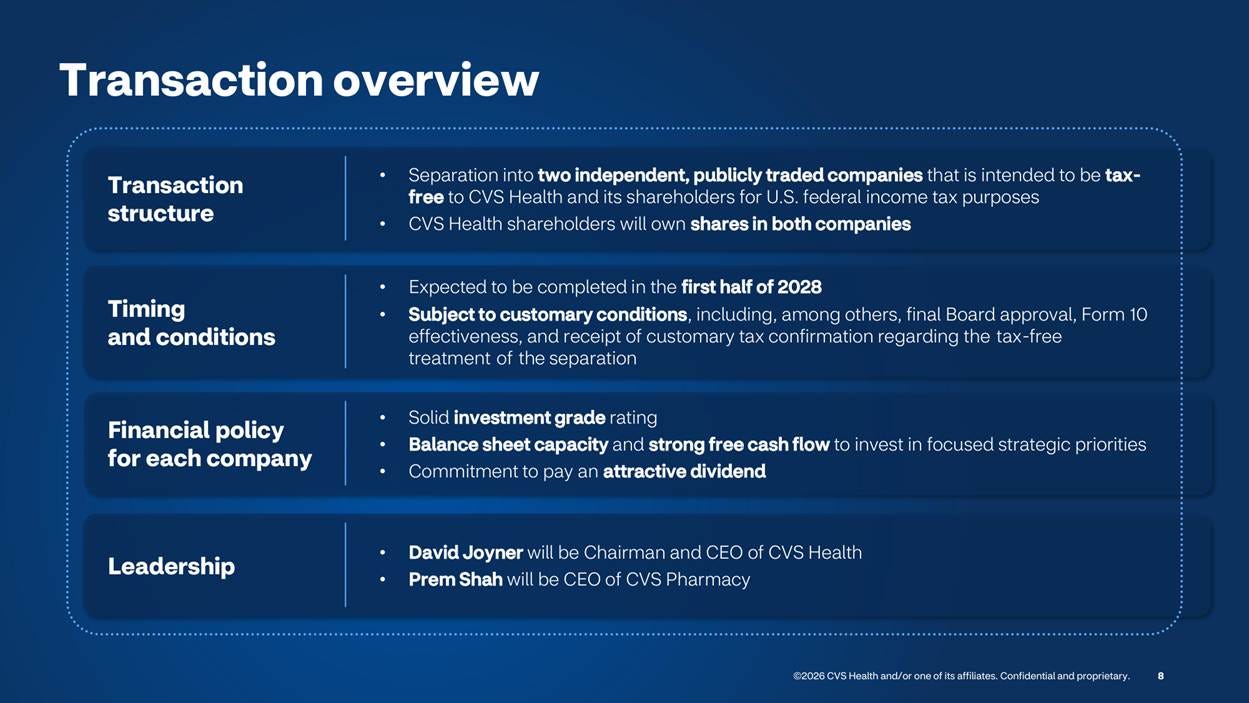
David Joyner will remain Chairman and CEO of this segment.
CVS Pharmacy will take the stores, Mail Order, MinuteClinic and the Health100 app,
Segment has about $145B of revenue for 2026.
Prem Shah becomes CEO.
Structure and timing: intended to be tax-free, with shareholders holding both companies, and “expected to be completed in the first half of 2028.”
Source: CVS Health Investor Update, 4 November 2026.
The 2 revenue estimates add up to $465B, against consolidated guidance of at least $420B.
CVS doesn’t reconcile the gap, but it’s consistent with heavy trading between the segments: the release shows $51.2B of intersegment eliminations in the first 9 months. After a split, some of that becomes a contract (probably at arms length) between 2 separate companies. CVS Pharmacy’s value will be very dependent on the terms of that contract.
Also undisclosed: how the $60.7B of debt is divided, who pays what share of the $2.66 annual dividend, and what the separation costs. CFO Brian Newman called the costs “certainly manageable, and in line with other transactions of this type” without putting a number on them.
These all point to why the stock dropped so much yesterday:
Unclear costs: The stock rose 3.3% on Tuesday’s leak, and Wednesday’s details left out costs, the debt split and the dividend split.
The light Q4 expectation and a guided 2027 trough in Health Services.
Star ratings: More than 69% of Aetna’s Medicare Advantage members are in 2027 plans rated 4 stars or higher, down from more than 81% for 2026.
Fundamental Overview
Q3 Results
Revenue has grown 16% since Q4 2023, from $93.81B to $108.4B.
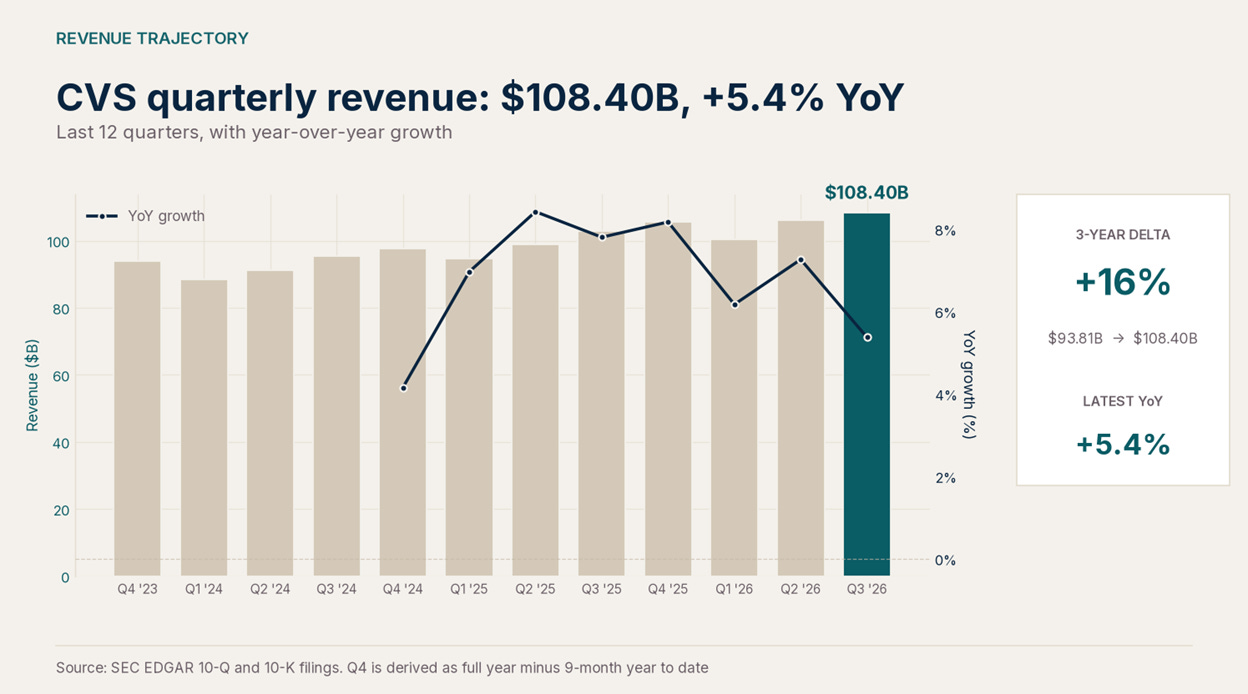
The profit mix moved more than the top line:
Aetna (Health Care Benefits): adjusted operating income of $912M versus $314M. The medical benefit ratio, or MBR (the share of premiums paid out as claims), improved to 91.3% from 92.8%.
Caremark and clinics (Health Services): revenue up 9.5%, but adjusted operating income up only 2.7% to $2.11B, with margin down to 3.9% from 4.2% on client price concessions.
Stores (Pharmacy and Consumer Wellness): revenue down 2.0%, adjusted operating income up 10.6% to $1.64B, gross margin 19.2% vs. previous 18.1%.
The store result is encouraging, showing they can earn more net income on less revenue. But the current retail segment isn’t the future CVS Pharmacy, which also gets Mail Order, MinuteClinic and Health100.
Operating cash flow reached $15.3B for 9 months, up from $7.2B last year, though about $4.0B of the gain was a year-over-year positive change in operating assets and liabilities.
Leverage fell to 3.13x from 4.01x as adjusted net debt dropped $8.2B and trailing adjusted EBITDA rose $2.8B.
The Guidance
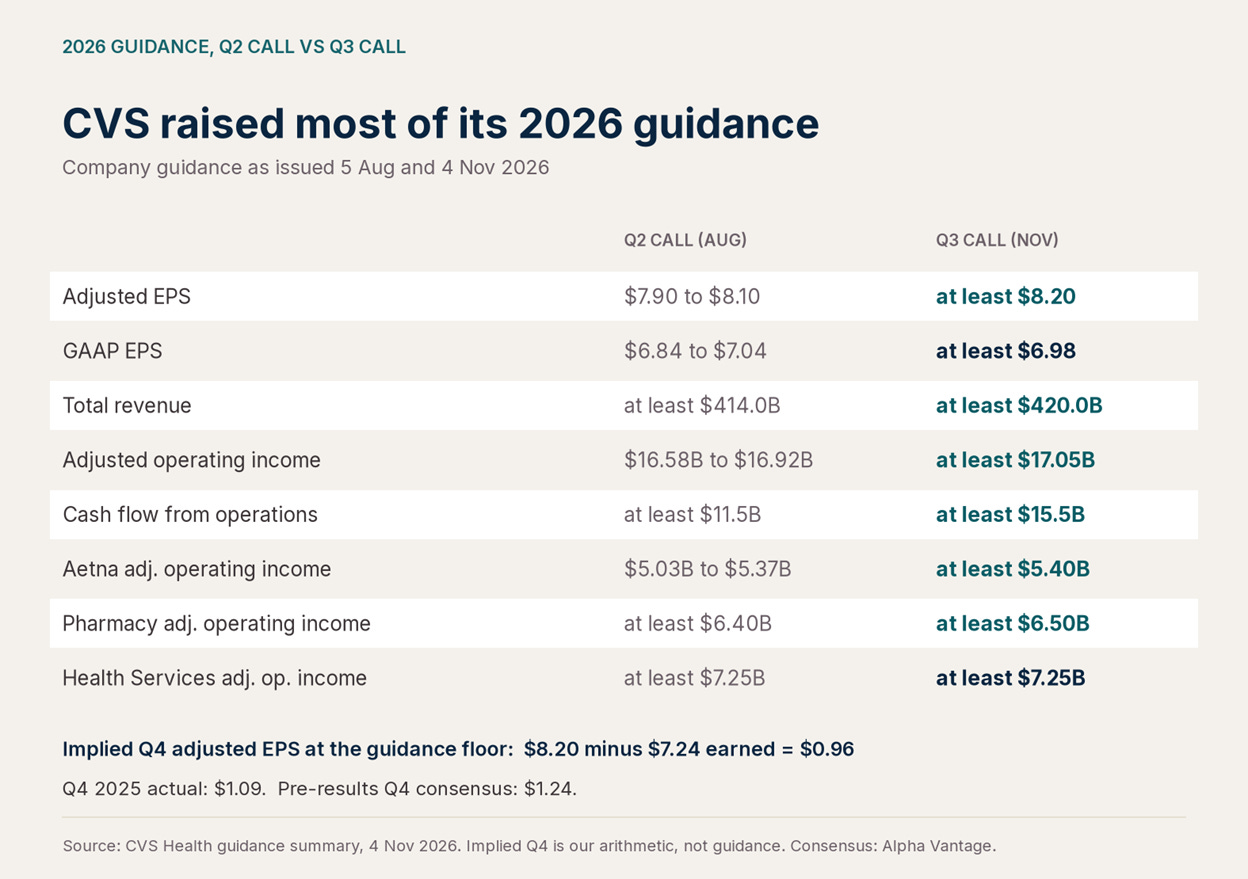
The new $8.20 minimum Adjusted EPS is $0.30 above the old lower estimate and $0.10 above the old top, after a quarter that beat by about $0.44. That’s a real raise.
But Q4 is typically Aetna’s heaviest claims quarter, and full-year MBR guidance points to a Q4 ratio in the mid-90s (our estimate), against Q3’s 91.3%.
Management says it’s “maintaining a cautious view for the remainder of the year in light of continued elevated cost trends.”
CVS has beaten consensus 8 quarters running, but 2026 also includes $1.3B of favorable prior-year reserve development that can’t be counted on going forward.
CVS handles this with a “baseline” of $7.66, which removes $0.54 for prior-year health cost estimate changes and certain prior-period revenue adjustments. Thus, the 2027 EPS of at least $8.65 can be compared to 2026 results in 2 ways:
Up 5.5% on the reported 2026 floor of $8.20
Up 12.9% on the $7.66 baseline
Formal 2027 guidance comes in February.
The soft spot is Health Services, particularly the pressures facing Caremark. The segment is guided to at least $7.0B of adjusted operating income in 2027, against at least $7.25B this year.
On the earnings call, Prem Shah put it plainly:
“We expect 2027 to represent trough earnings of at least $7 billion.”
Management also expects “a year-on-year decline in our 340B business” next year (340B is a federal drug-discount program), stabilizing by the end of 2027. Management also pointed to lower Caremark membership, partly offset by continued strength in specialty pharmacy and improvement in care delivery.
What you’re paying
Trailing GAAP multiples are distorted by last year’s $5.7B goodwill impairment. Forward numbers at the $79.96 close:
9.8x the 2026 minimum of $8.20
10.4x the $7.66 baseline
9.2x the 2027 expectation of $8.65
3.3% dividend yield
Consensus forward P/E for peers at the same close was:
9.1x for Cigna CI 0.00%↑ (the nearest model, insurer plus PBM)
14.3x for Elevance ELV 0.00%↑
17.6x for UnitedHealth UNH 0.00%↑
Fundamental conclusion: Aetna’s recovery and the improvement in retail profitability are no longer theoretical. Both are visible in the operating results. Against them sit a low Q4 expectation, a guided trough year for Health Services, a 340B decline, a star-ratings slip and a separation with no disclosed economics.
Wednesday moved the valuation from “recovery priced” to “recovery discounted,” but the catalysts that could close that discount, February’s guidance and the separation filings, are months away.
Technical Overview
On 5 August, CVS beat Q2 consensus by 39% and opened 10.2% lower.
On 4 November it beat by 27% and closed 12.5% lower.
That’s twice in 3 months that an earnings beat led to a stock breakdown.
Weekly Chart
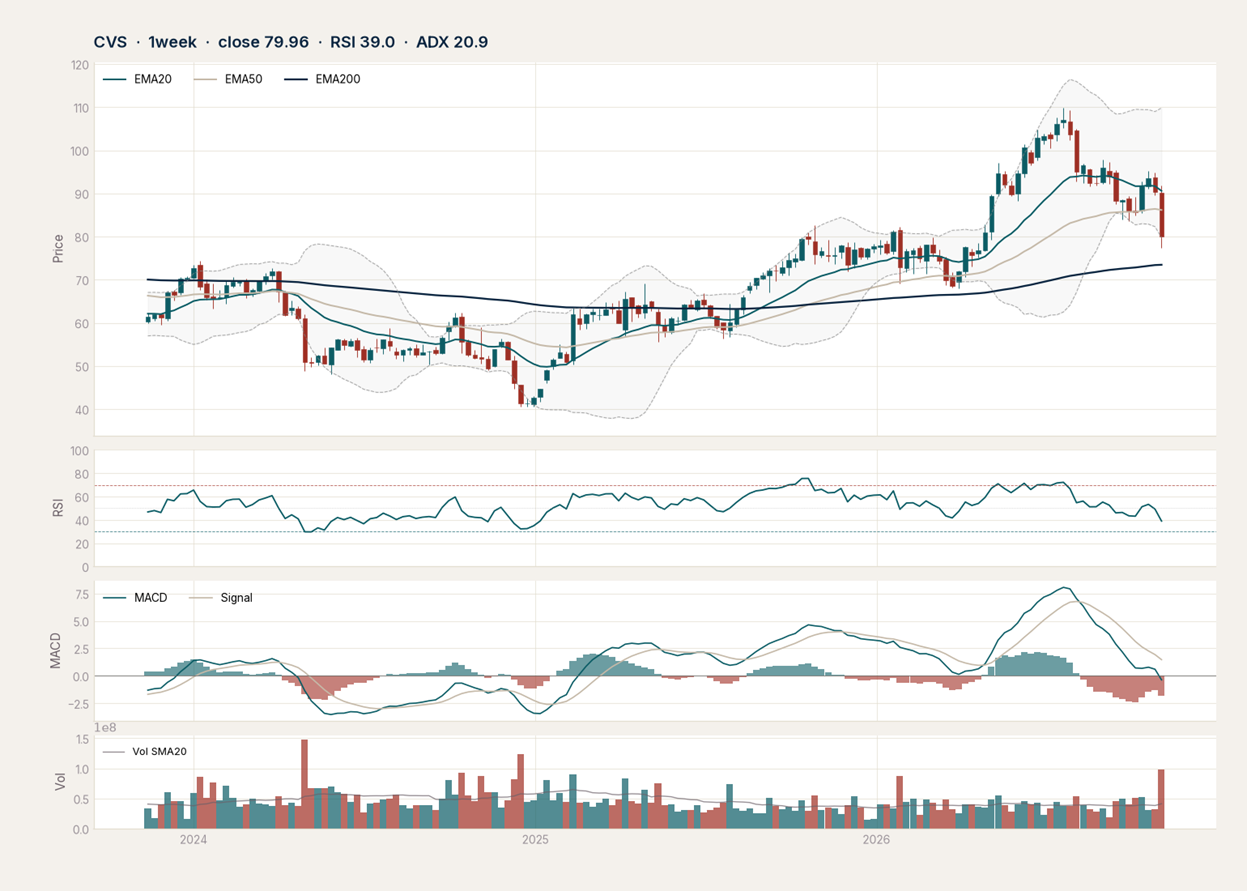
The long-term uptrend from the 2024 lows survives. The intermediate trend doesn’t.
Averages: price fell below the 20-week EMA ($90.58) and the 50-week ($86.16). It’s now testing the 100-week ($79.05). The 200-week ($73.46) is still below.
Retracement: the rally from the March low of $69.51 to the July high of $110.68 has given back 78.6% at $78.32. Wednesday’s low of $77.33 went through that level and the close recovered above it.
Momentum: RSI 39.0. The MACD histogram has turned more negative, so the decline is gaining pace.
Direction: sellers lead buyers on the directional readings, -DI 30.3 against +DI 18.9, with ADX at 20.9. Above 20 means a trend is starting to form, and right now it points downwards.
The intermediate break has already happened. A Friday close below the 100-week near $79 would reinforce it, and a close back above would be the first sign the selling is stabilizing.
Daily Chart
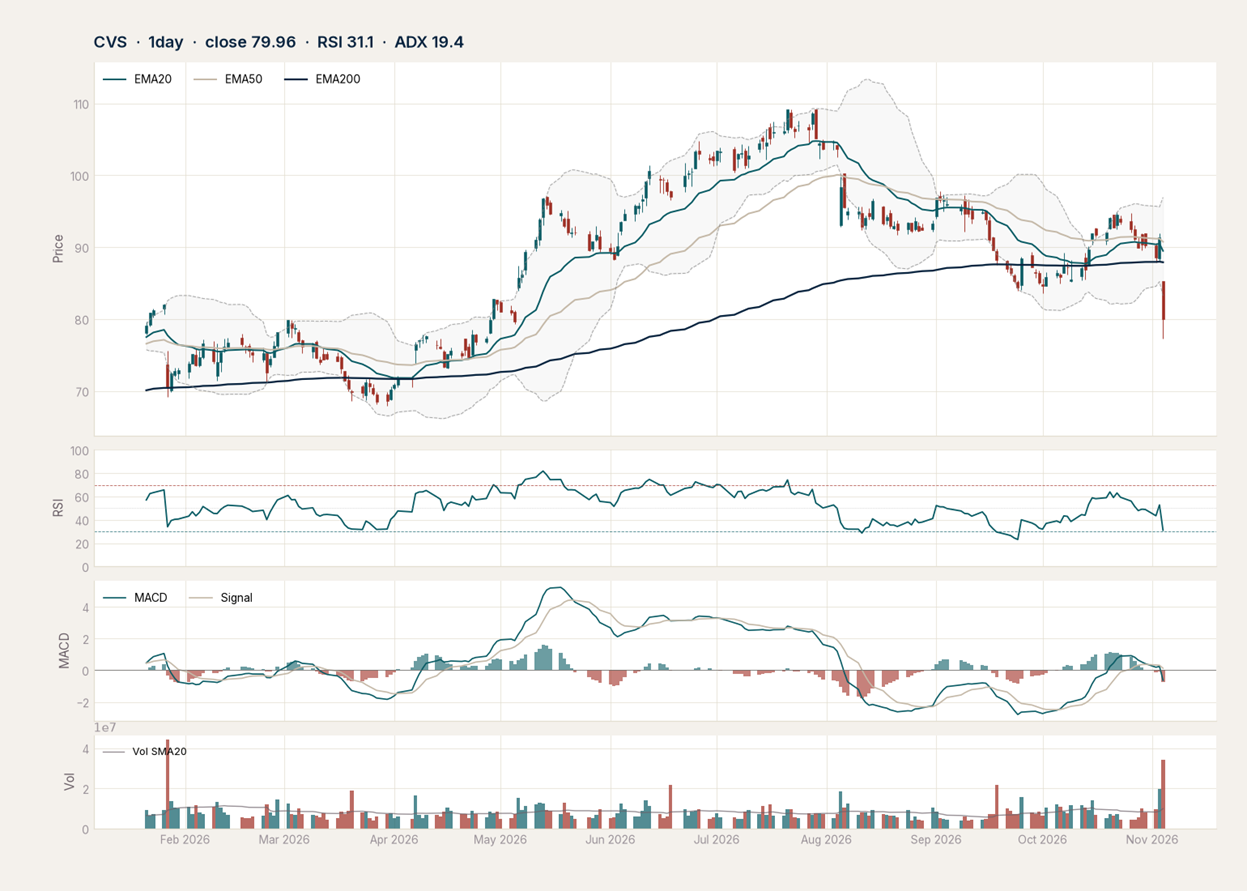
The daily timeframe broke on Wednesday:
The gap: CVS opened at $85.30, below Tuesday’s low of $88.02, and never traded back into it. That $85.30 to $88.02 gap is now overhead supply, and the 200-day EMA ($87.92) sits right inside it.
Structure: the October low of $84.23 is gone. The pattern is now lower highs ($110.68 in July, $95.26 in October) and a lower low ($77.33). That’s a downtrend by definition.
Stretch: daily RSI is 31.1, near oversold, and price closed below the lower Bollinger band (2 standard deviations under the 20-day average). Stretches like this often bounce but don’t reliably mark the low.
Direction: -DI 39.9 against +DI 13.8, so sellers are firmly in control.
Here’s the map we see:
Resistance: $81.50 to $83.30 (the January highs), then $84.23 to $88.02, where the failed October base, the gap and the 200-day all stack together.
Support: $77.33 (Wednesday’s low), then $72.50 to $74.00 (the February lows and the 200-week EMA), then $69.20 to $69.51, where the 61.8% retracement of the whole advance from the December 2024 low of $43.56 meets the 52-week low.
Technical conclusion: The daily trend has moved into a downtrend. Same on the weekly, with an uptrend visible only in the long-term. Price is on the 100-week EMA. An oversold bounce is possible but the bull case needs a daily close above $88.10. The long-term structure fails below $69.20 to $69.51.
The Trade Plan
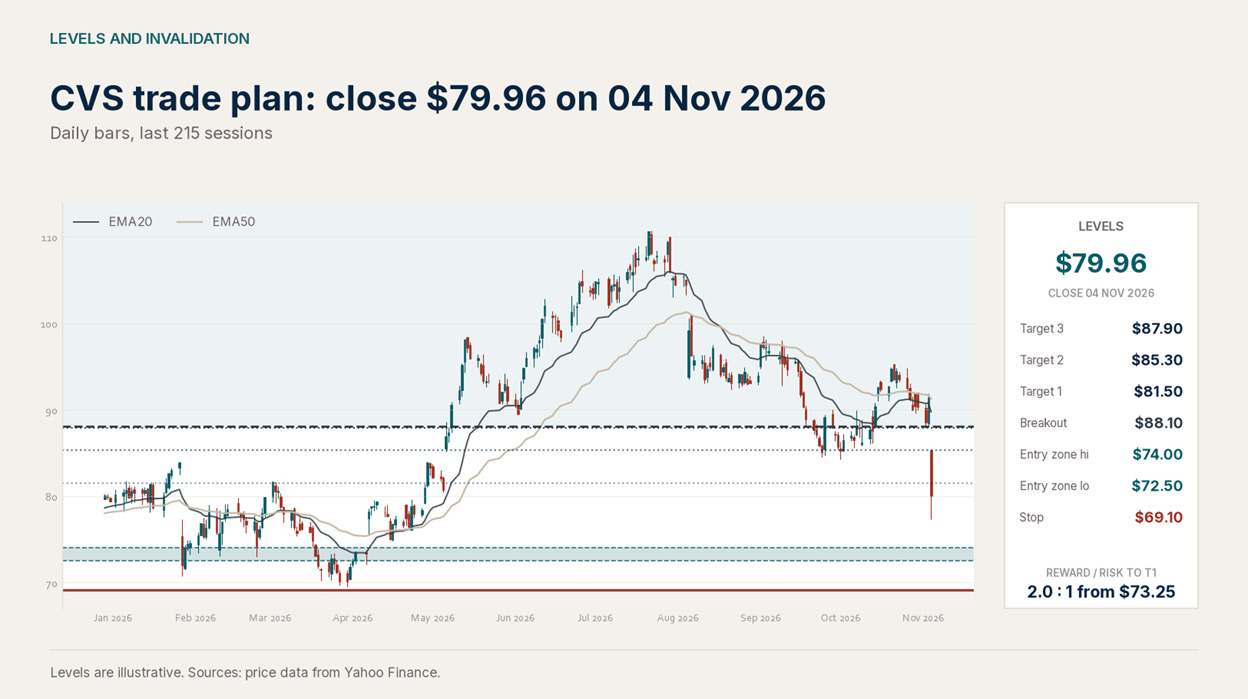
There’s no trade at the 4 November close.
From $79.96, the tactical stop is 13.6% below and the first target only 1.9% above.
Buying the day after a 12.5% one-day decline on news usually means owning it before the sellers are done.
Scenario 1, the pullback (preferred):
Pullback entry: $72.50 to $74.00, where the February lows meet the 200-week EMA at $73.46. The setup needs the zone to hold on a daily close, ideally followed by a higher low.
Tactical stop: $69.10 on a daily close, below both the 52-week low ($69.51) and the 61.8% retracement ($69.20).
Firm stop: $65.80 on a weekly close, under the mid-2025 shelf where weekly lows held at $65.87 to $66.54. Losing it would break the long-term structure.
Target 1: $81.50, the bottom of the January resistance range.
Target 2: $85.30, Wednesday’s open and the lower edge of the gap.
Target 3: $87.90, the 200-day EMA and a near-complete gap fill.
From the $73.25 midpoint, that’s $4.15 of risk against $8.25 to Target 1, about 2.0 to 1, and 2.9 to 1 to Target 2.
The entry price matters considerably here. A confirmation entry above the midpoint gives up some of that reward.
Scenario 2, the reclaim:
Breakout entry: a daily close above $88.10, which fills the gap and reclaims the 200-day.
Tactical stop: $84.10 on a daily close, back below the old October base.
Targets:
T1: $91.40 (Tuesday’s close)
T2: $95.25 (the October high)
T3: $98.50 (the September shelf).
If Scenario 1 triggers before the Q4 report, start at half size. These levels expire at that report, and closing stops won’t protect you from a gap like Wednesday’s.
If you already own it, watch Friday’s weekly close against the 100-week EMA near $79. A close below it reinforces the intermediate break. The line that ends the long-term case is $69.10.
With regards to the anticipated business split, keep in mind that the legal separation is targeted for the first half of 2028, which is still far out.
But the Form 10 and standalone numbers should arrive well before then, which could give some indication on what to expect.
In the meantime, look out for specific catalysts:
The Q4 report and formal 2027 guidance, to be expected in February
The 2028 Medicare Advantage Advance Notice, which should come around late January or early February 2027
The final 2028 rate announcement. Look out for this in early April 2027
Bottom Line
CVS 0.00%↑ is a stronger business than a year ago, and Wednesday made it a cheaper one, at 9x the 2027 floor.
Cheap isn’t the same as ready. Health Services faces a hard year, the Q4 expectation sits below last year’s Q4, the separation terms are blank, and the daily trend has turned down.
The setup is better at $72.50 to $74.00, where the February lows meet the 4-year average, or after a close back above $88.10. Until then, waiting is the position.
We don’t predict. We prepare.
All content provided is for informational and educational purposes only and does not constitute investment advice, a recommendation, or an offer to buy or sell any security. The trade plans, levels, and scenarios discussed are illustrative frameworks based on market structure and are not guarantees of performance. Markets involve risk, and losses are possible. Past performance is not indicative of future results. Each reader is responsible for their own investment decisions, position sizing, and risk management.