


Smart investing is usually less about “Is this good?” and more about “What am I paying for what I’m getting?”
Duolingo just reminded everyone what happens when a beloved growth stock trips over guidance.
The company delivered another monster quarter. Revenue up more than forty percent. Paid subscribers climbing. Daily active users hitting fresh highs. And yet the stock fell off a cliff, dropping roughly a third in a single session.
So what gives?
This isn’t a bankruptcy story. It’s not a fraud story. It’s a valuation and expectations reset on a high-quality business that was priced for perfection.
In this note we’ll keep it simple: what the fundamentals say, what the chart says, and how a patient medium- to long-term investor might approach Duolingo from here.
Big picture first. Noise later.

Key Takeaways
Duolingo’s business remains very strong: revenue up ~41 percent year on year in Q3, DAUs up ~36 percent, paid subs up ~34 percent. Reuters
The stock collapsed because Q4 bookings guidance undershot expectations and management is openly prioritizing teaching quality and long-term product over near-term monetization. Reuters
Even after the drop, Duolingo trades at roughly 9–10x sales and a very high earnings multiple, far richer than peers like Coursera and Chegg.FullRatio
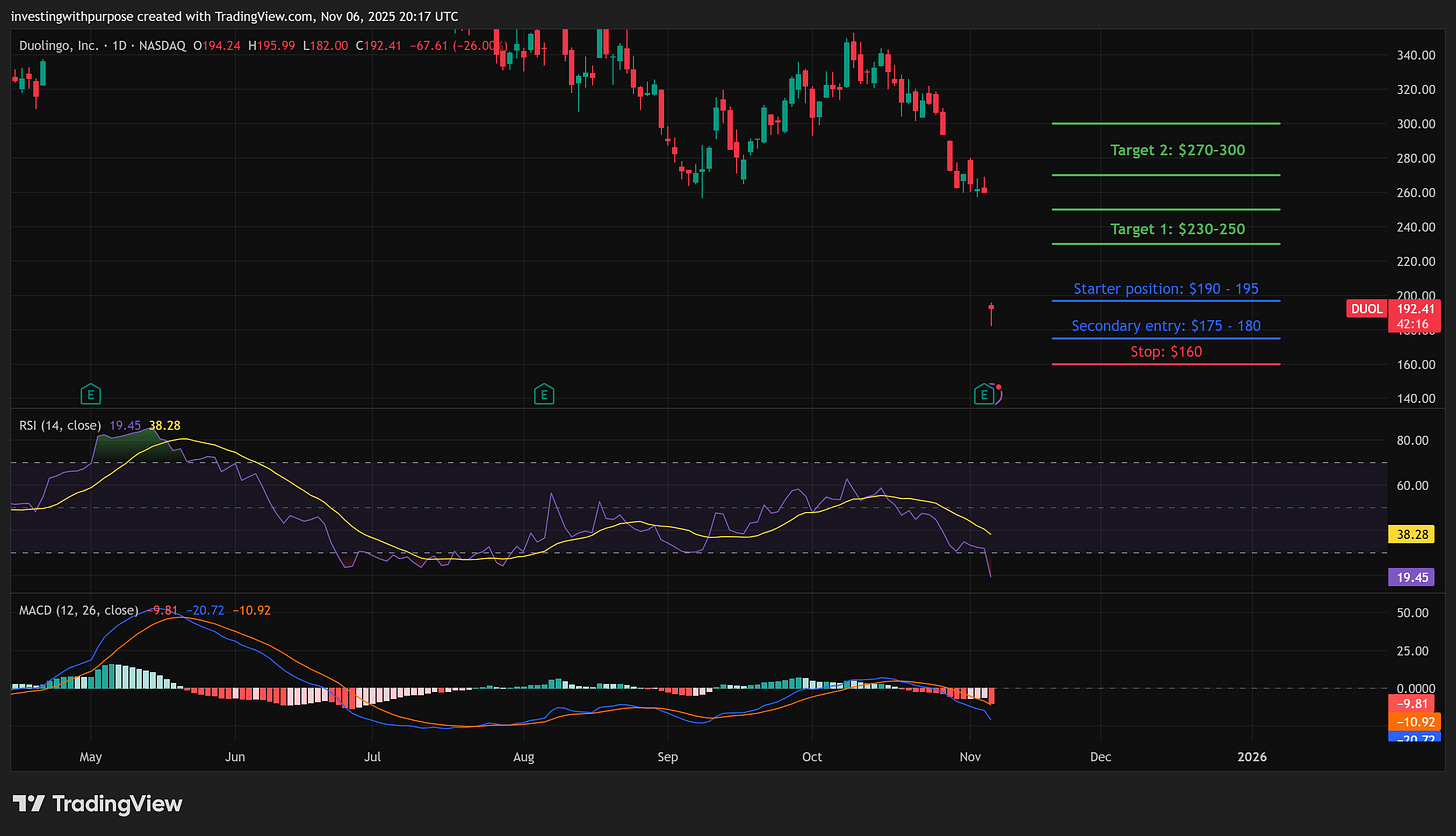
Technically, the chart is broken but extremely oversold: price is far below all key moving averages, RSI is in the low teens on the daily, and volatility just spiked.
For medium-long investors, DUOL looks like a high-quality, high-volatility satellite position, not a bargain core holding. Staggered entries and modest sizing make more sense than swinging for the fences.
Business “pipeline” – product, AI and where growth comes from
Duolingo isn’t a biotech, so there’s no FDA calendar to track. But it does have a genuine product pipeline.
Core drivers:
Subscriptions (Super and Max) are the main engine, with subscription bookings growing faster than total revenue and accounting for the majority of sales. Porter’s Five Forces
Duolingo Max is the AI-powered tier using GPT-4 for features like Explain My Answer, Roleplay and video calls with in-app characters. It’s priced above the regular Super plan and is designed to drive ARPU higher over time. Duolingo Blog
New subjects (Math and Music) and the Duolingo English Test add optionality outside pure language learning. English testing volume has been growing quickly as universities adopt it. goarno.io
Q3 showed these engines still humming:
41 percent revenue growth
36 percent DAU growth to over 50 million
11.5 million paying subscribers, up 34 percent. Reuters
The strategic shift that spooked the street is subtle but important. Management is leaning into:
Better teaching quality and long-term engagement
Continued AI investment despite slightly lower gross margins
A willingness to let bookings growth slow a bit in exchange for a more durable product
If they’re right, this is the kind of move that pays off over a five year horizon. If they’re wrong, you end up with slower growth and the same high multiple.
So the pipeline is real. The question is whether it earns today’s price tag.
Fundamental analysis
On the numbers, Duolingo looks like a classic high-quality growth story:
Full-year 2024 revenue of ~748m, up ~41 percent vs 2023.Business of Apps
2025 is tracking toward just over 1.0b in revenue based on raised guidance. Reuters
Gross margins around 72–73 percent, which is software-level efficiency even with rising AI compute costs. TradingView
Adjusted EBITDA margin brushing high 20s.Barron’s
Balance sheet with ~1.1b in cash and no debt, giving them plenty of runway to keep investing. Yahoo Finance
Against that you have valuation:
Post-selloff, price to sales still sits near 9–10x.Companies Market Cap
Coursera trades closer to 1.8–2.0x sales. FullRatio
Chegg, the cautionary tale of EdTech disruption, sits around 0.2–0.3x sales. FullRatio
Duolingo absolutely deserves a premium to peers; it’s growing faster, actually profitable, and has a stronger brand. But even after the selloff, the spread is wide. You’re paying a lot for a lot.
If you strip out the noise, Duolingo is a financially strong, high-growth, high-margin platform with an ambitious AI roadmap. The business itself is investable.
The real debate is whether paying almost ten times sales for that growth, right after the first notable guidance wobble, is enough of a discount for the risks.
For value-driven investors, the answer is probably no. For growth-oriented investors who can live with volatility, it’s more of a “yes, but slowly and in moderation.”
Technical analysis
Trend:
The daily chart is decisively broken. Price has sliced below the 20, 50, 100 and 200-day EMAs and left a large earnings gap.
On the weekly, we’ve gone from an extended bull trend to a sharp break that undercuts the prior swing lows.
Momentum:
Daily RSI is in the low teens, my calc is roughly 11, which is classic capitulation territory.
Weekly RSI is around 29, marking the first weekly oversold zone of this entire major uptrend.
MACD lines on daily and 4h are deeply negative with wide histograms, signaling strong downside momentum that hasn’t yet mean-reverted.
Volatility and volume:
ATR spiked from about 15 to nearly 20 on the daily after earnings.
OBV turned sharply down, confirming that this was real selling pressure, not a low-volume air pocket.
Levels:
The daily Fibs you drew place current price around a 1.618 extension zone near 190–200, often a spot where oversold bounces start.
Weekly extensions highlight potential deeper supports near 178, then around the 140s, with a very distant fib down in the 70s that’s more “worst case tail” than base case.
Overhead, there’s a stacked resistance band between 270 and 300 where the gap, prior support and EMAs all intersect. Any bounce into that area is more likely to meet profit-taking than smooth continuation.
Short term, DUOL is ripe for a violent reflex rally, but structurally it’s a broken trend until proven otherwise.
You don’t need to catch the exact bottom. You need to respect that price can still explore lower fib levels before a durable base forms.
A trade approach
Here’s how we’d think about it as a medium- to long-term investor.
Position size: Max 2–4% of portfolio.
Entries:
Tier 1: $190–195 — starter position.
Tier 2: $175–180 — add if price stabilizes.
Tier 3: $150–160 — only if fundamentals remain intact.
Stops:
Hard stop: below $120 (thesis broken).
Soft stop: growth slows <25% or valuation stays elevated.
Targets:
Trim 1: $230–250 (gap fill + EMA test).
Trim 2: $270–300 (heavy resistance zone).
Hold remainder: for 2–3 year compounding thesis.
Key watchpoints: subscriber growth, bookings, AI-driven product rollout, and margin trends.
Time horizon: 2–3 years. Add only if metrics stay healthy; cut quick if growth narrative cracks.
Bottom line
Duolingo today is not a “broken company.” It’s a strong, growing, profitable platform that finally ran into the gravity of its own valuation.
The Q3 print tells you the product is working. The guidance and the price action tell you investors were pricing in a near-flawless path and now realise that path is bumpier than they wanted.
If you’re looking for sleepy compounders at reasonable multiples, you can skip this one for now.
If you’re comfortable owning a high-quality, high-multiple growth stock through volatility, Duolingo after this flush is interesting. Not screamingly cheap, but no longer absurd. It calls for:
Small, staged entries
Respect for the broken chart
A two to three year view on whether AI-enhanced learning and new products can keep growth high enough to justify a still premium multiple
In other words: this is a stock to approach thoughtfully, not fearfully. If you size it right and stay honest about the risks, it can earn a place in a diversified, growth-tilted portfolio.
This content is for informational and educational purposes only and does not constitute financial or investment advice.