



Introduction
Electronic Arts EA 0.00%↑ just turned from a high-quality public compounder into a classic event-driven story. A consortium led by Silver Lake with Saudi Arabia’s Public Investment Fund and Affinity Partners agreed to take EA private for $210 per share in cash, valuing the company around $55B. This makes it the largest leveraged buyout in gaming history. With the stock popping into the $190s yesterday and low $200s today, investors may be asking a simple question: Is there still money to be made? Short answer: yes, if you treat it like an arbitrage and respect the risks.
If the merger is terminated due to board decisions or accepting of a higher bid, EA 0.00%↑ will have to pay a $1 billion fee. Likewise, if the new buyers can’t secure regulatory approval before September 28 2026 (or if they breach the agreement), EA would receive the same amount.
Key Takeaways
Electronic Arts EA 0.00%↑ has agreed to a $210/share all-cash buyout led by Silver Lake, Saudi Arabia’s Public Investment Fund (PIF), and Affinity Partners, valuing the company at roughly $55 billion.
Shares ripped nearly 15% on the news and another 5% in pre-market. Now trades around $203, shrinking the upside spread to ~3.4%.
With closure expected sometime in FY27, the trade is now all about deal risk vs. timeline.
The smarter play: wait for a pullback into the $185–177 zone, where arbitrage funds are likely to defend, then ride the spread back toward $205–210.
If the deal breaks, downside risk could extend into the $165–175 range (so, risk management is paramount).
What’s Driving the Move
Electronic Arts shocked the market this week after reports confirmed it’s in advanced talks to go private in a $210/share all-cash deal. The buyer consortium, anchored by Silver Lake, Saudi Arabia’s PIF, and Affinity Partners, plans to take EA 0.00%↑ off the market in a record-setting $55 billion transaction.
The logic behind the bid is straightforward: EA owns one of the deepest and most reliable content pipelines in gaming - from EA Sports FIFA and Madden to Apex Legends and The Sims - supported by high-margin live services and annualized sports franchises that generate recurring cash flow.
This is exactly the type of cash engine private equity is willing to pay up for. Especially one with a clean balance sheet, consistent free cash flow, and sticky user ecosystems.
The deal, however, isn’t done. With regulatory approvals, financing syndication, and shareholder votes ahead, the timeline stretches into 2026-2027. That’s why the stock is trading at ~$203 instead of right up against the $210 offer. The spread reflects both time value and deal uncertainty.
Fundamental Picture: Why They’re Paying Up
EA 0.00%↑ remains one of the most profitable and cash-generative publishers in the industry:
Revenue (TTM): ~$7.47B
Gross Margin: ~79%
Operating Margin: ~18%
Net Margin: ~14%
Free Cash Flow (TTM): ~$1.75B (~23% FCF margin)
Net Debt: ~$579M (~0.3x net leverage)
This is textbook private equity territory: high-margin recurring revenue, massive free cash generation, and minimal leverage. These numbers make EA 0.00%↑ a rare asset, one that can comfortably handle a leveraged capital structure without threatening long-term viability.
Fundamental Conclusion
The $55B offer reflects a reasonable premium for EA’s IP portfolio and cash flow durability. It’s neither a steal nor an overpay.
Technical Picture: Fade Before the Grind
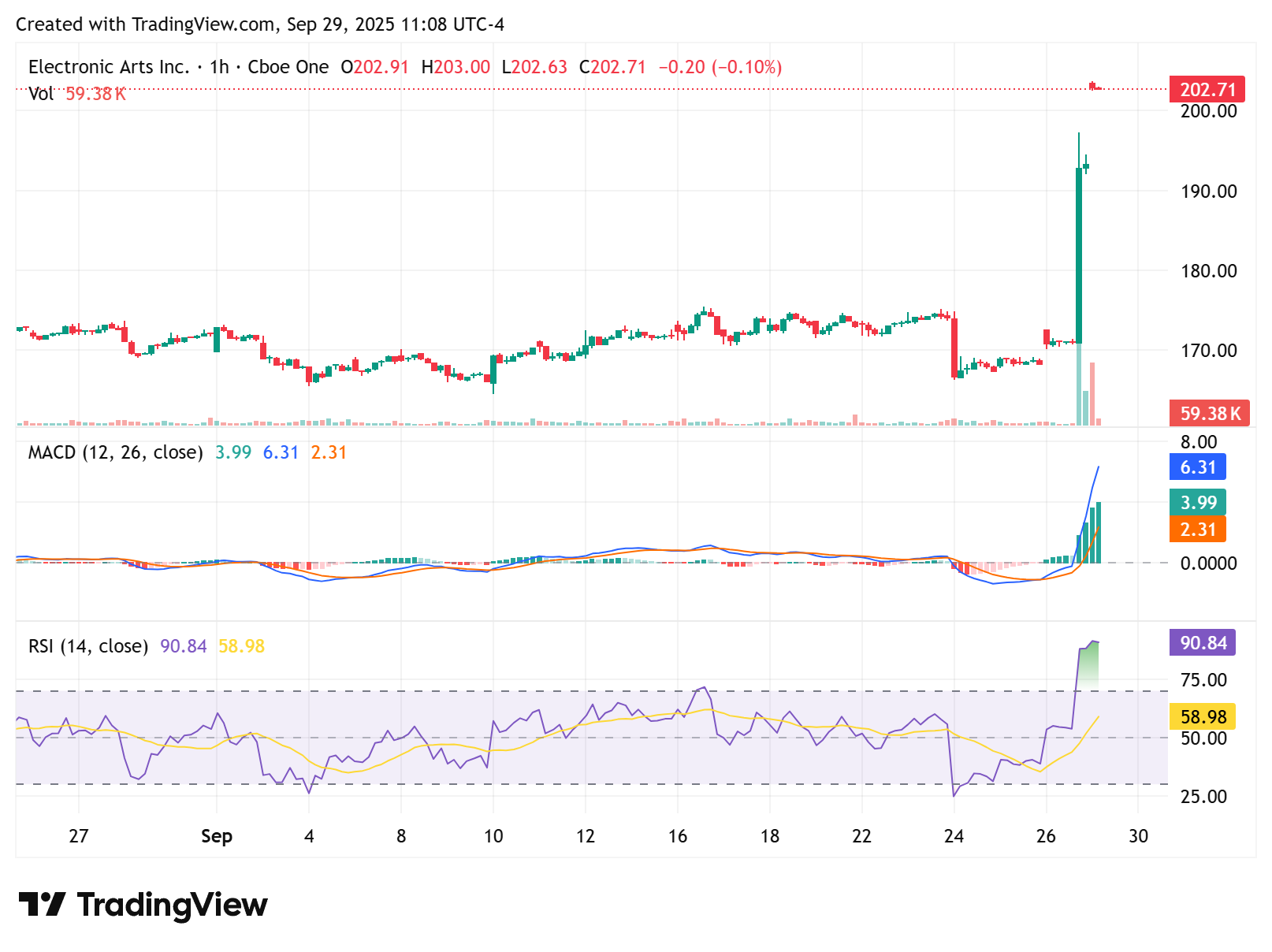
The buyout announcement triggered a vertical breakout in EA 0.00%↑’s price action, sending shares from the $170s to over $193 in a single session. They’re now in low $200s. That thrust has pushed RSI readings deep into overbought territory across multiple timeframes and left an unfilled gap below $185.
That gap is key. Arbitrage funds tend to build positions after initial euphoria fades, and deal spreads often mean revert before stabilizing. This sets up a high-probability pullback zone in the $185 to 177 range, aligning with key Fibonacci retracements (0.382 to 0.618 of the impulse move) and long-term moving average support.
Momentum/oscillators
RSI:
1h/2h: ~90 (extreme overbought)
Daily: ~80
Weekly: ~78
Expect mean-reversion attempts into the gap.
MACD: Bullish curl across 1h/2h/daily with expanding histogram, confirming thrust.
Structure & levels (Fibs/Elliott)
Wave 5 near-term: ~203 (cluster across 1h/2h/daily).
Stretch extension: ~217 (2h 1.618).
Retracement buy zones: 0.382 ~184.8, 0.5 ~180.9, 0.618 ~177.0 (all sit above the 2h 100/200-EMAs and daily 50/100-EMAs), forming a support shelf.
Weekly overhead: 1.272/1.618 extensions ~205/221 (supply above the deal price where arb supply may fade).
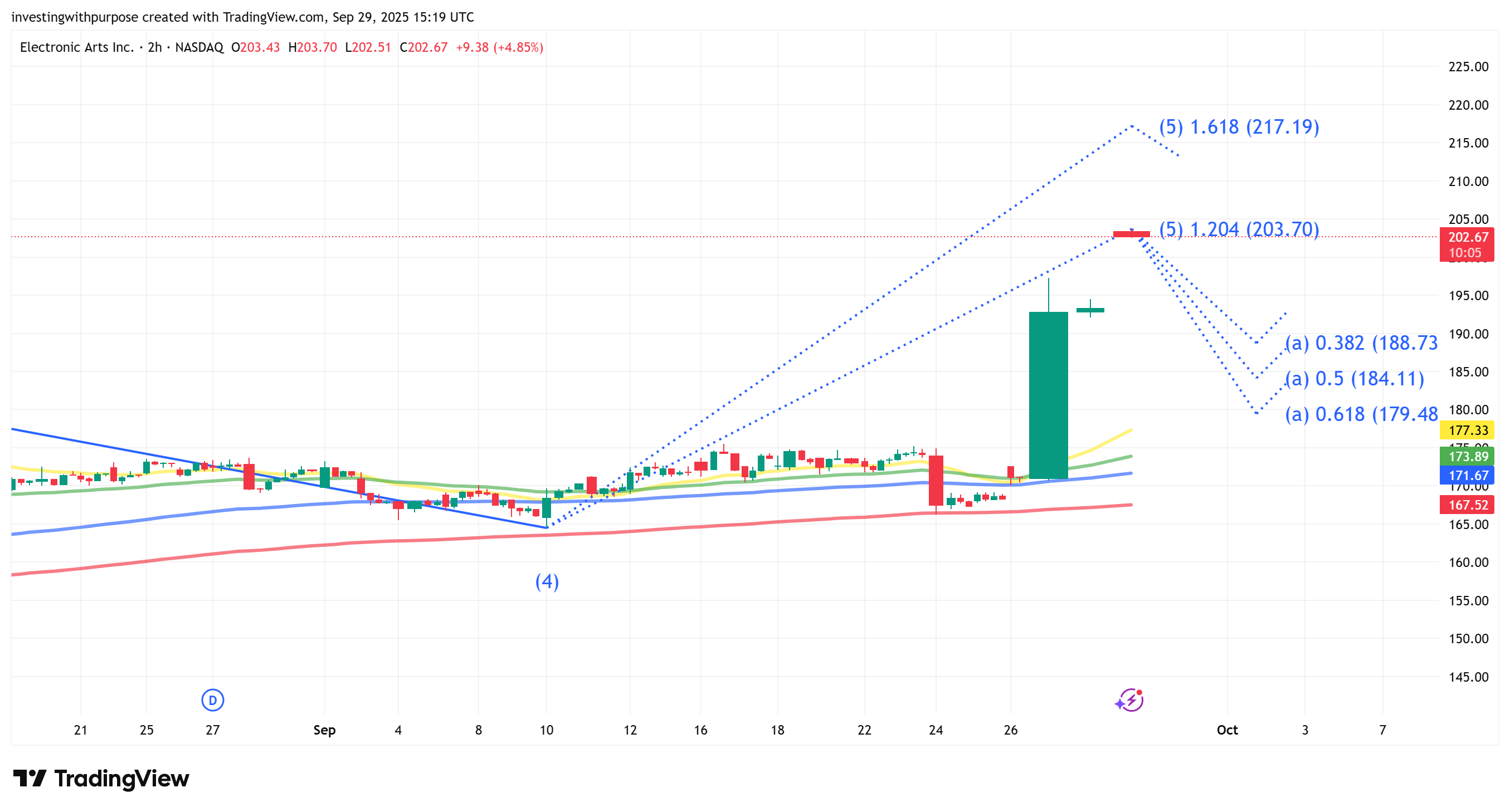
Into a cash deal, arbitrage mechanics often compress realized volatility over time around the offer (minus discount). Near-term, the gap combined with overbought RSI favors pullbacks toward 185–177 before stabilization.
Technical Conclusion
Short term: likely fade, then range as merger arbitrage capital takes control of the order book. Overshoots to ~197/205 can happen on headlines, but mean-revert is the base case toward mid-180s.
Trade / Investment Plan
From here, EA 0.00%↑ is an event-driven position, not a classic growth swing. Upside is capped by $210 cash, and risk is primarily deal break / timeline.
Base case (merger-arbitrage long):
Entry: Scale in on pullbacks $185–177 .
Target: $208–210 (deal close/late-stage spread compress).
Stop/exit:
Deal risk event (financing/regulatory stalemate, consortium change):
Exit on decisive break of $172 (2h 50-EMA area) or if spread blows out >15% on credible negative headlines.
If stock trades >$205 early on no new bid, take partials. The carry from $205 to $210 is thin versus headline risk.
Position sizing: Smaller than a normal swing; this is binary headline risk.
Alt case (no deal/competing bid):
Break risk: If $210 falls through, expect gap fill toward $170–160s (daily EMAs) before fundamentals stabilize the tape.
Bump risk: A higher bid would likely be incremental (e.g., $215–$225); upside exists but don’t count on it.
Bottom Line
EA 0.00%↑ has become an event-driven setup with capped upside and binary risk. With shares now near $203, the easy money has been made. The focus from here should be on buying controlled weakness, not chasing strength.
The sweet spot lies between $185 and $177, where technical support aligns with arbitrage entry zones. From there, the trade is simple: accumulate into weakness, ride the spread toward $210, and step aside if the deal narrative deteriorates.
The fundamentals justify the bid. The structure rewards patience. And the trade, from here, is all about discipline.
This publication is for informational and educational purposes only. It does not constitute investment advice, a recommendation, or a solicitation to buy or sell any securities. The analysis reflects the author’s views at the time of writing and may change without notice. Investors should conduct their own research and consult with a licensed financial advisor before making investment decisions.