


Patients filled roughly 3.6 million US prescriptions for Novo Nordisk’s Wegovy pill last quarter, and combined US Wegovy sales rose 21%. Novo’s total US GLP-1 sales grew 0%.
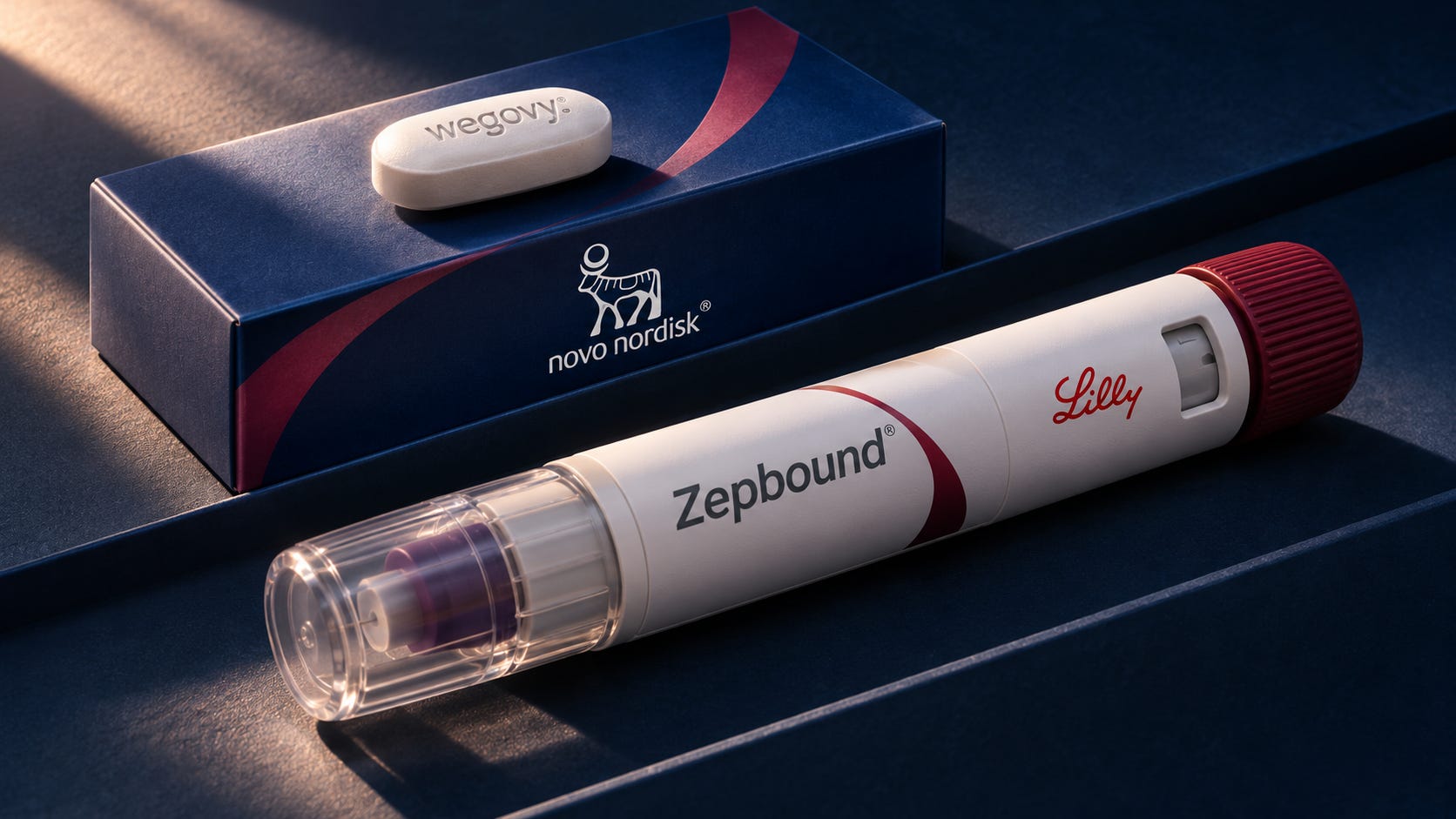
Lilly’s lead is wider than the headline growth rates suggest. It’s also priced.
Eli Lilly reported on 29 October, Novo Nordisk on 4 November. Lilly’s revenue grew 39% as reported to $24.4bn; Novo’s adjusted sales grew 4% at constant rates to DKK 79.2bn, about $12.2bn.
My conclusion first. Lilly is the better business by a distance, but on my numbers it returns about 9% a year to the end of 2028 against a 39% downside case. That isn’t enough, so I’d want about $1,320 rather than Friday’s $1,354. Novo is cheaper than it looks and still not cheap enough: $37 to $39, depending on February’s guidance. Neither is a buy today.
GLP-1 drugs copy a gut hormone that blunts appetite and lowers blood sugar, so one molecule sells into both obesity and diabetes, and a price war in one shows up in the other.
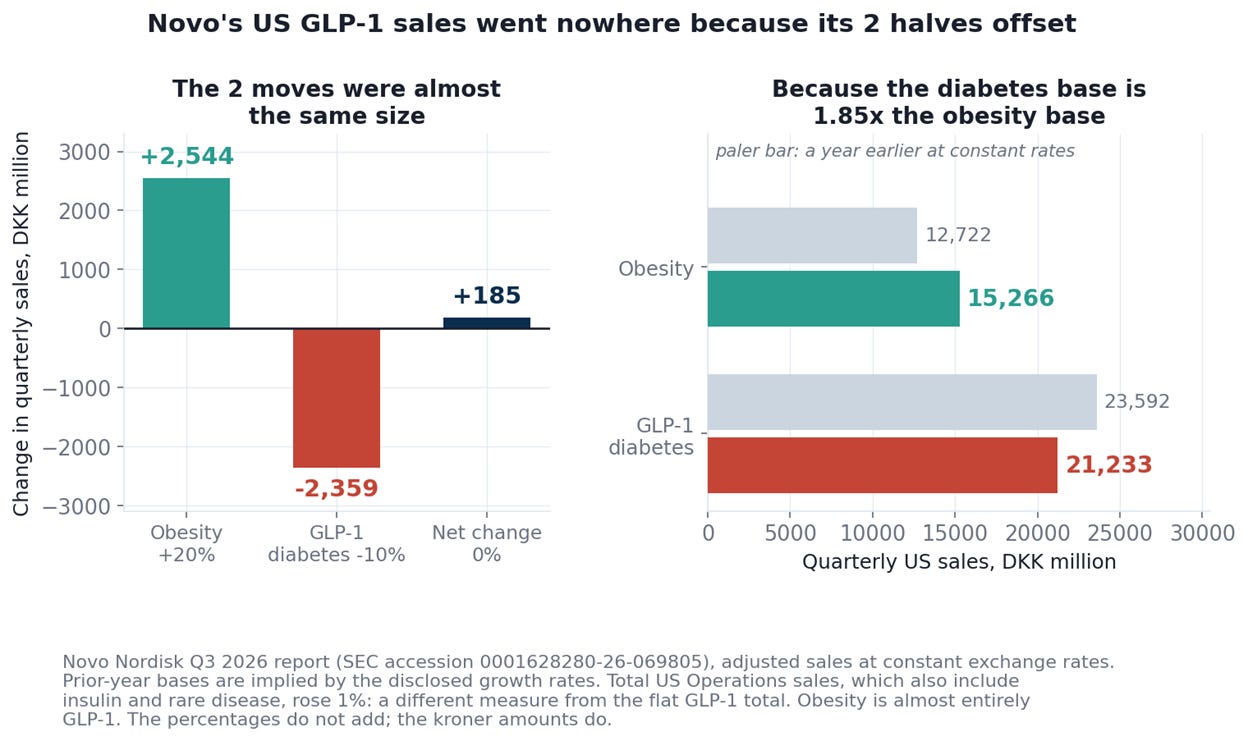
The Answer Comes In 2 Halves
Novo’s US obesity sales grew 20% to DKK 15.3bn. Its US GLP-1 diabetes sales fell 10% to DKK 21.2bn. In kroner those moves were worth plus 2.5bn and minus 2.4bn, so they cancelled and total US GLP-1 sales came out flat. The diabetes base is about 1.85× the obesity base, so a tenth off the larger erases a fifth added to the smaller. Total US sales, which also carry insulin and rare disease, rose 1%.
The 2 halves disappoint for opposite reasons. In obesity, volumes rose and realized prices fell: Wegovy injectable sales dropped 13% while the pill added DKK 4,178m, leaving combined Wegovy up 21%. In diabetes, Novo blames lower volumes and wholesaler inventory movements, with prices slightly positive.
So Novo is losing price where it’s growing and losing volume where it’s shrinking. Different problems, different fixes, and only the first is about the pill. Outside the US the same products did well: Wegovy injectable up 16%, combined Wegovy up 31%.
2 cautions on the pill. Its US sales divided by prescriptions give roughly $179, a rough sales-per-prescription figure rather than a realized price, since it mixes doses, channels and lengths. And from 1 January Novo cuts Wegovy’s US list price to $675, about 50% lower, with Ozempic down 35%. That’s wholesale list, not what Novo collects, and self-pay patients already pay $149 to $299 a month, so it won’t pass through one for one.
Lilly Has The Same Price Problem
Lilly’s volumes rose 53% while realized prices fell 15%. Outside the US, volume up 76% and price down 29%, mostly because Mounjaro joined China’s reimbursement list. In the US, reported prices fell 7%, and finance chief Lucas Montarce said that excluding a favorable rebate adjustment, “U.S. price declined 10%.”
The pressure is industry-wide; Lilly has enough volume to bury it.
Here’s the comparison that supports the title, holding geography and indication fixed. US Zepbound sales grew 48% to $5.3bn. Novo’s combined US Wegovy sales grew 21%, and its whole US obesity business was about $2.4bn. Lilly’s US obesity franchise is more than twice Novo’s and growing more than twice as fast. Both are US-only, so currency barely matters, though Lilly’s figure is reported and Novo’s at constant rates.
Treat that 39% carefully. It’s reported growth against Novo’s 4% at constant currency, and both quarters carried one-off items. Adjusting for them gives about 36%.
What Lilly Actually Earns
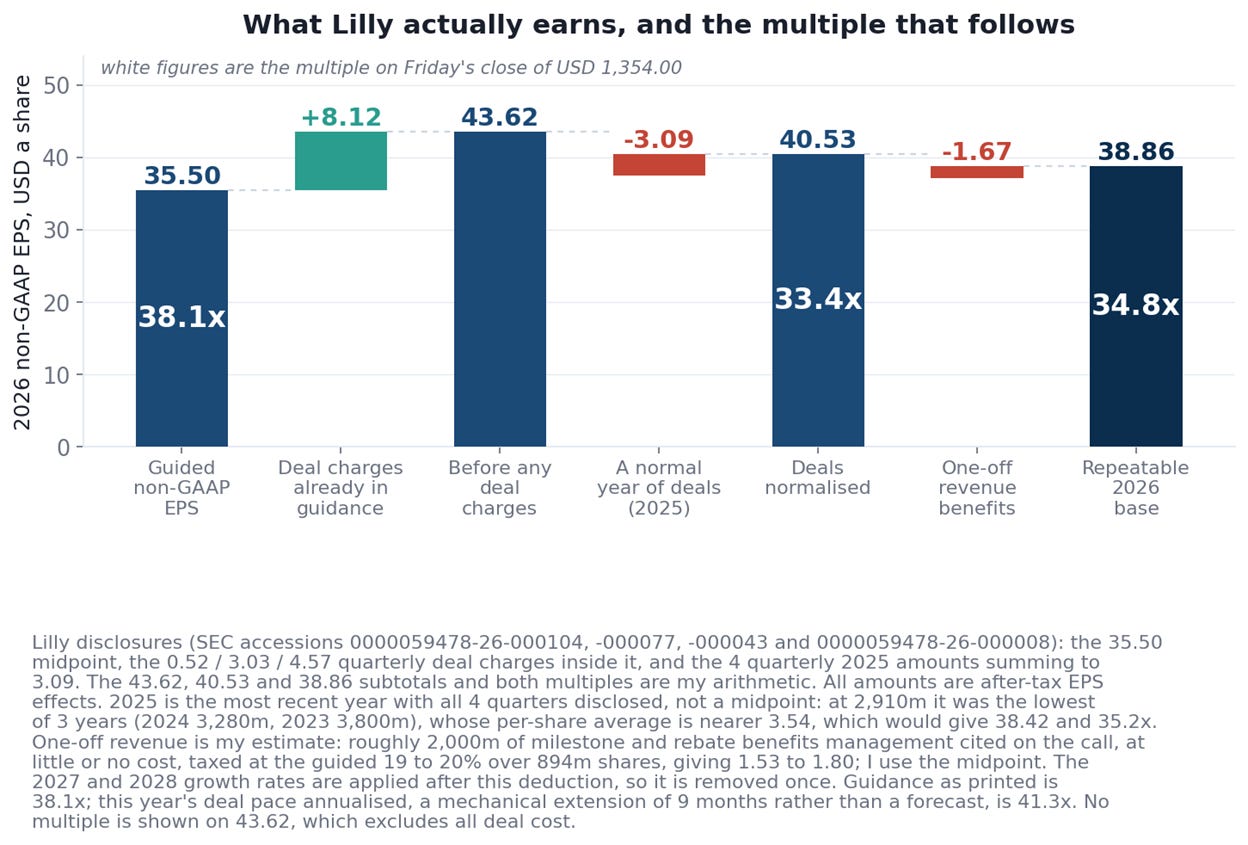
Lilly guides to non-GAAP earnings of $35.00 to $36.00 a share.
That carries a cost quick comparisons miss. When Lilly buys a drug candidate that isn’t yet a business, accounting rules make it expense the payment at once rather than spread it over the asset’s life. Lilly charged $0.52 a share for such deals in the first quarter, $3.03 in the second and $4.57 in the third. All $8.12 sits inside the guidance; only spending after 30 September is excluded.
The same disclosure makes the quarter look better than its headline. Lilly cut the EPS guidance midpoint by $0.50, but says that’s a $4.07 operational increase offset by the $4.57 charge. The business raised its outlook; the deals took it back.
Add the $8.12 back and Lilly earns $43.62 before deal charges. It does deals every year, so charging a normal year beats charging none. I use 2025, the most recent complete year, at $3.09 a share. That flatters the result: its $2,910m was the lowest of the last 3 years, below 2024’s $3,280m and 2023’s $3,800m, which put the 3-year average nearer $3.54.
Then the one-off revenue. Lilly’s guidance says the first 3 quarters gained from sales-based milestones and rebate-estimate adjustments, without quantifying them; management put it near $2bn on the call. Those items carry almost no cost, so at the guided 19% to 20% tax rate and 894m shares they’re worth $1.53 to $1.80 a share. I use $1.67.
Deduct a normal deal year and the one-off revenue, and Lilly’s repeatable 2026 earning power is about $38.86. At Friday’s close of $1,354.00 that’s 34.8×.
The alternatives bracket it: guidance as printed, 38.1×; one-offs left in, 33.4×; the 3-year deal average too, 35.2×; this year’s deal pace mechanically annualized, 41.3×.
Where The Cash Went
Over the 9 months Lilly turned $27.4bn of operating cash flow into $19.0bn after capital spending. Novo turned $18.8bn into $13.0bn.
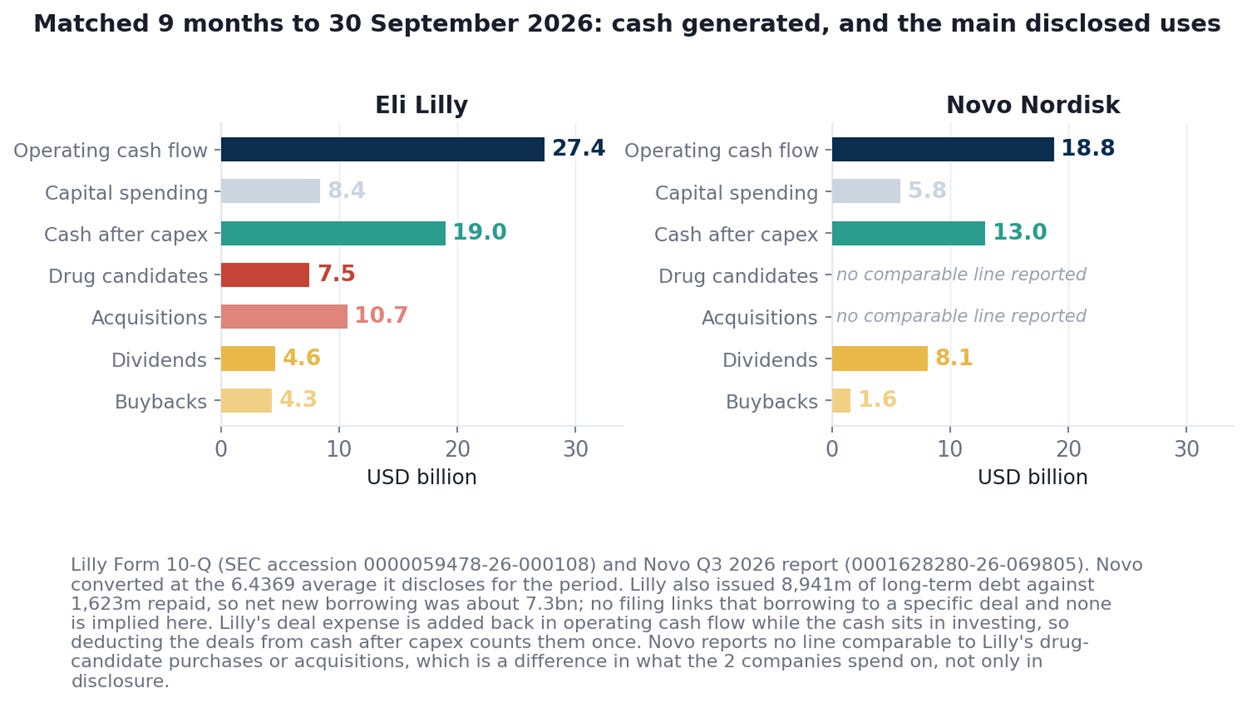
Lilly then put $7.5bn into drug candidates and $10.7bn into acquisitions, paid $4.6bn of dividends, bought back $4.3bn and borrowed a net $7.3bn long-term, which I can’t tie to any one deal. Novo paid $8.1bn of dividends, bought back $1.6bn, and reports no comparable deal line.
Patents Are Less Dramatic Than They Look
Novo’s filing puts US compound patent expiry for Ozempic, Rybelsus and Wegovy at 2032, and the US was about 60% of Novo’s global GLP-1 sales last quarter, obesity and GLP-1 diabetes combined. The bulk of the franchise is protected for years.
The exposure sits outside it, and it’s live rather than looming. India’s patent expired in March and generics followed, with Novo suing on formulation patents. Canada has lost exclusivity, where Novo says prices fell but volumes held. Brazil cleared a semaglutide pen in May and a true generic in August, though products still need pricing clearance.
Novo’s Fourth Quarter
Novo guides 2026 adjusted operating profit to between minus 2% and plus 2% at constant rates, with kroner growth in line.
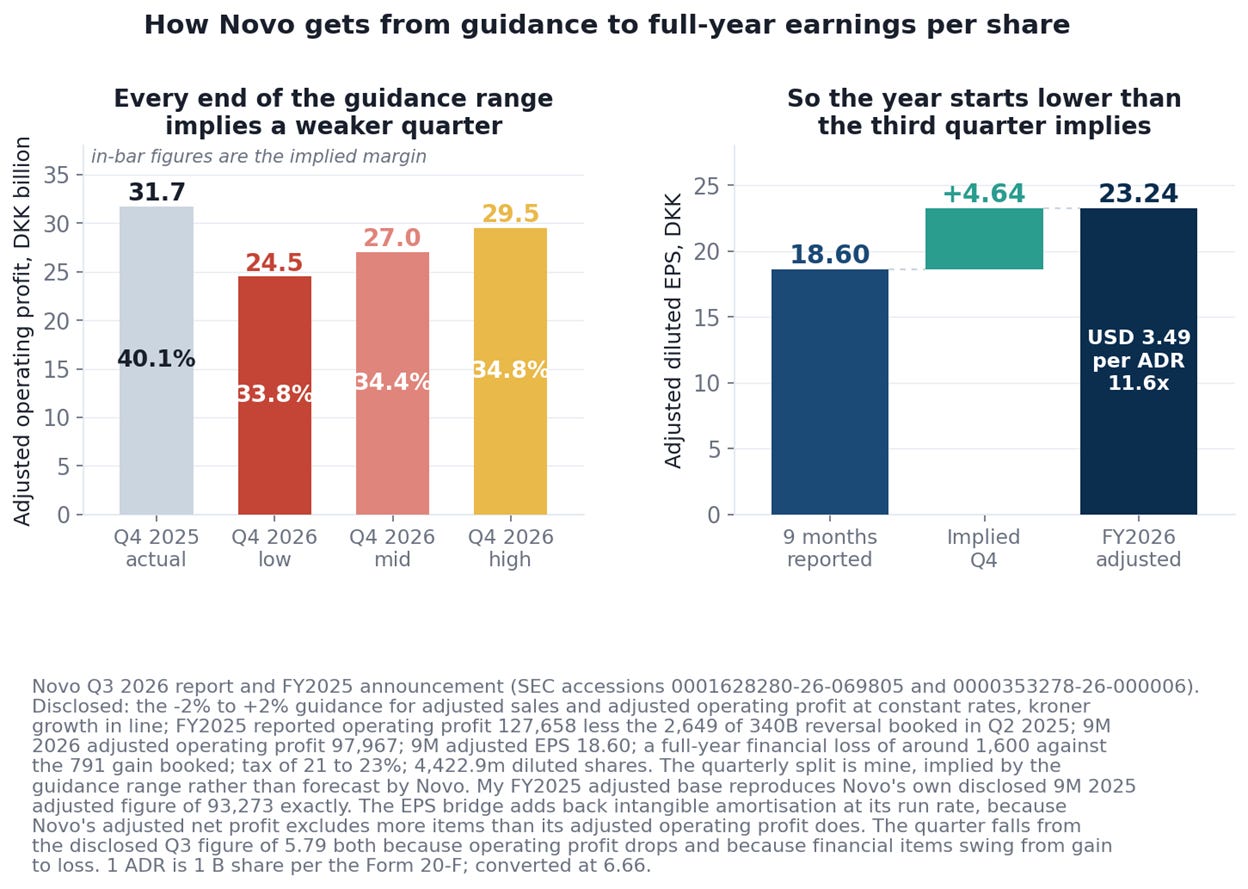
Apply that to 2025’s DKK 125.0bn, deduct the DKK 98.0bn already reported, and the range implies DKK 24.5bn to 29.5bn in the fourth quarter against DKK 31.7bn a year ago. At the midpoint, implied sales of DKK 78.7bn give a 34.4% margin against 40.1%. Every end of the range implies a decline, and the quarterly split is my arithmetic.
That also fixes the starting earnings figure. Novo has reported DKK 18.60 of adjusted EPS in 9 months, and the midpoint quarter, run through the company’s own modelling assumptions, adds DKK 4.64 for DKK 23.24 on the year. Each ADR is 1 B share, so at 6.66 to the dollar that’s $3.49 and Novo trades at 11.6×. The quarter falls from DKK 5.79 because operating profit drops and financial items swing from gain to loss; annualised, it runs 20% below the full year, which is what 2027 must recover from.
