The industrial market is no longer grading demand; it’s grading conversion. GE Vernova’s blowout order quarter met an 8.7% drop because margins missed. Honeywell’s first standalone print earned a 5.7% rally on 100 basis points of margin expansion. Here’s the rubric, and the levels where it gets tested.

Backlogs are promises. Margins are proof.
The season’s 2 most consequential industrial reports landed a day apart, and the market graded them in opposite directions. GE Vernova, the gas turbine and grid equipment maker at the center of the AI power buildout, reported on Wednesday, July 22: the best demand quarter of its public life, and the stock closed down 8.7% at $985.03 before clawing back 4.7% to $1,031.19 on Thursday. Honeywell reported on Thursday morning, July 23, its first print since spinning off Aerospace: 4% organic growth, wider margins, and a 5.7% jump to $246.27. Prices below are based on the July 23, 2026 close; results are from both companies’ releases and earnings calls.
Key Takeaways
GE Vernova’s demand evidence was overwhelming: revenue of $11.1B grew 22%, orders of $24.2B rose 88% organically, and backlog hit $176B, up $13B in a quarter.
The stock fell anyway because conversion disappointed: adjusted EPS of $2.47 missed the $3.04 consensus, EBITDA margin of 11.3% came in below the roughly 11.9% expected, and the Wind segment lost $275M.
Free cash flow was the quarter’s defining number: $5.1B versus $0.2B a year ago, with the full-year guide raised to $11.5 to $12.5B, funded partly by customer deposits reserving turbine slots into 2030.
Honeywell’s first standalone quarter delivered 4% organic sales growth, 16% organic orders growth, segment margin of 19% (up 100 basis points), and adjusted EPS of $1.95, up 10%; the full-year adjusted EPS guide rose to $8.05 to $8.35.
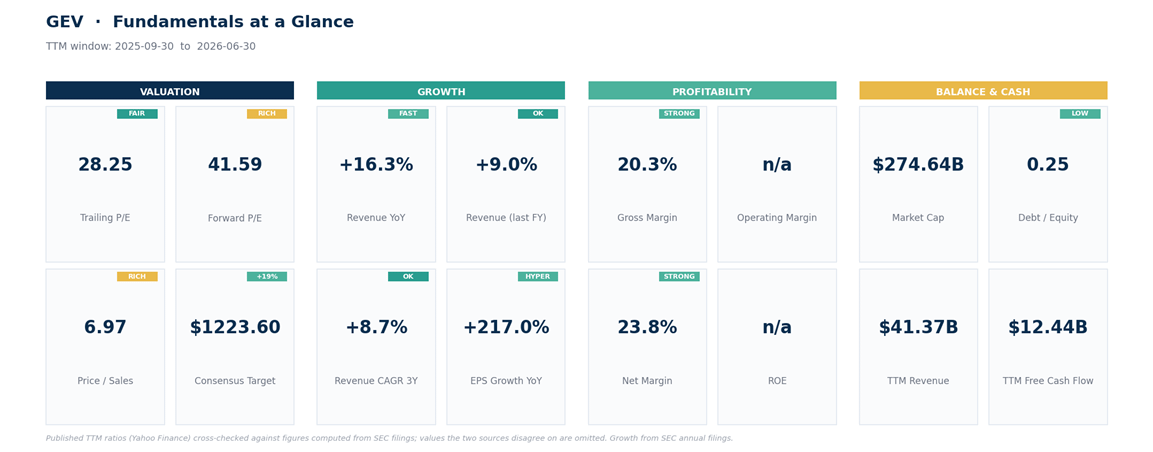
Both trailing P/E ratios are broken: GE Vernova’s 28x is deflated by one-time gains (the cleaner multiple is 41.6x forward); Honeywell’s 18.6x describes a conglomerate that no longer exists (the standalone stock trades near 30x this year’s guide).
The frameworks: GE Vernova support 975 to 990, invalidation 950, repair 1080. Honeywell pullback zone 233 to 238, stop 223, breakout 251.
GE Vernova: The Order Machine and the Margin Bill
Start with what went right, because most of it did. Revenue of $11.1B rose 22%, the fastest growth of the company’s short public life. Orders of $24.2B nearly doubled from a year ago, a book-to-bill above 2, meaning the backlog is growing twice as fast as the business can work it off. Total backlog reached $176B, up $13B in a single quarter.
The gas equipment queue grew from 100 gigawatts to 116, with management targeting more than 125 by year-end, and factory slots are being reserved years out, some into 2030, with customers paying deposits to hold them. Those deposits are why free cash flow printed $5.1B in a quarter that produced less than $0.7B of net income, and why the full-year cash guide jumped by $5B at the midpoint.
The cash is real but front-loaded, though: it arrives before the turbines are built and delivered, so the cash guide runs ahead of current earnings power. Revenue guidance rose to $45.5 to $46.5B as well.
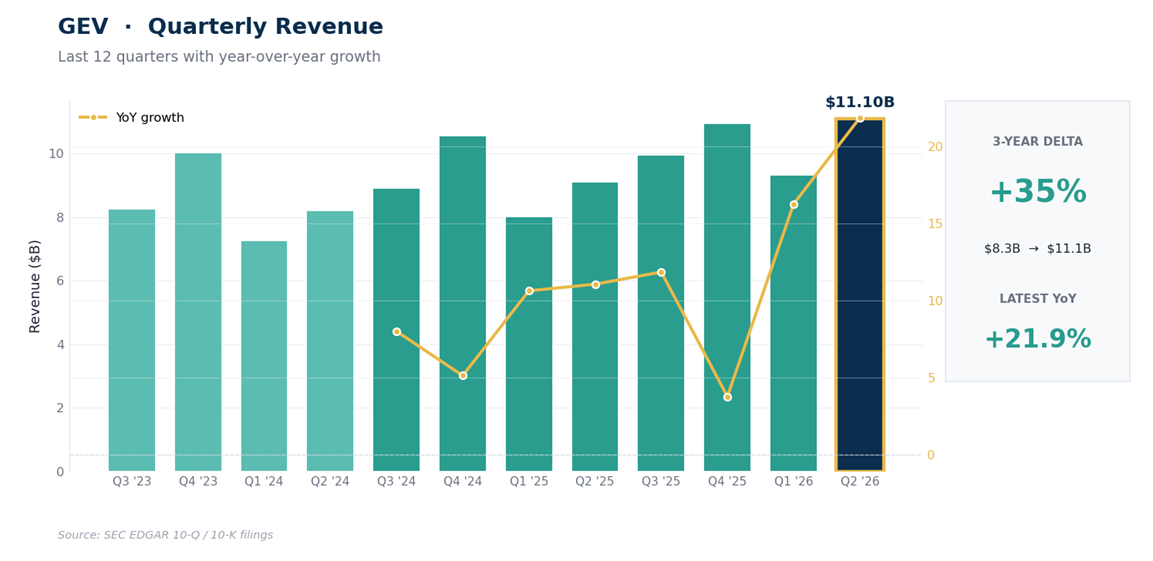
The market sold the report anyway, and the reason sits below the revenue line. Adjusted EPS of $2.47 missed the $3.04 consensus by 19%. EBITDA margin came in at 11.3% against expectations near 11.9%. And Wind lost $275M at a negative 13.6% margin, with a full-year loss guided around $400M on soft US onshore orders. Power and Electrification both run EBITDA margins near 19% and carry the model; Wind burns part of what they earn.
An 8.7% single-day repricing on numbers like these isn’t the market doubting demand. It’s the market noticing that at this valuation, demand was already assumed, leaving margin execution as the variable that moves the price.
Valuation is where the honesty matters most. The trailing P/E of 28x looks almost reasonable but is mostly an accounting artifact: trailing earnings include a $4B pre-tax gain booked when the company took control of Prolec GE plus a $0.3B gain on selling its Proficy software business. Set those gains aside and the cleaner anchor is the forward multiple, 41.6x, for a company guiding to a 12% to 14% EBITDA margin.
That’s a premium that assumes the margin story catches up to the order story. This quarter it didn’t, and the analyst consensus near $1,224 tells you the Street still believes it will.
Honeywell: The First Print of a Much Simpler Company
What changed is simple: Honeywell is now a standalone automation company. Aerospace separated on June 29 and trades as HONA, and what remains, renamed Honeywell Technologies, is a pure-play automation business with roughly $20B of annual sales in 3 segments. The rest of the portfolio surgery, a 1-for-2 reverse split to about 317M shares, a partial Quantinuum IPO with 47% retained, the Johnson Matthey catalyst acquisition closed July 17, and 2 divestitures closing in early August, compresses into a single point: the structure is nearly done changing.
Why the numbers are messy is just as simple: the as-filed quarter still contains Aerospace through the spin date. That’s why the consolidated release shows $9.7B of sales, up 4%, and why every trailing ratio you’ll see quoted, the 18.6x P/E included, describes a company that no longer exists. It’s also why our usual trailing-fundamentals summary is missing for Honeywell this time: the figures it would display are the old conglomerate’s.
The standalone numbers are the ones that matter, and they’re quietly strong. Organic sales grew 4%, but organic orders grew 16%, and the backlog is 9% larger than a year ago. Segment margin expanded 100 basis points to 19%, and adjusted EPS of $1.95 rose 10%. Building Automation was the star: 9% organic growth with orders up 30%, led by data centers and healthcare, at a 27.1% margin. Industrial Automation grew 4% with margins up 90 basis points. Process Automation dipped 1% on catalyst volumes, but its orders rose 24% and management says its proprietary LNG equipment is sold out for 3 years. Software annual recurring revenue is growing 15%. All of that pushed the full-year adjusted EPS guide to $8.05 to $8.35 from $7.90 to $8.30, on 3% to 4% organic growth.
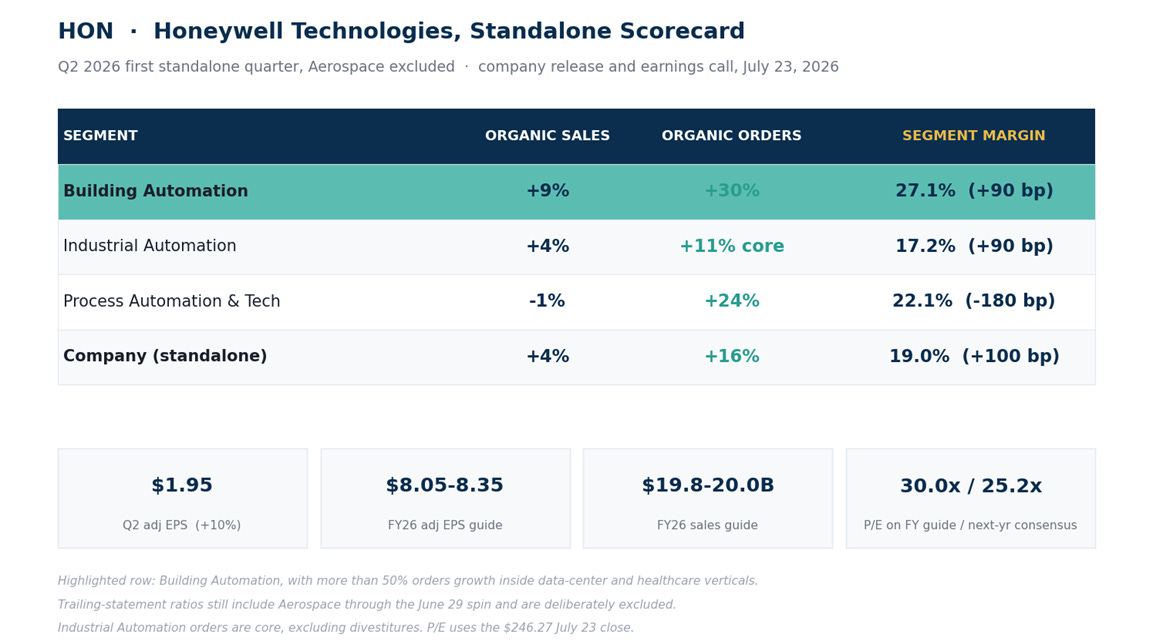
The price of the new clarity is the multiple. At $246.27, Honeywell trades at 30x the $8.20 midpoint of this year’s standalone guide, and about 25x consensus for next year. The diversified predecessor rarely commanded anything close to that. What justifies the price from here: organic growth holding in the mid-single digits, margins expanding toward the above-22% exit rate management guided, the 16% order growth converting to revenue, and software staying above the group’s pace. Miss those and 30x has room to compress.
What the 2 Reactions Say Together
Put the prints side by side and the market’s grading rubric is visible. GE Vernova brought the best demand quarter of the industrial season and lost $94 a share because margins missed. Honeywell brought 4% growth and gained $13 because margins expanded and the structure got simpler. The lesson isn’t that one company is better. It’s that for premium-valued industrials exposed to power, automation, and data-center spending, strong demand is increasingly the starting assumption, not the final proof point. Order books no longer earn the multiple on their own. Conversion does.
The Frameworks
One possible framework, not a promise.
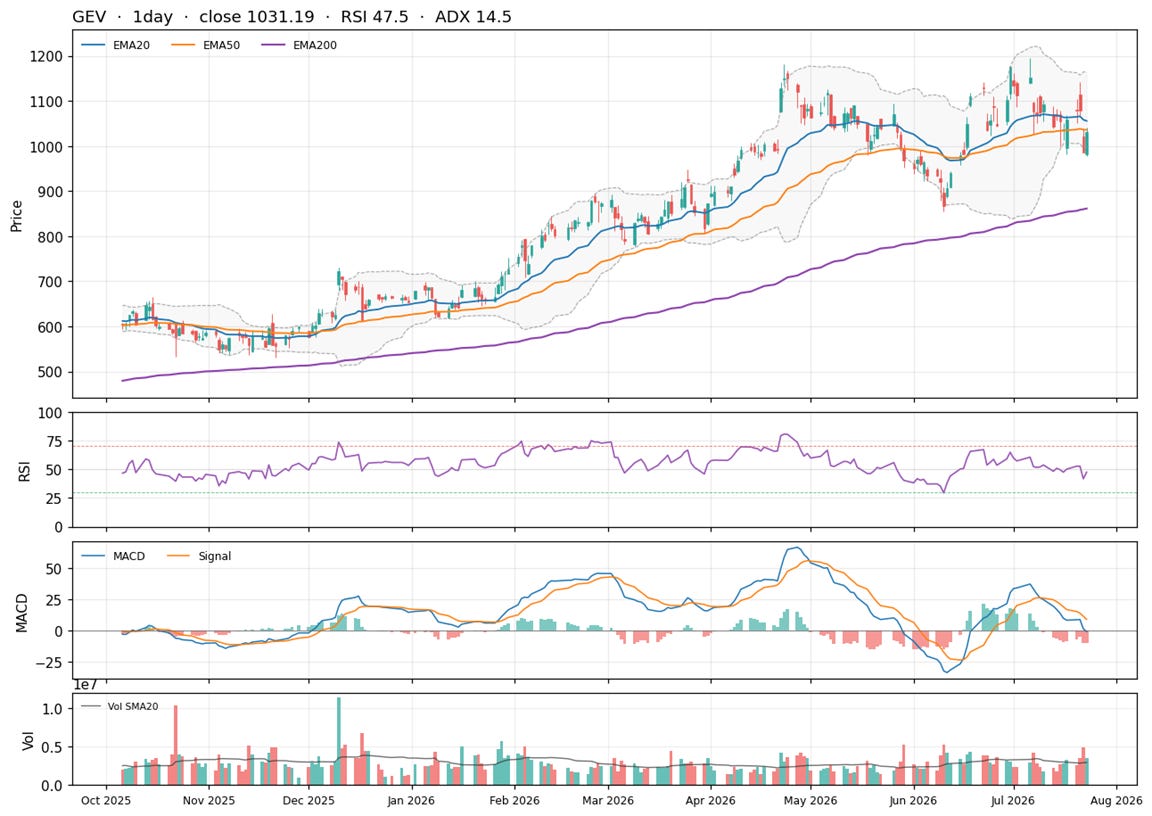
GE Vernova, daily timeframe, all triggers meaning daily closes. The stock sits between its post-earnings floor and its pre-earnings shelf, with momentum neutral (RSI near 48) and an average daily range near 6% of the price, so every level here needs gap room.