


A jobs shock revived talk of a rate hike, the dollar is at its highest in more than a year, and real yields are climbing, the one thing that reliably hurts metals that pay no income. Gold has erased its 2026 gains; silver has been cut nearly in half from its high. Both funds are now oversold. Here are the levels that matter, in fund and in ounce terms.
Higher-for-longer is the metals’ kryptonite.
Gold and silver are supposed to be the assets you hide in when things get scary. Lately they’ve been the trade you flee. Gold has fallen back to about $4,115 an ounce, dragging the big gold fund, GLD, to roughly $377, while silver has dropped to near $62, taking the silver fund, SLV, down to about $56. The trigger isn’t a collapse in the case for metals, it’s the Federal Reserve.
A blowout jobs report killed hopes for rate cuts, the Fed’s own projections now point to higher rates later this year, and the dollar has surged to a 13-month high. That’s a brutal mix for assets that pay no income. Both funds are stretched to the downside and approaching oversold, where bounces start, but the force that broke them hasn’t turned.
Key Takeaways
Gold has fallen to about $4,115 an ounce (GLD near $377), and silver to about $62 (SLV near $56). Gold has given back its 2026 gains; silver is down nearly 50% from its 52-week high.
It’s a rate story, not a gold story. A strong jobs report killed rate-cut hopes; the Fed’s own projections now point to higher rates this year, and futures put the odds of a hike by year-end near 70%. Rising real yields, the return on bonds after inflation, are the main enemy of assets that pay no income.
Silver fell harder, as it usually does. It’s part industrial metal and far more volatile: SLV is off about 49% from its high while GLD is down about 26%.
The gold-silver ratio has jumped to about 66 from 55 in May, meaning silver has cheapened relative to gold, a level that has often come before silver catching up once metals recover.
Both funds are stretched to the downside, with daily momentum near oversold, and sit below every major moving average. That sets up a bounce, but stretched-in-a-downtrend isn’t a bottom; the Fed is still the swing factor.
Start with what these funds actually are.
What GLD and SLV Are
GLD, the SPDR Gold Shares fund, is the simplest way to own gold without storing bars yourself. It holds physical gold in a vault, and each share represents a slice, currently just under a tenth of an ounce, so the share price runs near a tenth of the gold price. With gold near $4,115, GLD trades near $377. SLV, the iShares Silver Trust, does the same for silver: each share tracks just under a full ounce, so with silver near $62, SLV trades near $56.
Both charge a small annual fee (0.40% for GLD, 0.50% for SLV) and pay no dividend, because metal generates no income. One practical wrinkle for US investors: in a taxable account, long-term gains on these funds may fall under “collectibles” rules, taxed at a maximum federal rate of 28%, higher than the rate on stocks, worth knowing before you hold them.
Why They’re Falling: The Rate Story
The metals didn’t break on their own merits, they broke on rates. A much stronger-than-expected jobs report, with payrolls roughly double what economists penciled in, convinced markets the Fed is done cutting and may even hike again. The Fed held its benchmark at 3.50% to 3.75% in June, but its own projections now point to higher rates this year, and futures put the odds of a hike by year-end near 70%. Here’s the mechanism in plain terms.
Gold and silver pay no interest, so when “real” yields, what bonds pay after subtracting inflation, rise, the opportunity cost of holding a lump of metal climbs, and money rotates into bonds and the dollar instead. The dollar just hit a 13-month high, another headwind, because metals are priced in dollars and a stronger dollar makes them costlier everywhere else. Inflation alone doesn’t save gold if real yields are rising. And with the crisis bid fading at the margin, easing US-Iran tensions have stripped away one of the few supports left, rates have taken back control of the trade.
Why Silver Fell Harder
Gold and silver rhyme, but they aren’t the same trade. Gold is mostly a monetary asset, a store of value. Silver is a hybrid, part safe haven and part industrial input, with roughly half its demand coming from solar panels, electronics, and manufacturing. That industrial side makes silver more economically sensitive and far more volatile: it tends to move like gold with the volume turned up, rising more in rallies and falling more in selloffs.
This was the falling-more kind. SLV is down about 49% from its 52-week high, while GLD has fallen about 26%. The gauge that captures the relationship is the gold-silver ratio, the gold price divided by the silver price, or how many ounces of silver it takes to buy one ounce of gold. It’s jumped to about 66, from 55 in May. That doesn’t guarantee silver rebounds first, but it does show silver has gotten cheap relative to gold, and when the complex stabilizes, silver has historically had more catch-up room.
The Technical Picture
Both funds are stretched to the downside. GLD, near $377 (gold about $4,115), sits below its 20-day, 50-day, and 200-day averages, with its daily relative strength index, a 0-to-100 momentum gauge where under 30 is oversold, down to 33, just shy of that line.
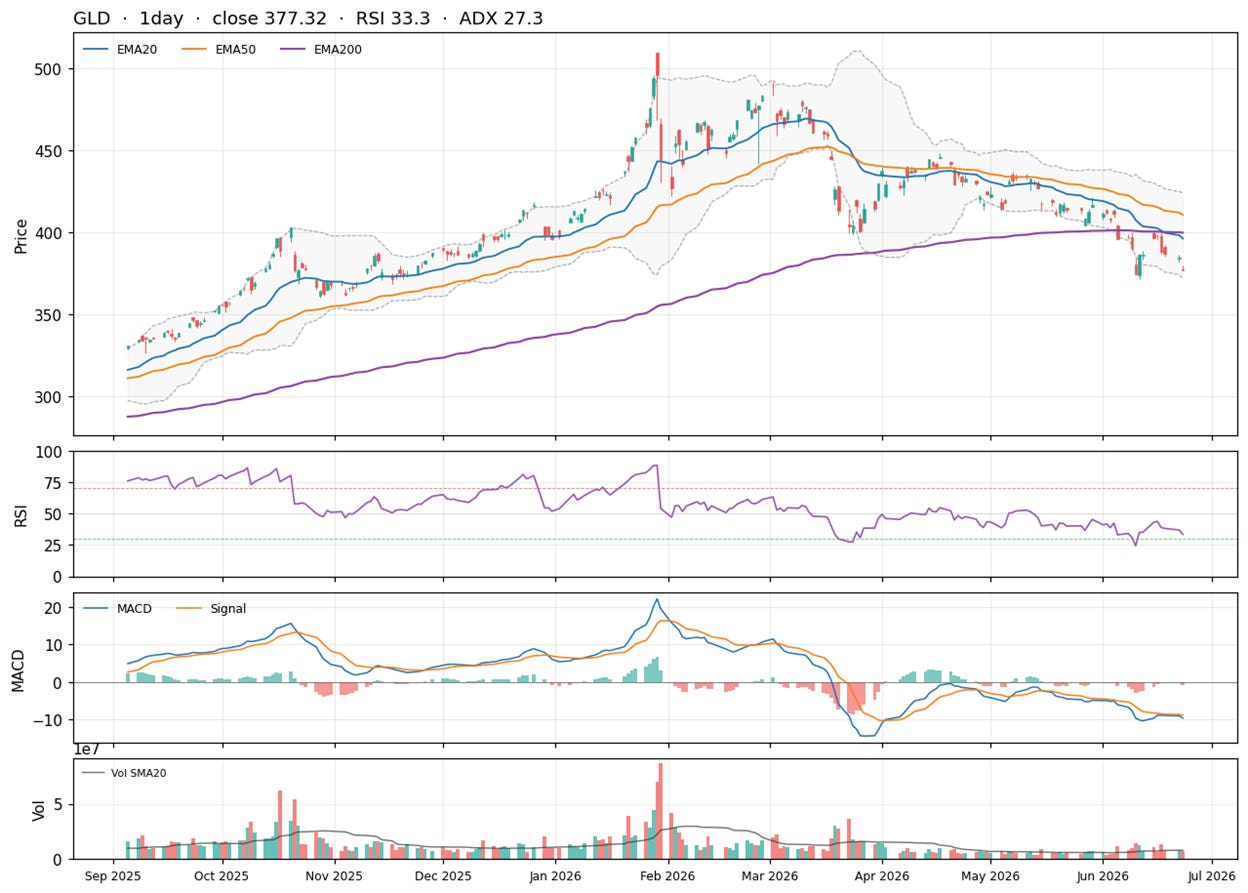
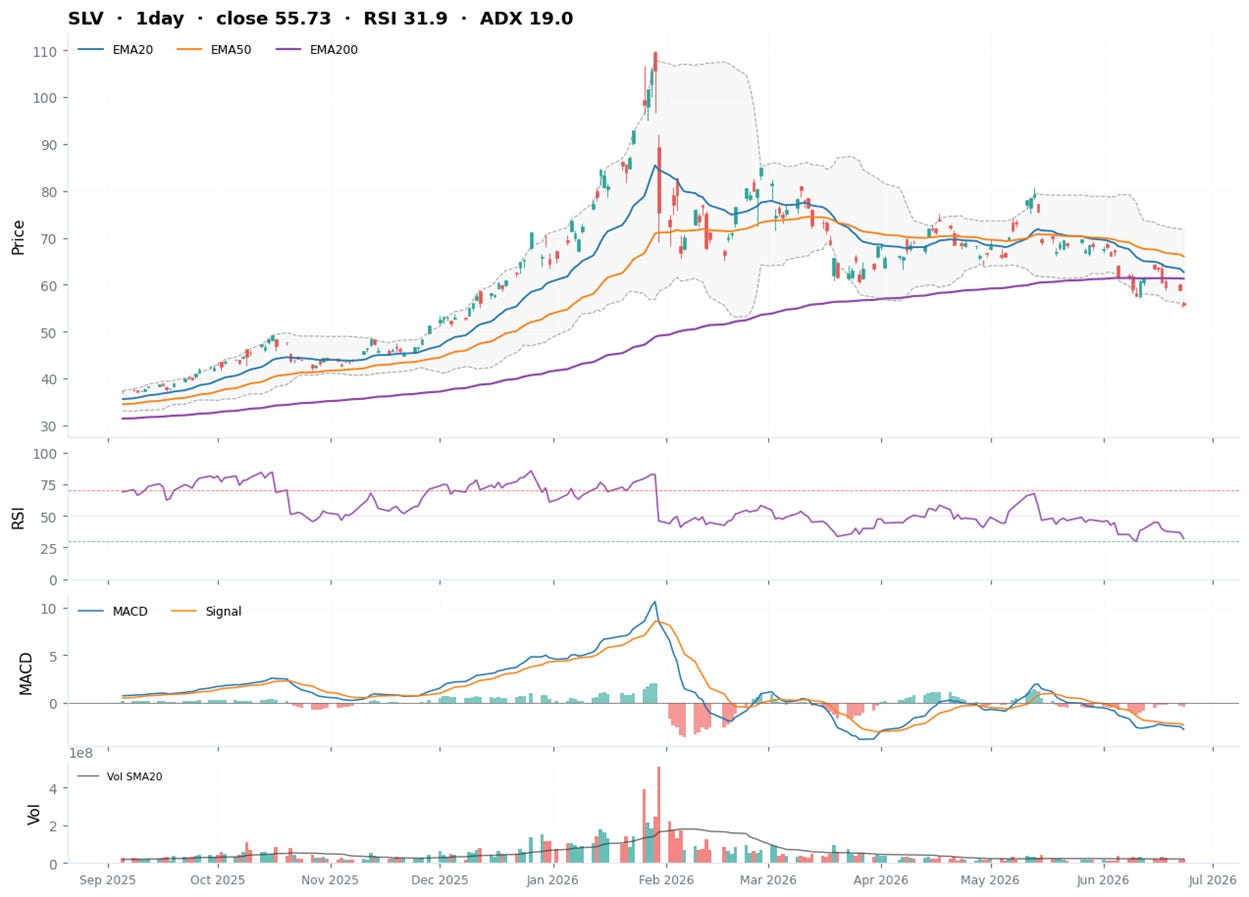
SLV, near $56 (silver about $62), tells the same story, below all its major averages with a momentum reading of 32, also near oversold. Readings this low often precede a bounce, but oversold is a condition, not a catalyst, and a bounce inside a downtrend isn’t the same as a bottom. Until these funds reclaim their falling averages, rallies are for trading, not investing.
Levels I’m Watching
These are levels to watch, in both share and ounce terms, not instructions, based on prices as of the June 23 close. Be clear about what this is: a watchlist for a bounce inside a downtrend, not a breakout setup, with both funds below their major averages and the Fed still the swing factor.
