


In this article, we analyze both the price of GLD 0.00%↑, the SPDR Gold Shares ETF, and the underlying price of gold to provide a complete view of the market.
GLD’s rally from the mid-300s (roughly $3,800 gold) into the 500 area (around $5,400 gold) was not subtle. It was driven by a clear combination of inflation persistence, geopolitical instability, and aggressive central bank accumulation. That phase rewarded early positioning.
Now the environment is different.
The trend has matured. Momentum has cooled. Price is no longer expanding, it is compressing. The question is no longer whether gold is in a bull market. It is whether this is a pause before continuation or the beginning of a deeper reset.
The distinction matters.
Because this phase is where positioning either compounds or gets trapped.

Key Takeaways
Long term structure remains bullish as long as 422 (Gold ≈ $4,600) holds
Gold is in a macro-supported consolidation, not a breakdown
Real rates and geopolitics are the dominant drivers, not short term sentiment
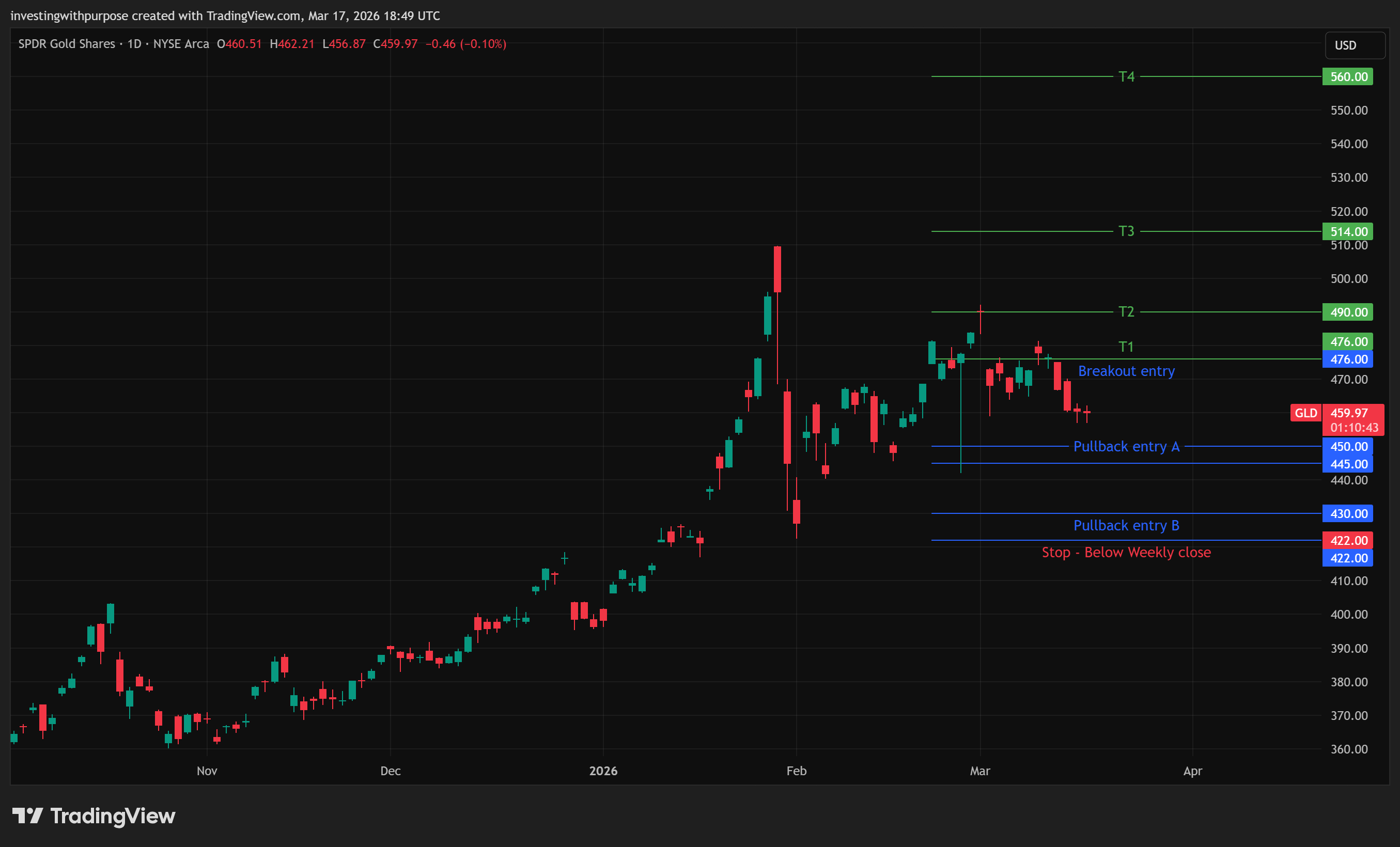
Price is compressing between 450 (Gold ≈ $4,900) support and 470 (Gold ≈ $5,120) resistance
A break above 476 (Gold ≈ $5,190) opens continuation toward 500 (Gold ≈ $5,450) to 560 (Gold ≈ $6,100)
A loss of 445 (Gold ≈ $4,850) increases the probability of a deeper reset toward 430 (Gold ≈ $4,680) to 422 (Gold ≈ $4,600)
Macro Drivers, Demand, and Structural Positioning
Gold does not have earnings. It has forces.
And right now, those forces remain firmly in its favor.
The most important driver is still real interest rates. Gold tends to perform when real yields are stable or falling. What makes the current environment unusual is that inflation is being pushed higher by energy and geopolitical disruptions, while central banks are keeping nominal rates elevated.
That creates tension.
Rates are high, but inflation is sticky. The result is that real rates are not tightening enough to pressure gold meaningfully. That is why price is holding rather than breaking down.
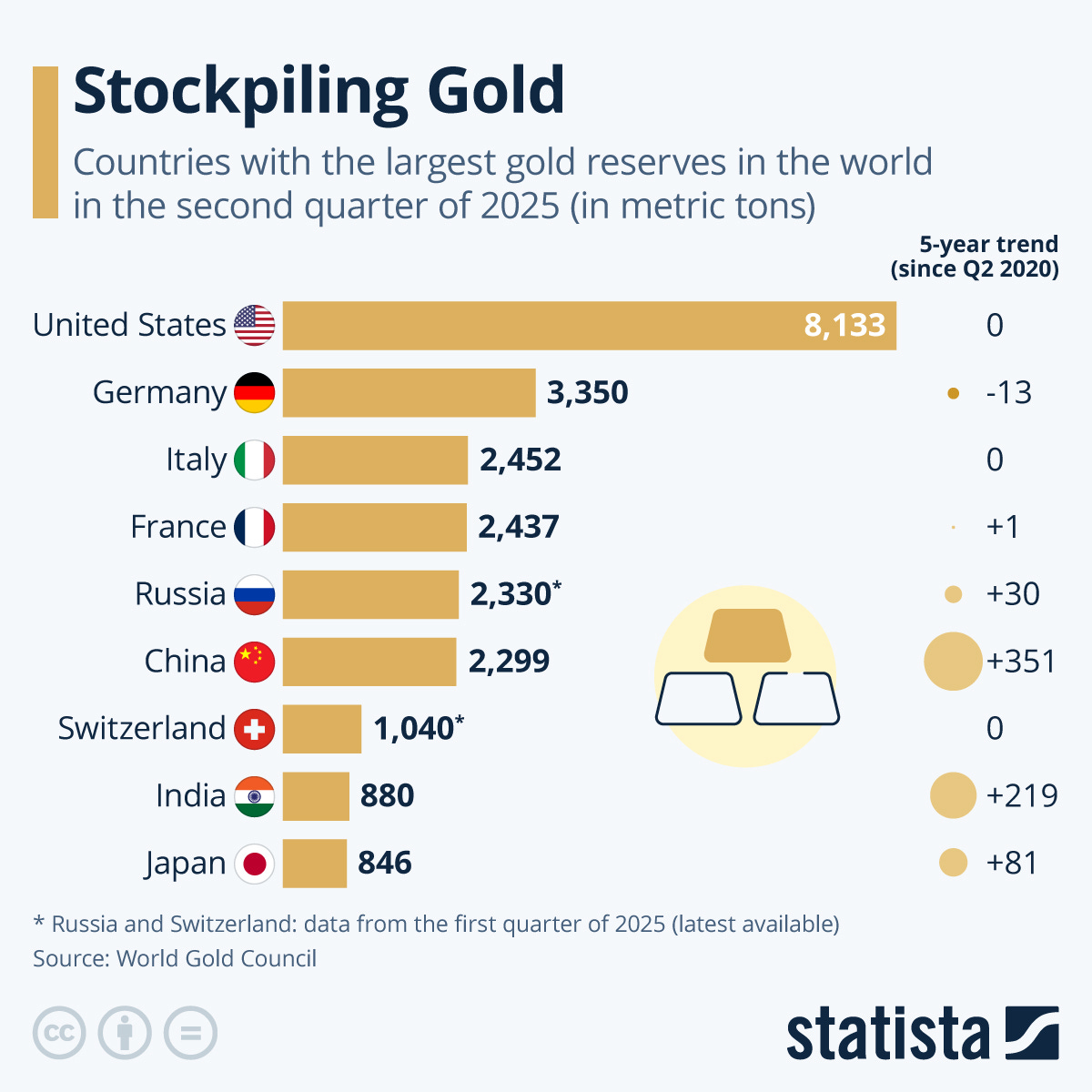
At the same time, central banks continue to accumulate gold at a structural level. This is not speculative demand. It is reserve diversification.
Annual central bank purchases remain near 800 tonnes
Demand is largely insensitive to price fluctuations
Buying is driven by long term strategic positioning, not short term returns
This creates a floor under the market.
On top of that, geopolitical risk has moved from background noise to a primary input. Energy volatility, regional conflicts, and trade fragmentation are all contributing to elevated uncertainty.
When uncertainty rises, gold does not need a catalyst to go higher. It simply needs time.
There is also a supply dynamic worth noting.
Global demand continues to exceed mine supply
The market remains structurally tight
Incremental demand shocks can have outsized price effects
However, the market already priced in a significant portion of this macro stress during the move to 500 (Gold ≈ $5,450).
That is why we are seeing consolidation.
Not because demand has disappeared, but because expectations got ahead of themselves.
The long term macro backdrop remains supportive. Central bank demand, geopolitical instability, and constrained real rates create a durable bid under gold. What is missing is a new catalyst to drive immediate expansion.
Technical Analysis
Now we shift from drivers to structure.
The long term trend is still intact.
Price continues to hold above all major moving averages, and the higher high and higher low structure remains unbroken. The key pivot is 422 (Gold ≈ $4,600). That level defines the current bull market.
Above it, the trend is alive. Below it, the structure changes.
After the move into the 500 (Gold ≈ $5,450) area, gold retraced sharply. That retracement was deep, approaching the 78.6% level of the prior advance, but it did not break structure. Instead, it established a clear demand zone.
Since then, price has been consolidating.
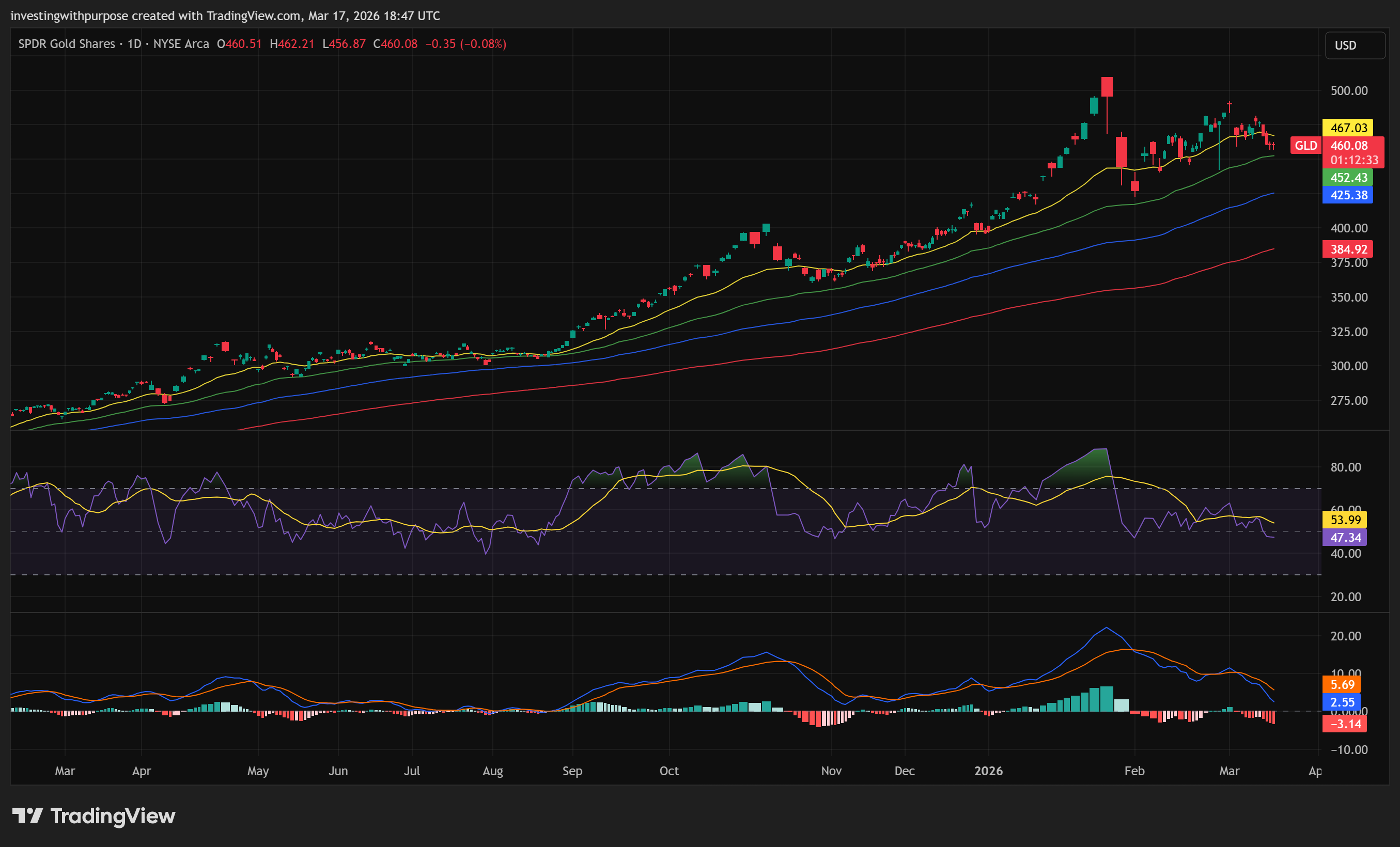
The structure is clean.
450 to 445 (Gold ≈ $4,900 to $4,850) is near term support, where buyers have consistently stepped in
465 to 470 (Gold ≈ $5,070 to $5,120) represents internal resistance from prior failed rallies
476 (Gold ≈ $5,190) is the structural breakout level that confirms supply has been absorbed
Price is currently sitting between those levels, slightly below resistance but well above support.
That positioning matters.
Momentum tells a similar story.
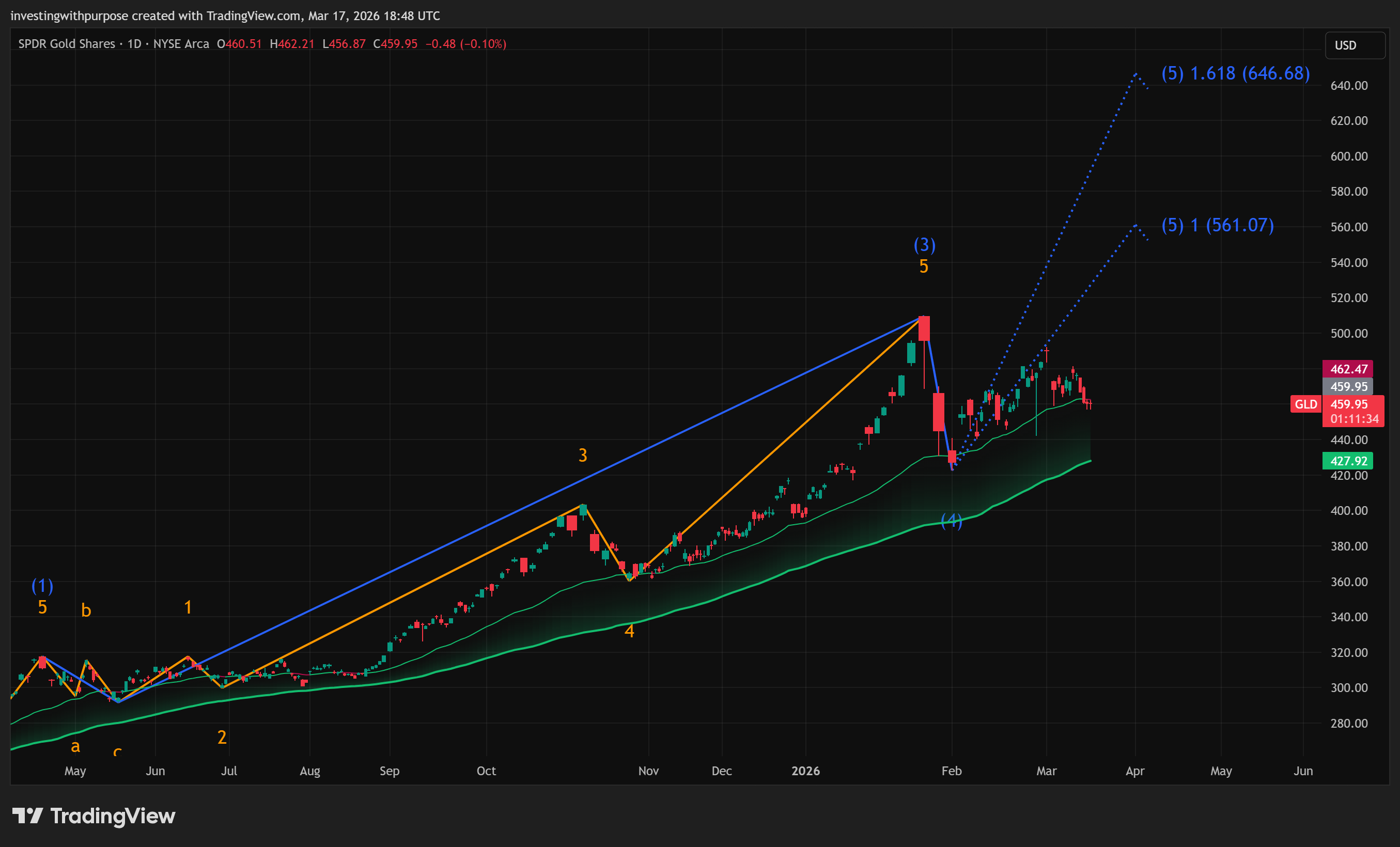
On higher timeframes, momentum has cooled but remains positive. That suggests digestion, not distribution. On shorter timeframes, momentum is weaker, with lower highs forming and volatility compressing.
Compression is the key.
Periods of tightening range and declining volatility typically precede expansion. The next directional move is unlikely to be gradual. It is more likely to be decisive.
From a structural perspective, this looks like a corrective phase within a broader trend, potentially setting up for a continuation move once resistance is cleared.
Gold is not trending higher right now, but it is not breaking down either. It is compressing within a defined range, and that range is approaching resolution.
Our Trade Plan
This is not an environment for aggressive chasing. It is an environment for precision.
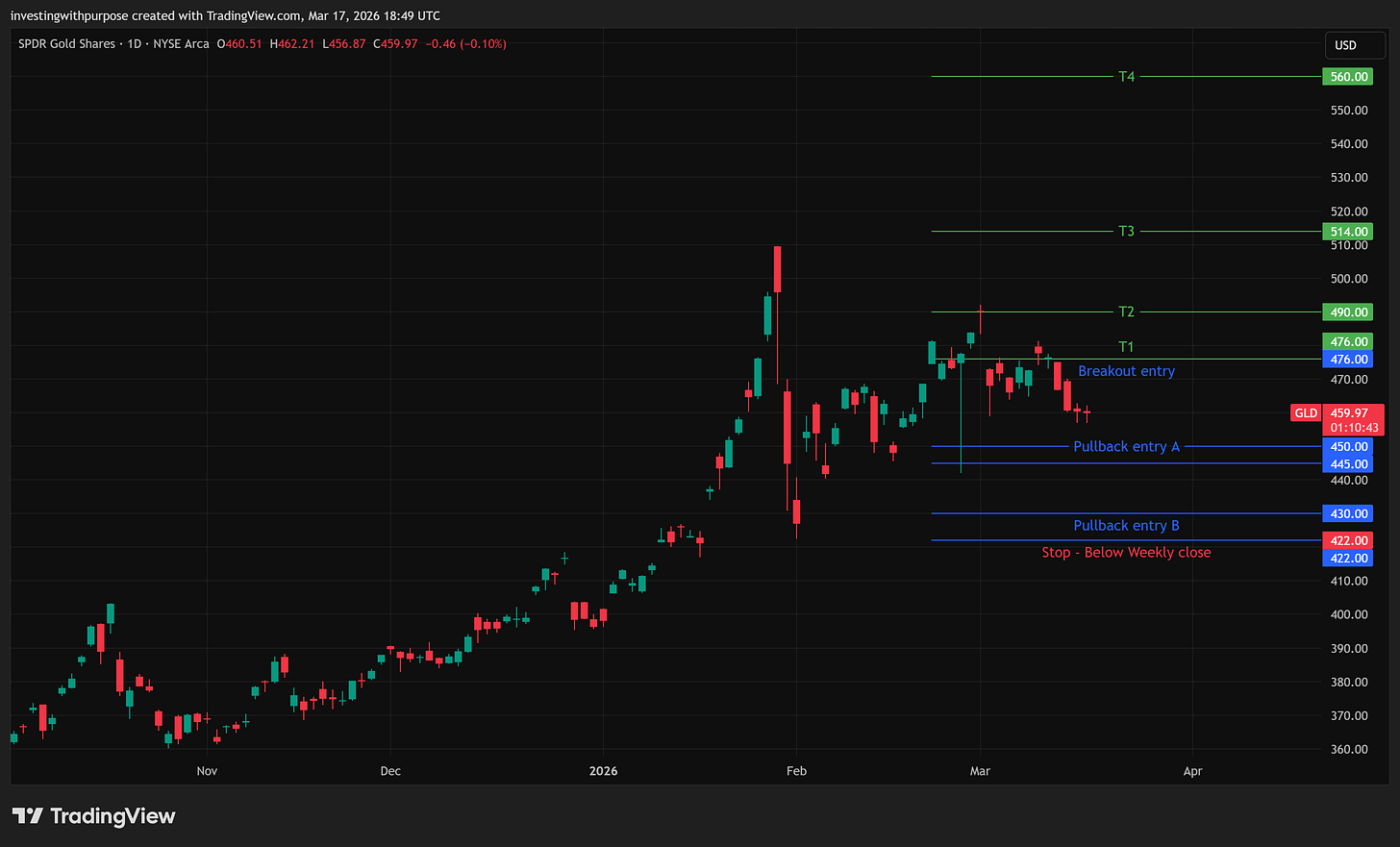
Pullback entries
445 to 450 (Gold ≈ $4,850 to $4,900) if higher low structure holds
430 to 422 (Gold ≈ $4,680 to $4,600) only if price shows a strong reaction and confirms demand
These areas align with prior demand zones and structural pivots.
Breakout entry: Sustained move above 476 (Gold ≈ $5,190)
This confirms that supply from the prior high has been absorbed and that the next leg is underway.
True invalidation: Weekly close below 422 (Gold ≈ $4,600)
This breaks the higher low structure and shifts the outlook toward a deeper correction.
Targets
Short term: 476 (Gold ≈ $5,190) retest if entering near support
Medium term: 490 to 515 (Gold ≈ $5,340 to $5,610) based on prior resistance and measured extension
Long term: 560 to 650 (Gold ≈ $6,100 to $7,100) if macro conditions reaccelerate
Rolling stop logic
Initial stop below recent higher low
As structure develops, trail under daily higher lows
After breakout, trail under the prior resistance turned support
Risk-based position sizing
Risk 1% to 2% if entering near deeper support with wider stops
Risk 1.5% to 3% on breakout entries with tighter structure
Reduce position size as stop distance increases
Risk is defined first. Everything else follows.
Bottom Line
Gold is not breaking down. It is resetting.
The macro environment continues to provide a strong foundation through central bank demand, geopolitical uncertainty, and constrained real rates. That foundation is what keeps pullbacks controlled rather than impulsive.
At the same time, price is no longer in expansion. It is in compression.
That creates a decision point.
Above 476 (Gold ≈ $5,190), the path opens toward continuation and a retest of highs. Below 445 (Gold ≈ $4,850), the probability of a deeper reset increases. Below 422 (Gold ≈ $4,600), the entire structure changes.
Until then, this is a patience environment.
The opportunity is not in predicting the move. It is in positioning around the levels that define it.
The single most important level remains 422 (Gold ≈ $4,600).
Above it, the bull case survives. Below it, it does not.
Stay disciplined.
This article is for informational and educational purposes only and reflects personal opinion, not individualized investment advice. Nothing here should be interpreted as a recommendation to buy, sell, or hold any security. All investments involve risk, including the potential loss of principal. Market conditions can change quickly, and past performance does not guarantee future results.