Introduction
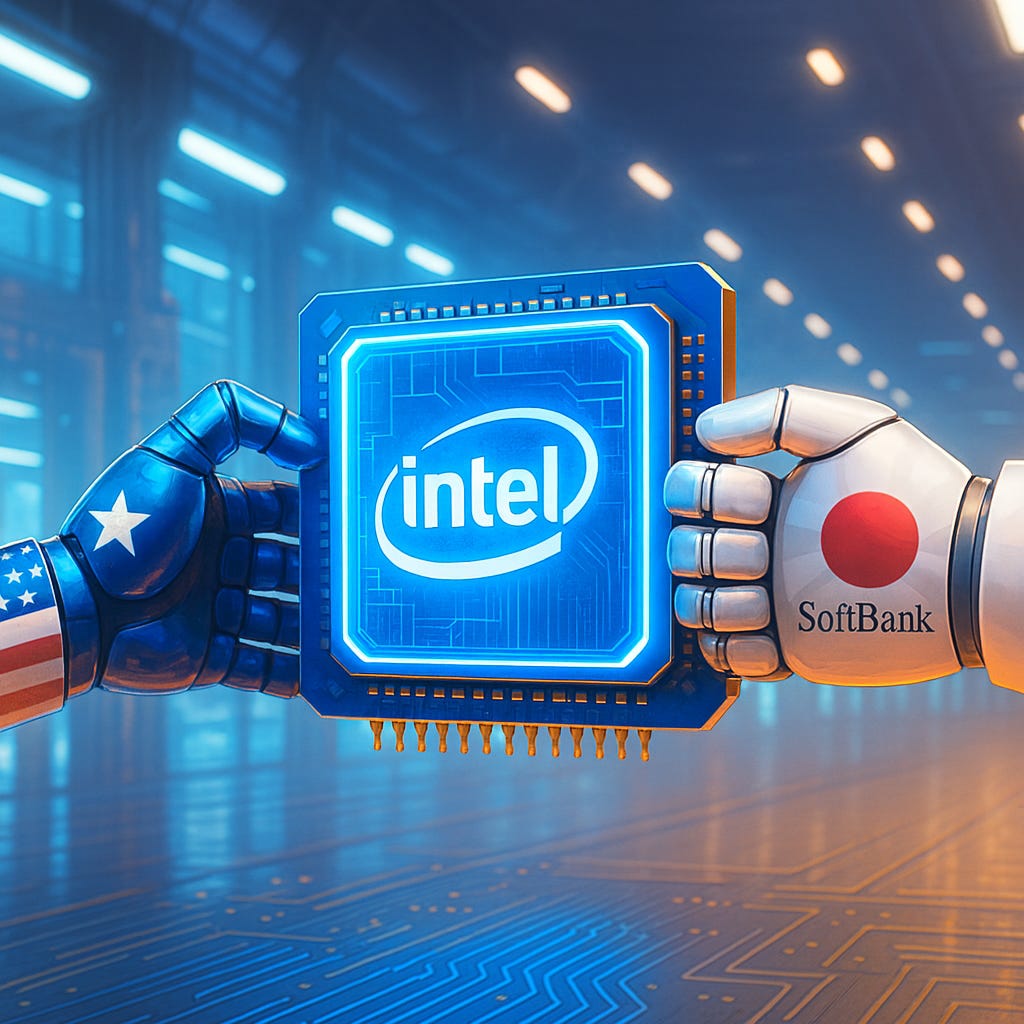
INTC 0.00%↑ isn’t just another turnaround chart anymore. It’s now a geopolitical chess piece. SoftBank’s Masayoshi Son just committed $2B at $23/share, buying ~2% of Intel directly from the company. Meanwhile, reports say the Trump administration is considering converting CHIPS Act grants into equity—potentially making the US government Intel’s largest shareholder with a 10% stake.
Together, these moves signal a new phase: Intel isn’t simply a semi turnaround. It’s a candidate for state-backed industrial policy, with both foreign capital and Washington’s hand at play.
Key Takeaways (TL;DR)
SoftBank stake: $2B at $23/share. Immediate vote of confidence, but more symbolic than balance-sheet saving.
Trump admin stake: Floated 10% equity swap of CHIPS Act grants (~$10B)m which would make government Intel’s top shareholder.
National champion optics: Intel is now framed as essential to US tech sovereignty. This bolsters political will, but doesn’t fix execution risk.
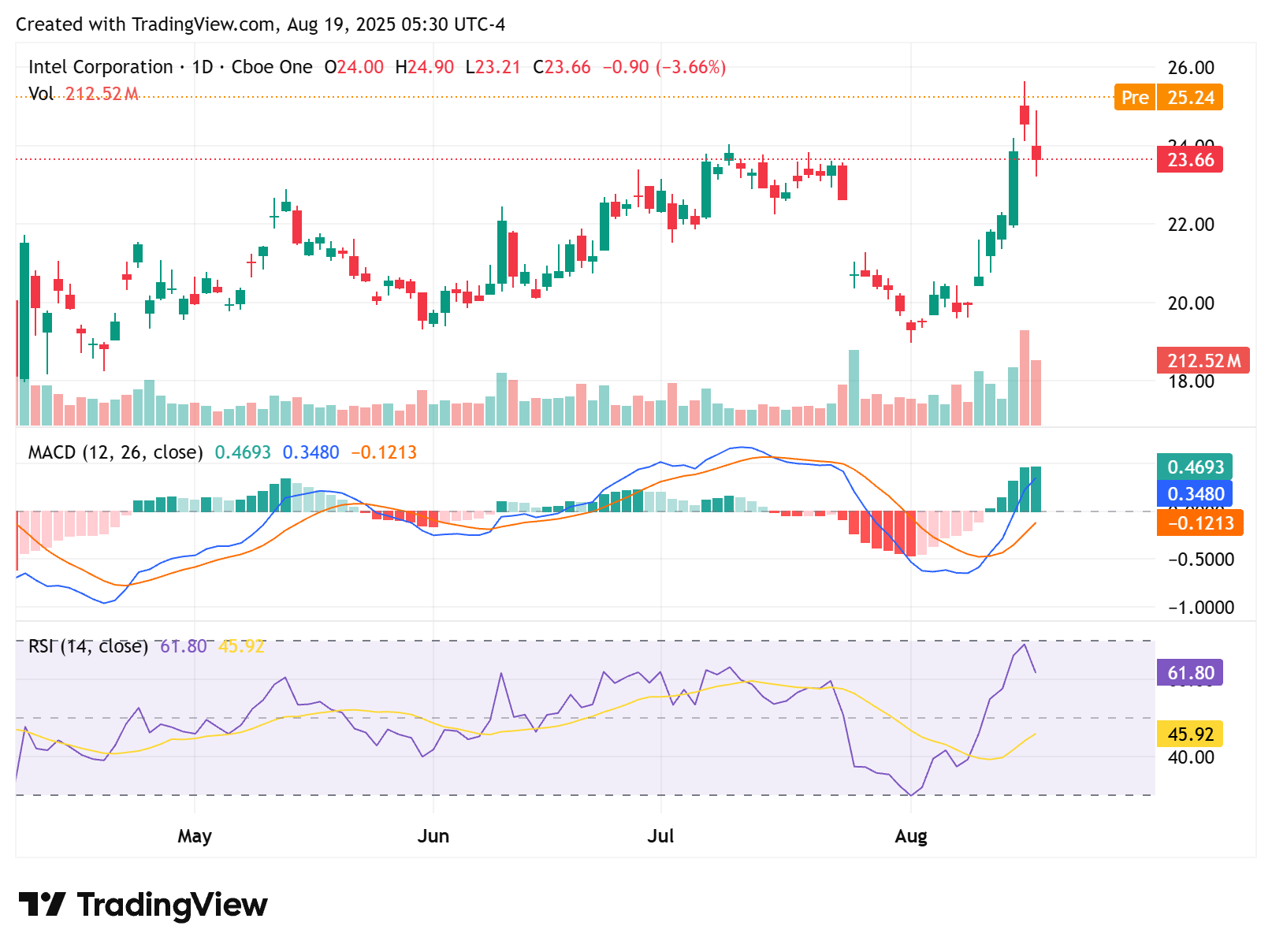
Market reaction: Stock ripped ~12% last week on gov’t stake chatter, cooled, then popped +5% AH on SoftBank’s deal.
Fundamentals still tight: TTM revenue ~$53B, gross margin <30%, FCF deeply negative on $21B capex. Cash burn is still real.
Technical analysis and trade plan below
Strategic Context
SoftBank’s move
Son paid $23/share for $2B new INTC 0.00%↑ stock, signaling long-term confidence and aligning with his broader push into US AI + infra (OpenAI/Oracle’s $500B Stargate project). It gives Intel short-term balance sheet breathing room, but more importantly, symbolic validation from a global capital allocator.
Trump’s potential stake
Reports say the administration may swap CHIPS Act grants for equity, valued at 10% ownership ($10.4B). That would make the US Intel’s largest shareholder. For Trump, this creates a state-backed national champion narrative in semiconductors, aligned with tariffs + reshoring rhetoric. For Intel, it means more time to fix execution without purely market discipline.
Implications
Intel becomes harder to short against government + SoftBank support.
Strategic bifurcation: either catch TSM 0.00%↑ via capex + state aid or break up pieces if execution stalls.
CEO Lip-Bu Tan sits between two forces: Son’s private capital and Trump’s public capital. Both want Intel alive as a US production anchor.
Global benchmark
Intel’s sudden turn into a state-backed story isn’t unusual globally—it’s late to the party.
TSM 0.00%↑ (Taiwan): Taiwan treats TSMC as its crown jewel, with government guarantees, political protection, and security alliances built around it. Subsidies, tax breaks, and even defense commitments effectively wrap TSMC in national armor. The US itself lobbied for TSMC’s Arizona fabs—proof that the company operates at the intersection of geopolitics and markets.
Samsung (Korea): Samsung Electronics benefits from direct alignment with Seoul’s industrial policy. Korea has channeled tens of billions into Samsung’s chip and display dominance, supporting the firm’s $200B+ capex plan through tax breaks, financing, and research grants.
INTC 0.00%↑ (US): For decades, Intel was the US answer to those national champions. But as it slipped technologically behind TSMC, the US pivoted with the CHIPS Act. Now, with SoftBank and the Trump administration weighing equity stakes, Intel is finally being positioned the same way: as a national champion whose survival is tied to industrial strategy, not just market forces.
This framing matters. It suggests Intel’s stock is no longer just about execution on gross margin—it’s also about policy durability. The more Intel resembles TSMC or Samsung in its relationship with the state, the lower the odds that investors can write it off as “just another struggling manufacturer.”
Fundamental analysis
Revenue and margins:
TTM revenue $53.1B (flat vs 2024, down from $63.1B in 2022 and $79.0B in 2021).
TTM gross profit $15.8B → gross margin ~29.8%. 2024 was ~32.7%, 2023 ~40.0%, 2022 ~42.6%, 2021 ~55.4%. The long slide is the story: underutilization, mix, and foundry start-up costs.
Operating line:
TTM operating income - $4.4B (operating margin -8.3%). TTM EBIT - $10.8B; TTM EBITDA $1.1B. But Normalized EBITDA adds back unusual items to $9.0B, which is a more realistic lens for ongoing earning power during a heavy build. That puts normalized EBITDA margin ~17%.
Accounting vs economic reality.
Unusual items TTM - $7.9B are flowing through “Other income expense” and crushing GAAP net income.
Tax provision TTM + $9.2B despite a pretax loss shows the accounting noise, with deferred tax add-backs of $7.6B in CFO.
Depreciation TTM $11.9B is substantial and non-cash, reflecting the capital intensity of the node transition and new fabs.
Cash flow, the heart of the thesis:
Cash from operations (CFO) TTM + $10.1B. This is the crucial fact. It’s supported by non-cash charges and better working capital:
Depreciation and amortization +$11.9B
Deferred tax +$7.6B
Working capital +$3.1B improvement
Asset impairment +$2.6B is non-cash
Stock-based comp +$2.8B
These offset the GAAP loss and confirm the core business still throws off cash.
Capex TTM -$21.0B. Capex intensity ≈ 40% of revenue. CFO covers ~48% of capex, leaving a cash gap that explains negative free cash flow TTM = -$10.9B.
Investing cash flow TTM - $8.5B includes more than capex, implying partial offsets from non-capex investment flows.
Financing TTM - $3.1B net. Debt issuance $5.0B vs repayments $7.7B. End cash still rose to $9.7B, so liquidity is fine near term.
Balance sheet capacity:
Total debt $50.0B, net debt $41.8B. With normalized EBITDA $9.0B, net-debt/normalized EBITDA ~4.6x. On raw EBITDA it looks much worse.
Working capital cooled to $11.7B from $31.1B in 2021. Still positive, just tighter.
The net loss is largely accounting driven. If the capex translates into utilization and yield, earnings then multiple. Liquidity is sufficient, but leverage and dilution need monitoring.
Technical analysis
Trend and momentum:
Weekly: RSI ~55 and rising. MACD bull cross and building. Price still below the long weekly 200 EMA cluster near low 30s, with the 100-week EMA ~26.7 acting as near-term overhead.
Daily: MACD is positive and expanding. RSI ~62 and cooling from near overbought. Trend bias up after the August surge.
Intraday: Pullback off the 25.5–25.7 spike has walked price into a support box 23.8 to 22.8, aligned with 0.382–0.618 retraces across the grids and the intraday EMA bundle.