


A great narrative and a finished-turnaround price, on a business that’s barely turned.
Intel is the comeback story of the cycle. The stock has gained more than 400% over the past year, peaking near $133 last week, as investors bet that its long, painful turnaround, new advanced manufacturing, a revived foundry, and AI-driven chip demand, is finally working. Then yesterday it fell about 8.5%, from $127.86 to $117.05. There was no disaster behind it: no bad earnings (the next report is July 23), no guidance cut, no scandal. It was profit-taking in a stretched stock on a weak day for tech, against a louder competitive backdrop. The drop didn’t break the trend. But it’s a useful reminder of what the rally has glossed over: the numbers haven’t caught up to the story.
Key Takeaways
Intel has gained more than 400% in a year on turnaround optimism: its 18A process is moving through production milestones, and AI is reviving demand for its processors. The narrative is genuinely improving.
But it’s still losing money on a GAAP basis: a $3.7B net loss in the March quarter, the foundry alone down $2.4B, even as adjusted earnings just squeaked positive. It’s also burning cash to build fabs.
The valuation has run far ahead of the business. At $117 the stock trades around 10 times sales and an extreme multiple of the slim profits analysts expect, with no trailing GAAP earnings at all.
Wall Street doesn’t buy the price. The average analyst target sits around $90, roughly 20% below where the stock trades, and the rating is a hold.
Yesterday’s 8.5% drop was profit-taking, not a fundamental break. Intel still sits above all its major moving averages, so the uptrend is intact, just stretched.
Start with why the stock ran so far.
The Comeback Story
For years Intel was the cautionary tale of American technology: it lost the manufacturing lead to TSMC, missed mobile, missed AI accelerators, and watched AMD eat its market share. The turnaround bet is that this is reversing. Its most advanced process, 18A and the 18A-P variant, is moving through production milestones, the first time in years Intel’s manufacturing has looked competitive with TSMC’s leading edge. Its foundry arm, the contract-manufacturing model that minted TSMC, is chasing external customers. AI is refreshing demand for the PC and data-center processors Intel still serves. And Washington’s drive to reshore advanced chipmaking hands it a strategic tailwind few companies enjoy. That story, more than any single quarter, is what took the stock up more than 400%.
It isn’t pure hope, either. The real validation is still ahead, external customers buying 18A at volume, with competitive yields and margins, but if that lands, the whole thesis confirms at once, and today’s losses read as the investment phase of a much larger franchise. That’s the prize the rally is reaching for.
The trouble is what the story still costs.
But the Numbers Haven’t Caught Up
Strip away the narrative and the financials are sobering. In the March quarter Intel lost about $3.7B on a GAAP basis, the foundry alone accounting for $2.4B of it, even as adjusted, non-GAAP earnings squeaked to a small profit of about $0.29 a share. Management guided the current quarter to roughly breakeven on a reported basis and a modest adjusted profit, the inflection bulls point to. But step back to the trailing year and Intel still generated roughly $54B of revenue at a net loss, with a negative return on equity, while burning cash to pour tens of billions into new fabs. On a reported basis, there are no trailing earnings to value it on at all.
On the measures that do work, it’s expensive. The stock trades around 10 times its sales, rich for a low-margin manufacturer that isn’t reliably profitable, and at an extreme multiple of the modest forward profits analysts expect, with estimates running from the 70s to well over 100 times earnings, all of them steep. Its market value is more than half a trillion dollars. And the people paid to value it aren’t convinced: the average analyst target sits around $90, roughly 20% below the current price, the rating is a hold, and one widely-followed fair-value model pegs it far lower still. In plain terms, the stock is priced as if the turnaround is already finished. It’s barely begun.
The bull’s fair counter is that turnarounds are always priced on the future, not the past, and that the foundry losses are deliberate, the cost of building capacity that swings to profit as the fabs fill. That’s true, and it can run a long way: if utilization keeps climbing, the losses keep narrowing, external customers commit real volume, and AI keeps refreshing the PC and data-center cycle, Intel can stay expensive far longer than the financials alone would justify. Momentum names usually do. The question is degree. At 10 times sales, no GAAP profit yet, and the stock 20% above what analysts think it’s worth, the market isn’t just betting the turnaround works, it’s betting it works quickly and cleanly, with little room for the stumbles that have defined Intel’s last decade.
What Happened Yesterday
The 8.5% drop had no single smoking gun: no earnings miss, no guidance cut, no scandal. A few things lined up instead. It was a stretched stock taking a breather on a weak day for tech, with the Nasdaq down more than 1%. After a 400%-plus run, a pullback like this is the kind of air pocket momentum names hit regularly. And in the background, Nvidia’s push into AI-focused PC chips, aimed at the personal-computer processor market Intel still leads, added to the competitive pressure, a reminder that even Intel’s strongholds are contested. None of it changes the long-term thesis. Together they gave a crowded, extended trade an excuse to take profits. See the move for what it was: a stock that had nearly tripled from its April low, shedding 8% in a jittery tape as the competitive backdrop got louder. Extended winners don’t need much of a reason. What matters now is whether the dip-buyers who powered this run keep showing up.
The Technical Picture
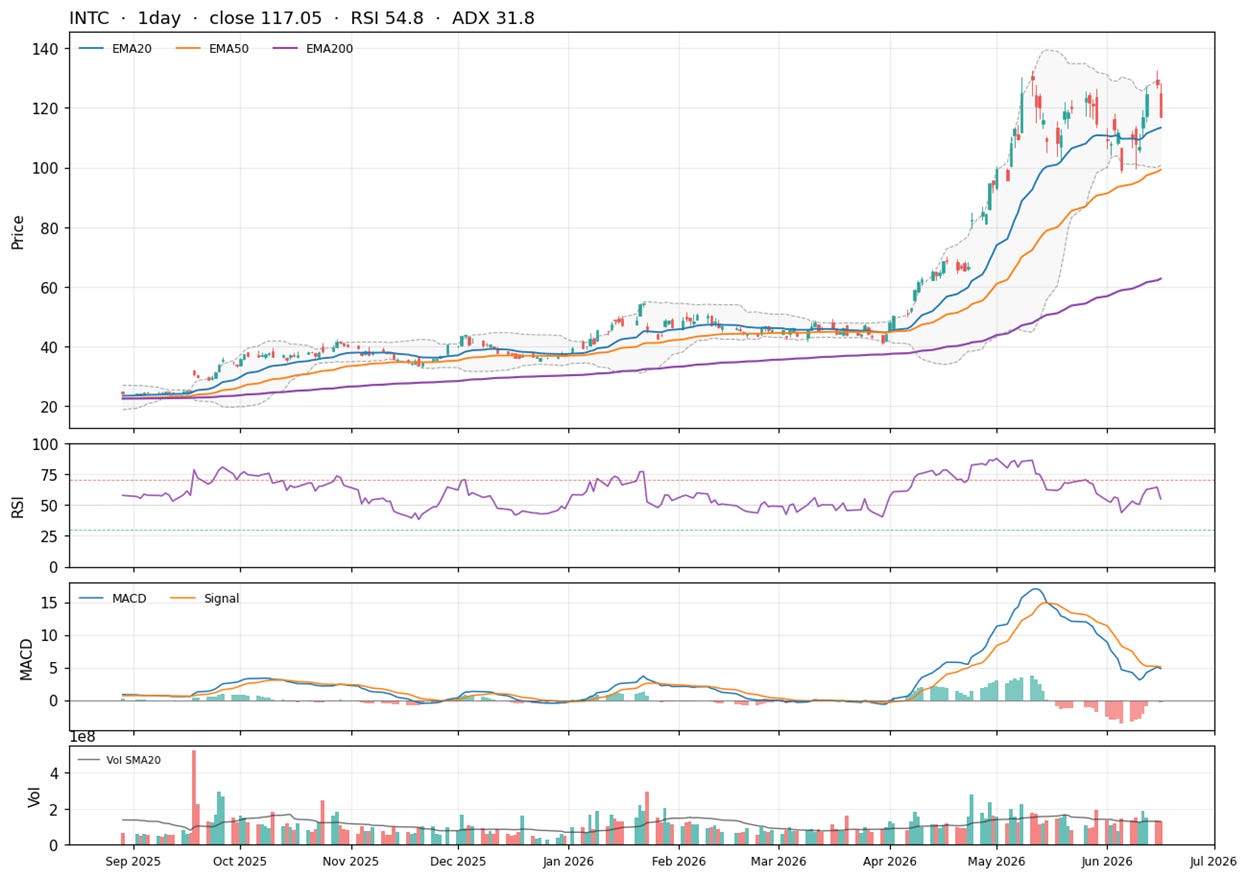
For all the drama, the drop barely dented the uptrend. Intel still trades above its 20-day average near $113, its 50-day near $99, and its 200-day near $63, the last of which shows just how far and fast this has run. Its daily relative strength index, a 0-to-100 momentum gauge where over 70 is overheated, sits at a neutral 55 after the pullback, while the weekly reading is hotter at 67. The drop pulled price right back to the rising 20-day line, the first test of whether buyers still step in. As long as that area holds, this is a pause in an uptrend, not the start of a reversal.
How to Position
This is a momentum-and-story stock, not a value one, so treat it that way. These are levels to watch, not instructions.
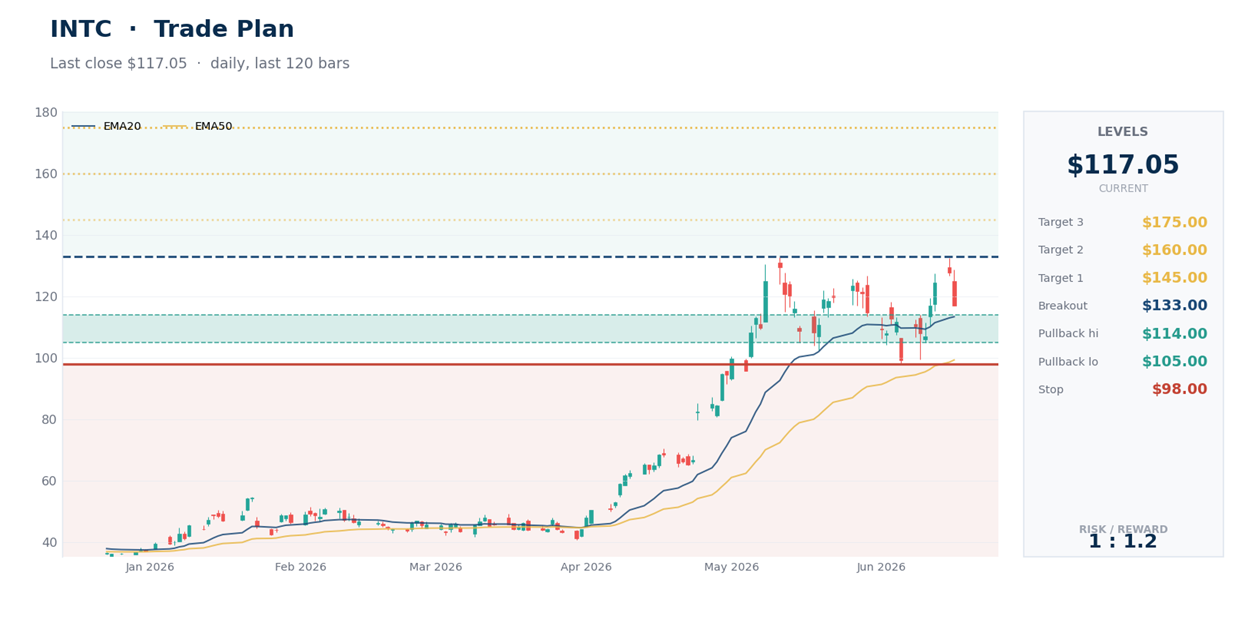
Pullback support: $105 to $114, the rising 20-day average and the early-June base, where a stretched uptrend tends to find its footing.
Breakout: a reclaim of the $133 high would say the momentum has resumed.
Caution line: a close below $98, the 50-day average, would break the near-term uptrend and warn the air pocket is turning into something bigger.
Targets on continuation: $145, then $160 and $175. Size for the swings, because a stock up 400% can give it back fast.
The real test isn’t a level, it’s the July 23 earnings report. Evidence the foundry losses are narrowing and external traction is building would justify the price. Another quarter of deep losses would make $117 hard to defend.
Bottom Line
Intel’s comeback is real, and that’s exactly why it’s dangerous here. The 18A progress, the foundry traction, the AI demand, all genuine. But a stock up more than 400% in a year, still posting GAAP losses, burning cash, and trading 20% above what analysts think it’s worth has already banked the win in advance. Yesterday’s drop didn’t break anything; it just showed how little cushion is left.
One number frames it: Intel is worth more than half a trillion dollars today, on a business that lost $3.7B in the March quarter alone. The market is paying for the Intel that might exist in 2028. Whether you want to own it comes down to whether you believe that Intel arrives, and on a name this stretched, the cheaper moment to ask usually comes after the next pullback, not before it.
This is research and commentary, not personal investment advice. Levels are illustrative; size positions to your own risk tolerance and time horizon. The author may hold positions in names discussed.