


Intuit reported after Tuesday’s close, beat on both lines, and was trading about 11% lower in Wednesday’s pre-market. The headline everywhere is that fiscal 2027 earnings guidance of $22.88 to $23.12 came in miles below a $27.30 consensus. That comparison is broken.
From this year Intuit stops adding back stock compensation to its adjusted numbers, worth $5.81 a share, while the estimate it supposedly missed was built on the old one. Put the guide back on that basis and it’s about $28.81, roughly 5% above consensus rather than 15% below. The revenue guide really is light. But the number that should worry you is neither of those. It’s 39 million, and the problem behind it isn’t confined to TurboTax.

Key Takeaways
The $4 shortfall in earnings guidance is a definition change: Intuit now includes share-based compensation, and on the old basis the guide is about $28.81 against estimates near $27.30.
Revenue guidance of $23.28 to $23.51 billion, growth of 9% to 10%, sits below the $23.74 billion consensus and below the 14% Intuit delivered in fiscal 2026.
TurboTax units fell 2% to 39 million. The chief executive says price is now the number 1 reason customers leave.
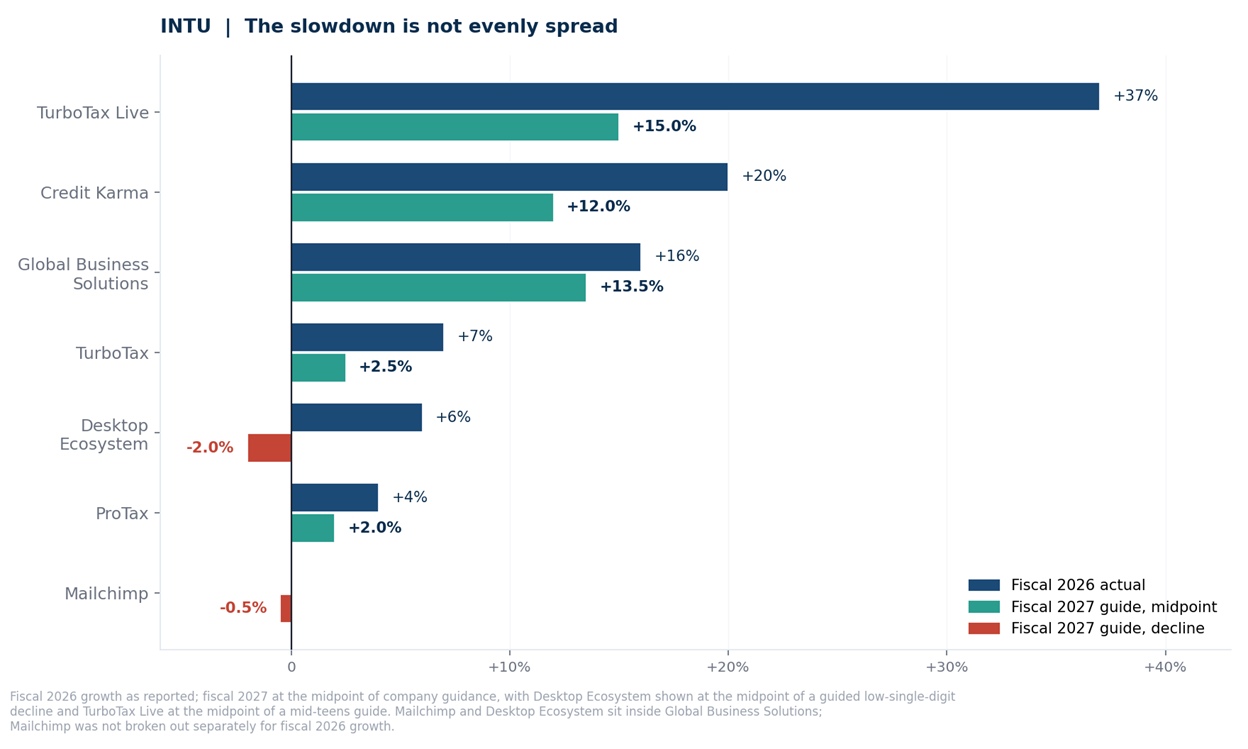
The slowdown is concentrated: Intuit names Desktop, TurboTax and Credit Karma, and Global Business Solutions still guides to 13% to 14%. TurboTax Live, the lever that carried tax revenue while units fell, slows from 37% to mid-teens.
The same pattern runs through the business side. Online paying customers grew 3% to 8.9 million while revenue per online customer rose 15%.
Levels and readings are the Tuesday August 25 close of $357.46, the last completed session. Intuit reported after it; the pre-market print at 7:12 Wednesday was $317.90.
Start with the number that isn’t what it looks like.
The Miss That Isn’t
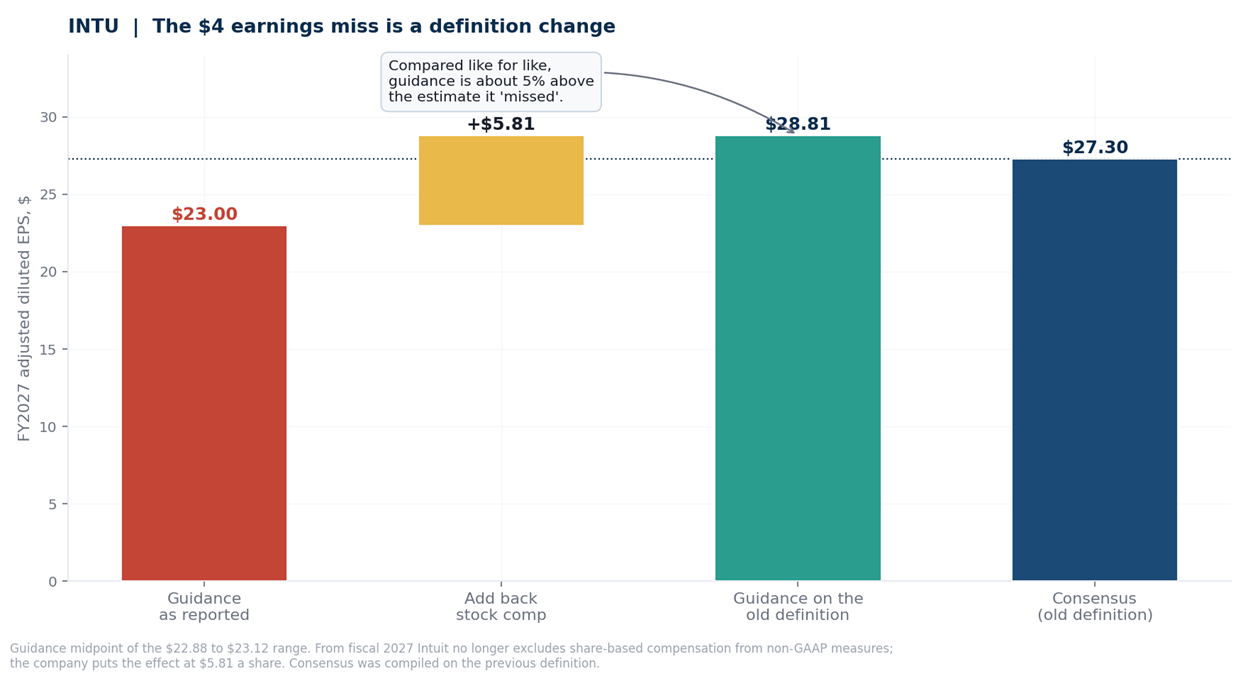
Beginning in the first quarter of fiscal 2027, Intuit no longer excludes share-based compensation from its non-GAAP measures. Its reasoning is that stock comp is a recurring cost of paying people, so leaving it out misrepresents the operating result. Intuit quantifies it twice: $2.02 billion of operating expense, and $5.81 per diluted share.
So the guide and the estimates it was measured against, which run from about $27.30 to $27.34 depending on the provider, are not counting the same thing. Add the stock comp back and guidance is $28.69 to $28.93, roughly 5% above the number it was reported to have missed. Intuit’s own framing agrees: it calls the guide 23% to 24% earnings growth, which only works against a fiscal 2026 base restated the same way.
This deserves credit rather than suspicion. Few large software companies volunteer to stop pretending equity compensation is free, and doing it in the same release as a slowdown makes the headline read like a collapse in profitability that didn’t happen.
The screens will disagree for a while, too. On the new definition the stock traded near 15.5 times forward earnings at Tuesday’s close and 13.8 times in Wednesday’s pre-market; on the old one, about 12.4 and 11.0. Same company, same day, 3 points of multiple depending on which convention your data provider has caught up with.
The Miss That Is
Revenue guidance of $23.279 billion to $23.512 billion, growth of 9% to 10%, sits below the $23.74 billion FactSet consensus. That shortfall is roughly 1% to 2%, which isn’t dramatic in itself. The deceleration is what stings: fiscal 2026 grew 14%.
Intuit named the causes itself, and they’re worth quoting because the popular summary has them wrong. The deceleration is “primarily driven by Desktop Ecosystem, TurboTax, and Credit Karma.” Mailchimp isn’t on that list. It’s guided to flat or down 1%, which is poor, but small and already poor.
They aren’t the same kind of problem. Desktop grew 6% last year and is guided to decline in the low single digits as customers migrate to the online products, which is a transfer inside the company rather than a loss. Credit Karma grew 20% and guides to 11% to 13%, which management calls prudence after a strong year rather than deterioration. Neither is an emergency, and Global Business Solutions, the largest piece at $12.9 billion, grew 16% and still guides to 13% to 14%.
That leaves TurboTax, and it is the one that matters.
39 Million
US TurboTax units fell 2% in fiscal 2026, to 39 million. Online units fell 2% to 34.9 million and desktop fell 7% to 4.1 million. Revenue still grew 7%, because TurboTax Live revenue rose 37% and now makes up 53% of the franchise. Intuit sold tax software to fewer people and made more money doing it.
The mix underneath is worse than the headline. TurboTax Live customers grew 38% while total units fell 2%, which strongly suggests the count of people filing on their own without paid help fell by considerably more than 2%. That base is the top of the funnel, and it’s shrinking faster than the segment total lets on.
Sasan Goodarzi said the quiet part out loud on the call: “Consumers have more lower-cost alternatives and we lost quality DIY customers to lower-cost providers this year. Price is now the number 1 reason customers leave TurboTax.”
That single admission explains the whole guide. Intuit is deliberately accepting lower revenue per customer to stop the unit decline, which is why TurboTax is guided to 2% to 3% and the Consumer segment to 4% to 6%. It’s sacrificing price to rebuild a funnel it let weaken, and the fiscal 2027 guide is the invoice.
And the offset is fading. TurboTax Live, which carried the segment while units fell, is guided to mid-teens growth this year, because fewer customers are left to upgrade after 2 strong years of conversion. So Intuit is cutting price into the base at the exact moment its best way of making more per customer slows down.
And it isn’t only tax. On the business side, total online paying customers finished the year at 8.9 million, up 3%, about 2 points slower than the year before, while revenue per online customer rose 15%. Across both sides of Intuit, monetisation has been doing considerably more of the work while customer acquisition slowed. That’s the equation management is trying to reverse, and rebuilding it will weigh on fiscal 2027 growth.
So the question isn’t whether the guide is soft. It’s whether the customer count turns, and the honest scorecard is wider than units alone: units, share of total e-filers, revenue per DIY customer, and how many of those filers end up on Credit Karma too. Reaching 40 million with revenue per customer collapsing and no crossover wouldn’t be a win. If units keep sliding while price falls anyway, Intuit will have discovered that the pricing power was the business.
What They’re Buying
Management’s defence is specific. Customers who use both TurboTax and Credit Karma generate roughly twice the revenue of single-product customers, and Credit Karma members filing through TurboTax grew more than 50%. On that arithmetic a cheaper return isn’t a discount, it’s an acquisition cost for a larger relationship. The open question is causality. Dual-product customers do generate twice the revenue, but Intuit has to show that a lower entry price creates more of those relationships rather than discounting people who’d have filed anyway. They may simply be the higher-value customers to begin with. Intuit is also widening distribution, including inside the AI assistants people already use, which is where its Anthropic and OpenAI agreements show up.
There’s evidence it works somewhere. Intuit’s 3 big bets, assisted tax, money and mid-market, grew 34% together and now make up 30% of revenue. Operating margin expanded again and is guided to expand again next year on savings from the roughly 3,000 jobs cut in May. Beyond fiscal 2027 the stated goal is still double-digit growth. This isn’t a company in trouble. It’s one deliberately giving up near-term growth to rebuild customer acquisition, and asking the market to wait.
One detail tells you when the answer arrives. The first quarter is guided to about 11%, faster than the 9% to 10% full year. With the TurboTax reset landing in tax season, the cleanest test comes in the January to April quarter.
The Setup
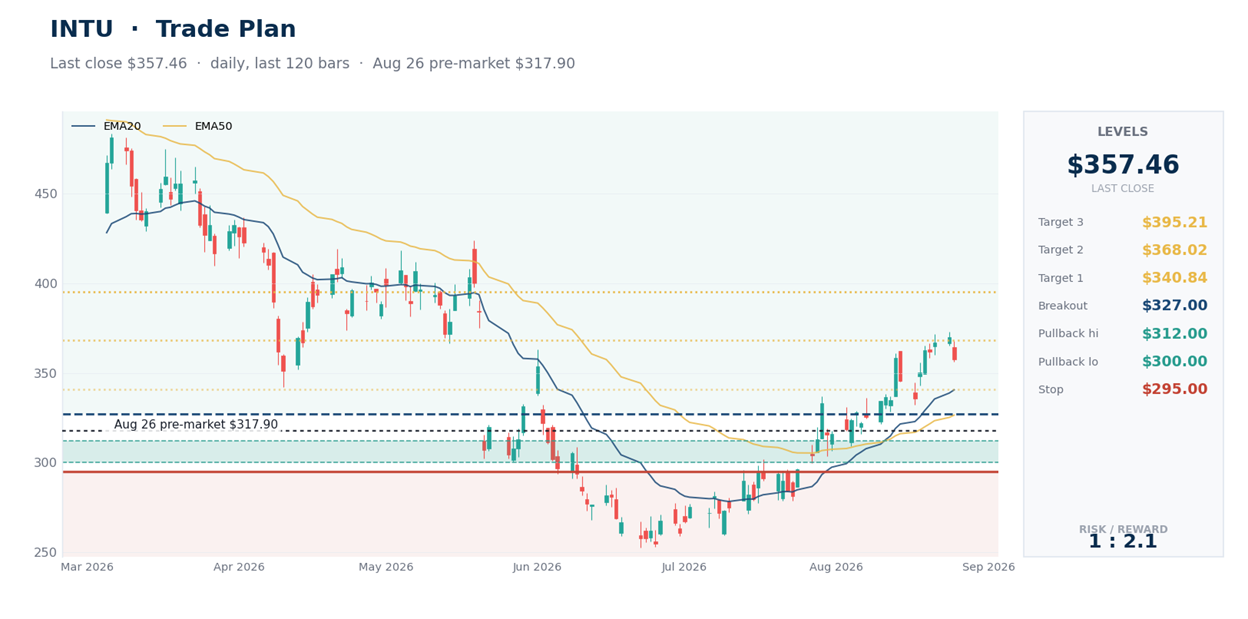
Intuit closed Tuesday at $357.46, already down 3.4% before the report landed, and 49% below its 52-week high of $705.08 set last September. The pre-market print of $317.90 takes that to 55%. Tuesday’s bar was constructive: above the 20-day and 50-day exponential averages at $340.54 and $326.48, with ADX near 30 indicating a trend rather than a drift. The gap erases that.
What it doesn’t erase is the base underneath. Late July and early August produced a run of lows between $299.63 and $316.05, and the 78.6% retracement at $302.14 and the lower band at $303.90 sit in that same area. The stock is gapping back into ground it spent 3 weeks building on. Average true range is $14.05, about 4%, wider than the zone itself, so size for that rather than trying to be precise about the entry.
1. The zone: $300 to $312. Invalidation is a close below $295, under the whole of that base. Beneath it there’s little until the June low at $252.84.
2. From the middle of the zone you’d risk about $11 to reach the 50-day at $326.48, close to 2 to 1, and roughly 3 to 1 to $340.84.
3. Reclaim: a close back above $327, over the 50-day and the Ichimoku baseline at $325.96. Objectives $340.84 at the 61.8% retracement, where the 20-day average also sits, then $368.02 and $395.21. Mind the geometry. Against the same $295 stop that’s $32 of risk, so only the last objective pays about 2 to 1; the first pays 0.4 to 1 and the second 1.3 to 1. Entering on the reclaim costs most of the reward.
4. Not at the open. The opening print isn’t confirmation of anything, and a gap this size can produce noisy price discovery before a level holds.
Bottom Line
Both of these are true, and most of the coverage will only carry the first. Intuit guided fiscal 2027 revenue below consensus and decelerated from 14% to 9% or 10%, which is real. And it did not miss on earnings by $4, because the estimate and the guide were denominated differently, and like for like the guide is above the number. Anyone building a view off the headline comparison is working from an artefact.
The thing worth tracking isn’t the multiple, which now depends on whose definition you use, and it isn’t the revenue guide in isolation, because part of that slowdown is deliberate. It’s customers. The apparent EPS problem is mostly definitional. The operating problem is customer acquisition, and it exists on both sides of the house. TurboTax has 39 million units and had 39.9 million a year ago; the business side added 3% more paying customers while charging each 15% more. Tax season is where that gets settled.
This is research and commentary, not personal investment advice. Levels are illustrative; size positions to your own risk tolerance and time horizon. The author may hold positions in names discussed.