


Intuitive Machines LUNR 0.00%↑ did everything the bull case asked for last quarter.
Revenue nearly tripled.
Backlog hit a record.
Adjusted EBITDA turned positive for the first time.
It also ended up on the Space Force’s Andromeda programme and picked up 18 missile-tracking spacecraft through L3Harris.
The stock closed Tuesday at $13.96, down 22% this year and 70% below its high.

Key Takeaways
Q1 was genuinely good. Revenue of $186.7M was around 3x from one year ago ($62.5M). Gross profit also went from $6.7M to $30.1M, and adjusted EBITDA hit positive $2.7M, the first ever.
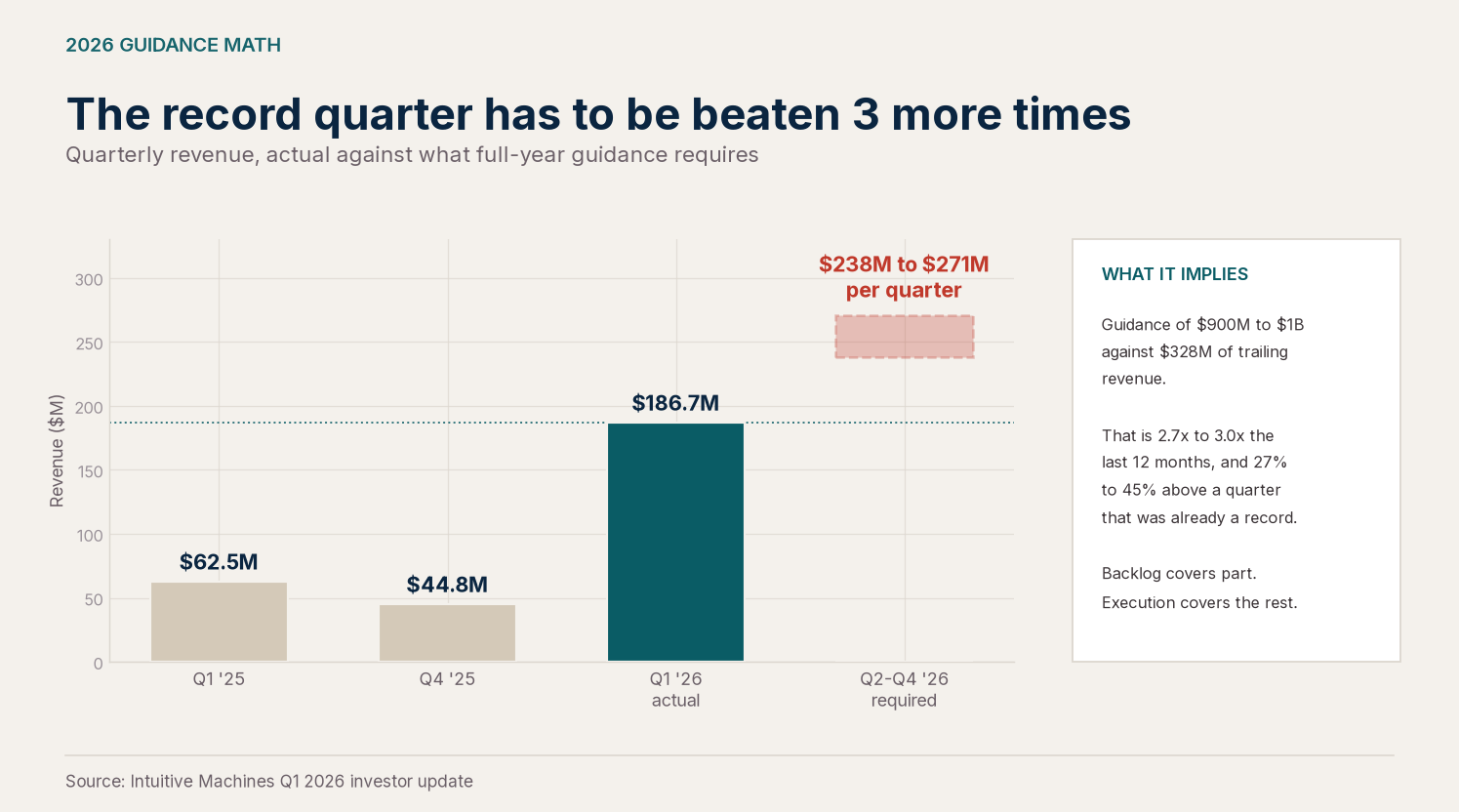
Guidance is the problem. Management targets $900M to $1B for 2026. That requires Q2 through Q4 to average $238M to $271M, so the record quarter has to be beaten by another 27% to 45%, 3 times in a row this year - which isn’t an easy accomplishment.
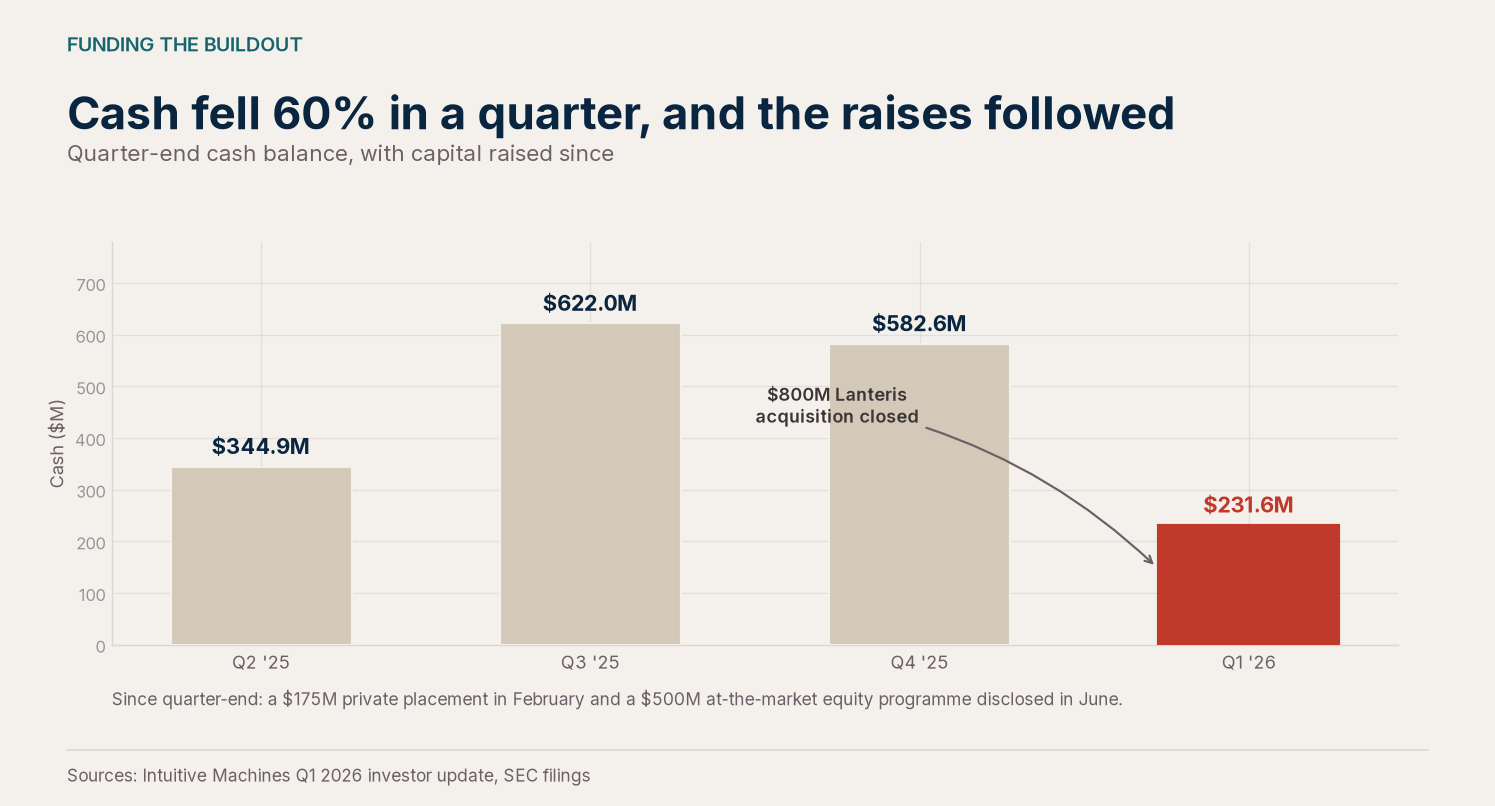
Cash fell from $582.6M to $231.6M last quarter, after the $800M Lanteris purchase. The company has since raised funds twice.
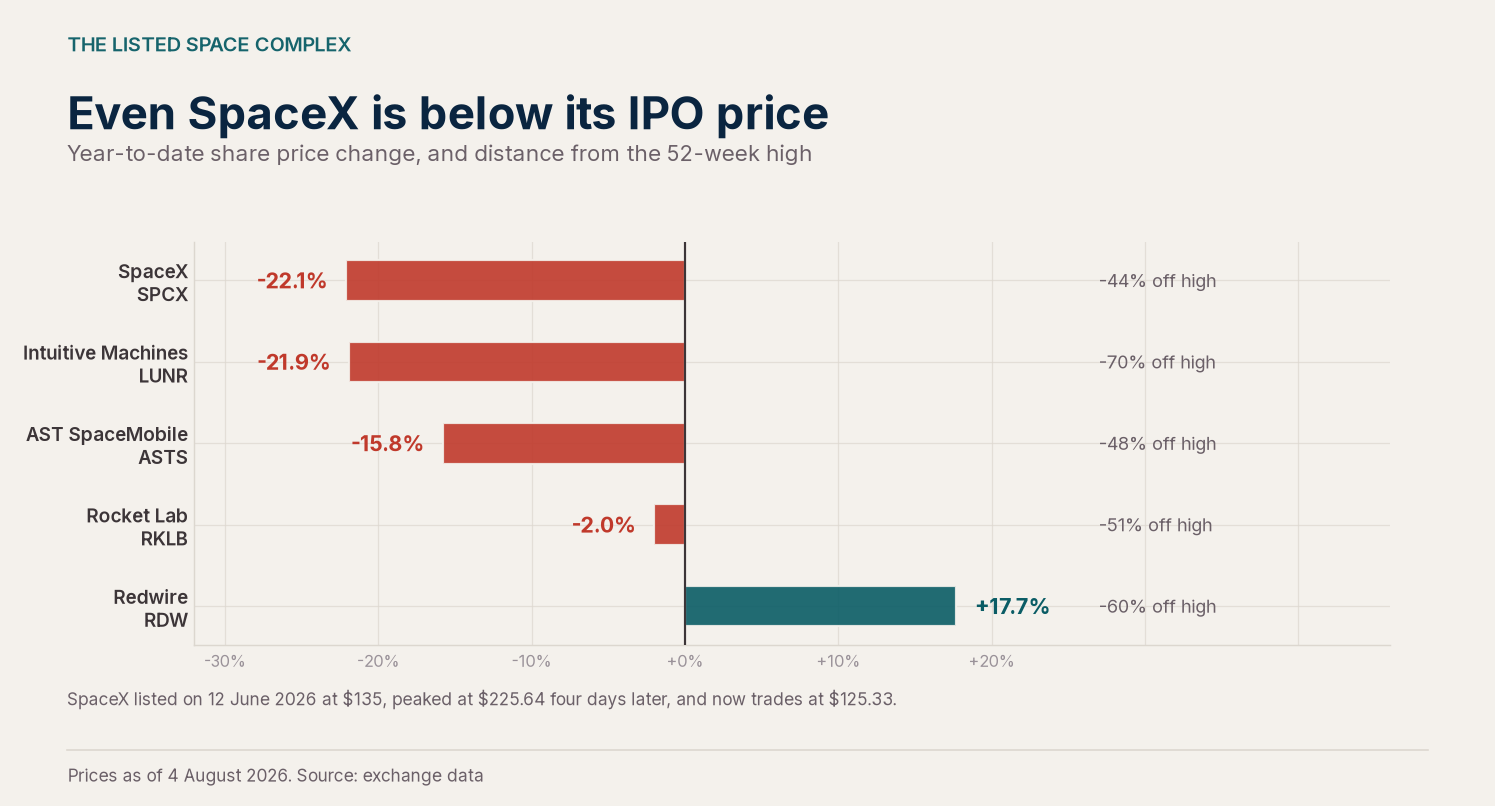
SpaceX SPCX 0.00%↑ completely changed the game with its listing. It listed in June at $135, hit $225.64 in the same week, and now trades at $125.33, below its own IPO price. Every small-cap space name lost its scarcity premium when that happened.
The framework says avoid until it reclaims. Price sits below every daily moving average with sellers in control. There’s one level worth watching, and it’s below here.
About the Company
Intuitive Machines builds and flies lunar landers, satellites, and the ground network to communicate with them. It’s the company that put the first US commercial lander on the Moon.
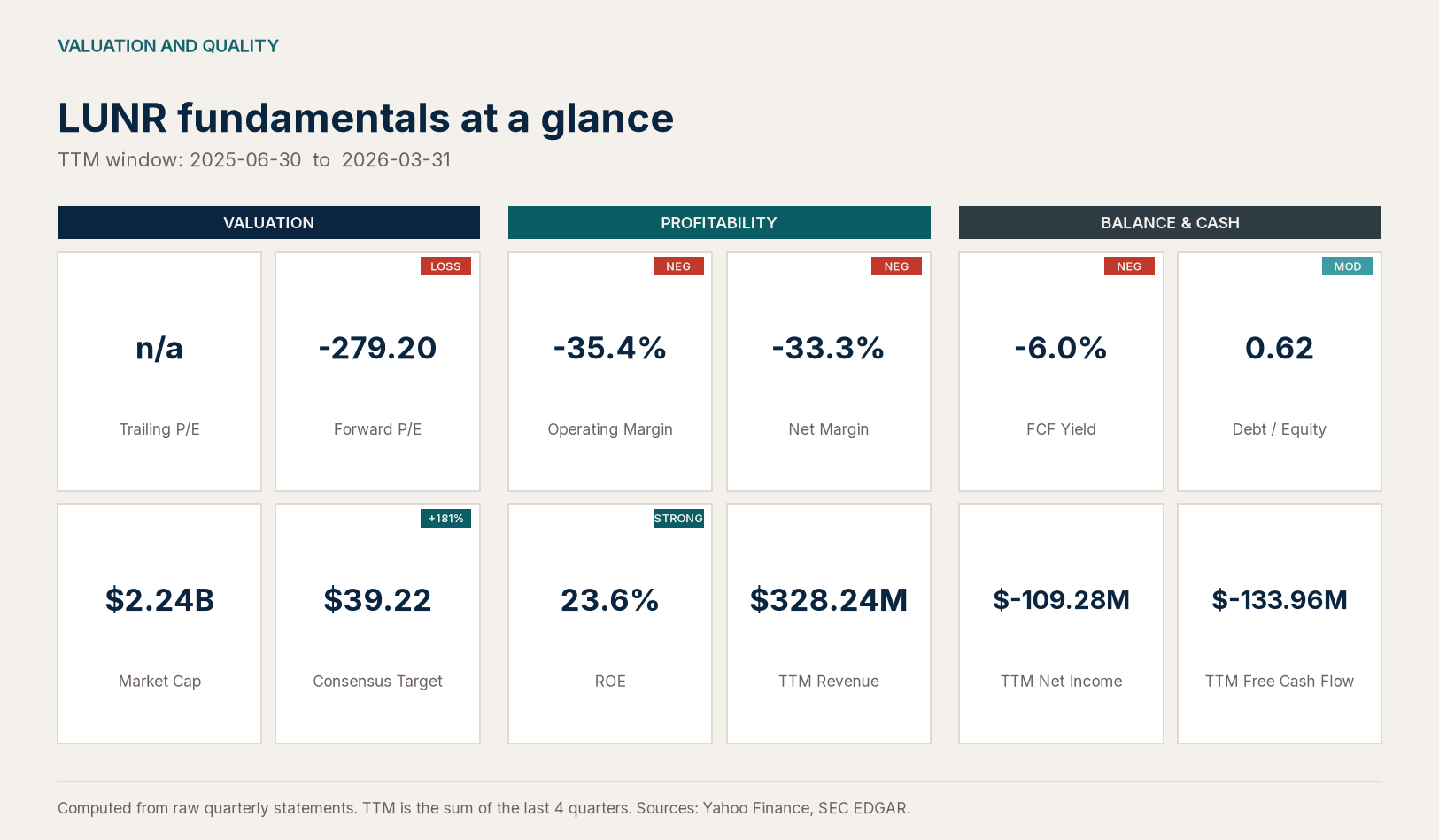
Today, it’s far different from what it was 18 months ago. The acquisition of Lanteris Space Systems shifted it from a mission-services company to a vertically integrated manufacturer, and a pending deal for Goonhilly Earth Station and COMSAT adds global ground stations. Management calls the result a next-generation prime contractor. Trailing revenue is $328.2M with market cap around $2.24B.
Its customer base is almost evenly split: 38% civil, 35% commercial, and 27% national security.
News and Pipeline
The contracts are real but mostly not revenue yet
The Q1 haul was substantial. $428.9M in new awards, driven by the Space Development Agency’s Tranche 3 tracking layer and a $180.4M CLPS award from NASA in March. Backlog jumped $842M in a single quarter to $1.1B.
Since then, 2 things landed:
The Space Force selected Intuitive Machines for Andromeda, the programme replacing its GSSAP surveillance satellites. The company cites a $6.24B ceiling, but that amount is allocated across 14 companies.
18 spacecraft for missile tracking, ordered through L3Harris under the SDA’s accelerated Tranche 3 tied to the Golden Dome initiative, built on the company’s IM-300 platform. The stock rose 5% on the news.
Still pending: awards for the lunar terrain vehicle, where the company has submitted both an uncrewed design (Moon RANGER) and a crewed one (Moon RIDER). Management expected decisions “in the coming weeks” back in May.
NASA has also expanded CLPS 1.0 from $2.6B to $4.2B and added a $6B CLPS 2.0 for heavier cargo beyond 2028, against what the company frames as a $20B Moon Base opportunity split across 2 phases.
The pipeline is good, but the issue is converting it on schedule, with enough cash to get there.
The Funding Gap
Cash went from $582.6M at year-end to $231.6M by the end of Q1. Most of that is the Lanteris purchase, but the operating business also burned cash. LUNR burned around $54.8M in Q1, plus $9.9M of capex, for negative free cash flow of $64.6M.
The company has gone to the market twice. A $175M private placement in February to fund Lanteris, and a $500M at-the-market equity programme disclosed in June, which is roughly 9% dilution against about 160M shares outstanding.
That’s the trade-off in plain terms. You’re being asked to fund a land grab. Whether that’s a good deal depends entirely on whether the backlog converts.
The SpaceX Effect
For years, owning LUNR 0.00%↑ or RKLB 0.00%↑ was one of the few ways to own the space economy. That ended when SPCX 0.00%↑ listed.
It peaked at $225.64 within 4 days. It now trades at $125.33 ($112 in pre-market today, down a further 10%), below the IPO price, with a market value near $1.65 trillion.
When the category leader is available directly, capital doesn’t need a proxy. And when that leader is itself down 22% on the year, the smaller players get hit. Rocket Lab is off 2% this year, ASTS 0.00%↑ down 16%, Intuitive Machines down 22%. RDW 0.00%↑ is the only one up by about 18%.
Fundamentals
Gross profit went from $6.7M to $30.1M year over year, and gross margin on the quarter reached roughly 16%, well above the 8% trailing figure. Adjusted EBITDA turned positive at $2.7M. For a company that lost $19.1M on that measure just one quarter earlier, that’s a genuine inflection.
Operating loss widened to $(39.2M) from $(10.1M) a year ago. SG&A of $50.7M includes $20M of one-time acquisition costs and $6.3M of stock compensation tied to Lanteris, so the underlying number is better than the headline, but it’s still a loss.
TTM figures are not great but they predate the acquisition. Revenue $328.2M, net loss $109.3M, operating cash flow negative $88.5M, free cash flow negative $134.0M.
Stockholders’ equity is negative $334.3M, and has been negative in all 12 reported quarters. Some of that is the capital structure it inherited from going public through a SPAC. It still means there’s no book value cushion underneath you.
The current ratio is 1.22, so short-term assets cover short-term bills, but not by much.
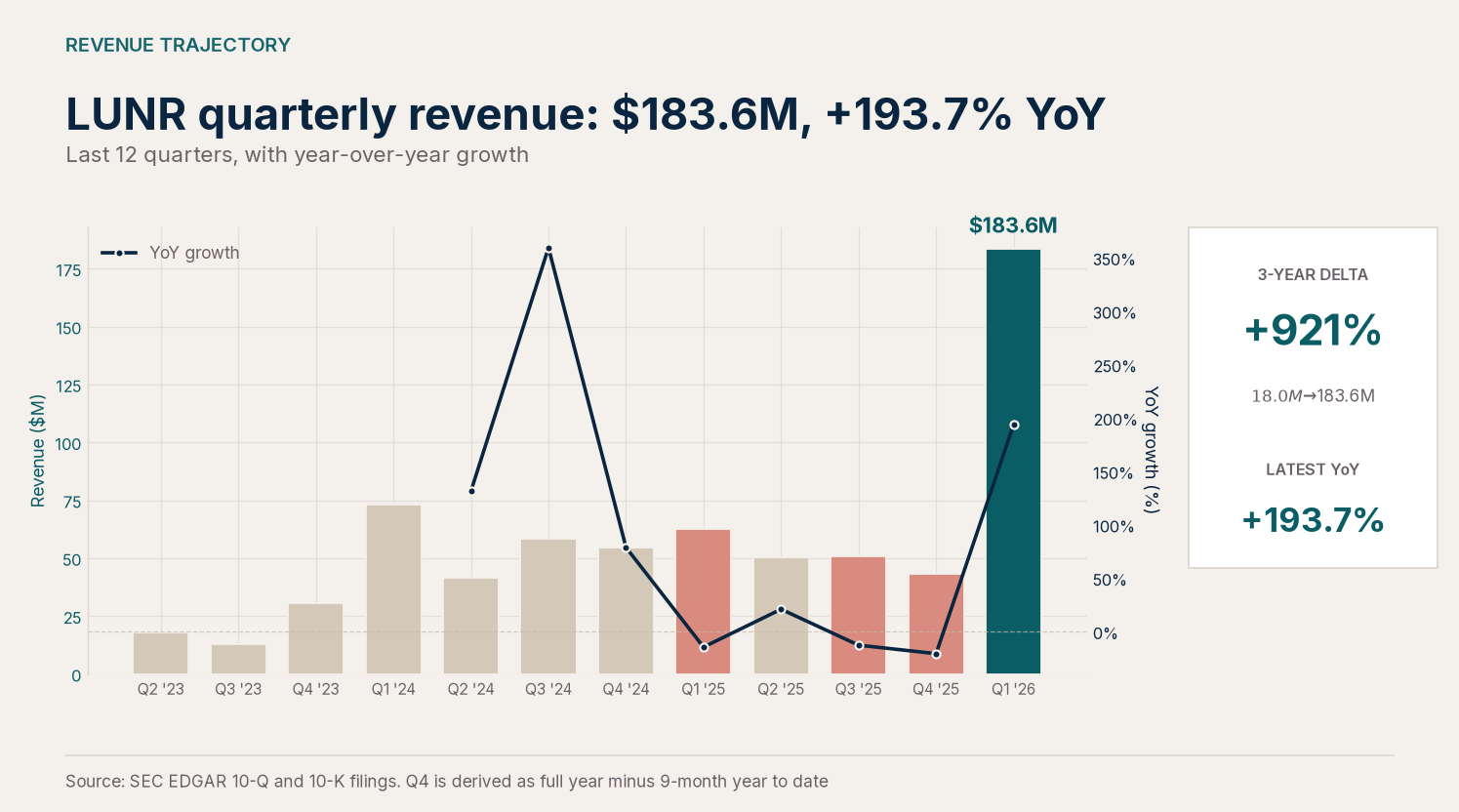
How does it compare to peers?
Well, Rocket Lab runs a 37% gross margin and grew 64%. The market pays $46.5B for it.
Redwire runs a 13% gross margin on 58% growth for $2.5B.
Intuitive Machines is closest to Redwire on quality and size, and it trades at $2.2B.
The stock is not expensive when compared to management guidance. At $2.24B against the $950M guidance midpoint, that’s roughly 2.4x 2026 sales.
Rocket Lab trades at many multiples of that. The thing is that Rocket Lab’s revenue exists and Intuitive Machines’ is a forecast requiring 3 consecutive record quarters.
Fundamental conclusion: the business inflected and the balance sheet did not. First positive EBITDA, record backlog and a credible move into national security all argue the story is working. Negative equity, a 60% cash drawdown, 2 capital raises in 6 months and guidance demanding 27% to 45% sequential growth from a record base all argue you’ll be asked to fund it again. At 2.4x guided sales you’re paid for that risk. At 6.8x trailing sales, you’re paying for the guide to be right.
Technicals
There’s no way to make this chart look good.
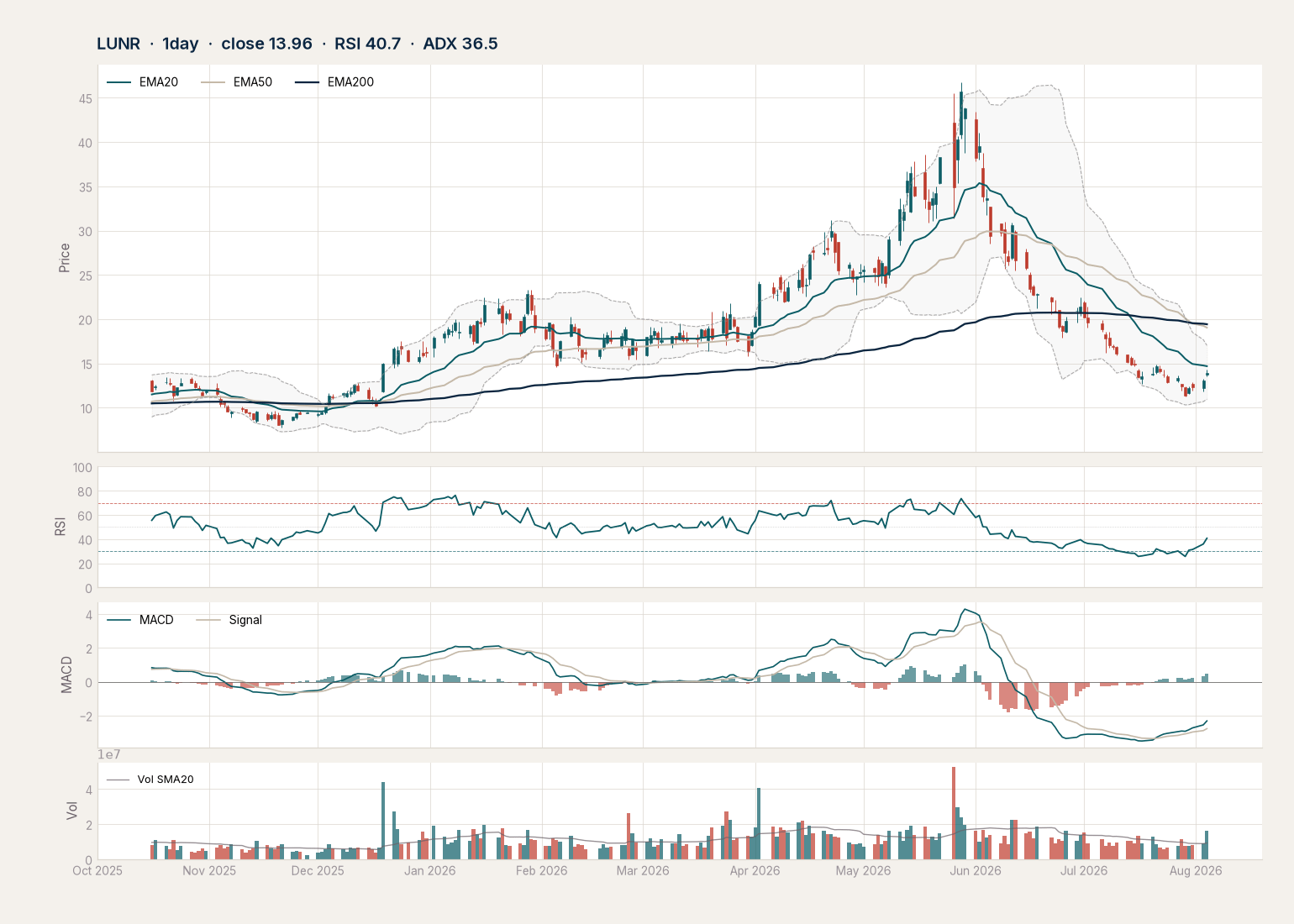
Price at $13.96 sits below every daily moving average: the 20-day at $14.69, the 50-day at $19.04, the 200-day at $19.42 and the 100-day at $20.79. When the 50-day, 100-day and 200-day all sit 36% to 49% above spot, the damage is structural, not a dip.
ADX at 36.5 means a strong trend is in force, and the direction is down, with sellers at -DI 28.9 against buyers at +DI 17.7.
RSI is 40.7, weak but nowhere near washed out.
MACD is improving, at -2.31 against a signal of -2.77, so the histogram has turned positive at +0.46. That’s deceleration, not a reversal.
ATR is $1.46, which is 10.5% of the share price. This name moves more in a day than most move in a month, and any stop has to respect that.
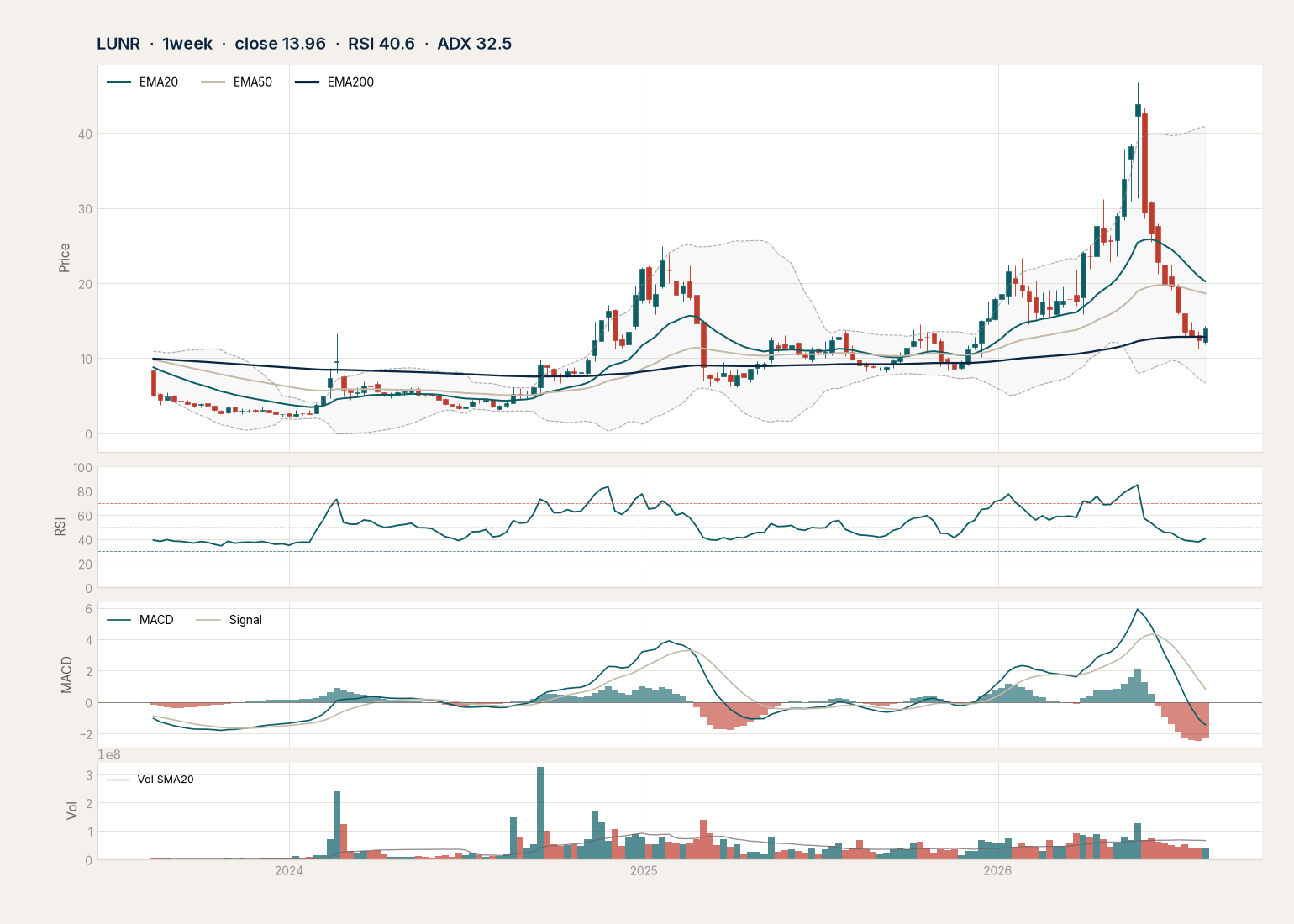
The weekly chart holds the only level that matters. Price is below the weekly EMA20 at $20.24 and the weekly EMA50 at $18.64, but it remains above the 200 week at $12.85. That average has defined the floor of this entire structure, and it sits just under the swing low at $11.29.
Technical conclusion: a Breakdown, not a base. Our framework’s rule for names in this condition is to stay out until price reclaims something, and nothing has been reclaimed. The one constructive detail is that the weekly 200-day at $12.85 is still holding, roughly 8% below spot. That is where a speculative buyer has defined risk. Everywhere else is guessing.
The Trade Plan
Earnings land Thursday, August 13, so everything below carries the same warning we give every name into a print. This one is riskier than most, because a 10.5% daily range means a bad number can move this stock 20% before you’ve finished reading the release.
The framework’s default answer here is no position. Price is below every average with a strong downtrend confirmed. That said, here are the levels that would change the picture.
Speculative starter: $12.85 to $13.40. This is the weekly 200-day, the last structural support in the name. Starter size only, and only if you accept that you’re buying a downtrend.
Stop: below $11.20. That sits under the swing low at $11.29. Losing it opens the 52-week low at $7.78, and there is nothing in between.
The reclaim that matters: a daily close above $15.00. Above there, the 20-day flips from resistance to support and the first real objective is the weekly 50-day at $18.64.
Targets:
T1 at $14.69 at the 20-day
T2 at $18.64
T3 at $20.79 where the 100-day sits
If it gaps down through $11.20 after earnings, there’s no trade. That’s a fresh leg lower and the next reference is $7.78.
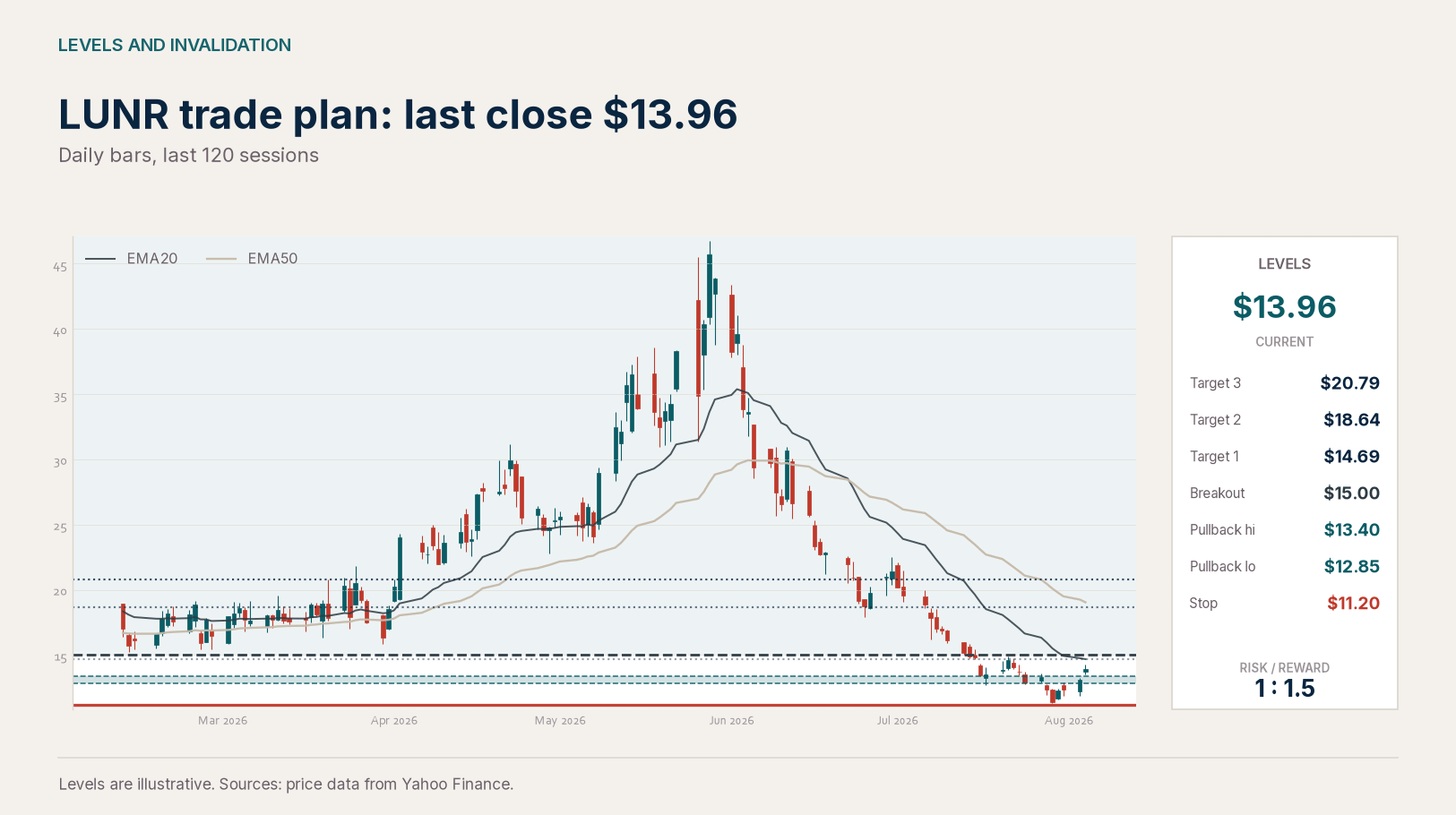
The stop sits around 15% below the entry zone, because a name with a 10.5% ATR cannot carry a tight stop. Position size has to be small enough that a 15% loss is survivable. If it isn’t, the trade is too big.
Bottom Line
Intuitive Machines is a genuinely improving business inside a broken chart.
The bull case is straightforward. Backlog of $1.1B, first positive EBITDA, a place on a Space Force programme with a multi-billion ceiling, 18 spacecraft ordered through L3Harris, and a Moon economy NASA is funding at scale. At 2.4x guided 2026 sales, none of that is priced as a certainty.
The bear case is equally straightforward. Guidance requires beating a record quarter by up to 45%, 3 times consecutively. Equity is negative, cash fell 60% in a quarter, and the company has raised twice in 6 months with a $500M programme still open. Meanwhile SpaceX’s arrival removed the reason anyone had to own the small caps by default.
The analyst mean sits at $39.22 against a $13.96 price. When the gap between the analysts and the market is that wide, one of them is badly wrong.
One number decides it: $12.85. Above the weekly 200-day, this is a beaten-down growth story with defined risk. Below it, the last support in the structure is gone and $7.78 comes into view.
We don’t predict. We prepare.
All content provided is for informational and educational purposes only and does not constitute investment advice, a recommendation, or an offer to buy or sell any security. The trade plans, levels, and scenarios discussed are illustrative frameworks based on market structure and are not guarantees of performance. Markets involve risk, and losses are possible. Past performance is not indicative of future results. Each reader is responsible for their own investment decisions, position sizing, and risk management