


IREN closed Tuesday at $46.93, up 27.5% over 4 sessions, and it led its peer group doing it. Cipher Digital rose 26.7%, Nebius 22.2%, TeraWulf 21.9%, Core Scientific and Applied Digital 16.6% each. Bitcoin added 1.3%.
Leading a group that moved together isn’t the same as being repriced. On daily close-to-close returns over the 3 months to September 8, IREN correlated 0.85 with Core Scientific, 0.83 with Applied Digital and 0.78 with both TeraWulf and Cipher Digital. When the basket moves, IREN moves.
Tuesday shows what that costs in information. IREN announced that its 2 gigawatt Sweetwater Hub had been conditionally classified as Base Load in the ERCOT process, a genuine milestone on its largest development. The stock rose 5.0% and finished mid-pack. TeraWulf rose 8.2%, Nebius 7.7% on a Palantir partnership, Applied Digital 7.4%.
Underneath sits the fact every write-up reached for. In the June quarter IREN’s AI cloud revenue passed its bitcoin mining revenue for the first time, $70.5 million against $66.7 million. The crossover is real. It’s also not unique, and why it isn’t is the story.
Key Takeaways
AI cloud revenue was $70.5 million in the June quarter against $66.7 million of mining. Across the full year bitcoin was still 82% of revenue.
TeraWulf and Core Scientific crossed earlier. What separates IREN is that it buys and runs the hardware while they lease space and power.
Deferred revenue grew $1.84 billion, 88% of the $2.10 billion of reported operating cash flow. Of the $1,842.6 million closing balance, 97.5% is non-current.
Contracted obligations were $16.6 billion at June 30, before July’s $2.8 billion and an August deal of undisclosed value.
Prices are the Tuesday September 8 close, the last completed session. Wednesday is pre-open as this is written.
The Crossover Is Real, and It Isn’t Rare
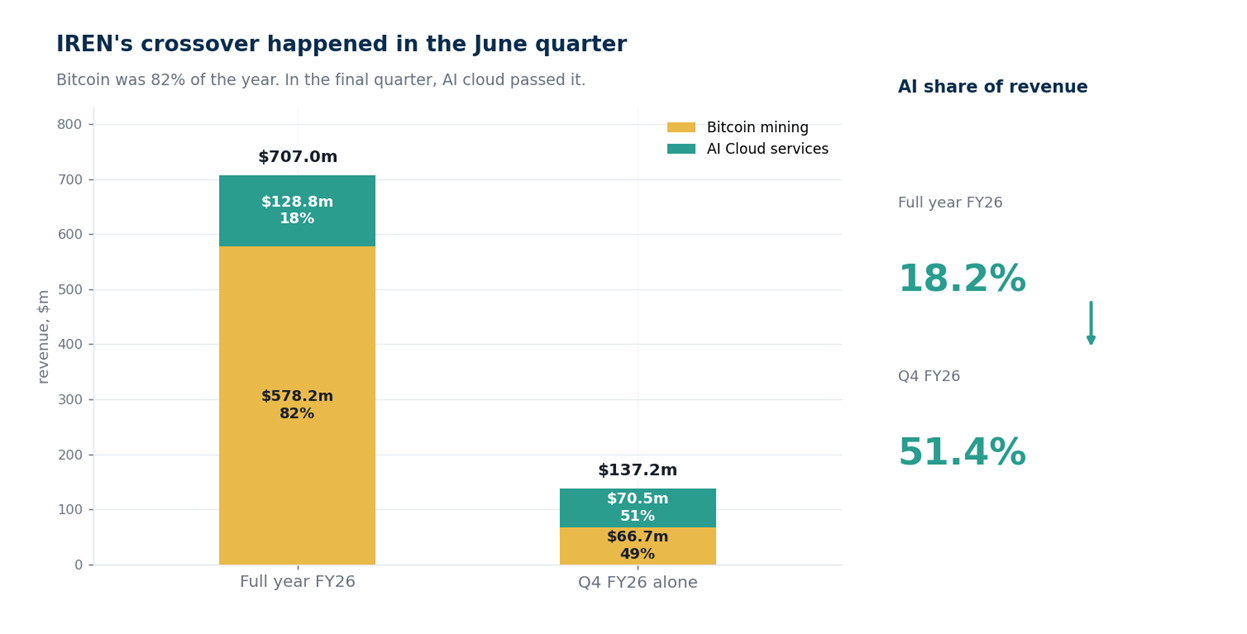
For the year to June, IREN did $707.0 million of revenue, up 41%. Bitcoin mining was $578.2 million and AI cloud $128.8 million, so the old business was still 82% of it. The June quarter inverts: $137.2 million total, AI cloud $70.5 million, bitcoin $66.7 million. The AI share went from 18.2% across the year to 51.4% in the final 3 months.
The annual rate hides the cost. Quarterly revenue peaked at $240.3 million in September 2025 and fell to $137.2 million by June, a 43% decline, because bitcoin collapsed faster than AI arrived. The run rate nearly halved while the full year grew 41%. IREN lost $702.6 million in fiscal 2026, $638.8 million of it non-cash impairment from decommissioning mining hardware.
Now the part that undercuts the easy version. TeraWulf got there first: HPC lease revenue was 62% of its total in March, then $31.9 million against $12.8 million of digital assets in June, 71%. Core Scientific is further along, with June colocation revenue of $136.7 million against $21.5 million of self-mining, roughly 84%. Cipher renamed itself Cipher Digital in February to make the same point.
IREN didn’t cross first and isn’t crossing alone. Anyone selling the crossover as the differentiator hasn’t read the peer filings.
What Actually Separates Them
The difference isn’t that these companies left bitcoin. It’s what they became.
TeraWulf, Core Scientific and Cipher Digital are landlords. They lease space, power and cooling to somebody else who brings the compute. TeraWulf’s Anthropic arrangement runs 20 years over 401 megawatts; Cipher’s capacity goes to AWS and to Fluidstack for Google. Landlord is shorthand: these companies still design, finance and operate complex data centres. The customer owns the compute risk.
IREN is doing something structurally different. It buys the NVIDIA hardware, operates it, and sells AI cloud services directly. Customer prepayments, the company says, cover 45% to 55% of the associated GPU capital cost.
That choice changes everything downstream. IREN carries the hardware, so it absorbs obsolescence risk a landlord never touches. Its portfolio averages roughly 4 years against 10 to 20-year base terms across much of the colocation cohort, so it re-prices sooner, either way. It needs more capital per megawatt. And if it works, it keeps the margin between renting a building and selling compute, which is the reason to take the risk.
That’s a real fork in the road, and the market isn’t pricing it. These 6 names moved within 11 percentage points of each other over those 4 sessions while running materially different businesses.
What the Contracts Say
Microsoft signed on November 3, 2025: 5 years, roughly $9.7 billion of contract value, a 20% prepayment, and an expected $1.94 billion of annualised run-rate revenue once commissioned. NVIDIA followed in May 2026 with about $3.4 billion. In July, Prometheus, Perplexity and Together AI added about $2.8 billion, and in August IREN signed a frontier lab whose value it hasn’t disclosed. Horizon 1, the first of 4 liquid-cooled 50 megawatt Microsoft deployments, arrived that month.
The company’s own measure beats adding up press releases. Unsatisfied performance obligations plus contracted lease value totalled $16.6 billion at June 30, before the July and August additions.
Hold that against the accounts, and mind the dates. The AI business billed $70.5 million in the June quarter, annualising to $282 million of recognised revenue. Operating run-rate was $1 billion on August 26. Contracted run-rate is $4 billion on capacity targeted to be operational by December 31. Those are 3 clocks, and IREN warns run-rate can materially exceed recognised revenue. The distance between $282 million and $4 billion is where the equity value lives.
Management intends bitcoin mining to be effectively decommissioned by the end of December. This is not a hedged pivot.
The Same $20.2 Billion, Divided 4 Ways
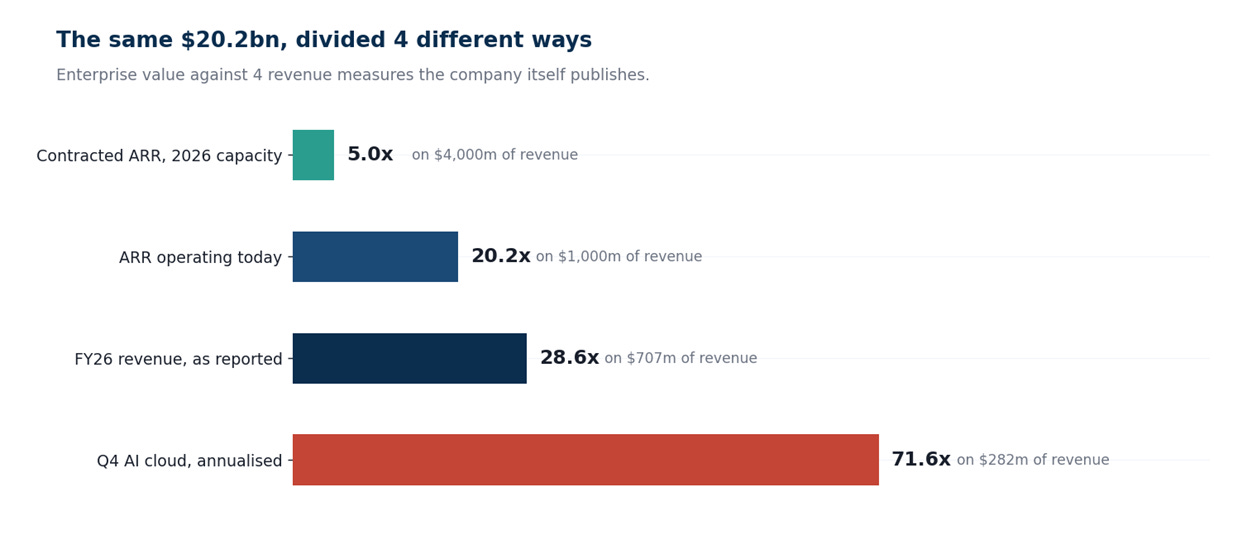
At $46.93 the equity is worth $18.5 billion. Add $7.59 billion of borrowings, take off $5.90 billion of cash, and enterprise value is $20.2 billion.
Against the $707 million reported for the year, that’s 28.6 times. Against the AI quarter annualised, 71.6 times. Against the $1 billion operating run-rate, 20.2 times. Against the $4 billion contracted, 5.0 times.
All 4 are defensible and they differ by a factor of 14. Anyone quoting a single multiple has chosen a conclusion first. What the range tells you is that the valuation already assigns substantial value to capacity that hasn’t yet produced reported revenue.
Where the Cash Comes From
Operating cash flow was $2.10 billion. On $707 million of revenue, that should stop you.
It isn’t earnings. Deferred revenue grew $1.84 billion during the year, 88% of the reported figure. That’s customer money, the Microsoft prepayment and its equivalents, sitting as a liability until capacity is delivered. Strip it out as an analytical adjustment and the underlying figure is about $259 million. The closing balance was $1,842.6 million, 97.5% of it non-current, so IREN doesn’t expect to recognise it within 12 months.
Against $4.33 billion of capital spending, free cash flow, on my calculation rather than a reported line, was negative $2.23 billion.
The gap closed in the capital markets. Inflows included $4.74 billion from ordinary shares, $6.30 billion from convertible notes and $938 million from financing facilities. After $1.62 billion of induced conversion payments, capped calls, fees and repayments, net financing cash flow was $9.68 billion. Cash went from $564.5 million to $5.90 billion against $7.59 billion of borrowings, leaving net debt near $1.7 billion, the one comfortable number.
The stack is more layered than it looks. Customers fund a large piece up front, asset-backed lenders finance much of the GPU balance, and the capital markets fund the infrastructure around it. IREN says its Microsoft GPU financing plus prepayments covers 96% of the associated GPU cost, and a newer $2.8 billion of GPU financings covers 90% before any prepayment. Revenue arrives after the capacity does.
The Pattern Worth Noticing
IREN’s intraday high was $76.87 on November 5, 2025, 2 days after the Microsoft contract. The stock is 38.9% below.
Oracle traced the same shape, peaking the session after it revealed the backlog that made it an AI infrastructure company, and sits about 53% below. The announcement was the top; the construction has been the drawdown. If that holds, the re-rating comes not from another contract but from the AI line climbing from $70.5 million a quarter toward the run-rate the company publishes.
The Case Against Me
The bull case deserves stating properly. 2026 capacity is largely sold out, the counterparties are Microsoft and NVIDIA rather than start-ups, Horizon 1 is delivered, and mining is being switched off rather than milked. Roughly 26% of the shares were short in mid-July, so delivery into that can move the price a long way.
The ERCOT ruling is more load-bearing than its reaction suggested, though it’s provisional and a later commitment gate still has to be cleared. If power is the constraint, a ruling on 2 gigawatts beats another contract IREN can’t yet serve.
The model argument cuts both ways too. Owning the hardware is what makes IREN more than a landlord, and it’s also what could ruin it if utilisation or GPU pricing disappoints.
