


SoFi is down about 50% from its 2026 high and 8% since our June piece, while every operating quarter keeps setting records. The market’s reasons are specific: rising personal-loan charge-offs, a soft quarter in its loan-marketplace arm, and a technology segment still filling the hole a big client left. The company reports Wednesday morning, options price an 11.5% move, and the stock enters the print sitting on the floor of its summer range.

The price says credit cycle. The income statement says compounder. Wednesday tests the difference.
Our June 19 piece, written at $17.91, concluded that SoFi at 40x earnings “isn’t a chase” and set 2 triggers: add on a clean reclaim of $20, or down near the $15 base. Neither fired.
The stock rallied to $19.74 on July 10, failed just under our $20 line without ever closing above it, and has since bled to $16.46, Friday’s close, right on its lower volatility band.
Patience cost nothing and saved 8%. Now comes the event the June piece said would settle it: second-quarter results, Wednesday, July 29, before the open.
Prices below are based on the July 24, 2026 close; estimates and metrics are from company releases and Street previews.
Key Takeaways
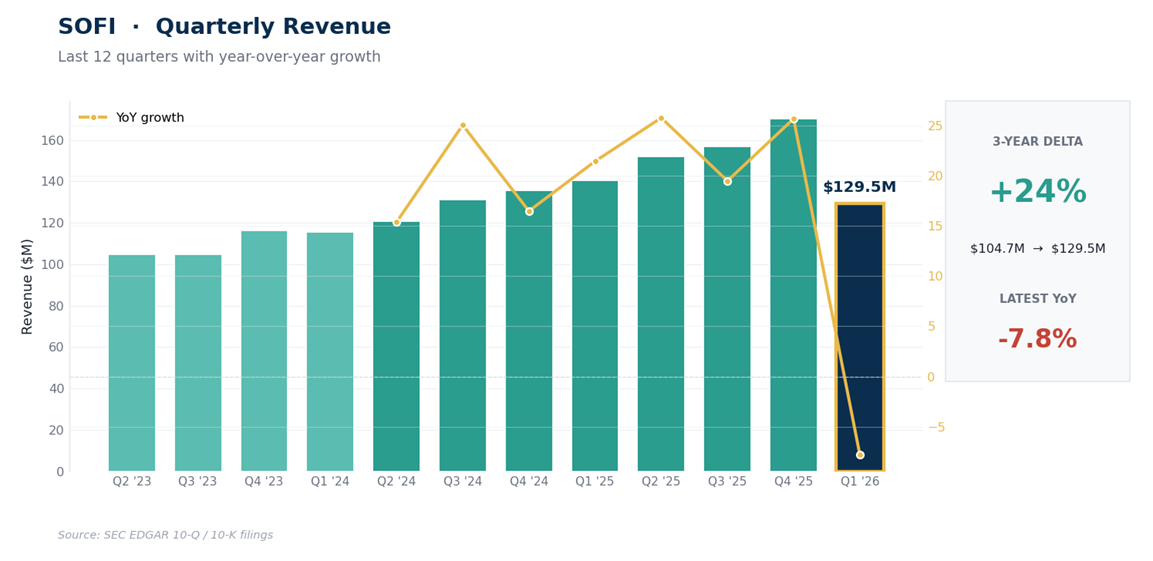
The stock has been cut roughly in half from its 2026 high of $32.73 while the business kept compounding: the March quarter set records with net revenue of $1.10B, up 43%, net income of $167M, and originations of $12.2B, up 68%.
The derating has 3 specific drivers: personal-loan charge-offs near 3.03%, a loan-marketplace arm that missed expectations on softer private-credit demand, and technology-segment revenue down 27% after Chime’s departure.
Wednesday’s consensus: revenue near $1.12B and EPS of $0.11, against a full-year guide of $4.655B in adjusted net revenue (about 30% growth) and $0.60 of adjusted EPS. Options imply an 11.5% post-earnings move.
The stock now trades near 27x this year’s $0.60 adjusted EPS guide (near 30x that same guide at June’s price) and about 20x next year’s consensus; the analyst mean sits at $20.63, about 25% above the price.
The map: support zone 15.90 to 16.50, invalidation at a daily close below 14.90 (under the May low), repair above 18.20, references 19.70 and 21.
The Derating: How Half Off Got Cheaper
SoFi’s price and its income statement spent 2026 telling opposite stories. The business kept delivering: the March quarter was another record, with net revenue up 43% to $1.10B, net income of $167M (more than double a year earlier), record originations of $12.2B, and membership up 35%. The stock fell anyway, and not irrationally.
The annualized net charge-off rate on the personal-loan book, as SoFi reports it, ticked up to about 3.03%, reviving the oldest bear case on this name: that SoFi is a consumer lender wearing a fintech multiple, and that the loan book’s credit costs show up before the fee-business dream pays.
The loan marketplace, where SoFi originates for private-credit buyers and earns fees without balance-sheet risk, came in below expectations with a cautious near-term outlook, denting the segment that was supposed to de-risk the model. And the technology segment, Galileo, is still working through the 27% revenue drop our June piece flagged after Chime moved off its rails. That’s 3 real dents, priced in one 50% drawdown.
What Wednesday Has to Show
The consensus bar is low relative to the company’s own habits: about $1.12B of revenue and $0.11 of EPS, versus $1.10B and $0.12 just reported in March. SoFi has made a routine of beating and raising; the full-year guide of $4.655B in adjusted net revenue and $0.60 of adjusted EPS has been lifted repeatedly. Whether it gets lifted again matters less than 4 specific lines.
First, charge-offs: our marker, not management’s, is 3.5%; another rise toward it feeds the credit-cycle story regardless of the headline beat, while stabilization near 3% starves it.
Second, the loan marketplace: volumes and fees need to stabilize after last quarter’s miss, because this segment is the fee-based future the premium multiple depends on.
Third, Galileo: any evidence the new client signings are refilling the Chime hole, since the technology narrative can’t run on promises for a third straight quarter.
Fourth, deposits and members: the cheap-funding engine behind the whole model, where growth has yet to slow. A quarter that clears all 4 rewrites the derating story. A beat that misses on 2 of them probably doesn’t.
What the Price Now Assumes
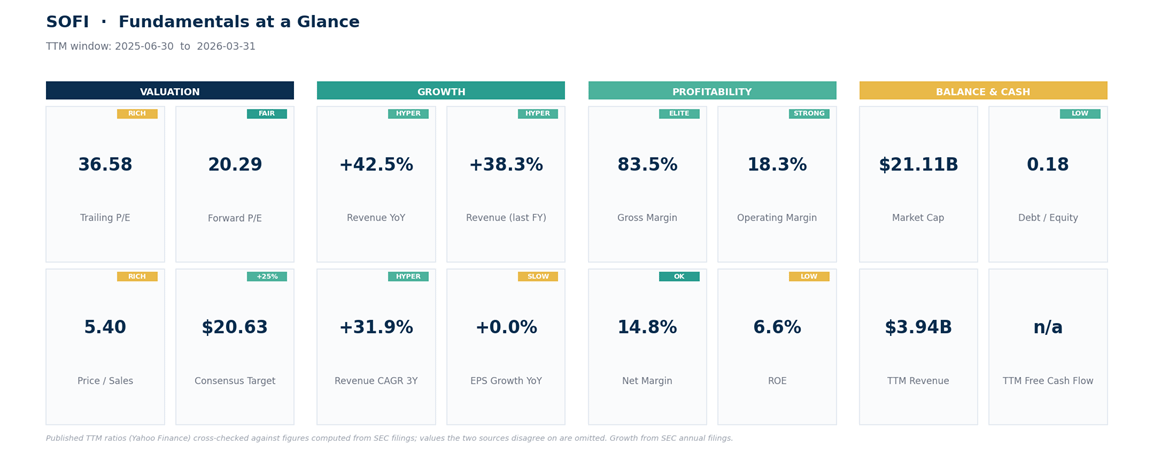
The valuation reset is the quiet story here, and it needs the same yardstick on both dates. Measured against the same $0.60 full-year adjusted EPS guide, the stock traded near 30x at our June price of $17.91 and trades near 27x today; next year’s consensus takes it to about 20x, and price to trailing sales (market cap against trailing-12-month revenue) sits at 5.4x, for a company still guiding to roughly 30% revenue growth. The bigger compression happened before June, on the ride down from $32.
The flat trailing EPS line on valuation screens remains an illusion, the leftover of a one-time tax benefit in the 2024 base we unpacked in June, not a stalled business. Return on equity near 6.6% is the honest weak spot: for all the growth, the profit engine is young.
The Street’s mean target of $20.63 sits 25% above the price and the median at $18 sits 9% above, which mostly tells you analysts have stopped defending the old highs but don’t believe the credit-cycle discount either. At this price, SoFi no longer needs a flawless fintech outcome, but it still needs credit stability, durable growth, and a return on equity that keeps climbing.
That’s a lower bar than the one the stock failed at $32; it isn’t a bank multiple either, and Wednesday is the next vote on whether the premium is deserved.
The Map and the Earnings Plan
One possible framework, not a promise, and this week the map comes second to the calendar: an 11.5% implied move is larger than any planned stop below, which means positions carried into Wednesday accept gap risk no level can control. The stock enters the print oversold short-term (the fast momentum gauge is pinned near its floor while daily RSI sits at 41) and resting on its lower volatility band at the bottom of the summer range.
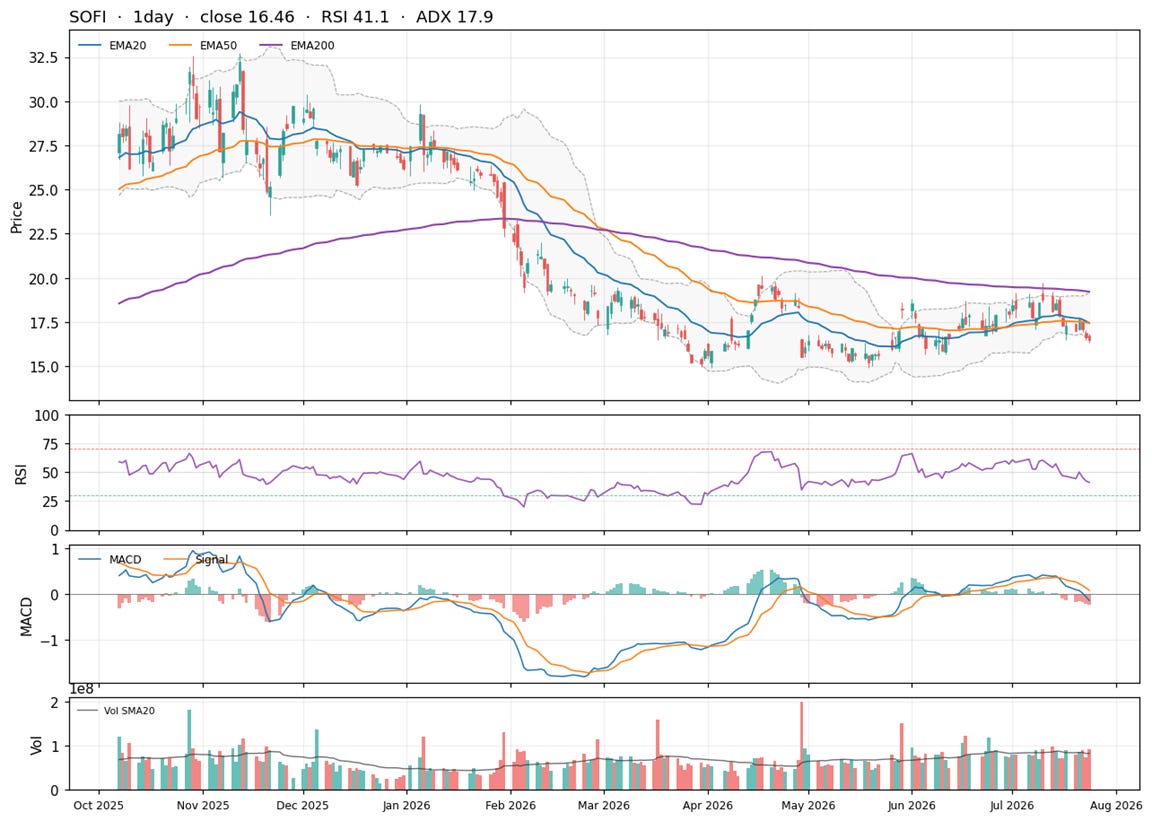
Support zone: 15.90 to 16.50, Friday’s low (16.33), the lower volatility band, and the deep retracement shelf of the May-to-July rally. The stock is sitting in it now.
Invalidation: a daily close below 14.90, under the May low of $14.92, which is also the 52-week low. Below that, the summer base has failed and the market is signaling that the credit concerns remain unresolved.
Repair: a daily close above 18.20 reclaims the 100-day average, the first level of the July breakdown worth trusting, with references above at 19.70 (the July high) and 21, which clears the 200-day average and the round $20 in one move.
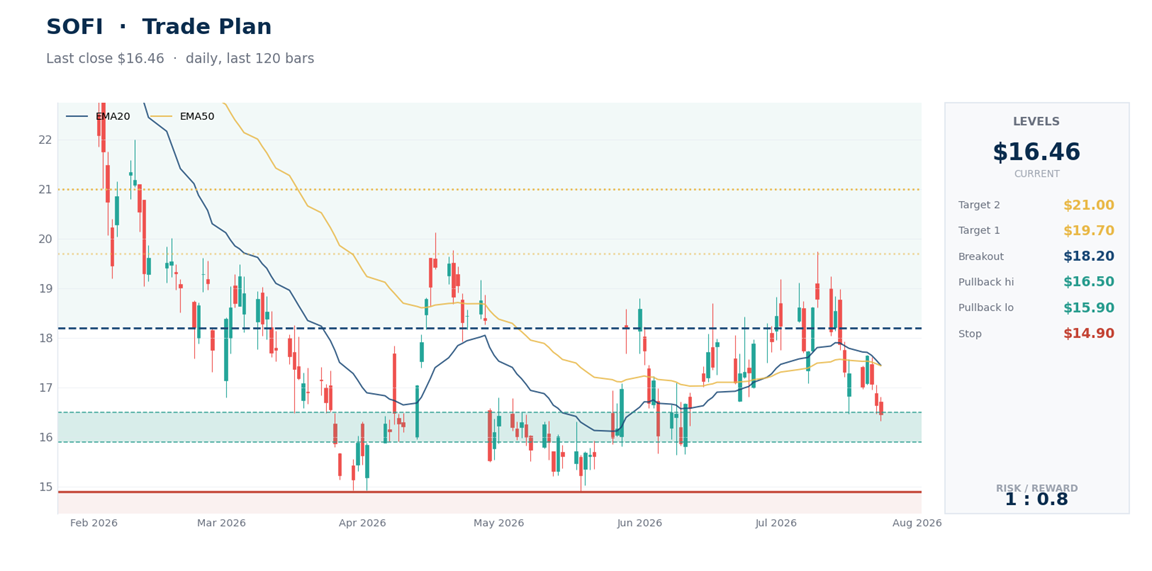
For positions into the print (illustrative): the distance from a $16.20 fill to the 14.90 line is about 8%, but realized loss can be materially larger, because the line is a closing-basis trigger and earnings can gap straight through it. Size so even a 12% to 15% gap against you stays inside your portfolio risk budget, or don’t carry the position through the report. The numbers land before Wednesday’s open, so whatever the market decides arrives as an opening gap, not a move you can manage in real time.
For patient capital, the June logic still applies with better prices: react, don’t predict. A post-earnings hold of 15.90 to 16.50 or a reclaim of 18.20 on the numbers is a signal; buying immediately before the report offers weaker risk-reward than waiting for either one.
Bottom Line
Since June, the framework did its job by doing nothing: no trigger fired, and the stock is 8% cheaper. Wednesday resets the whole question. SoFi enters the print halved from its high, at 27x a guide it has repeatedly raised, with the market focused on charge-offs, the loan marketplace, and Galileo rather than headline growth alone. If credit stabilizes and the fee businesses improve, the core justification for the derating begins to weaken, and the 18.20 repair is the confirmation to act on. If charge-offs keep climbing, no beat saves the multiple, and 14.90 is where the base formally fails. We don’t guess at binaries; we let Wednesday pick the story and trade the level it picks.
This is research and commentary, not personal investment advice. Levels and trade plans are illustrative; size positions to your own risk tolerance and time horizon. The author may hold positions in names discussed.