


This week isn’t just another turn of the market wheel, it’s a collision course between fragile fundamentals and a mountain of expectations.
On the calendar? A barrage of economic data that will either justify Wall Street’s optimism or shatter it:
Producer Price Index (PPI) on Wednesday
Consumer Price Index (CPI) on Thursday
Payroll revisions on Tuesday
Plus, ongoing political dramas in Europe and Japan, and commodity markets that are quietly rewriting their own rules.
The irony is hard to miss: equities are testing record highs even as the data beneath them weakens. It’s like a Broadway stage with dazzling lights and polished choreography, but the floorboards are starting to creak.
Key Takeaways
CPI & PPI are the week’s biggest catalysts.
Labor market cracks are widening fast.
Earnings “beats” are built on sand, not growth.
Gold flirts with records, oil pushes higher, dollar slips.
Political turmoil in France and Japan adds tension.
The risk: eventually, “bad news is good news” flips into just plain bad news.
Inflation Watch: The Main Course
Let’s not sugarcoat it. CPI and PPI are this week’s main event.
Markets are clinging to the idea that imported disinflation from China will finally filter into U.S. price data. The dream scenario? Softer wholesale and consumer prints, giving the Fed political cover to deliver a generous September cut.
The August jobs report, which showed a meager 22,000 payroll gains, already set the stage. With revisions pushing prior months lower, traders suddenly went from cautiously expecting one rate cut to whispering about a 50-basis-point bazooka.
But here’s the tension: if inflation doesn’t cooperate, the Fed’s hand may not be as loose as Wall Street hopes. Rate cut dreams could crash into the brick wall of sticky prices. And when that happens, tantrums are guaranteed.
Jobs Market: Cracks Are Showing
The U.S. labor market, long described as “resilient,” is starting to look less like a fortress and more like a sandcastle at high tide.
For the first time in four years, the number of unemployed Americans now exceeds job openings.
August payroll gains were the weakest in years.
Previous months weren’t just disappointing, they were revised into negative territory.
This isn’t noise. It’s the canary in the coal mine.
When job openings shrink, hiring slows, and revisions turn red, it signals something deeper: demand is cooling, momentum is slipping, and companies are tightening the purse strings. That’s why the jobs narrative matters so much. It’s not just about paychecks, it’s about confidence, consumption, and the flywheel of growth.
The question now is whether the Fed cuts will arrive in time to soften the blow, or whether they’ll look more like an emergency parachute after the engine’s already failed.
Earnings: The Sugar High Fades
Quarterly earnings reports were supposed to be the market’s anchor. Instead, they look more like a temporary sugar high.
Yes, many companies “beat” expectations. But that’s less a testament to robust growth and more a clever game of expectations management. Companies whisper lower guidance to analysts, then step gingerly over the lowered bar. Voilà: a beat.
But scratch beneath the surface, and the picture isn’t pretty:
Margins are under pressure.
Top-line growth is slowing.
“Beats” aren’t translating into sustainable upward revisions.
Investors may ignore this in the short term; after all, the Fed is the only show in town right now. But if earnings momentum keeps fading, the market’s lofty multiples will eventually feel like a balloon trying to float without helium.
Global Side Show: France & Japan
As if the U.S. narrative wasn’t messy enough, geopolitics demanded a cameo this week.
France
Political chaos is back on stage. Votes of no confidence, rising bond yields, and a euro that can’t decide whether to sulk or rally. French debt is under the microscope again, and every twitch of volatility in Paris ripples through the broader eurozone.
The kicker? Despite all the drama, EUR/USD climbed to a five-week high, proving yet again that FX markets sometimes enjoy chaos almost as much as they fear it.
Japan
Meanwhile in Tokyo, Prime Minister Shigeru Ishiba’s resignation might have looked like a crisis. Instead, it became a rallying cry for risk. The Nikkei surged to record highs, fueled by expectations that political instability means looser monetary policy and a weaker yen.
It’s an almost Shakespearean twist: a political vacuum at the top, but champagne on the trading floors.
Commodities & Currency Moves
If equities are fueled by Fed speculation, commodities are writing their own story.
Gold: Near record highs again, a glittering reminder that when investors don’t trust the economy or the Fed, they trust the oldest store of value around. Weak jobs data plus falling yields are gold’s perfect cocktail.
Oil: Rising in defiance of OPEC+’s production boost. Why? Because sanctions on Russian oil keep supply fears alive. The physical market is tighter than the headline numbers suggest.
Dollar: The U.S. Dollar Index (DXY) has slipped to its weakest level in months (~97.40). Cuts + geopolitics = dollar under scrutiny, and for once, the greenback isn’t looking invincible.
The through-line? The dollar’s losing altitude, while commodities; often the market’s “truth serum”, are flying high.
The Big Picture: A Balancing Act
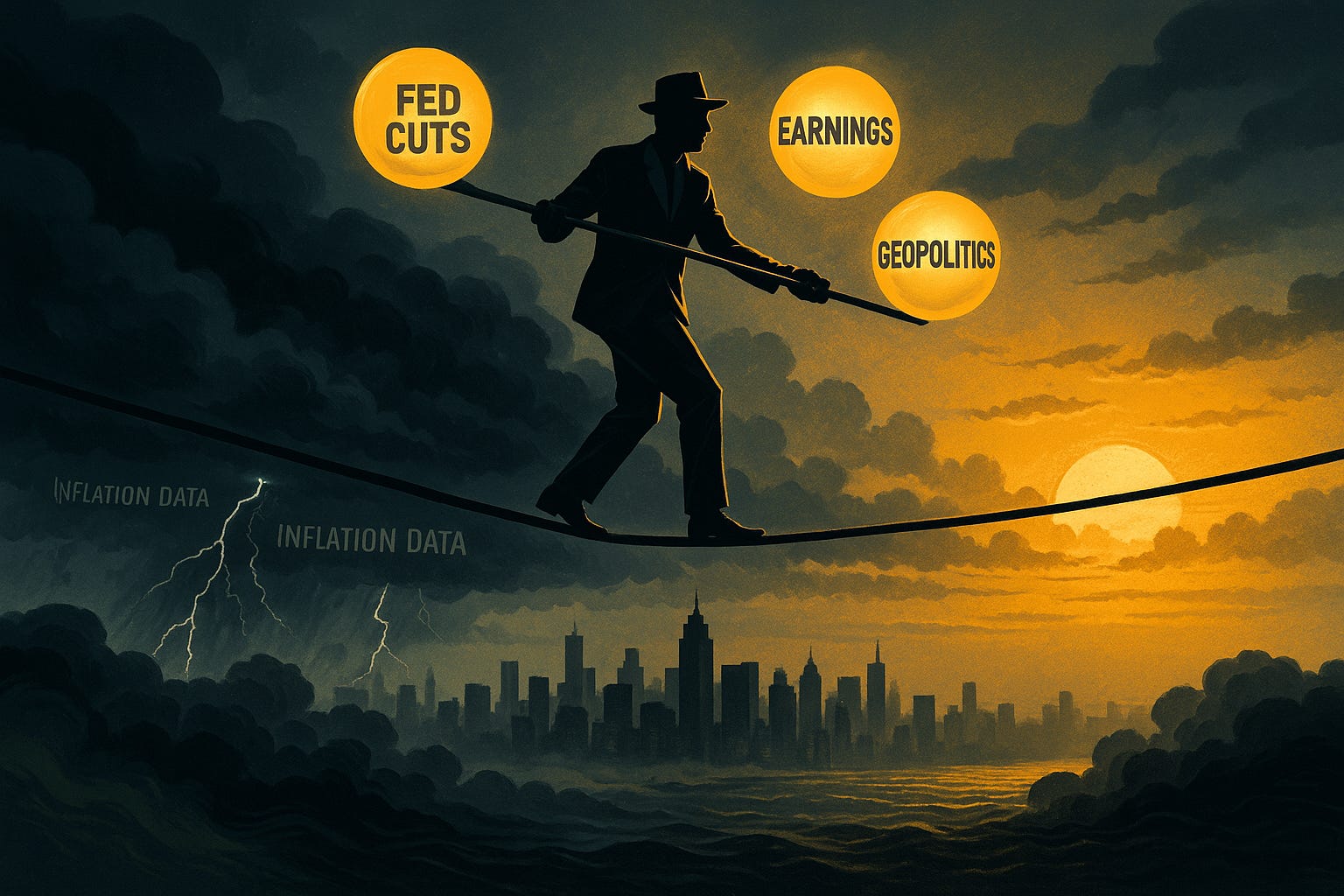
Markets today are like a tightrope walker juggling fire. The balance is precarious, and the applause could turn to gasps at any misstep.
Three narratives are colliding:
Fed policy: September cuts look inevitable. The only debate is “how much?”
Economic slowdown: Jobs, earnings, and consumption are flashing yellow lights.
Geopolitics: France’s fragility and Japan’s political theatre add uncertainty.
The S&P 500 hovering at record highs feels like an act of defiance, a triumph of liquidity over logic. But history reminds us that liquidity-driven rallies end not with a bang, but with a whimper. The danger isn’t today or tomorrow, but in the cumulative effect: when the bad news piles too high for rate cuts to mask.
For now, markets are happy to float on the Fed’s promise. But make no mistake; if the slowdown deepens, those cuts won’t be champagne. They’ll be triage.