


Meta Looks Cheap on Earnings. Earnings Are the Softest Number It Reports.
At $543.67 Meta trades at roughly 16 times forward earnings, 31% below its high, with 62 analysts covering it and not one carrying a sell rating. The lowest target on the Street, $580, sits above the current price. On the multiple everyone uses, this is the cheapest the stock has looked in years.
The problem is the denominator: reported earnings rest on one unusually judgment-sensitive input, and that input is about to absorb the largest capital program in the company’s history. Advertising is strong. Free cash flow is not. And the distance between those 2 facts is an assumption about how long a graphics chip stays useful.

Key Takeaways
Revenue grew 28% to $60.80 billion and advertising 27%, so the demand side of this business isn’t the issue. Operating margin fell from 43% to 31%.
Free cash flow fell 91% to $784 million as capital spending of $31.08 billion consumed almost all operating cash. Meta guided 2026 capex to $130 to $145 billion against $72.2 billion in 2025.
Meta extended the useful life of servers from 4 years to 5.5 in 2025, cutting depreciation by $2.9 billion. Amazon moved the opposite way, shortening its schedule.
Meta has now gone 3 consecutive quarters without repurchasing a share, leaving stock compensation unhedged and the share count drifting up.
A bellwether trial opened in Oakland on August 18, the first phase of litigation brought by 29 states. Damages are put near $200 billion; the $1.4 trillion figure is Meta’s own. The product remedies sought may matter more.
Start with what’s working.
The Advertising Business Isn’t the Problem
This isn’t a broken company and nothing below should be read that way. June-quarter revenue was $60.80 billion, up 28%, a figure the filings and aggregator feeds confirm independently. Advertising was $59.4 billion and grew 27%, with impressions up 14% and average price per ad up 12%, so volume and pricing are contributing together. Management guided September to $61 to $64 billion.
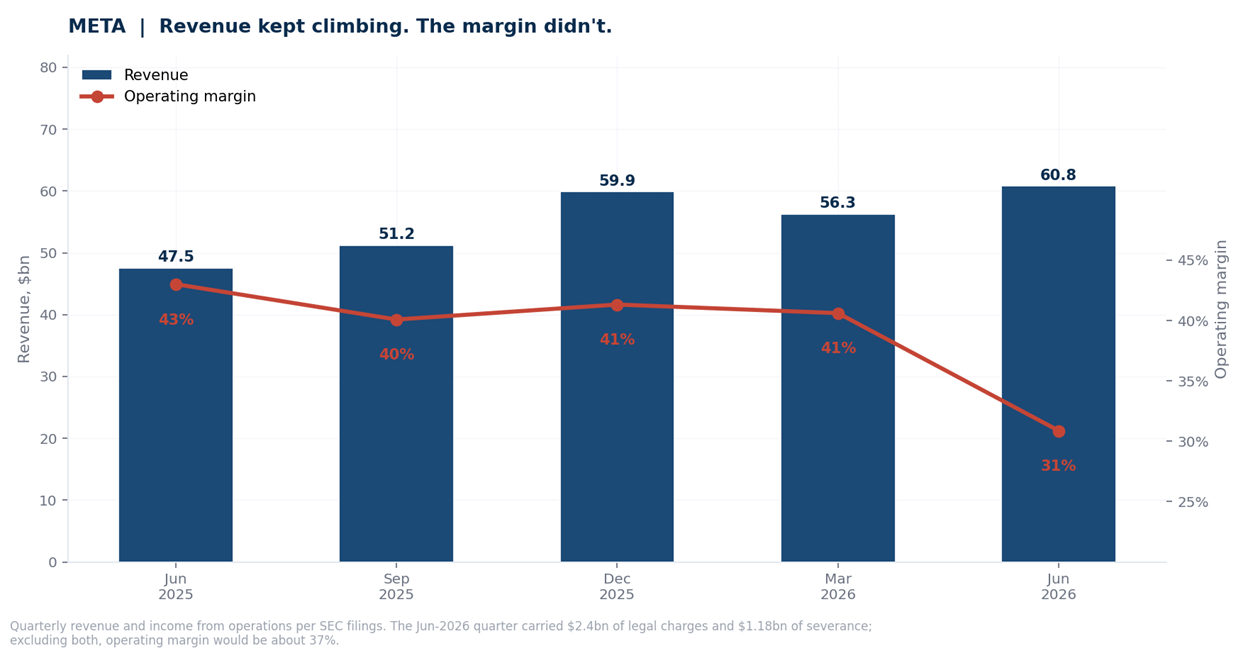
What changed is everything below the revenue line. Total costs rose 55%, research and development up 67% to $21.66 billion. Operating income fell 8% to $18.77 billion, the margin went from 43% a year ago to 31%, and net income fell 14% to $15.85 billion.
Be fair about the composition, because 2 items were quarter-specific: $2.4 billion of legal charges and $1.18 billion of severance tied to the May layoff of roughly 8,000 people. Strip both out and operating income would have risen 9%, putting the underlying margin near 37%. That’s still 6 points of compression, and those 6 points are the part that doesn’t reverse. Legal costs aren’t obviously a one-off here either. Reality Labs generated $431 million of revenue against a $4.62 billion operating loss.
Now for the denominator.
The Assumption Underneath the Multiple
Effective January 2025, Meta extended the estimated useful life of most servers and network assets from 4 years to 5.5. That revision reduced 2025 depreciation by $2.9 billion, flowing directly into reported profit. Management cited better hardware reliability and operational experience, a legitimate argument. Short sellers argued it overstated earnings by understating how fast a graphics chip becomes obsolete, also legitimate.
The reason to take the sceptical side seriously is that Amazon went the other direction. In February 2025 it shortened the useful life of a subset of servers and networking equipment from 6 years back to 5, explicitly citing the increased pace of technology development in AI. 2 hyperscalers facing the same acceleration in hardware economics reached opposite conclusions about useful lives. Both can be defensible, since fleets, workloads and upgrade cycles differ, but the divergence tells you how much judgment sits inside the number.
The argument isn’t that analysts missed the disclosure; they build forecasts off Meta’s stated policy. It’s narrower: if AI hardware loses economic usefulness faster than the accounting life assumes, reported and consensus earnings overstate sustainable economic earnings, and a multiple built on them is less cheap than it looks.
That would be a modest concern if the asset base were stable. It isn’t. Meta guided 2026 capital spending to $130 to $145 billion against $72.2 billion in 2025, close to a doubling. The outlook was raised from an original $115 to $135 billion to $125 to $145 billion in April, before the lower end was lifted again to $130 billion in July. Most of it will reach the income statement as depreciation once assets are placed in service, on varying schedules, landing on the very line the multiple divides by. The effect has started: depreciation and amortisation ran $6.36 billion in the June quarter against $4.34 billion a year earlier, up 46%, before most of the 2026 spending has arrived. Bank of America estimates capital spending will be a 1.6 point drag on operating margins this year against late 2024.
So the multiple looks cheap partly because the market hasn’t settled which company it’s buying: an advertising business with a temporary spending problem, or a capital-intensive infrastructure business never worth 25 times earnings.
Cash settles arguments that accounting can’t.
Cash Doesn’t Care What You Assume
Depreciation is an estimate. Cash isn’t, and the cash statement is where it gets uncomfortable.
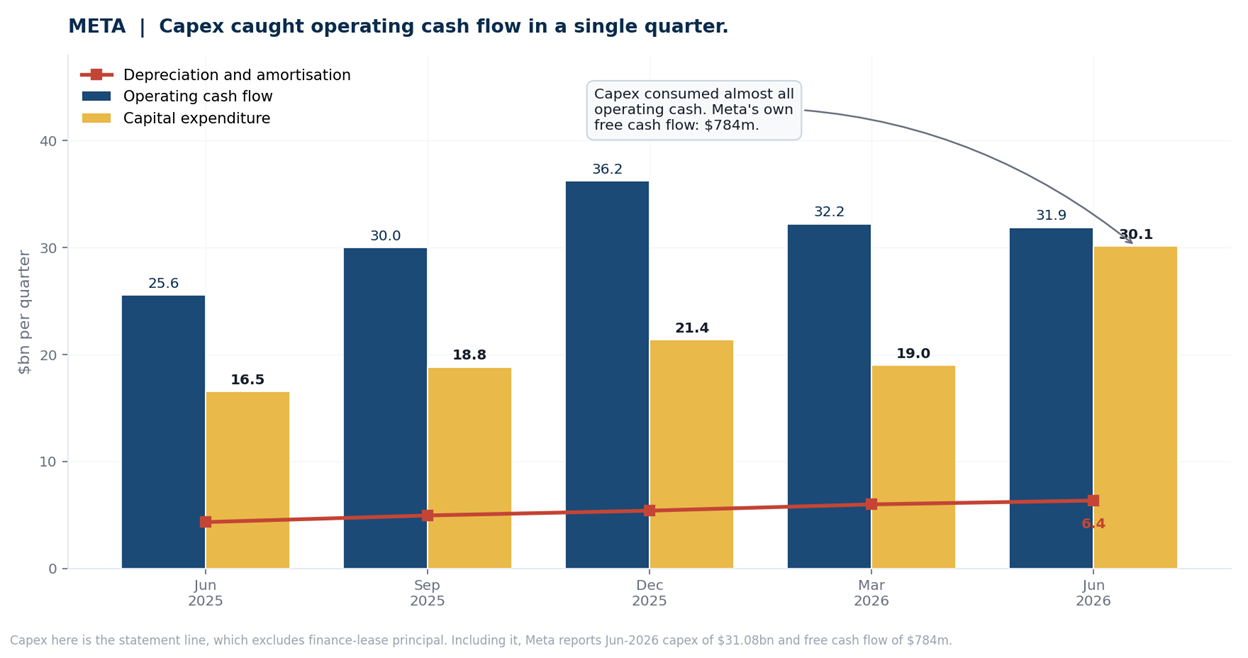
Operating cash flow was $31.86 billion, up 25% from $25.56 billion a year ago, so the business is generating more cash, not less. Capital expenditure is what changed: $31.08 billion including finance-lease principal against roughly $17 billion a year earlier. That left free cash flow of $784 million on Meta’s own definition, against $8.55 billion a year ago, a 91% decline, with capex absorbing about 97% of the cash produced. You’ll see a second pair of figures quoted, since the statement line excludes finance-lease principal and gives $1.75 billion; the direction is identical either way.
Funding the gap has changed the balance sheet. Long-term debt rose to $83.66 billion from $58.74 billion at year-end, roughly $25 billion of it issued in the June quarter, against $90.26 billion of cash and securities.
That comparison understates what Meta has committed to, because the balance sheet doesn’t carry it. The June filing discloses about $279 billion of lease obligations for leases not yet commenced, covering data centres, colocations and network infrastructure beginning through 2036 on terms of up to 30 years. Separately it discloses $349 billion of non-cancelable contractual commitments, mostly third-party cloud capacity, servers, data centres and Reality Labs hardware, of which roughly $54 billion falls due this year and $82 billion next.
Those are 2 different categories and shouldn’t be added together or treated as debt. But they are contracted, enormous next to $83.66 billion of borrowings, and absent when you set that figure against $90.26 billion of cash. Hyperion in Louisiana shows the mechanism: Blue Owl funds own 80% of the venture and Meta 20%, so Meta isn’t the primary beneficiary under the accounting test and doesn’t consolidate it, having agreed an initial 4-year lease from 2029 with options extending to 20 years.
And the buyback is off. Meta has gone 3 consecutive quarters without repurchasing a share, having returned well over $10 billion a quarter that way as recently as early 2025. The $0.525 dividend continues, worth roughly $1.3 billion a quarter, but with repurchases at zero, share-based compensation is no longer being offset through buybacks, putting upward pressure on the share count. For a stock whose bull case is per-share earnings power, that direction matters.
The Trial Nobody Can Price
Opening arguments began in federal court in Oakland on August 18 before Judge Yvonne Gonzalez Rogers. Meta fell 4.4% that session on 1.6 times average volume while Pinterest rose 3% and Snap 2%, which suggests the selling was about Meta rather than advertising.
Be careful with the damages figure, because the widely quoted one isn’t the plaintiffs’. This is a bellwether phase with 4 states as plaintiffs, from litigation brought by 29 state attorneys general who argue Facebook and Instagram were designed to be addictive to minors and that children’s data was improperly collected. The states say damages could reach $200 billion, roughly Meta’s 2025 revenue. The $1.4 trillion number in circulation is Meta’s own characterization of what it could theoretically face. Both are ceilings rather than forecasts: in March a Los Angeles jury found Meta and Google liable in a separate case and awarded $6 million.
The money may not be the real exposure. The states are also seeking product remedies: bans on infinite scrolling, autoplay, like buttons and beauty filters for users under 18, and on engagement-optimised recommendation for minors. A financial penalty is a charge against a company generating roughly $60 billion of quarterly revenue and nearly $16 billion of quarterly net income. A court-ordered change to how ranking works for teenagers would reach the revenue line instead. The trial runs about 6 weeks; the 8-member jury is advisory and the judge decides.
What the price is doing.
The Price
Levels are based on the August 18 close of $543.67. Meta trades below every daily moving average, the 20-day at $587.82, the 50-day at $598.12 and the 200-day at $624.77, and closed below its lower volatility band. Sellers hold the directional readings decisively, though ADX at 13 says no trend has established itself, so this reads as sharp repricing rather than a mature downtrend. RSI at 36 is weak without being oversold, and the faster stochastic-RSI gauge near 55 is nowhere near a reset.
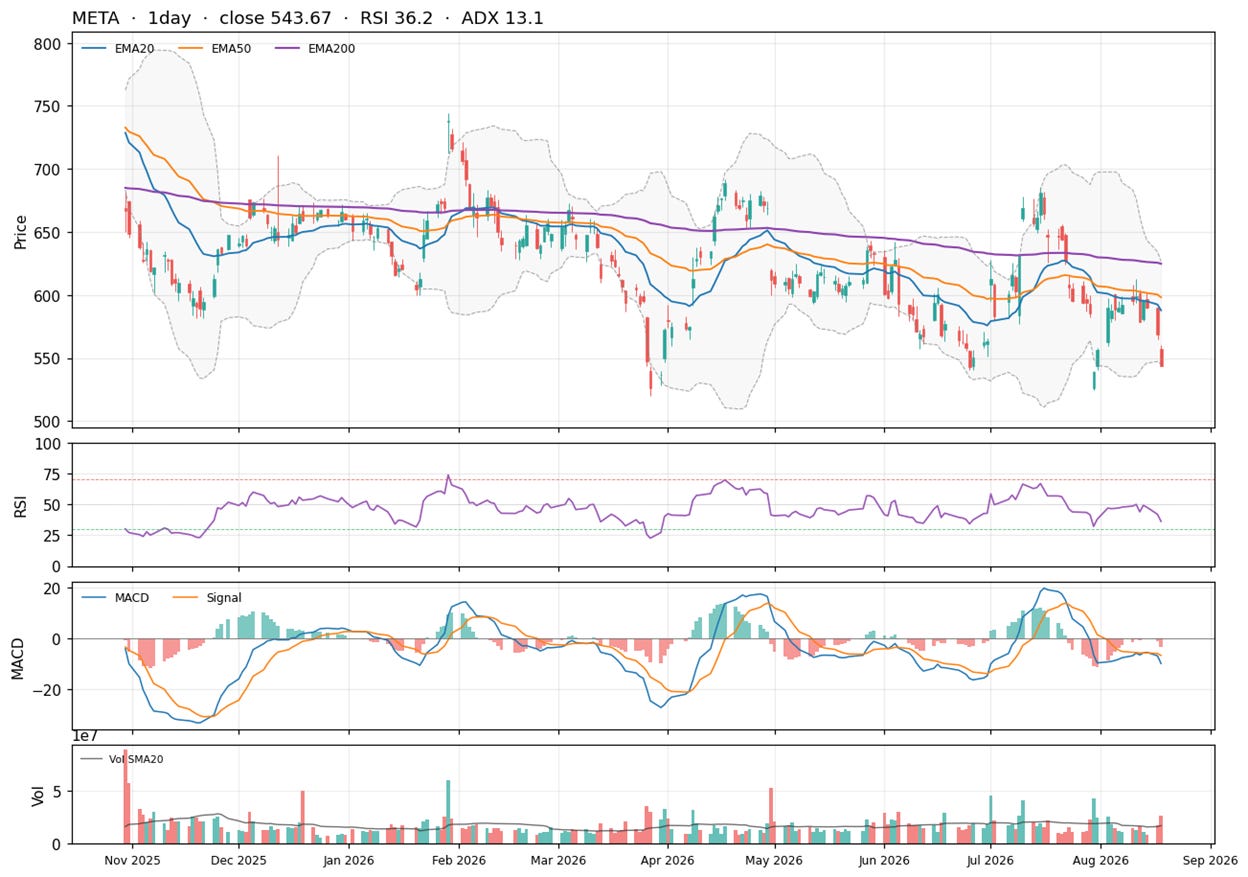
The level that matters is below: the 52-week low at $520.26, the 60-day low at $524.49 and the weekly 200-period average at $524.04 sit within $5 of each other.
