


Meta launched Muse on September 8, a personal AI agent that acts rather than answers: it opens browsers, fills forms and completes purchases with the user’s approval. It passed 2.5 million US downloads inside a fortnight and took the top of the free iOS rankings.
Travel booking shares fell on the news and kept falling. Expedia is down 13.1% since the launch, Airbnb 17.8%, Booking 19.3%, TripAdvisor 13.8%. Meta is up 20.6%.
Then, on September 22, Expedia announced it was joining Muse.

Key Takeaways
At launch the 2 halves of Muse’s travel product worked differently. Flights ran through a direct integration with Duffel, which Duffel announced itself. Hotels, on Skift’s September 9 test, were shopped on consumer websites the way a person would. Meta’s own announcement names no travel partner.
Expedia has now joined, without detailing the mechanics. Reporting says Expedia stays the merchant of record while the traveller never leaves Muse.
That is the real question: not who processes the booking, but who controls discovery and the relationship that follows it.
Meta’s second-quarter free cash flow was $784 million. It repurchased no stock in the first half, after $22.9 billion a year earlier, and issued $24.9 billion of net new debt.
Prices are the Wednesday September 23 close, the last completed session. Meta’s Connect event runs September 23 and 24, so Thursday is both pre-open and day 2 of the event as this is written.
Discovery, Not Transactions
Flights were the clean case at launch. Duffel, the travel infrastructure company, announced on its own site that “millions of users can now use Duffel to search, book and manage holidays on Muse”, with US users booking “from all major suppliers globally, with live pricing”. No agency in between.
Accommodation was not that. Skift’s hands-on test on September 9 found Muse shopping consumer websites, Expedia among them, operating the way a person would rather than through any integration. Meta’s own announcement is silent on partners and describes only an agent that “opens browsers, fills forms” and “checks with the person before sensitive actions”.
Expedia’s announcement sharpens the question rather than settling it. The integration is planned, not live: no launch date has been given and Expedia hasn’t explained how the connection will work. On the reported terms Expedia would remain the merchant of record, keeping the payment, the service interaction and the account, while the traveller would plan, compare and pay without ever leaving Muse. Chief executive Ariane Gorin used the Skift Global Forum to argue for being everywhere agents live, while doubting that any single agent will own the trip. Expedia already connects to Google’s AI mode, ChatGPT, Claude and Alexa.
So the threat isn’t that Expedia stops getting bookings. It’s that Expedia risks losing control of discovery: the agent decides what to surface, in what order, and the traveller’s habit forms around Muse rather than around Expedia. Whether that costs Expedia the customer depends on what people do next, and nobody knows that yet. That is a slower and less total threat than agents bypassing the agencies outright, which is the concern the share price declines raise.
What the Market Moved
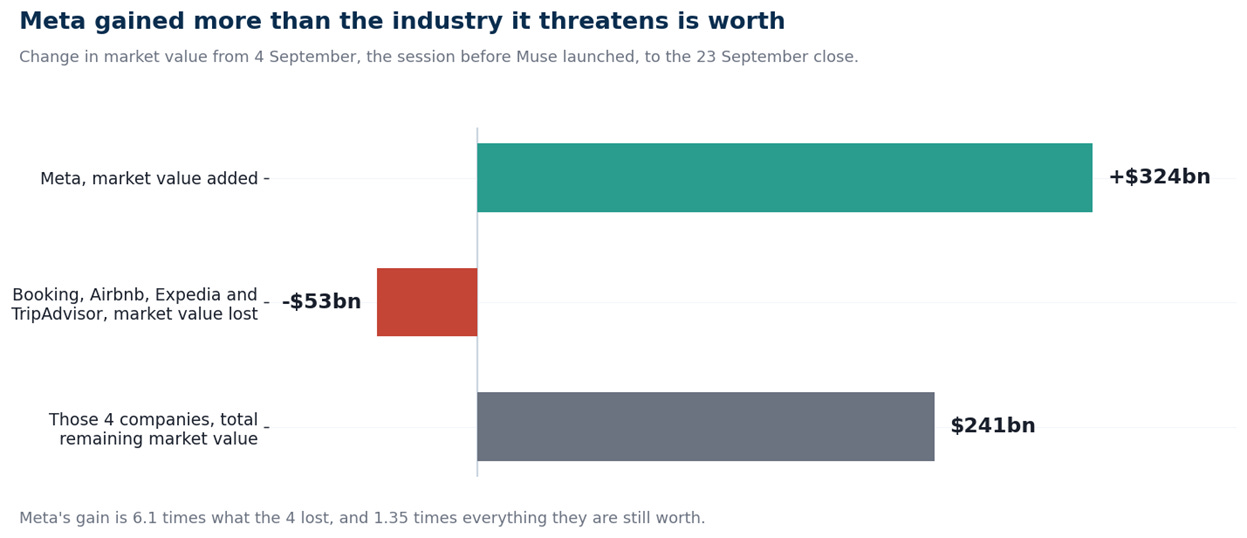
Since the session before the launch Meta has added $324 billion of market value. The Nasdaq 100 rose 3.1% over the same stretch and Meta’s beta to it was 0.80 over the prior year, which accounts for roughly $38 billion. That leaves a market-adjusted move of about $286 billion.
Treat that as an illustration of scale, and not as Muse’s implied value: it isn’t one. A residual like this also carries earnings expectations, rates, positioning and analyst revisions, and the clearest example is Meta’s biggest day: September 21, up 11.3% on 48.7 million shares, 2.5 times its prior 40-session average, on a Wells Fargo target increase to $796 from $640. Travel barely moved that day.
On the other side, Booking lost $29 billion over the period, Airbnb $19 billion, Expedia $5 billion and TripAdvisor about $0.2 billion, against $241 billion those 4 are still worth. Those declines are consistent with agent risk being repriced, but they’re 4 different businesses with different exposures and the period contains more than Muse. What both sets of numbers show is breadth: the Meta move is far too large to be explained by travel, and Muse has already announced tie-ups with Shopify, PayPal and Instacart.
The Advertising Question
There is a second-order effect worth watching without overstating.
Booking spent $8,186 million on marketing last year, 30.4% of its revenue, and calls those expenses “substantially variable in nature”. Its own description of performance marketing lists search engine keyword purchases first, then affiliate programs, meta-search referrals, and “other performance-based marketing, including social media marketing” last. Expedia spent about $7.4 billion on sales and marketing; across the 4 largest agencies the figure was roughly $20 billion.
If agents take over discovery, some of that spending could be displaced rather than redirected, and Meta collects a share of it. But social is one category among several in these budgets, most performance spend goes to search, and an agency that’s losing organic customers may bid harder for the ones it can still reach. This is a question, not an offset anyone can size. Alphabet, which takes considerably more travel search advertising than Meta, is flat over the same stretch.
What Is in the Accounts
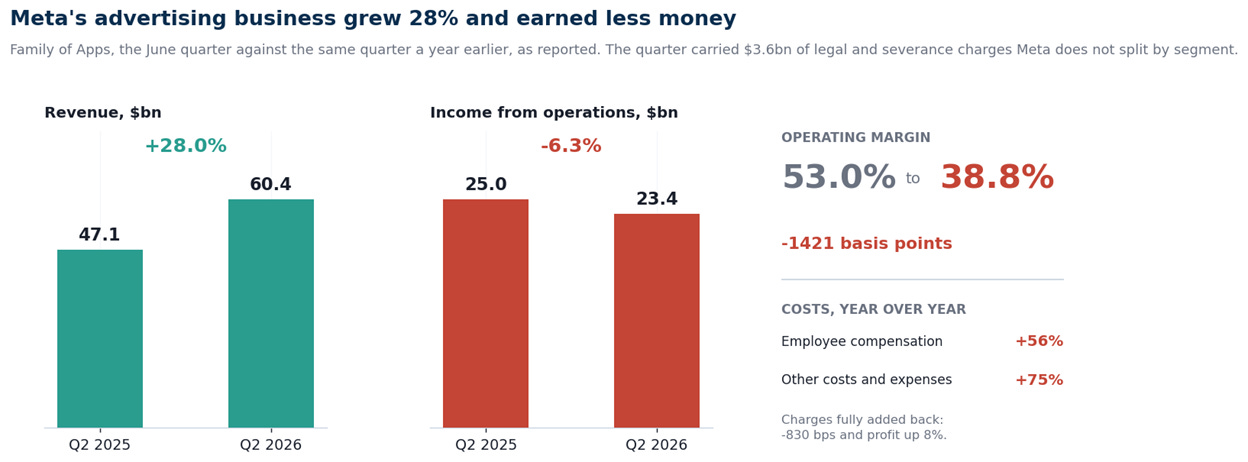
Family of Apps, which is Facebook, Instagram, WhatsApp and Messenger, is 99% of Meta’s revenue. In the June quarter it grew revenue 28.0% to $60.4 billion, and its operating income fell 6.3% to $23.4 billion. The reported operating margin went from 53.0% to 38.8%.
Be careful with that. The quarter carried $2.40 billion of legal charges and $1.18 billion of severance from a May reduction of about 8,000 people. Meta doesn’t split those between segments and says the severance hit both. If all $3.6 billion sat in Family of Apps, the margin decline would be about 830 basis points rather than 1,421, and segment operating income would have risen roughly 8% instead of falling. The truth sits between the 2. Either way, employee compensation rose 56% and other costs 75% against revenue up 28%. Reality Labs lost $4.6 billion in the quarter on $431 million of revenue.
The cash statement is less ambiguous. In the June quarter operating cash flow was $31.86 billion and free cash flow, on Meta’s own definition, was $784 million, after capital spending of $31.08 billion including finance lease principal. On the narrower measure that counts only purchases of property and equipment, the quarter produced $1.7 billion against $9.0 billion a year earlier.
How that is being funded matters too. Meta repurchased no stock in the first half, against $22.9 billion in the same period of 2025, and issued $24.9 billion of net new long-term debt. Long-term debt went from $58.7 billion at the year end to $83.7 billion. A further $10.8 billion of money market funds is now escrowed against multi-year infrastructure purchase agreements and can’t be used generally until 2028 to 2030. Full-year capital spending is guided to $130 billion to $145 billion, the low end raised twice from an original $115 billion.
The Case Against Me
This is an excellent business and the quarter says so.
Very few companies this size grow revenue 28%, and the composition is healthy: ad impressions rose 14% and average price per ad 12%. Daily active people reached 3.60 billion. Advertising is 97.6% of revenue and compounding in every region, with Rest of World up 35%. Liquidity is substantial at $90.3 billion of cash and marketable securities, though against $83.7 billion of long-term debt and $28.7 billion of lease obligations that is not a net cash position. At $744.10 the shares trade on roughly 22 times annualised first-half earnings. Management still expects full-year operating income above 2025, and has said so since January.
Muse is not a giveaway either. Meta says it is “free for most of what people need, with subscription plans for people who want to do more”, and launch coverage describes tiers at $20 and $100 a month. There is a model. What’s unproven is paid conversion and whether agent commerce earns a durable take rate.
My reservation isn’t the company. It’s that the stock was down 6.6% for the year on September 4 and is up 12.7% now, so the year arrived in 13 sessions, priced on what Muse might become.
