


After drawdowns of 36% and 44% in a month, the Street underwrote the memory dip with numbers, and the 2 stocks answered with their strongest sessions since the June peaks. Both trade below 8 times forward earnings. Whether that’s cheap depends entirely on what memory earnings look like in 2028.
In memory, 6 times forward earnings isn’t a bargain. It’s the entry fee the cycle charges.
Start with what happened to the stocks. From late-June records, Micron fell from $1,255 to $804 and SanDisk from $2,354 to $1,325 at last week’s intraday lows, drawdowns of 36% and 44% inside the broader semiconductor rout (a reported $3.3 trillion of sector value erased since late June, per press tallies). Our June Micron piece had closed on a warning, “a magnificent trade, but a dangerous one,” and the dangerous part arrived within a month.
Then this week changed the conversation. Morgan Stanley told clients it was buying the dip in memory, forecasting prices up at least 25% from Q2 to Q3 (as reported July 20), and KeyBanc’s channel checks (per reports, same day) pointed to DRAM shortages through 2027, sequential DRAM price gains of 15% to 20% in each of the next 2 quarters, and NAND up 30% to 40% this quarter. The 2-session recovery turned vertical on Tuesday: Micron closed up 12% at $970.82, SanDisk up 14% at $1,589.40.
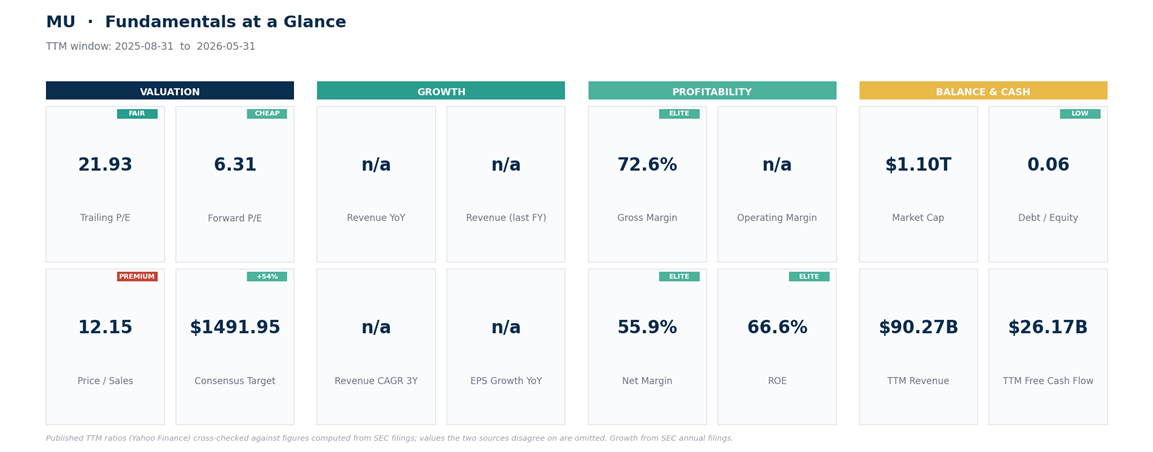
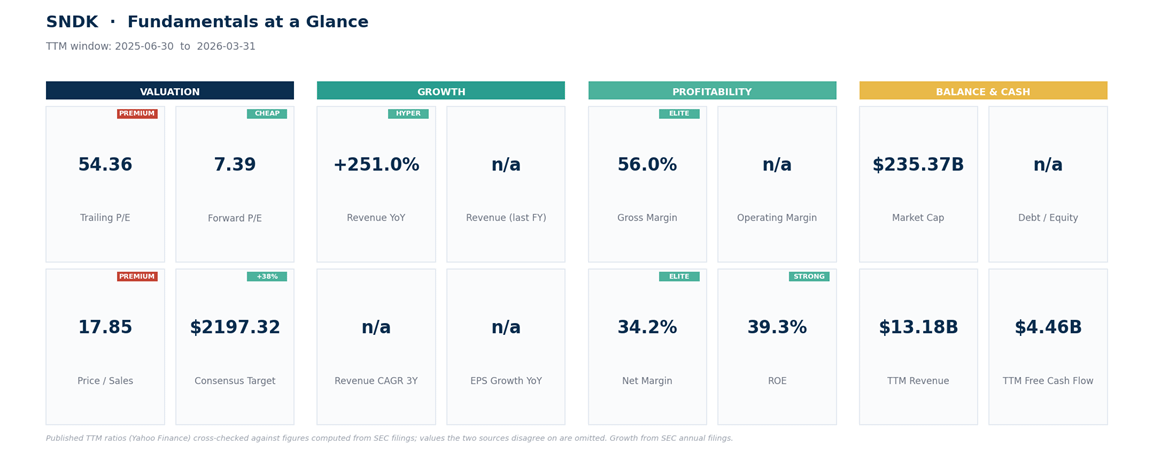
So the question this article answers is the one the multiples ask. Micron trades at 6.3x forward earnings and SanDisk at 7.4x (consensus estimates as of the July 21, 2026 close, which is also the price basis below). In memory, numbers that low are never a gift; they’re the market’s estimate of how much of this is peak. What follows quantifies that estimate.
Premarket update, July 22: MU and SNDK were each down about 4% at the time of publication.
Key Takeaways
The Street underwrote the dip: reported 25%-plus memory price gains into Q3, shortages seen through 2027.
Micron is the quality claim: DRAM and HBM, roughly $100B of take-or-pay contracts (company release, June 24), a $1.1T market value at 6.3x forward.
SanDisk is the torque claim: nearly pure NAND, spot-price sensitivity, a 36x year, 7.4x forward, and the group’s next scheduled test on August 5 (company-confirmed).
The multiple math is the debate: if earnings normalize 50% lower, today’s 6.3x and 7.4x become 12.6x and 14.8x. The discount exists only if the cycle holds.
Sizing beats levels here: these stocks move 8.8% and 12.6% on an average day (14-day average true range as a share of price).
2 Claims on One Shortage
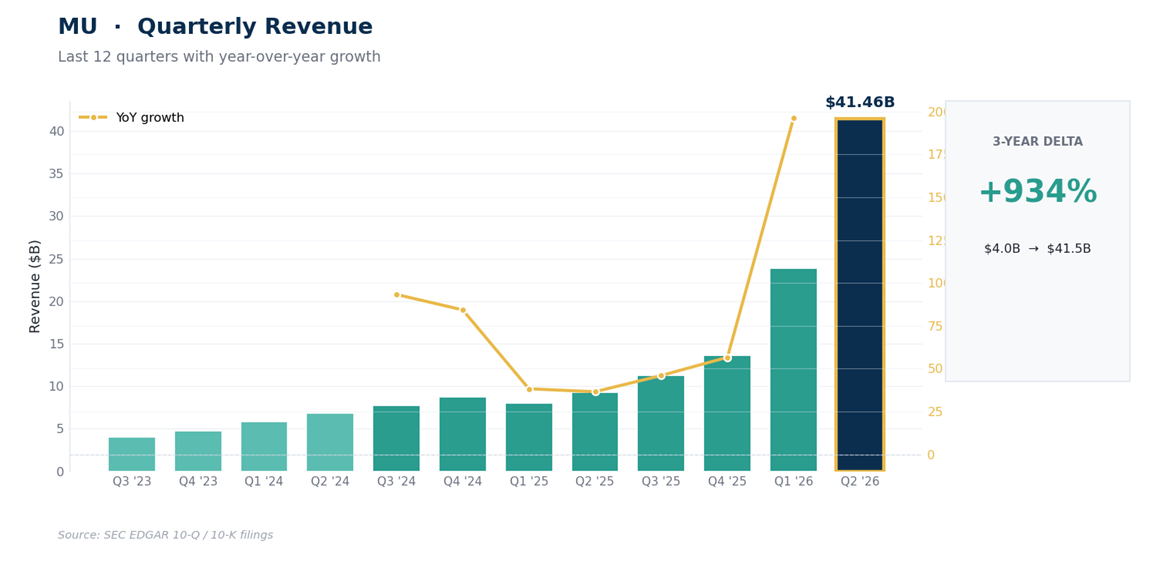
Micron is the quality claim. Its May quarter did $41.46B of revenue, up 346%, at an 84.6% gross margin (company release, June 24), with high-bandwidth memory sold out into next year under roughly $100B of multi-year agreements carrying take-or-pay terms, deposits, and pricing floors, a deliberate attempt to engineer the cycle out of the business. Trailing revenue is $90.27B with $50.47B of net income and a 67% return on equity, the company crossed $1T of market value this month, and its next report is currently expected around September 23.
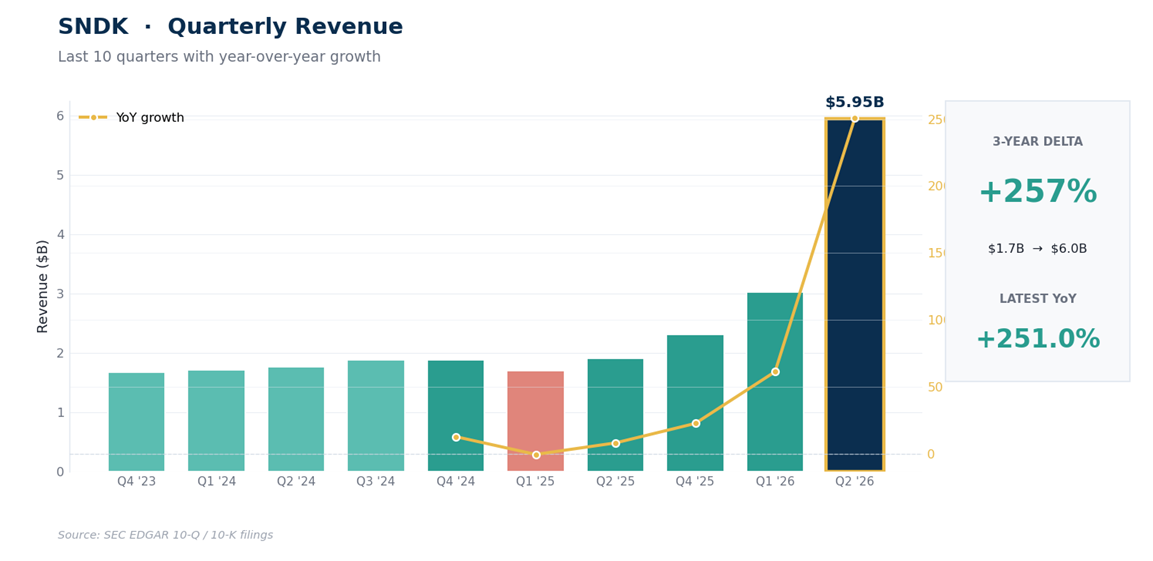
SanDisk is the torque claim. It’s a nearly pure NAND flash business without Micron’s contract architecture, which means spot prices hit its income statement faster in both directions. That cut both ways this year: the March quarter grew 251% to $5.95B as gross margin expanded from 22.5% to 78.4% in a year (company filings), the stock ran roughly 36x from its year-ago price to a June record, and then gave back 44% in 3 weeks. It reports August 5, first of the pair, which makes it the shortage’s next scheduled referendum. One disclosure for everything technical below: SanDisk has traded for barely a year and a half since its spin-off, so its long-term levels deserve looser confidence than a mature listing’s.
What 6x Forward Actually Prices
A company growing revenue 346% at an 85% gross margin doesn’t trade at 6x forward because the market missed it. It trades there because memory has spent 4 decades converting peak margins into losses on a schedule, and the market is pre-charging for the next conversion. Here’s that intuition quantified. Consensus forward EPS is about $154 for Micron and $215 for SanDisk; hold the July 21 prices fixed and re-rate the multiple as earnings normalize:
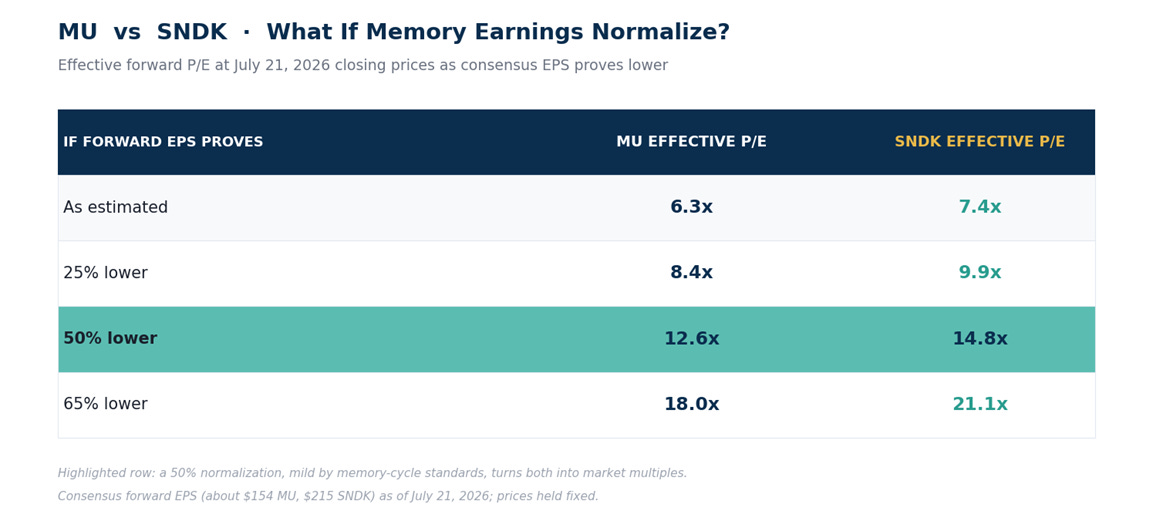
A 50% earnings normalization, mild by memory’s standards, turns both “cheap” multiples into market multiples at today’s prices. And mild is the operative word: in the last downturn Micron’s earnings didn’t fall 65%, they went negative.
The $100B of contracted take-or-pay revenue is Micron’s argument that this cycle’s floor sits higher than history’s; SanDisk carries no such argument, which is why its multiple runs a turn richer.
Both valuations anticipate an earnings decline; neither appears to price a prolonged collapse. That’s the entire bet, in both names. The bull case is that this cycle’s structure, HBM under contract, shortages projected through 2027, capacity that takes years to add, pushes the normalization out far enough for the earnings to compound first; the Street leans that way, with 40 of 45 Micron ratings and 18 of 23 SanDisk ratings at buy or better and mean targets 54% and 38% above the prices (consensus as of July 21).
The Technical Maps, 3 Levels Each
All levels are from the daily timeframe; every trigger below means a daily close, not an intraday touch.
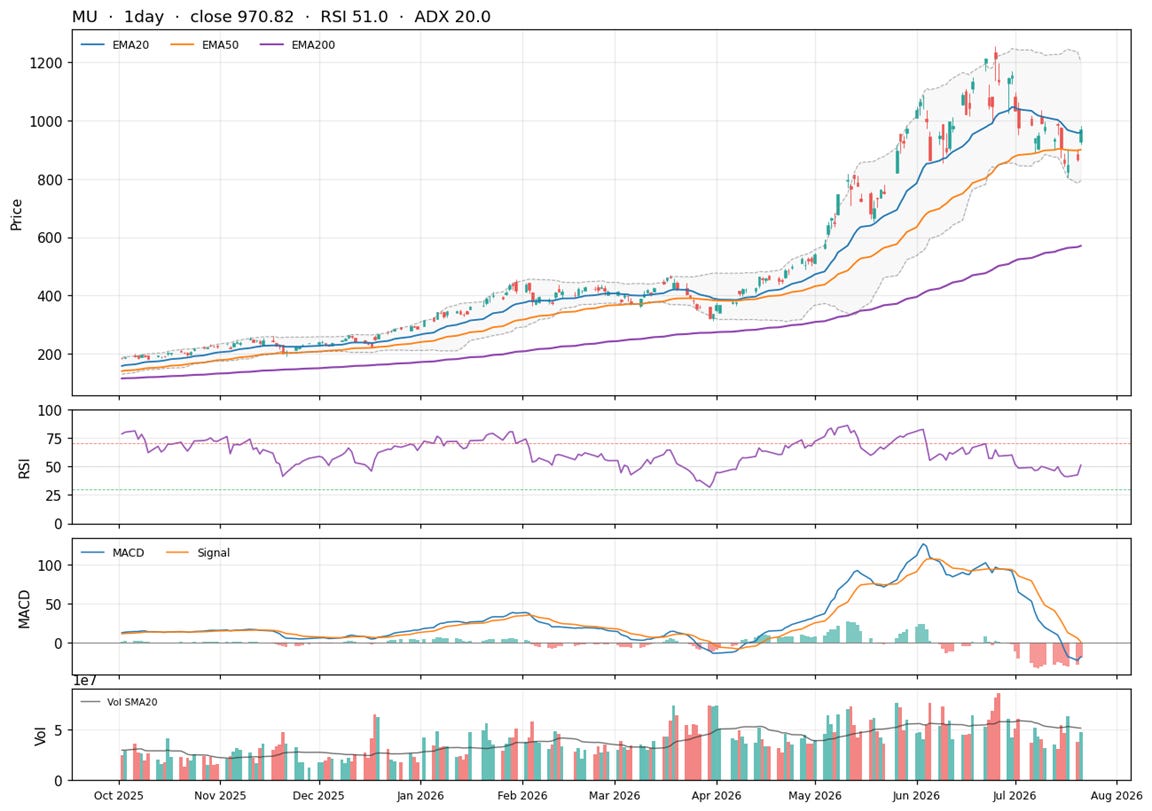
Micron, at $970.82:
Support: 895 to 905, the 50-day average and the 38.2% retracement of the spring advance, with the $804 July low the deeper marker.
Repair: a daily close above 1005 (round number, 20-day midline, and the 38.2% retracement of the June-to-July decline), which re-opens the 1255 record.
Invalidation: a daily close below 780, under the halfway retracement of the entire spring run.
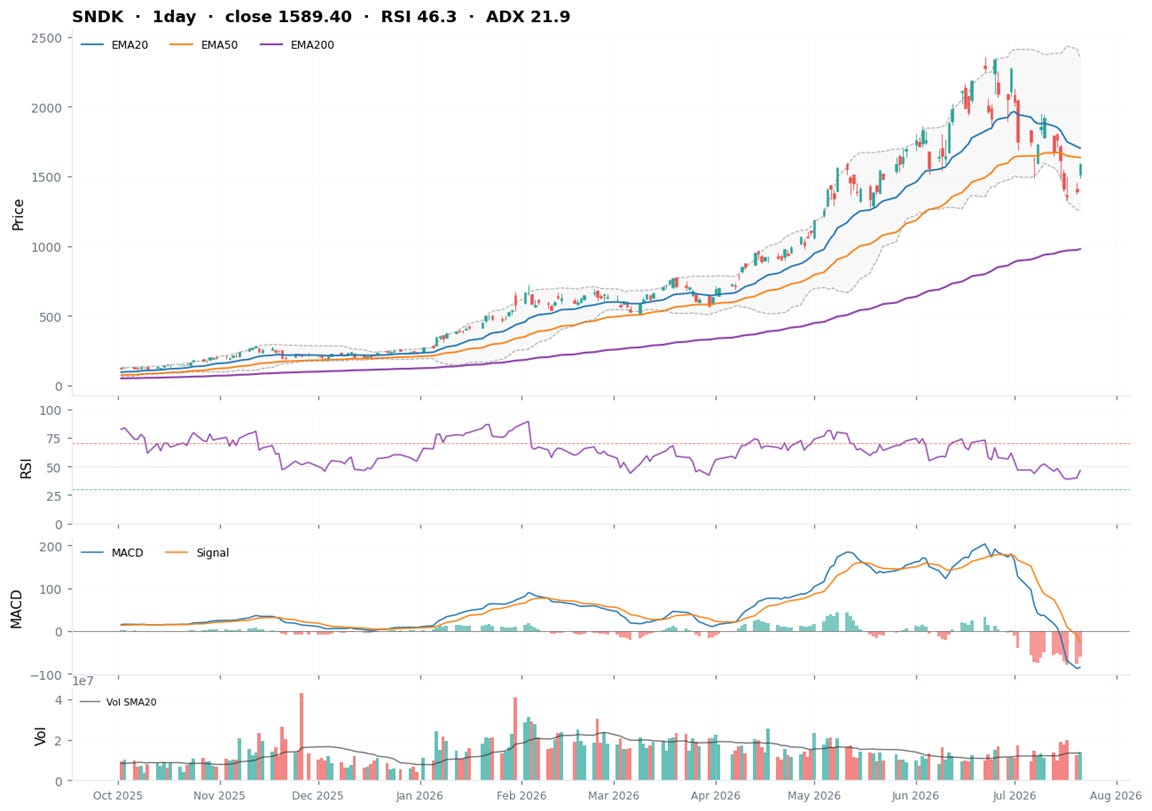
SanDisk, at $1,589.40:
Support: 1355 to 1430, last week’s closing low plus the halfway retracement of the post-spin advance; the intraday extreme at $1,325 sits just beneath.
Repair: a daily close above 1710 (the 20-day average and the 38.2% retracement together), which re-opens the mid-July shelf near 1925 and eventually the 2354 record.
Invalidation: a daily close below 1195, under the 61.8% retracement, where the entire post-spin trend is in question.
2 violent recoveries inside corrections that haven’t fully repaired, in the 2 highest-volatility large caps we track. Strength this fast is for respecting, not chasing, and Wednesday’s premarket made the case in real time.
One possible framework, not a promise.
