


Memory has produced the most violent earnings expansion in modern semiconductor history, and the market has priced 3 very different companies almost identically. Micron trades at 22.0 times trailing earnings, SK Hynix at 22.3, Sandisk at 22.3. On forward estimates all 3 sit in single digits. That symmetry says the market has one question about all of them: do these earnings survive 2027? What’s changed this summer is that all 3 have tried to answer it the same way, by signing multi-year supply contracts that reduce their exposure to the cycle. They haven’t done it equally well. On the evidence, Micron did it best.
Key Takeaways
All 3 trade near 22x trailing and in single digits forward. The market is treating them as one AI-memory trade rather than as businesses with different exposures.
Micron disclosed 16 take-or-pay agreements carrying about $100 billion of minimum revenue, backed by $22 billion of customer commitments including roughly $18 billion of cash already received.
Sandisk disclosed $93.9 billion of minimum contracted revenue in floor-and-ceiling bands, backed by $16.5 billion, covering more than half of fiscal 2027 bits. Deeper coverage of its own book than Micron has.
SK Hynix says it has closed long-term agreements with around 10 key customers, but hasn’t published the economics.
On latest reported operating margin the order is Micron at 81.2%, Sandisk near 79% and SK Hynix at 76%, not the ranking most write-ups assume.
Start with what the market is saying.
The Market Says They’re One Trade
The convergence isn’t a coincidence. All 3 report the same phenomenon: DRAM contract prices rose about 90% in the first quarter and another 58% to 63% in the second, while enterprise NAND rose in the mid 50s in the first and 70% to 75% in the second. That’s the largest move in a decade, and it lands almost entirely in gross margin because the cost base barely moves.
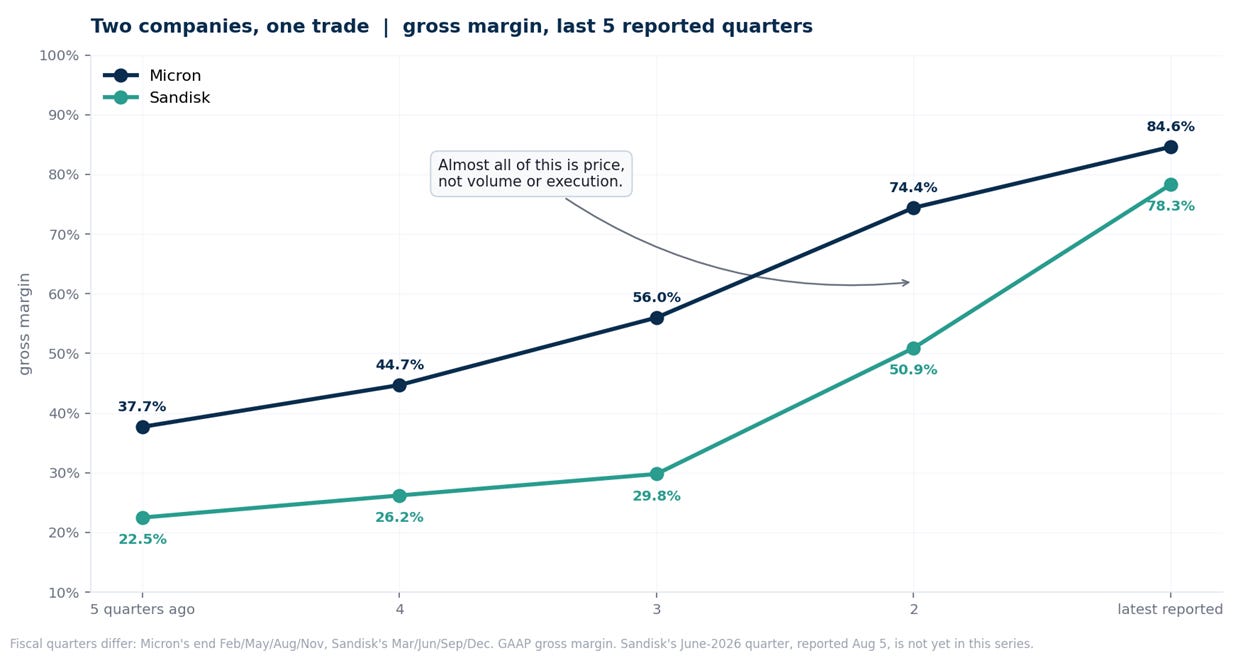
Look at the shape rather than the levels. Micron’s GAAP gross margin went from 37.7% to 84.6% in 5 quarters, Sandisk’s from 22.5% to 78.3%. Neither invented a product in that window; Sandisk said 2 thirds of its sequential growth was pricing. This is a price event wearing an earnings costume, which is why the market refuses to capitalize it.
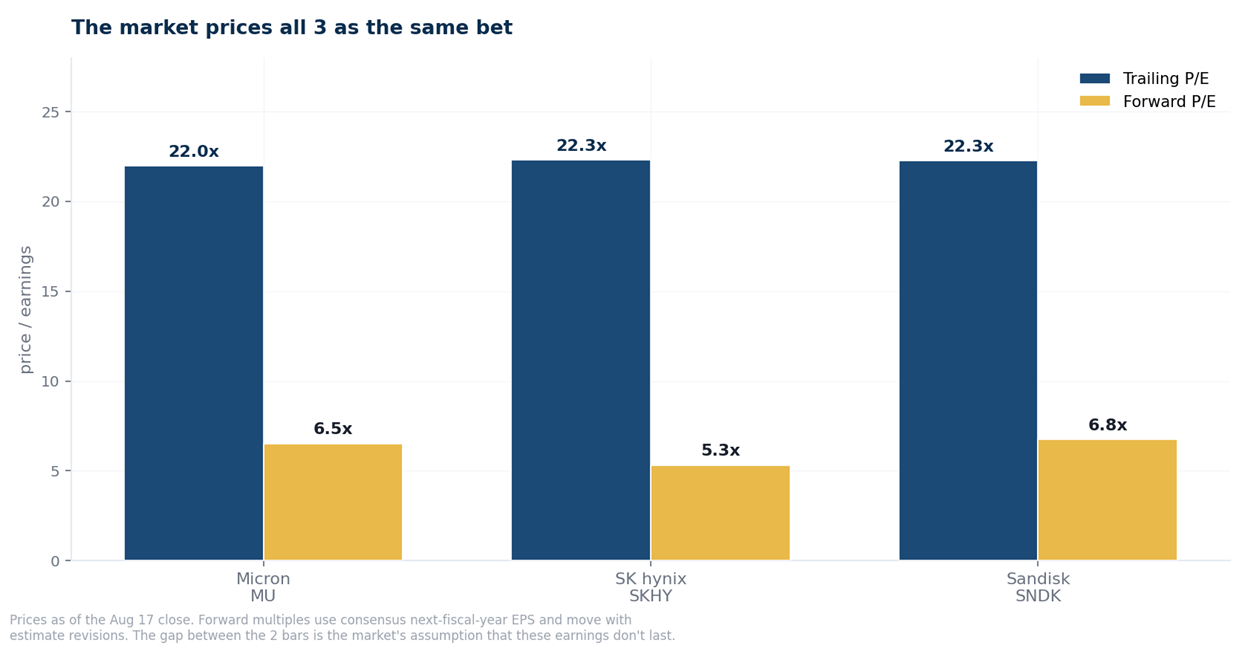
One caveat on those forward figures. They’re consensus as of the August 17 close and are being revised weekly against fast-moving prices; other providers currently put Sandisk nearer 8 times and SK Hynix in the high 6s. The precise number matters less than the pattern, which is single digits for all 3.
Now what they did about it.
All 3 Tried to Contract Away the Cycle
Between late June and early August, each told investors it had locked in future revenue. It’s the most important development in memory this year, and it’s been reported piecemeal.
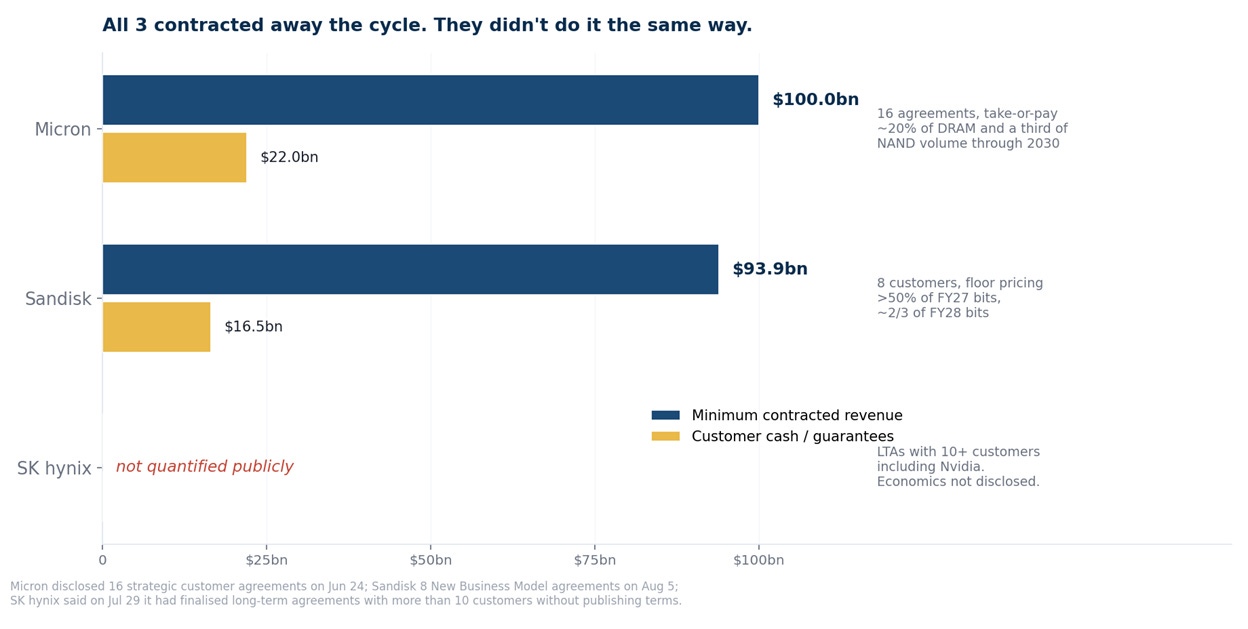
Micron disclosed 16 strategic customer agreements on June 24, 14 carrying cumulative minimum revenue commitments of roughly $100 billion. Most run 5 years, they’re take-or-pay and can’t be cancelled, and customers put up over $22 billion of financial commitments including almost $18 billion of cash. They cover about 20% of DRAM volume and a third of NAND volume through calendar 2030.
Sandisk disclosed its own version on August 5: $93.9 billion of minimum contracted revenue across 8 customers, priced in bands with floors and ceilings, backed by $16.5 billion of cash deposits and financial instruments, with a weighted-average duration above 4 years. Supply and demand commitments are set annually and quarterly, and a customer that misses its quarterly obligation sees those guarantees convert into compensation. The agreements cover more than half its fiscal 2027 bits and roughly 2 thirds of fiscal 2028, deeper coverage of its own book than Micron has arranged.
SK Hynix said on July 29 it had finalised long-term agreements with around 10 key customers, most spanning 5 years, its president describing them as a way to reduce exposure to price swings. It also has a separately confirmed multi-year technology and supply partnership with Nvidia. It hasn’t published minimum revenue, coverage or guarantees.
So the popular framing, that one has visibility while the others are naked cycle bets, is wrong. What differs is the shape of the protection, not its existence.
What the contracts don’t cover.
What the Contracts Don’t Cover
None of this covers the whole book. Micron’s agreements leave roughly 80% of DRAM volume exposed. Sandisk’s pricing bands trade some upside for downside protection and revenue visibility, which is what a floor paired with a ceiling does. SK Hynix hasn’t given enough detail to judge.
That leaves the cycle argument, and it’s a real argument rather than a settled fact. TrendForce projected in late July that DRAM stays in structural shortage through 2028 with the gap widening in 2027, while NAND supply turns sufficient in the second half of 2027. Against that, Morgan Stanley expects the NAND crunch to persist through 2027, on the view that solid-state drives absorb work when HBM and DRAM run short. Kioxia says its own NAND is sold out probably through 2027. The bear case rests on consumer devices, where smartphone and notebook production are both forecast to fall this year.
What isn’t disputed is that pricing is decelerating. DRAM contract prices are projected to rise 13% to 18% in the third quarter against 58% to 63% in the second, NAND 10% to 15% against 70% to 75%. Prices are still climbing. The rate of change has collapsed. That’s why SK Hynix fell 11% on a record quarter and why Sandisk beat on both lines and still sold off.
There’s also a supply answer nobody controls. Micron alone is spending about $27 billion of capital this year, and China’s CXMT grew DRAM revenue 716% to 7% share, freshly public and expanding. All 3 are being paid today to build the capacity that ends the shortage.
Why the pick is Micron.
Why Micron
Micron’s May quarter did $41.46 billion of revenue, up 346% from $9.30 billion, at a record 84.9% non-GAAP gross margin and $25.11 per share. It guided the August quarter to $50 billion give or take $1 billion, roughly 86% gross margin and a record $31.00 per share. At $1,011.75 it carries a $1.14 trillion market value.
3 things separate it, and none is the contract book alone.
Margins first, because this gets stated backwards constantly. On reported operating margin, Micron’s fiscal third quarter was 80.4%, Sandisk’s most recent quarter about 78.5%, and SK Hynix 76%. Those aren’t perfectly comparable, since the first 2 are US GAAP and the third is a Korean filing, but the ranking survives either convention. Micron is the most profitable of the 3 on the latest numbers, not the second or third.
Second, breadth. DRAM was $31.3 billion of the quarter and NAND $9.9 billion, so flash is 24% of revenue rather than all of it, and Micron’s entire 2026 HBM output is committed. Whichever way the NAND argument resolves, Micron owns a diversified version of the answer. Counterpoint put its DRAM share at 25% in the second quarter against SK Hynix at 26% and Samsung at 39%, a single point where there used to be several.
Third, the form of the protection rather than its size. Both books are enforceable, but Micron’s disclosed backing is almost $18 billion of customer cash actually received, against Sandisk’s $16.5 billion of deposits and instruments. Cash in hand is the cleanest version of a commitment. Debt to equity is 0.06 and short interest 2.65% of float, the lowest of the 3. Consensus runs 41 buys, 5 holds and no sells across 46 analysts, though targets from $361 to $2,200 say nobody agrees what normalized earnings are.
On price, patience is warranted. Micron trades above every daily moving average, the 20-day at $914.61 and the 200-day at $626.18, but the faster stochastic-RSI gauge is pinned at its maximum, as overbought as that reading gets, and average true range of $72.16 is 7.1% of the price. The 60-day range runs from $732.20 in May to $1,255.00 on June 25. The next report lands September 23.
Why the other 2 rank behind.
Why the Other 2 Rank Behind
SK Hynix has the strongest competitive position in the business. It reportedly won about 70% of Nvidia’s HBM4 orders for the Vera Rubin generation, and Goldman expects it to hold more than half the HBM market. The share-loss story gets quoted too confidently: estimates vary by house and by whether share is counted in revenue or bits. Second-quarter revenue of 79.3 trillion won rose 257% and operating profit of 60.5 trillion won rose 557%.
What holds it back is disclosure and instrument. Its 76% operating margin is the lowest of the 3, it hasn’t quantified its long-term agreements, and its US listing is 27 sessions old.
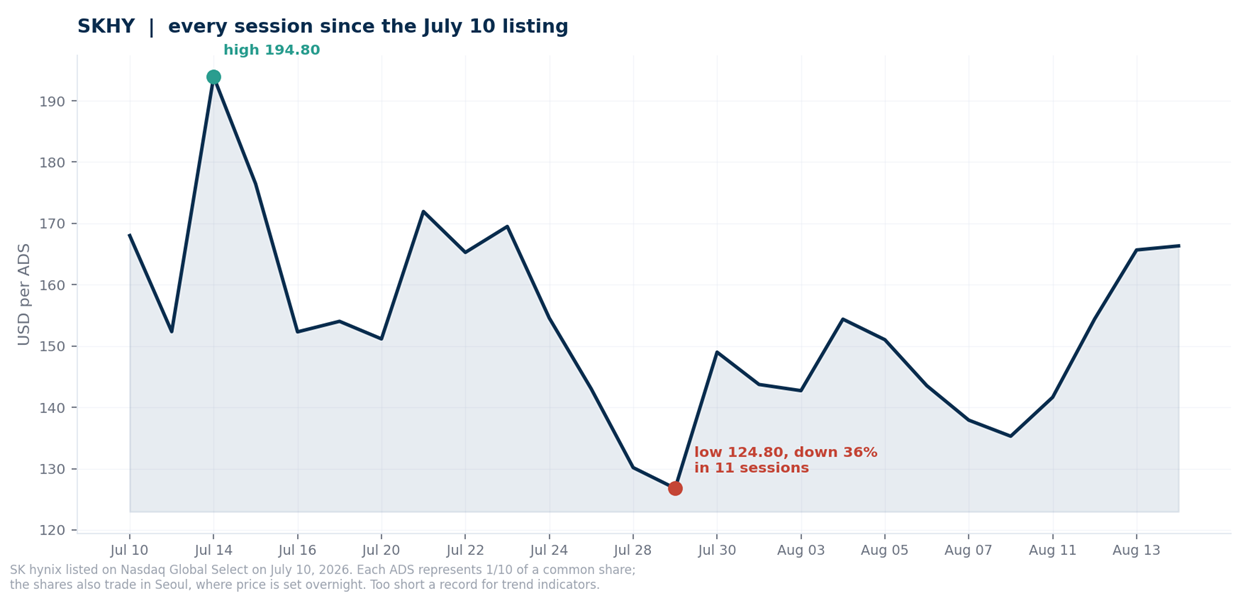
SK Hynix listed on Nasdaq Global Select on July 10, raising $26.5 billion at $149 a share in the largest initial US share sale ever by a foreign company, each share representing a tenth of a Seoul-listed common share. It’s sponsored, SEC-registered and trades 43.5 million shares a day. But it went from $194.80 on July 14 to $124.80 on July 29, down 36% in 11 sessions, and back to $171.38. There’s no moving average worth computing, and the price is largely set in Seoul overnight.
Sandisk is a better business than its critics allow. Its fiscal fourth quarter, ended July 3, did $8.97 billion of revenue, up 372% on the year, with $43.97 per share and another $14 billion of buyback authorized, and its contract book genuinely de-risks fiscal 2027. What keeps it third is concentration and price. It’s single-segment, so the uncontracted half of its book sits on the one product where forecasters disagree about 2027, and its ceilings cap what it earns if the bulls are right. Short interest is 7.36% of float, nearly 3 times Micron’s, the next report isn’t until November 6, and it’s up 653% this year, closing above its upper volatility band with average true range at 9.5% of the price.
The Answer
The evaluation favors Micron. Not because it’s the only one with contracts, because it isn’t, and not because it’s the cheapest, because it isn’t that either. Micron ranks first in our assessment because it earns the highest margin of the 3 on the latest reported figures, spreads that across DRAM, HBM and NAND instead of one product, backs its contracts with $18 billion of customer cash already banked, and trades through an instrument with years of history rather than weeks.
The gap is narrower than the market’s similar multiples suggest. SK Hynix has the stronger franchise and the cheaper valuation, and greater disclosure around its contract economics could materially strengthen its case. Sandisk, meanwhile, has protected a larger share of its own book than either.
For us, that leaves Micron with the best overall balance of profitability, diversification, contractual visibility and investability among the 3 today.
One caution applies to all 3. Each is short-term overbought, and this cycle has already produced drawdowns of 36% and 44% in these names within a single month this summer. Identifying the strongest setup does not remove entry-price risk.
This is research and commentary, not personal investment advice. Levels discussed are illustrative; size positions to your own risk tolerance and time horizon. The author may hold positions in names discussed.