


The monetization is real. The argument is about how much of it is durable, and that argument started before these results.

Netflix reported third-quarter results after Tuesday’s close. Revenue rose 12% to $12.87bn, operating margin reached 34.6%, and earnings per share came in at $0.87, up 49% and ahead of the $0.82 expected.
The stock opened Wednesday at $64.13, a gap of 6.6% below the previous close, touched $64.10 for a fresh 52-week low, then recovered to $67.12 before fading. As this is written, with the session still running, it trades near $65.60, down about 4.5% on roughly twice its average volume.
From its closing high of $133.91 in June 2025 the stock has now lost almost exactly half its value. Most of that happened before Tuesday.
5 Things Worth Knowing
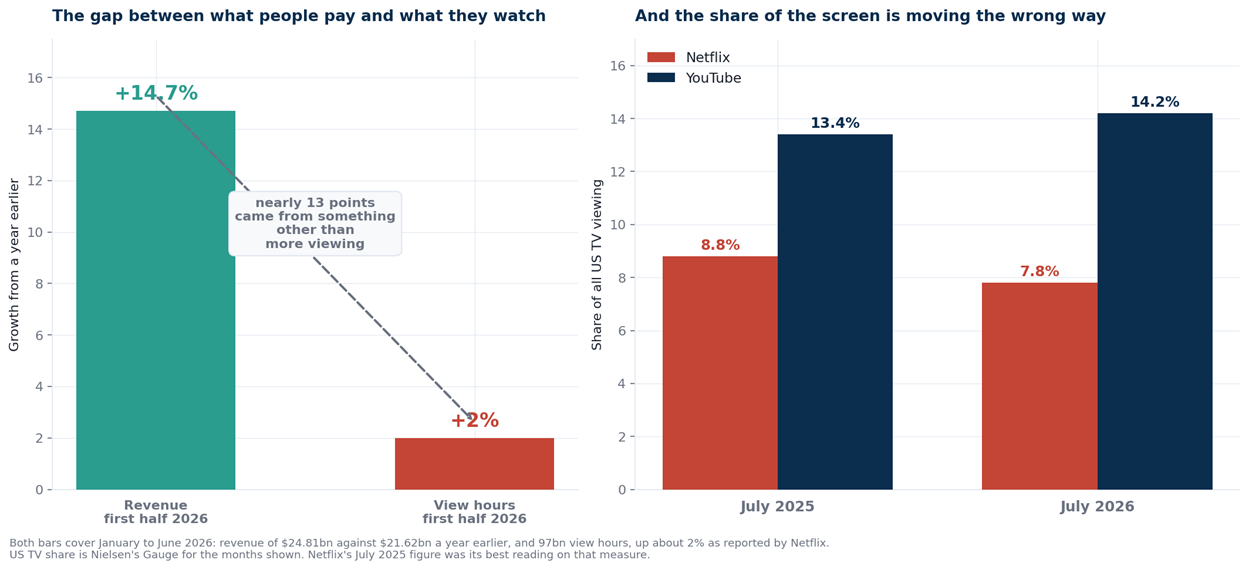
1. In the first half of 2026 Netflix revenue grew 14.7% while view hours grew about 2%. The company is earning substantially more per hour watched.
2. The headline strength is flattered at both ends: the beat against guidance came from expense timing, and the improvement against last year is mostly the absence of a $619m Brazilian tax charge in the comparable quarter.
3. The 2026 advertising outlook fell to about $2.7bn from roughly $3bn. That business is still growing more than 80% this year, so it’s a target missed rather than a business failing.
4. Free cash flow guidance of about $12.0bn includes the after-tax benefit of a $2.8bn one-off payment. Before that payment the company was guiding to roughly $11bn.
5. This de-rating didn’t start on Tuesday. Wells Fargo went underweight in mid-September and HSBC cut to hold on 22 September, both citing YouTube’s growing share of television time.
The Quarter, Properly Adjusted
Revenue of $12.87bn landed in line with the company’s own forecast, up 12%, or 11% excluding currency. That part is clean.
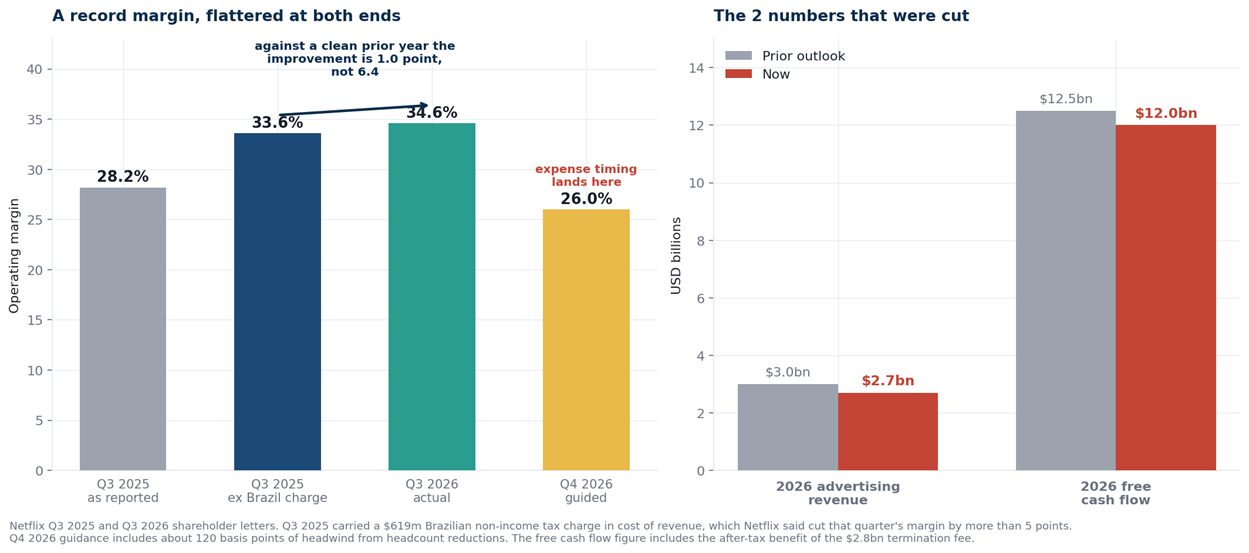
The profit figures need 2 adjustments. The margin beat guidance primarily on expense timing, and those expenses land in the fourth quarter. The prior-year comparison is also soft: Q3 2025 carried a $619m Brazilian non-income tax charge in cost of revenue, which Netflix said cut that quarter’s margin by more than 5 points.
Add that charge back and the comparison changes materially. Q3 2025 operating margin becomes roughly 33.6% rather than 28.2%, so this quarter’s 34.6% represents about 1 point of expansion rather than 6.4. Operating income growth becomes roughly 15% rather than 37%.
15% is still a good number. It just isn’t the headline number, which goes some way to explaining why a reported 49% rise in earnings per share met a 6.6% gap down.
The Gap
Netflix stopped reporting subscriber numbers from the start of 2025, which made view hours the metric investors watch. Across the first half of 2026 members watched 97bn hours, up roughly 2%, with television viewing up 4.5% and film viewing down 3.1%. Over the same 6 months revenue rose 14.7%.
That establishes Netflix is extracting considerably more revenue per hour watched. It doesn’t establish how much is price, because membership growth, geography, currency and the ad tier all move revenue without moving hours proportionately, and Netflix doesn’t break them out. The question isn’t which lever did it, but how long any of them runs at this pace while viewing grows at 2%.
Nielsen sharpens it. On its Media Distributor Gauge, Netflix took 7.8% of US television viewing in July 2026, down from 8.8% in the same month of 2025, its best reading on that measure. YouTube went from 13.4% to 14.2%. Streaming overall hit a record 49% of US television that month, so Netflix lost share in a category that was growing.
Management’s rebuttal is a good one. Greg Peters called engagement healthy and pointed to churn as the evidence: it has improved, which suggests members still see enough value to stay despite paying more. Ted Sarandos said the strategy is right but US execution isn’t, conceding the market “is just not growing as fast as it could or as fast as we’d like.” Analysts have also noted the first-half comparison ran into the World Cup and a lighter slate.
The counter is narrow: churn tells you customers accept the price they already pay, not what happens at the next one.
Worth flagging separately: from the first quarter of 2027 Netflix will publish engagement data annually rather than twice a year, a change announced in July. Reducing the reporting frequency of the most contested number in the story won’t help.
What Got Cut
2 forecasts came down, and they aren’t equally serious.
The advertising cut is the one that matters. Netflix now expects about $2.7bn of 2026 advertising revenue against roughly $3bn, attributed to delays in ad product capability and partner integrations. Peters stressed the business is still growing more than 80% this year, which is true and important: a missed target, not a failure. But advertising was how Netflix was going to extract more from the hours it already has.
The free cash flow reduction, $12.5bn to about $12.0bn, is attributed to a property transaction expected to close in the fourth quarter. That’s an explanation rather than a reassurance, since it doesn’t establish the outflow reverses next year.
More useful is what sits inside the $12bn. Netflix raised this guidance from roughly $11bn earlier in the year and said the increase came mainly from the after-tax benefit of the $2.8bn termination fee. It hasn’t reconciled the exact cash effect, so I won’t put a figure on the underlying rate. What’s clear is that $12bn contains a benefit that doesn’t repeat, and shouldn’t be read as a recurring level.
Where That Payment Came From
In December 2025 Netflix agreed to buy Warner Bros.’ studios and HBO Max for $27.75 a share, roughly $83bn including debt. Paramount Skydance went hostile, raised to $31, and Warner’s board judged that bid superior. Netflix declined to match, saying the economics no longer worked, and received a $2.8bn break fee that Paramount covered. Paramount completed the purchase on 6 October, so a direct competitor now owns HBO Max.
What that means is less certain. It’s tempting to read the bid as a fix for a thin slate, and the new content chief and 1,000 job cuts as related. Netflix hasn’t said that, and a library wouldn’t automatically solve an execution problem. What is certain is that the fee distorts both the earnings and cash flow figures quoted this week.
What You’re Paying
Netflix trades near 19 times trailing earnings. That number flatters: first-quarter earnings of $1.23 a share included the termination fee, which taxed at the quarter’s effective rate of about 19% is worth roughly $0.53 a share. Adjust for it and the trailing multiple is nearer 22 times. That’s my arithmetic, not a disclosed figure, and it rests on how the fee was actually taxed.
For scale: at the June 2025 peak of $133.91 the stock stood at about 53 times the earnings Netflix went on to report for that year. That’s a hindsight figure, not the multiple investors saw then, but it frames the distance travelled to today’s 19, or 22 adjusted.
On forward earnings the figure is about 17 times, using consensus of $3.78 a share for 2027 as quoted on 21 October. Other sources show closer to 18, depending on the estimate set and period, so treat the exact decimal loosely.
Against that: revenue guided to $51.1bn this year, a 31.5% operating margin, net debt of $7.1bn, and a record buyback of 63.9m shares for $4.8bn in the quarter, with $22.3bn still authorised. That retires over 1.5% of the company in 3 months, and keeps earnings per share growing when hours aren’t. Netflix still expects double-digit revenue growth in 2027, guidance due in January.
The Price
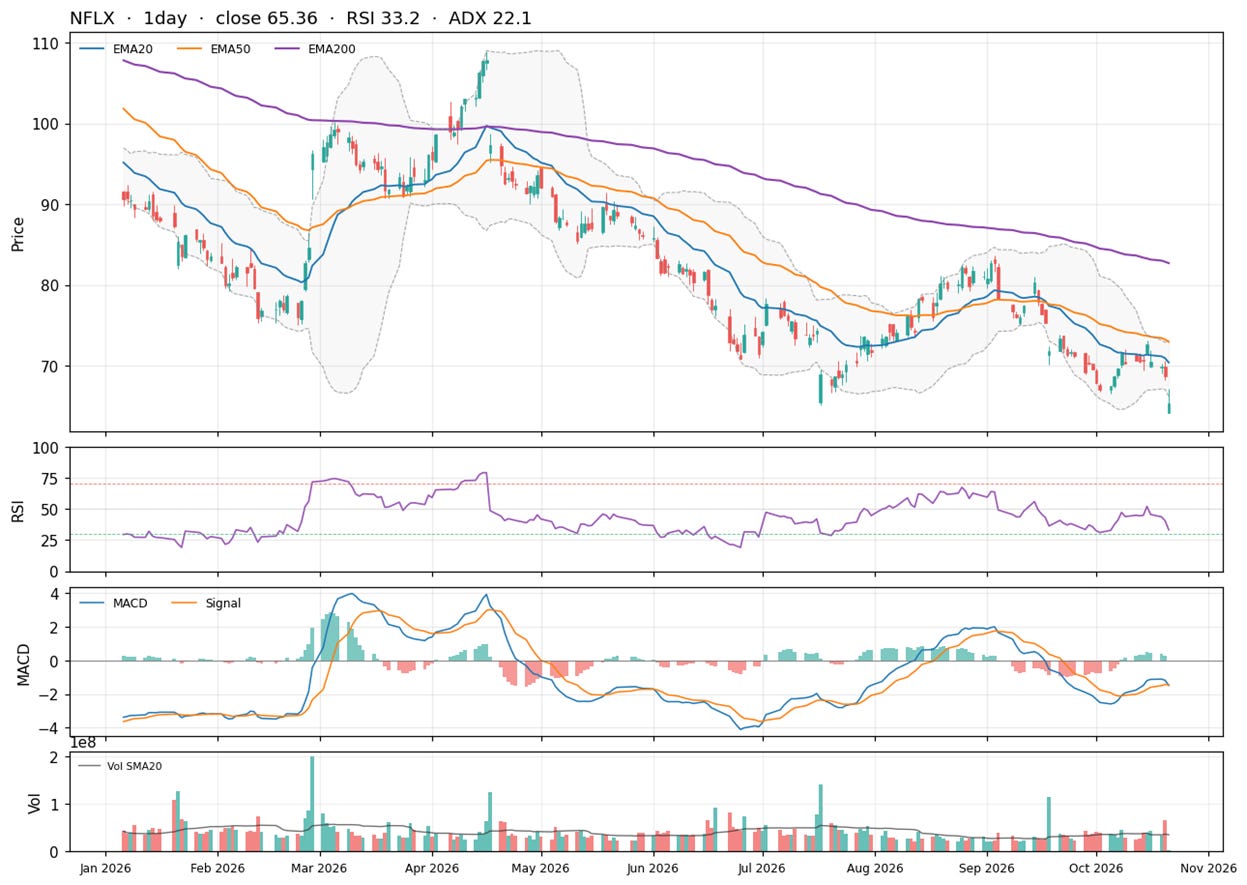
Near $65.60 the stock sits below its 20-day simple moving average of $69.67, its 50-day of $74.67 and its 200-day of $82.65. The 14-day relative strength index reads 33.2. All figures are as of the 21 October session.
The sell-side sequence matters more than the levels. Wells Fargo cut to underweight at $57 in mid-September, HSBC to hold at $76 on 22 September citing exactly the Nielsen share figures above, and Huber Research to underweight at $70 in mid-October. Only Needham’s downgrade, which withdrew a $120 target, came after these results, alongside target cuts from Guggenheim to $78, Morgan Stanley to $77, BofA to $90 and UBS to $110.
So the engagement argument in this article isn’t a contrarian one. It’s been the street’s argument for a month, and the shares were already at $70.53 on 16 October. Tuesday confirmed it rather than revealed it.
Our Trade Plan
These are zones where the odds shift, not exact instructions. Let price confirm before acting.
