


Nike reported its fiscal first quarter after Thursday’s close. Revenue fell 4% to $11.2 billion, gross margin expanded 60 basis points to 42.8%, operating expense fell 3%, and diluted earnings per share was $0.48 against $0.49. Pre-tax profit was flat. For a company almost 2 years into a turnaround, that’s a respectable quarter.
The stock fell on the release and kept falling, ending the extended session at $32.09 and last trading at $31.54 in pre-market dealing at 06:20 New York time, down roughly 10% from Thursday’s $35.15 close. That’s its lowest since 2013, and 82% below the peak of November 2021.
A fall that size invites the obvious question. The price has collapsed, but so has the profit behind it: Nike guided this year to $1.15 to $1.35 against $3.73 in fiscal 2024. Whether the shares are cheap depends on how much of that comes back, and how long it takes.
Key Takeaways
At $31.54 you pay about 25 times the earnings Nike guides to this year, 15 times what it earned in fiscal 2026, and 8.5 times fiscal 2024. Which number is right depends on how far profitability recovers, and how fast.
On the revenue Nike guides to, getting back to fiscal 2026 earnings needs a 7.3% net margin and getting back to fiscal 2024 needs 13.0%, against the 6.7% it managed last year. Nike earned 12.9% as recently as fiscal 2022.
Revenue is still falling. Guidance is a high-single-digit decline, Greater China fell 22% and Converse 28%. North America wholesale, up 9%, is the one line growing properly.
Dividend cover has gone from 3.05 times free cash flow in fiscal 2024 to 0.91 in 2026, and the buyback is paused. The balance sheet still has room, but less of it.
Prices are Friday pre-market, early and thin, against Thursday’s $35.15 close.
The Quarter Itself Was Not the Problem
Revenue of $11,213 million was down 4% reported and 5% currency-neutral. Gross margin still rose 60 basis points, which Nike puts down to lower warehousing and logistics costs. Selling and administrative expense fell 3% to $3,910 million, with operating overhead down 6% and demand creation up 5%, so the company cut back office rather than marketing. Income before taxes was $921 million against $922 million, and on Nike’s own earnings before interest and tax, which it flags as non-GAAP, $907 million against $904 million.
Earnings per share fell a cent because the tax rate went to 22.7% from 21.1%, not because the business deteriorated. That’s the good-news case, and it’s genuine.
The Guidance, and Why Last Year Is Hard to Compare With
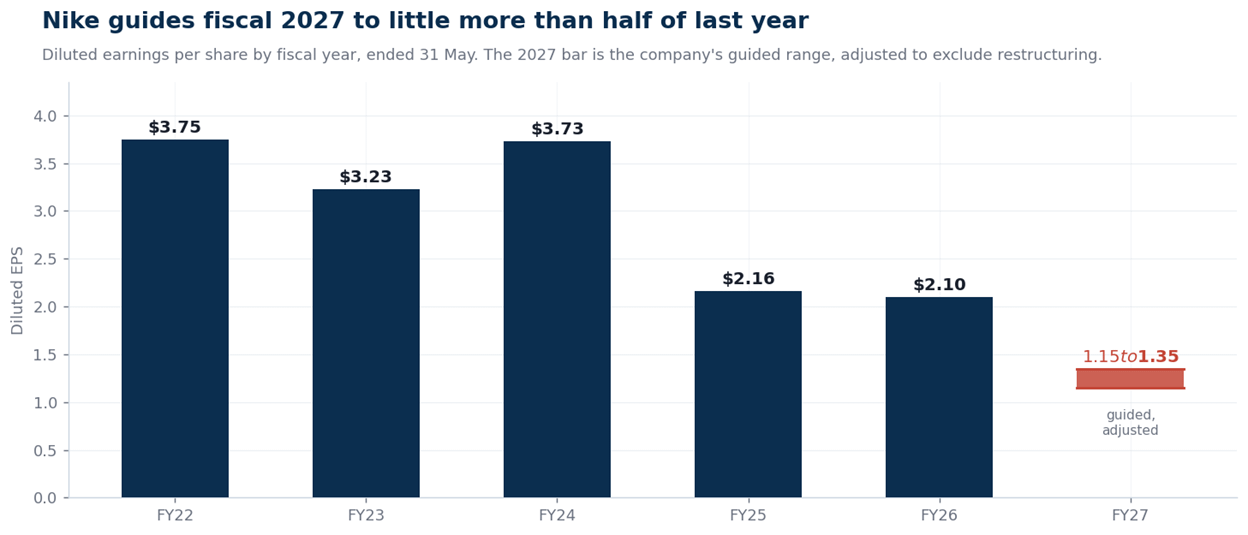
Nike guided fiscal 2027 revenue to decline high-single digits and adjusted earnings to $1.15 to $1.35, excluding about $0.15 of restructuring.
The cleanest way to see what that implies is to stay inside this year. Nike earned $0.48 in the quarter just reported, which leaves $0.67 to $0.87 for the remaining 9 months, about $0.26 a quarter. Nike gave no adjusted figure for the quarter and showed no separate restructuring line, so $0.48 is the reported number. If charges sat inside other expense lines the adjusted figure would be higher and the implied remainder smaller, so the comparison errs in Nike’s favor.
Comparing with last year needs more care than it’s getting. Fiscal 2026 earnings of $2.10 include a $0.52 benefit in the fourth quarter from the expected recovery of tariffs under the International Emergency Economic Powers Act, which the Supreme Court struck down in February. The benefit was $986 million and lifted that quarter’s gross margin by about 900 basis points. Nike says that across the full year the benefit largely offsets the tariff costs the year had already absorbed.
So the annual figure is roughly clean and the quarterly ones aren’t. On the annual basis the $1.25 midpoint sits 40% below $2.10, or about 45% below once both sides are adjusted for restructuring, Nike’s own definition. What you can’t do is set the guided 9 months against last year’s final 9 months, because the refund landed in a single quarter while the costs it offsets were spread across the year.
What You Are Actually Paying For
At $31.54 Nike is worth about $47 billion. That’s 25 times the $1.25 midpoint of this year’s guidance, and nearly 29 times the roughly $1.10 of reported earnings implied once restructuring is counted. On this year’s numbers alone the stock looks expensive, though a trough year is a poor basis for that judgement.
But nobody buying Nike here is buying this year. Against fiscal 2026’s $2.10 the same price is 15 times, and against fiscal 2024’s $3.73 it’s 8.5 times. Neither is a price you actually pay today. Both are prices conditional on earnings returning to a level Nike isn’t guiding to, and the argument is which of them describes the business in 3 years.
Work backwards from the revenue Nike guides to, about $43 billion. Earning $2.10 on that base needs a net margin of 7.3%, a little above the 6.7% Nike actually managed in fiscal 2026 and well above the 4.3% this year’s guidance implies. Earning $3.73 needs 13.0%, above the 11.1% of fiscal 2024. That isn’t unprecedented: Nike made 12.9% in fiscal 2022 and 12.9% in 2021, so the $3.73 case is a return to the margins of 4 years ago on a smaller revenue base. Revenue recovery would lower the bar rather than being strictly required.
The help already identified is harder to place than it looks. Pace is budgeted at roughly $2.5 billion of savings against $1.0 billion of charges, but both are cumulative through fiscal 2031 and stated before reinvestment. A cumulative total doesn’t establish annual earnings power, so it can’t be read straight into the margin for a particular year.
So the margin figures are the thing to hold on to. They tell you what has to happen; the cost program tells you only that management is working on it.
Reduced Flexibility
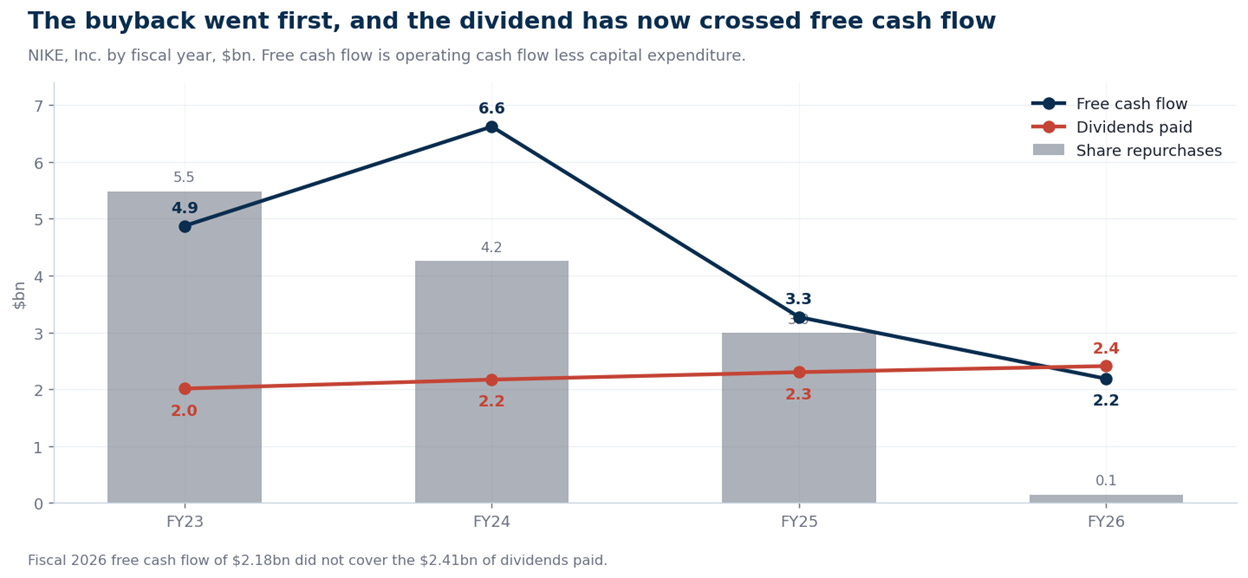
The balance sheet is what has to carry the company while that plays out. Nike declared $0.410 a share, so $1.64 annualised against a $1.25 adjusted midpoint: a payout ratio of 131% on guided earnings, 149% against the implied reported figure, and 121% to 143% across the guidance range.
Free cash flow was $6,617 million in fiscal 2024, $3,268 million in 2025 and $2,184 million in 2026, while dividends rose every year to $2,407 million. Cover went 3.05 times, then 1.42, then 0.91. Fiscal 2026 is the year it crossed, by $223 million.
That crossing is softer than it looks. Of the $986 million tariff benefit Nike booked, only $302 million arrived as cash by May 31. The other $684 million sat in receivables and the annual report says substantially all of it was collected after the year end, so a sum 3 times the shortfall moved out of fiscal 2026 cash flow and into fiscal 2027. It’s a real cushion, and a cushion that arrives once.
The buyback tells the same story. Repurchases went $5,480 million in fiscal 2023, then $4,250 million, $2,985 million and $146 million in 2026, with none in either of the last 2 quarters Nike has reported. That’s a pause, not an ending: $5.9 billion of the authorization is unused and the board renewed it in June 2026 with no expiry. But the diluted share count has turned, 1,484.2 million against 1,479.0 million a year ago, after 4 years of shrinking. Under the program Nike has bought 124.4 million shares at an average of $97.57. The stock is $31.54.
I’m not forecasting a cut. Nike holds $8.4 billion of cash and short-term investments against $7.9 billion of debt, and a board can fund a payout from reserves for a long time. What the numbers show is weaker coverage and less room than the company used to have, at the moment it needs room.
Where the Damage Is
Greater China is the worst of it. Revenue fell 22%, or 26% currency-neutral, to $1,180 million, and its earnings before interest and tax fell 34%. Converse is worse in percentage terms, down 28% to $263 million with profit down 36%.
The channel split is the more interesting read. Nike Direct fell 8%, with Brand Digital down 13%, while wholesale fell only 1% and North America wholesale rose 9%. That’s the deliberate reversal of the direct-to-consumer strategy working. Wholesale carries lower gross margins but also lower costs to serve, so the effect further down the income statement is less direct than it looks. By product, footwear fell 6% and apparel rose 2%, and footwear is the franchise.
The Case Against Me
Nike isn’t a broken brand. North America, its largest market, grew. Gross margin expanded in a down quarter, and the wholesale rebuild is working, which is the thing that had to.
The bull case doesn’t need my arithmetic to be wrong, only incomplete. A $2.5 billion savings figure is what management will commit to publicly, not the limit of what a program finds once running. Revenue recovery is excluded from my sums entirely, and a brand this size reclaiming a few points of growth changes the margin math quickly, because the cost base is being rebuilt smaller.
What I keep returning to is the clock. Nike has had almost 2 years under this management, the top line is still falling, China is still falling, and the cost program runs to 2031. That doesn’t make the shares expensive. It makes them a bet on duration.
Bottom Line
Nike delivered a quarter that did what it needed to: margin up, costs down, pre-tax profit flat on 4% lower revenue. Read only the first page and the turnaround is on track. The guidance describes a company earning a third of what it made in fiscal 2024, on revenue about $8 billion lower.
So is it cheap? Every answer is conditional. A multiple of 8.5 times fiscal 2024 earnings would be a low price if those earnings came back and held, and 15 times fiscal 2026 would be fair if $2.10 is reachable. The margin figures are how to judge which: 7.3% to get back to $2.10, 12.9% to get back to $3.73, against the 6.7% Nike managed last year and the 4.3% this year’s guidance implies. The first of those looks achievable, the second asks for 2022 again. What you can’t say is that the recovery comes free. Put a 15 times multiple on normalised earnings and $31.54 implies about $2.10, which is the fiscal 2026 outcome already. No recovery at all, on the same multiple against the guided $1.25, would be nearer $19. So the fiscal 2026 case is roughly in the price and the fiscal 2024 case isn’t, which makes the question whether Nike gets past 2026 earnings rather than back to them. I’d rather see revenue stop falling before paying for that. The weekly plan I publish had Nike at Avoid before the results, and the entry never triggered.
This is research and commentary, not personal investment advice. Levels are illustrative; size positions to your own risk tolerance and time horizon. The author may hold positions in names discussed.