


The market has turned AI semis into deities.
Nvidia, AMD, and Broadcom now sit at the center of a multi-trillion dollar capex super-cycle. Hyperscalers are building AI data centers like it’s a land grab. Governments are funding “sovereign AI.” Everyone’s talking about “chips as the new oil.”
At the same time, we’re not early anymore.
Valuations are rich across the whole semiconductor space: the US semis industry trades at roughly 56x earnings on average, already baking in aggressive growth expectations. Many listed semis sit closer to 30–40x. Our trio is well above that.
Key Takeaways
Nvidia NVDA 0.00%↑ – still the dominant AI compute platform with software-like margins and a fortress balance sheet. Valuation is expensive but not insane relative to its growth and profitability. Technically it looks like a strong uptrend in a wave-4 style correction, not a broken story.
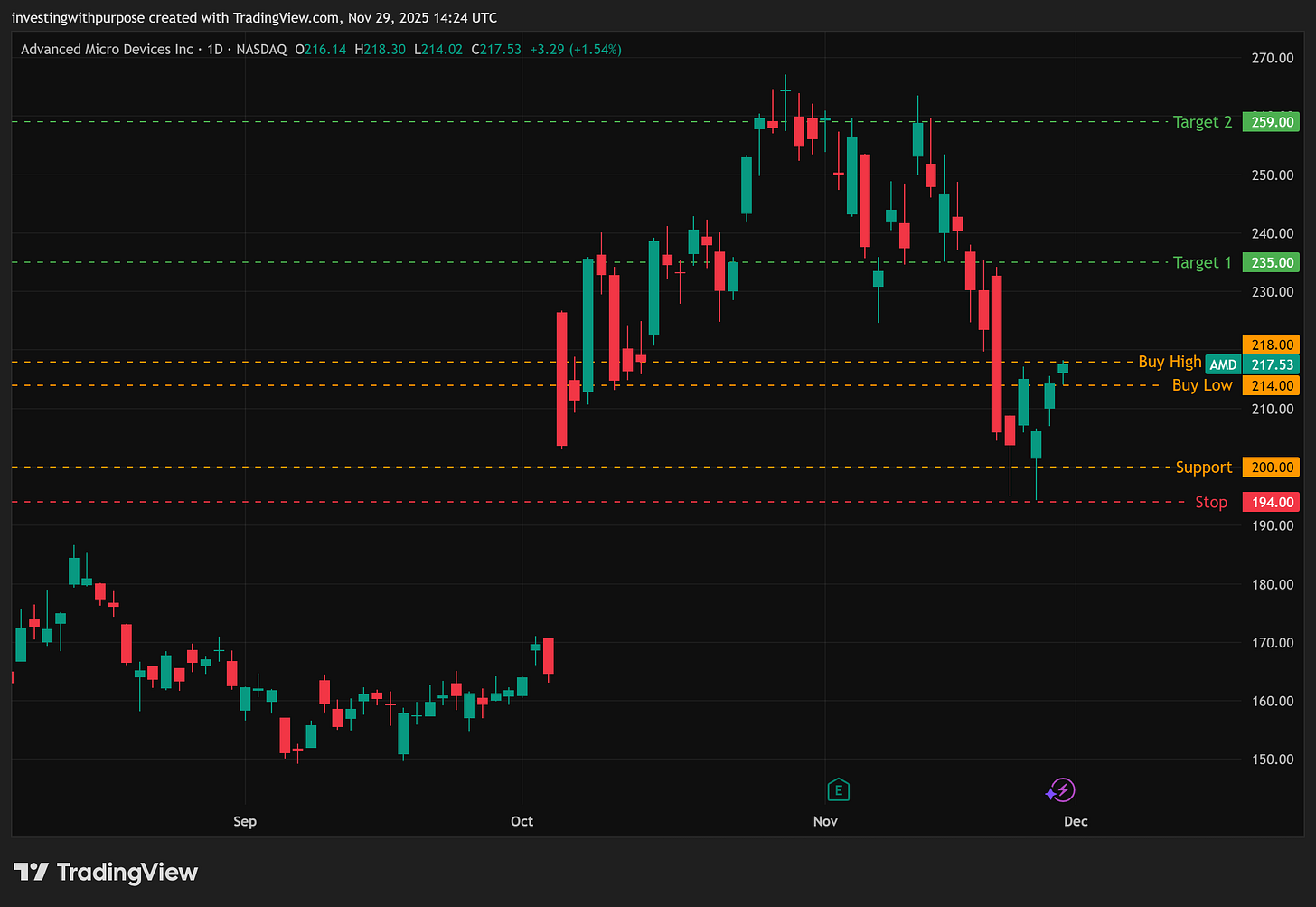
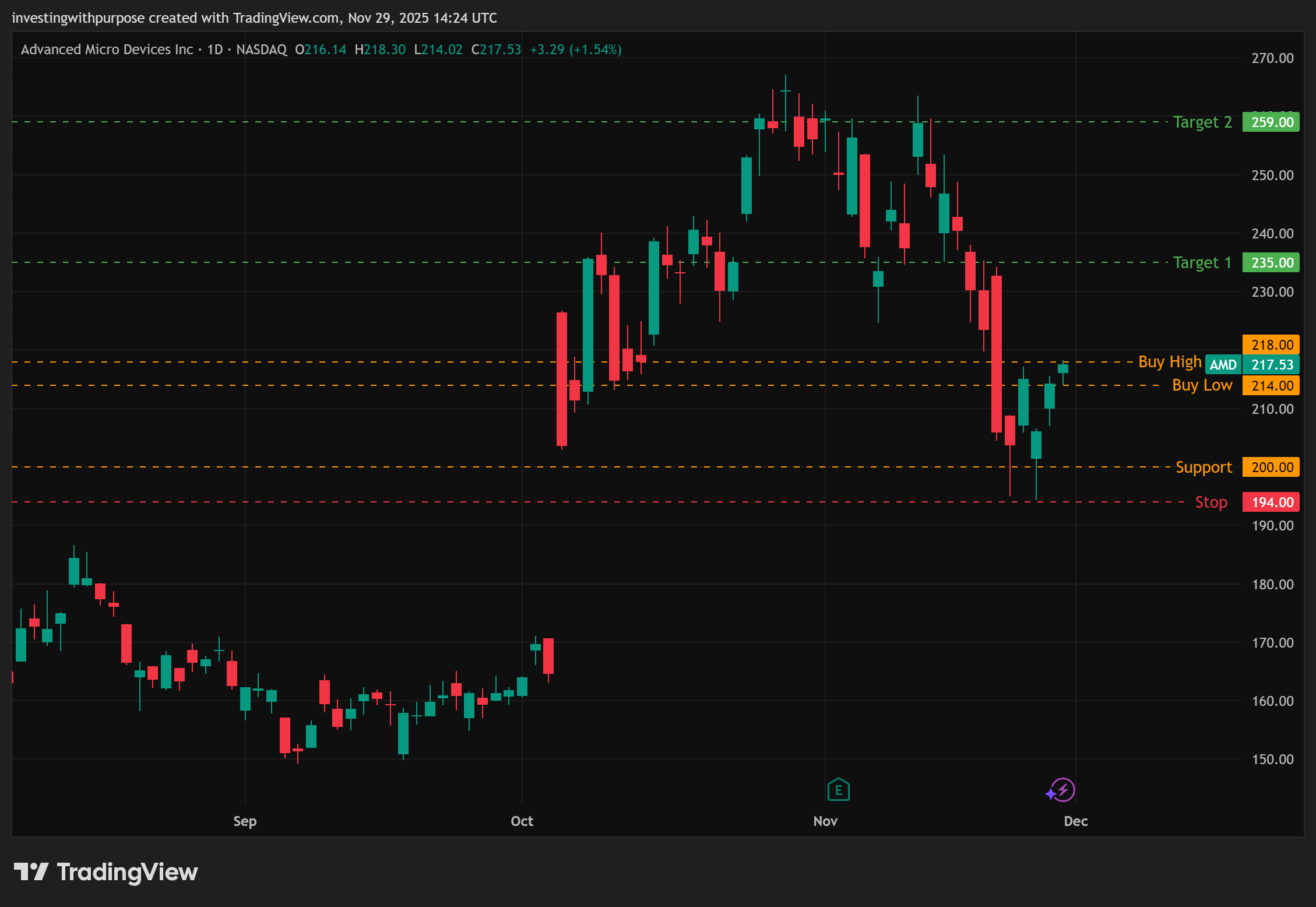
AMD AMD 0.00%↑ – credible AI challenger with real traction in data center and AI PCs, but earnings are far smaller and the multiple is extreme. Fundamentally more execution-sensitive; technically sitting on a key pivot around 194–200 that will decide whether we get a new leg up or a deeper ABC correction.
Broadcom AVGO 0.00%↑ – a hybrid: custom AI silicon plus networking plus VMware-driven infrastructure software. Financial quality is excellent, but the stock is in a technically stretched, late-stage up-leg with a very high multiple.
Valuation vs peers – as of late November 2025, rough trailing P/Es:
NVDA: 44x
AMD: 110x
AVGO: 100xF
All of them trade above both the broad semi universe (38x) and the US semis industry average (56x). AMD and AVGO are the most stretched relative to peers.
My bias for medium/long term (not advice):
NVDA: still the core compounder if you’re paying up for quality.
AMD: higher upside torque, but I’d size smaller and be strict on levels.
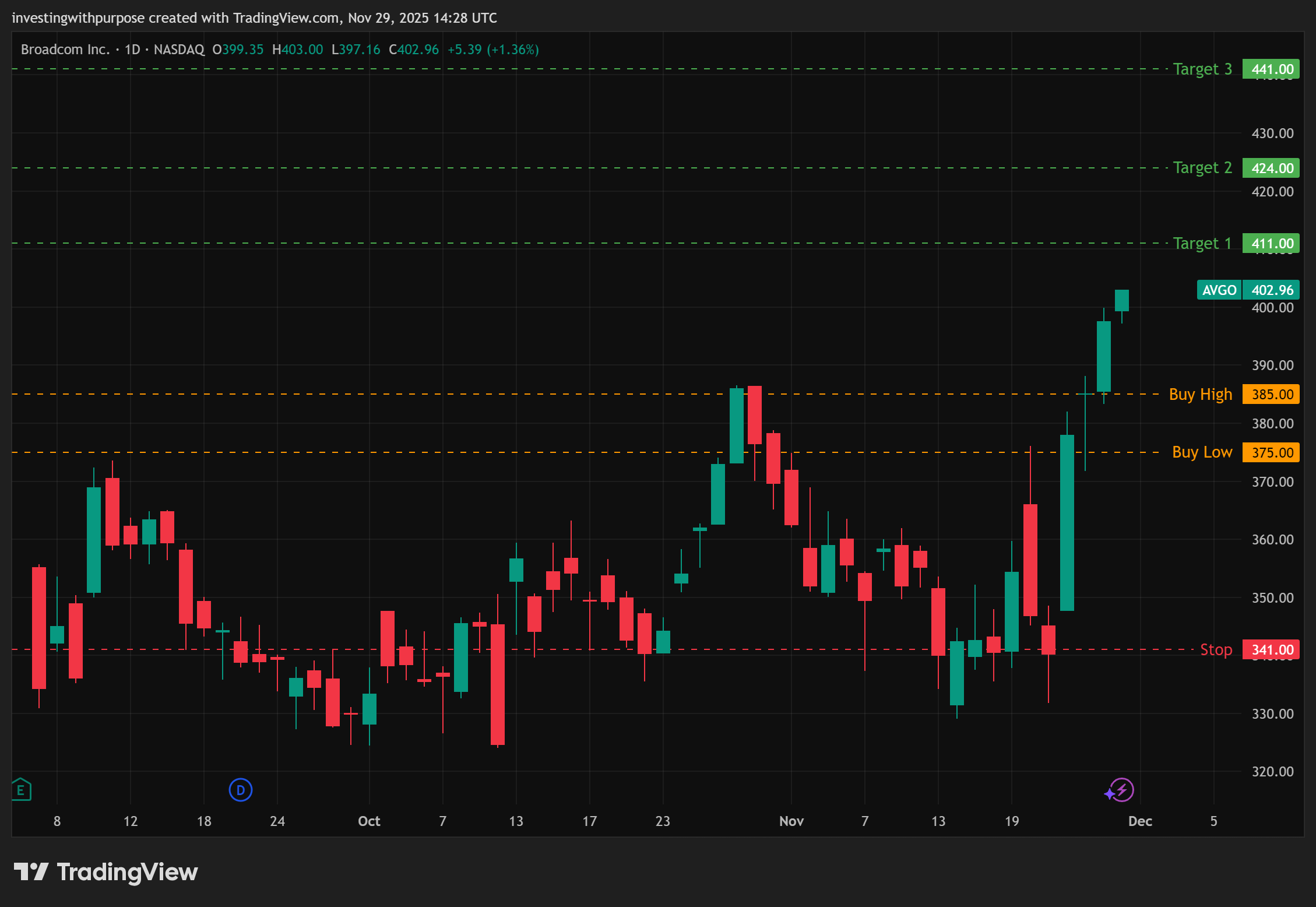
AVGO: fantastic business, but I’d want pullbacks away from the current confluence-resistance before leaning in.
Pipelines, Products, and “Moats in Motion”
Let’s translate the usual slide-deck buzzwords into something usable.
Nvidia – The AI utility
Nvidia is now effectively an AI compute utility:
Data Center is 90 percent of revenue, driven by GPU systems (Blackwell, Blackwell Ultra), networking, and the CUDA/AI software stack layered on top.
Margins are extraordinary: gross margin in the mid-70s, operating margin 60 percent, net margin >50 percent, with tens of billions in quarterly free cash flow.
Product pipeline: Blackwell ramping, Rubin/Rubin CPX next, with each generation increasing performance per watt and deepening CUDA lock-in.
Moat: CUDA ecosystem, dev tools, and the sheer scale of deployments with hyperscalers and sovereign AI projects. Even Alphabet building out TPUs and courting Meta is framed as “eroding a near-90 percent share to something like 60–70 percent,” not killing Nvidia.
Regulatory risk is real (export controls, antitrust, national security), and competition from in-house chips and TPUs is rising, but there’s no other vendor today with this combination of hardware, systems, and software.
AMD – The challenger with something to prove
AMD’s numbers and segment splits tell a clear story:
Data Center (EPYC CPUs plus Instinct accelerators) is now the growth engine. Revenue there almost doubled in 2024 and continues to ramp.
Client (PCs) is recovering on the back of Ryzen AI and the AI PC narrative.
Gaming and Embedded are in down-cycles, acting more as ballast than growth.
On the AI side:
AMD is pushing MI300/MI350 and the MI400 series as a credible alternative to Nvidia’s GPUs. Susquehanna’s forecast has AMD capturing a bit over 4 percent of a roughly 475 billion dollar AI chip market by 2030, versus Nvidia dropping from 80 percent share to the high 60s.
That’s meaningful upside, but still a distant number two.
The ROCm software ecosystem is improving, but it’s nowhere near CUDA’s maturity.
This is a share-gain and catch-up story in a huge market. When it works, the market pays up; when expectations wobble, the stock reprices quickly.
Broadcom – The quiet AI infra and software operator
Semiconductors 60 percent of revenue; Infrastructure Software (VMware, Symantec, CA, etc.) 40 percent.
Within semis, AI has exploded: AI revenue jumped to over 12 billion dollars and is on track for 20 billion plus next year, driven by custom AI accelerators and high-end Ethernet/optical networking for hyperscalers.
VMware and the software stack bring recurring revenue and private-equity-style cash generation.
Analysts now forecast Broadcom grabbing around 14 percent of AI chip spend by 2030 (mostly via custom chips), up from low-single-digit share today.
Broadcom’s edge is designing to spec for a handful of very large customers, and locking them into long multi-year contracts, while VMware smooths the cycle. The flip side is heavy customer concentration and big single-client risk.
If Nvidia is the “default,” AMD is the option, and Broadcom is the infrastructure landlord with upside to AI.
Fundamental Analysis
Nvidia – Fundamentals in one breath
Revenue: already well into the 100+ billion range annually, growing at hyper-scale with Data Center as the core.
Margins: gross 75 percent, operating 60 percent, net above 50 percent.
Balance sheet: large net cash position, very low financial risk.
TTM P/E around 44x, forward P/E just under 30x.
Sector context: that 44x is a premium to broad semis (38x) but actually below the semis industry average of 56x, despite Nvidia’s superior growth and margins.
You’re paying a premium, but for the one player whose financials justify it. If you want a single “AI infra core” in a medium/long term book, Nvidia is still the cleanest fundamental anchor.
AMD – Fundamentals in one breath
Revenue: mid-20s billions annually, with strong growth in Data Center and Client offsetting Gaming/Embedded cyclicality.
Margins: gross around 50 percent, operating margins improving but nowhere near Nvidia or Broadcom.
Balance sheet: net cash, asset-light, plenty of flexibility for R&D and small M&A.
TTM P/E 110x, with forward P/E just under 40x.
Simply Wall St flags AMD as expensive vs peer average P/E (24x).
Fundamentals are good, but the valuation embeds a lot of success in catching meaningful AI share. Compared to NVDA and AVGO, AMD’s multiple is the most sensitive to any disappointment in execution or AI narrative.
Broadcom – Fundamentals in one breath
Revenue: low-50s billions, growing >20 percent YoY, with AI semi and VMware driving most of it.
Margins: mid-70s gross, very high operating and FCF margins north of 40 percent.
Balance sheet: meaningful net debt from VMware, but covered by strong and stable FCF; S&P moved them up to A-, which tells you credit risk is manageable.
TTM P/E around 100x, forward P/E close to 60x.
AVGO’s business quality is excellent, but you are paying a hedge-fund premium multiple for that combination of AI chips and software cash flows. It’s less obviously mis-priced on fundamentals than it feels, but it is absolutely not cheap.
Roughly: Nvidia = “premium but justified,” AMD = “hope priced in,” Broadcom = “quality at a full AI multiple.”
Technical Analysis
NVDA – Strong bull trend in a corrective pocket
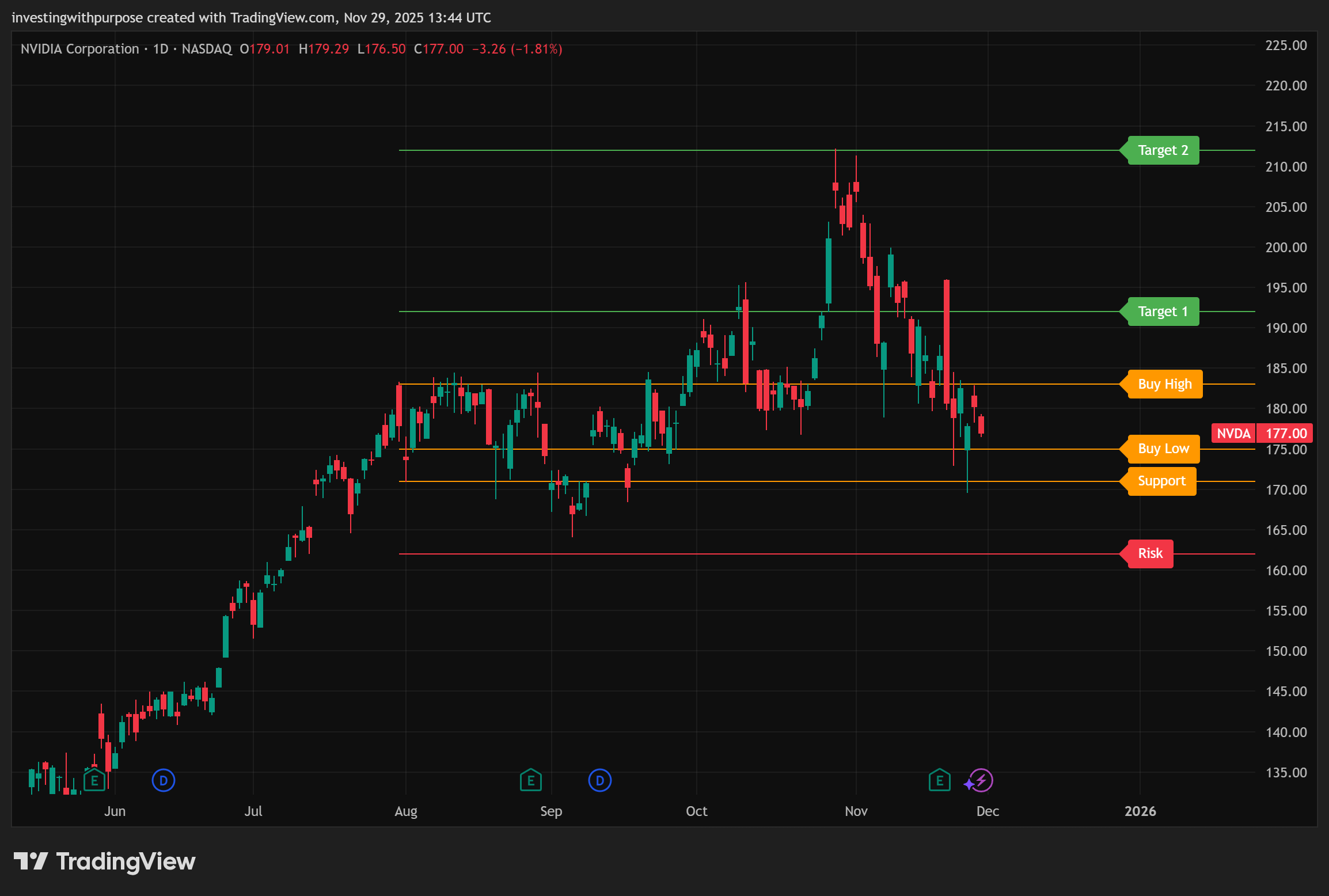
Weekly: clear 5-wave impulse 86 → 212; current move looks like wave (4) correcting that run. Price is sitting on the 20-week EMA around 176–177, with the 50-week down near 156.
Support clusters:
175–171: confluence of weekly 20 EMA, daily 100 EMA, BB lower band, and multiple Fib levels.
166–162: “max normal wave 4” region plus 200-day EMA.
150–135: deeper but still secularly bullish.
Resistance / triggers:
183–192: daily 20/50 EMAs, Ichimoku Tenkan/Kijun, Fib retraces.
199–205: bigger wall; reclaiming and holding above 200 would strongly support the “wave 5 next” thesis.
Momentum: daily RSI in the low 40s, weekly RSI >50 with Stoch RSI oversold. MACD negative on daily but flattening. All consistent with late wave-4 behavior, not an accelerating downtrend.
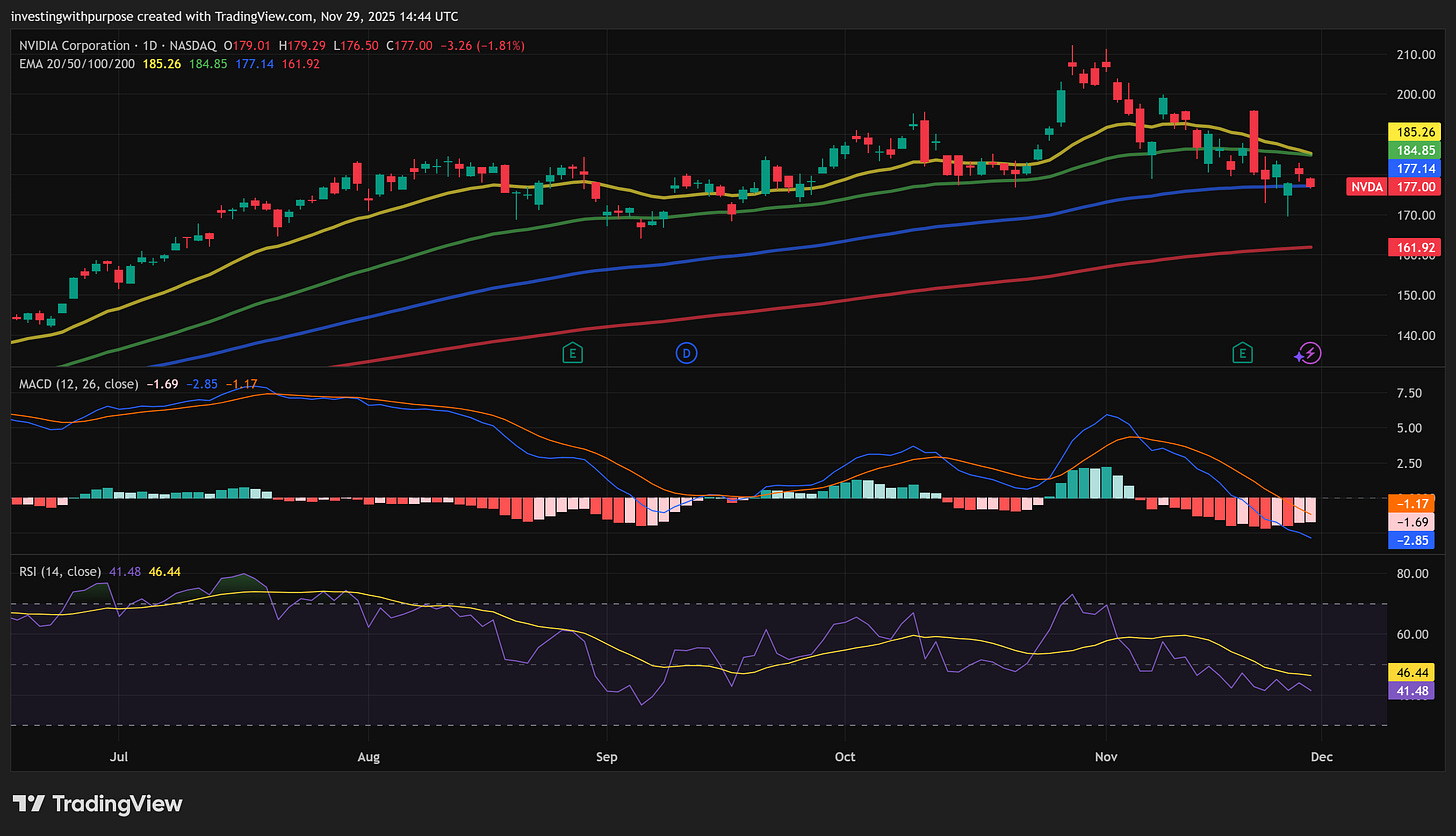
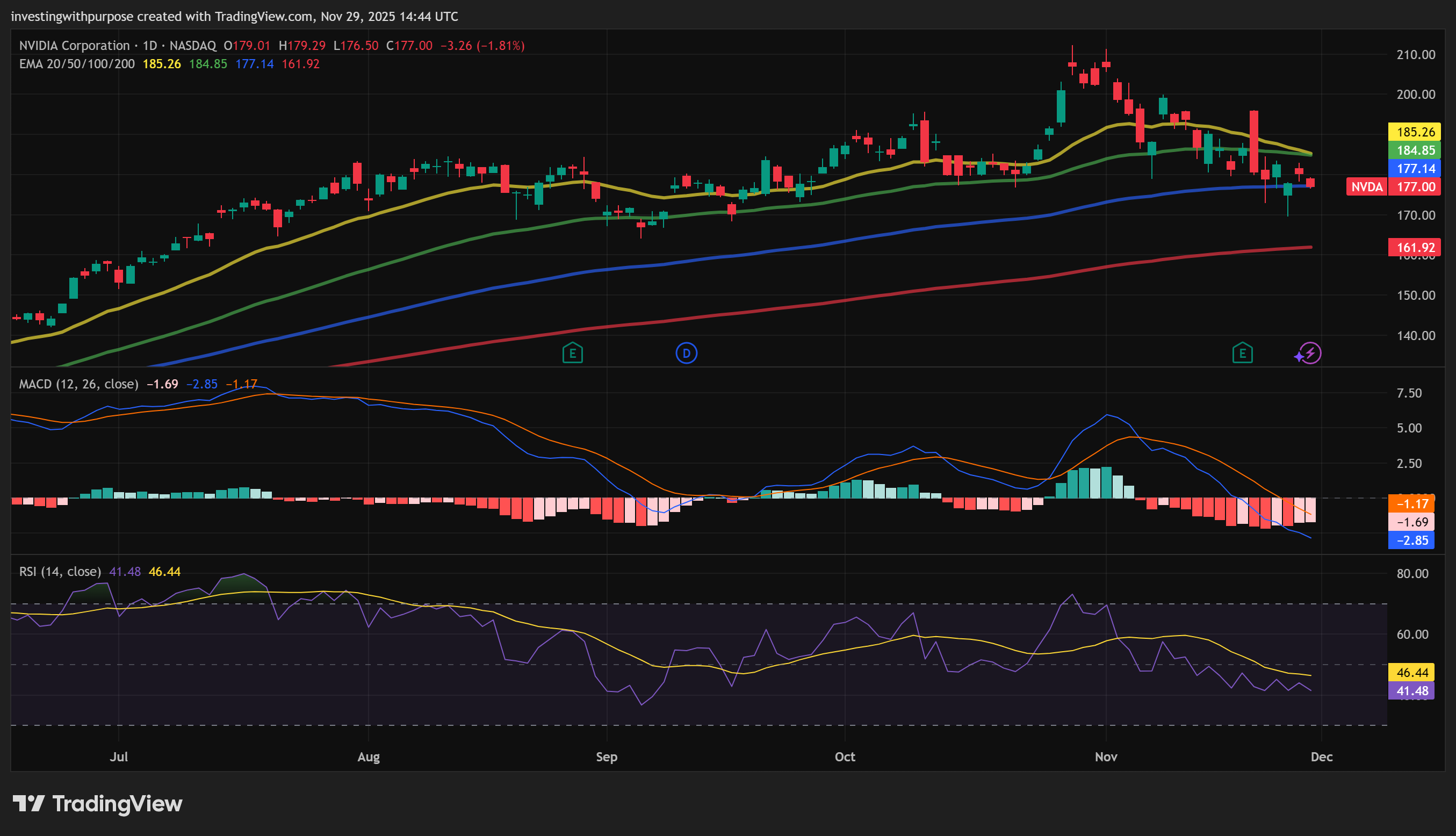
NVDA looks like a strong secular uptrend taking a breather. As long as the 160s and the 200-day remain intact on a closing basis, the charts agree with the fundamental secular bull.
AMD – Decision point stock
Long-term trend: still bullish on weekly, with price above all major EMAs and a big impulse from 149 to 267.
The key:
194–200 is the pivot.
Bullish Elliott count = wave (4) finished there, and we’re starting wave (5) toward 300+.
Bearish count = that drop was just wave (a), this bounce is wave (b) into 222–239, then a wave (c) down to 170–150.
Support:
214–218: near-term.
194–200: must-hold for the bullish count.
Below that, 177–172 then 150 open up.
Resistance:
220–222: first gate (Fib 0.618, 4h resistance, Tenkan).
226–235: bigger inflection (20d, Kijun, AKF level, cloud edge).
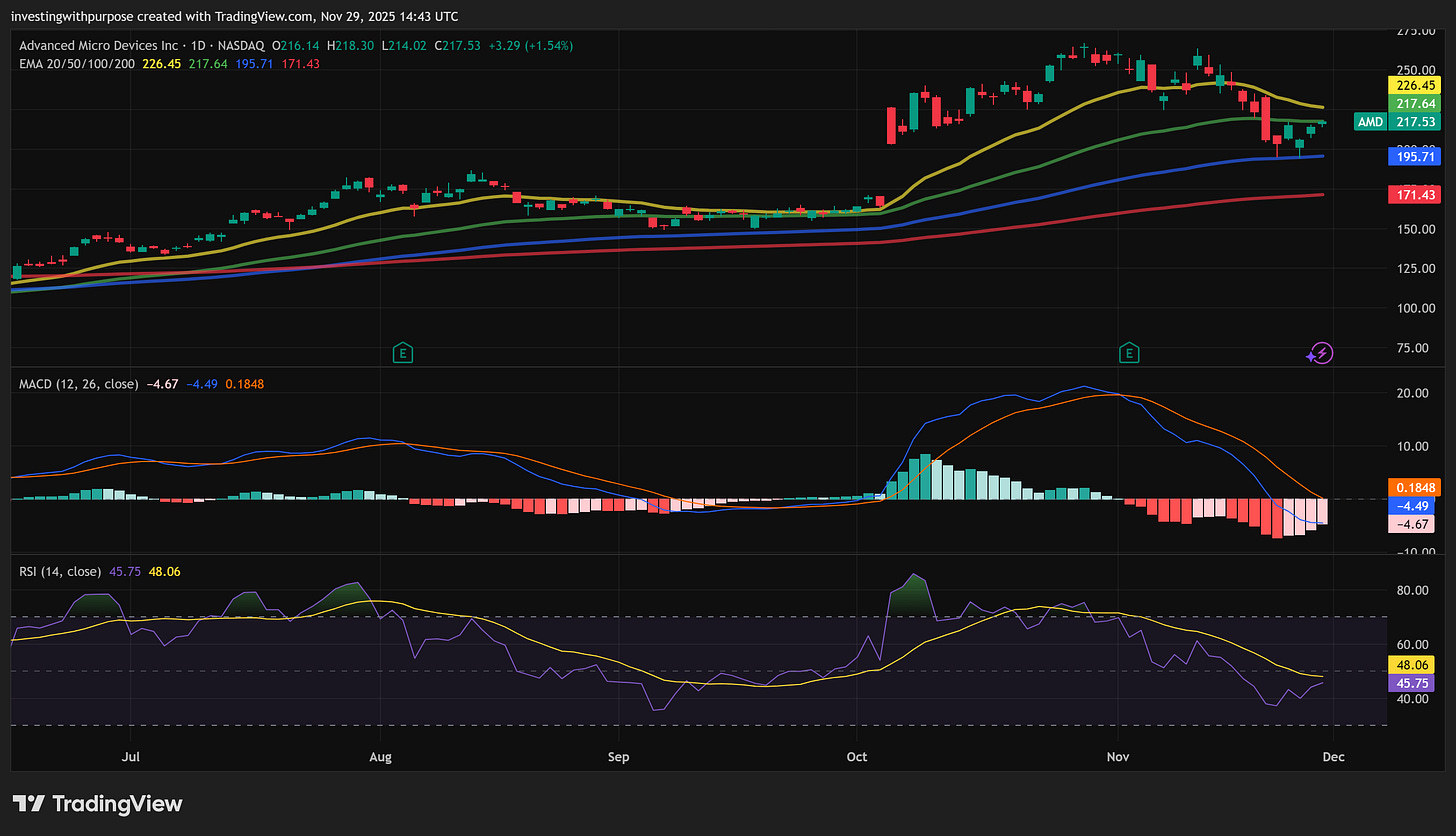
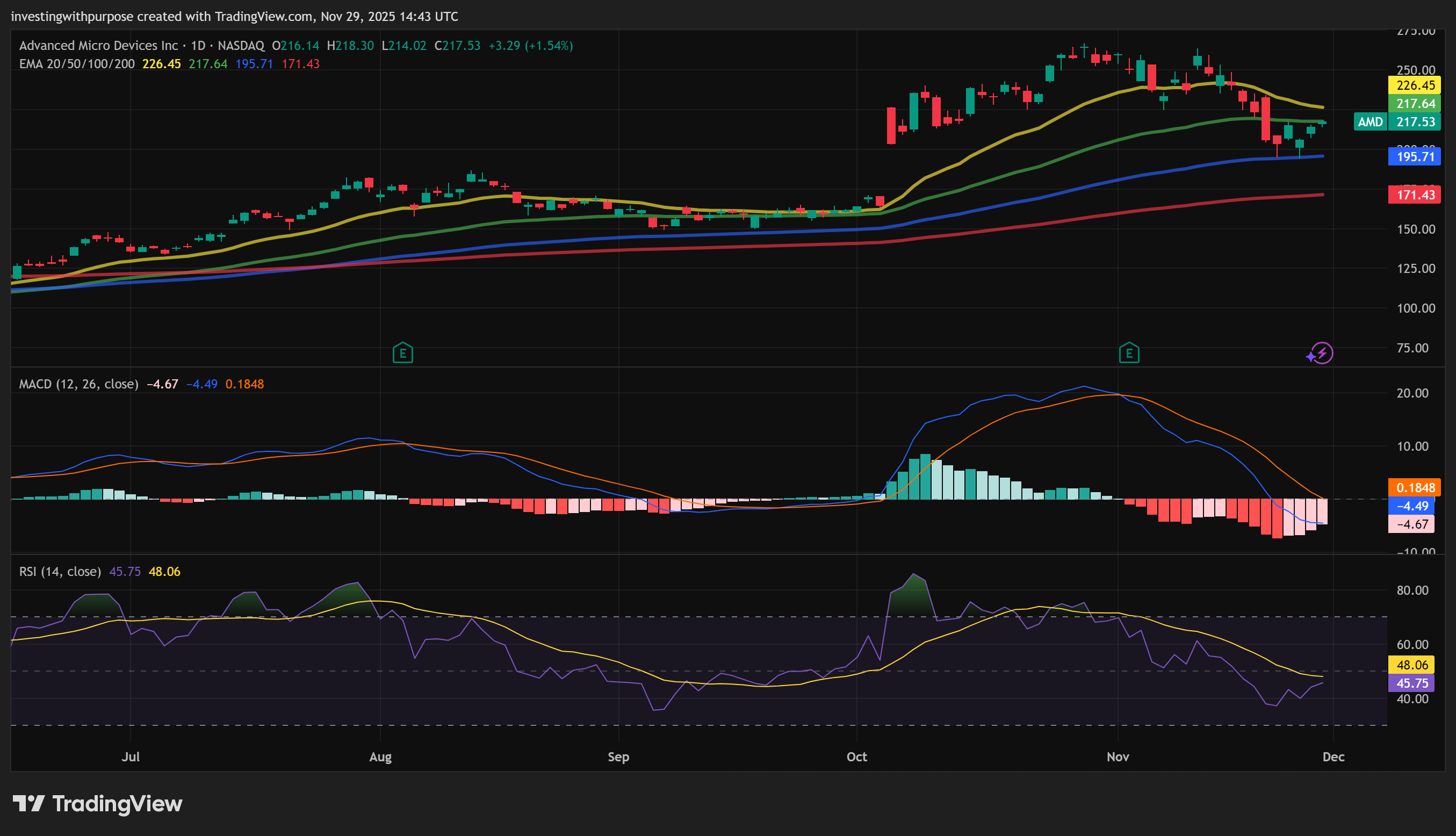
AMD is technically “fine” in the big picture, but you’re sitting right at the point where the market decides whether this was a simple pullback or the start of a larger corrective structure. It’s not broken, but it is far less comfortable than NVDA.
AVGO – Powerful trend, stretched location
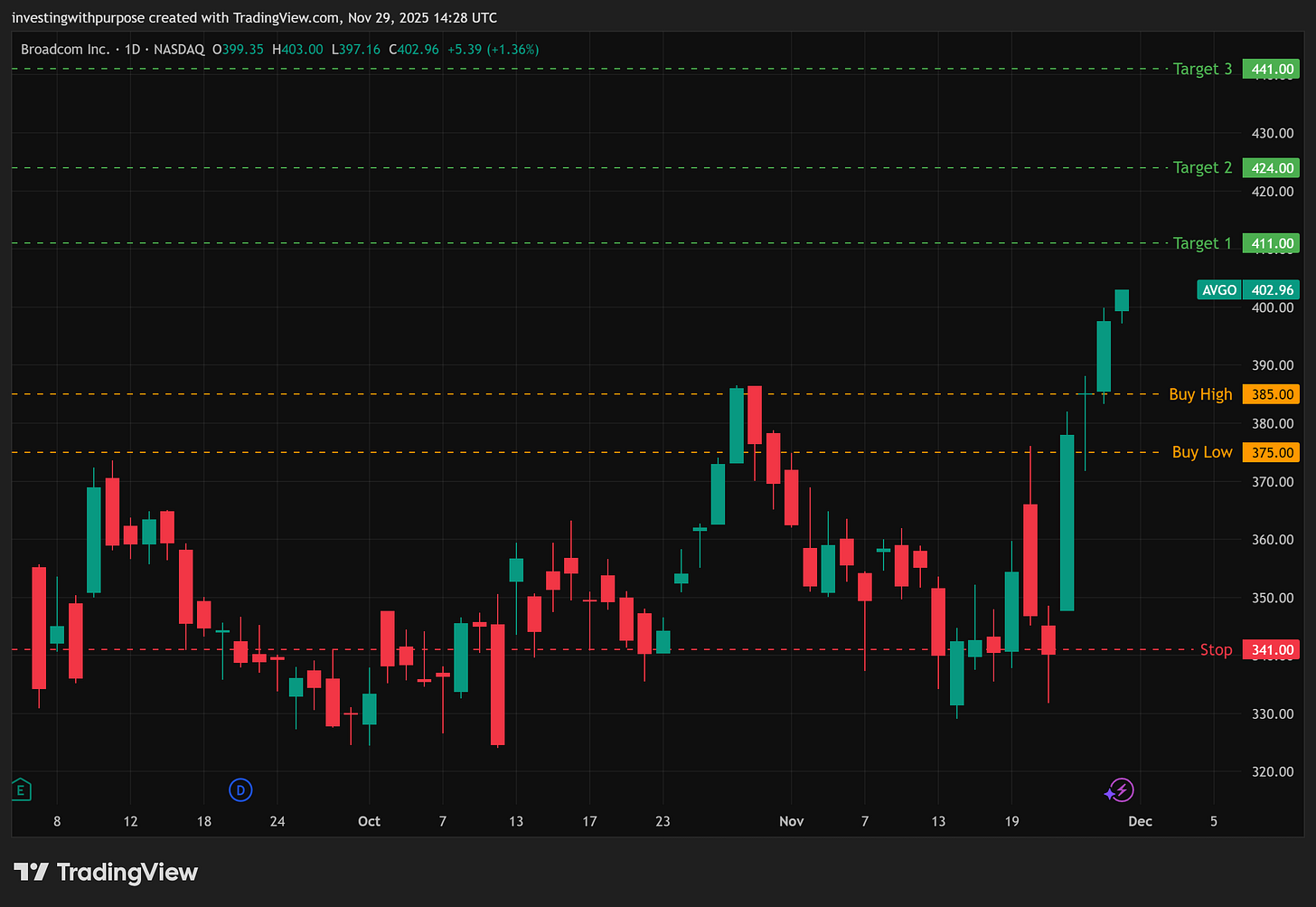
Weekly: EMAs stacked, ADX high, RSI >70, price riding the upper Bollinger band and hitting a 4.236 Fib extension around 400. Auto-Elliott even tags this zone as a possible wave-5 termination area.
Daily/4h:
Price ≈ 400+
Stoch RSI pinned overbought
Price hugging the upper BB and Kalman upper band
OBV confirming the move, not diverging
Key confluence:
398–403: daily 1.618 Fib, weekly 4.236 extension, 4h 0.786 extension, Elliott “(5) complete” tag. That’s a big cluster.
Pullback zones:
385–375: first mean reversion.
370–366 then 360–351: more substantial, where 20d/50d and key Fibs meet.
341–330: deeper, more like wave-A of a larger correction if the AI run cools.
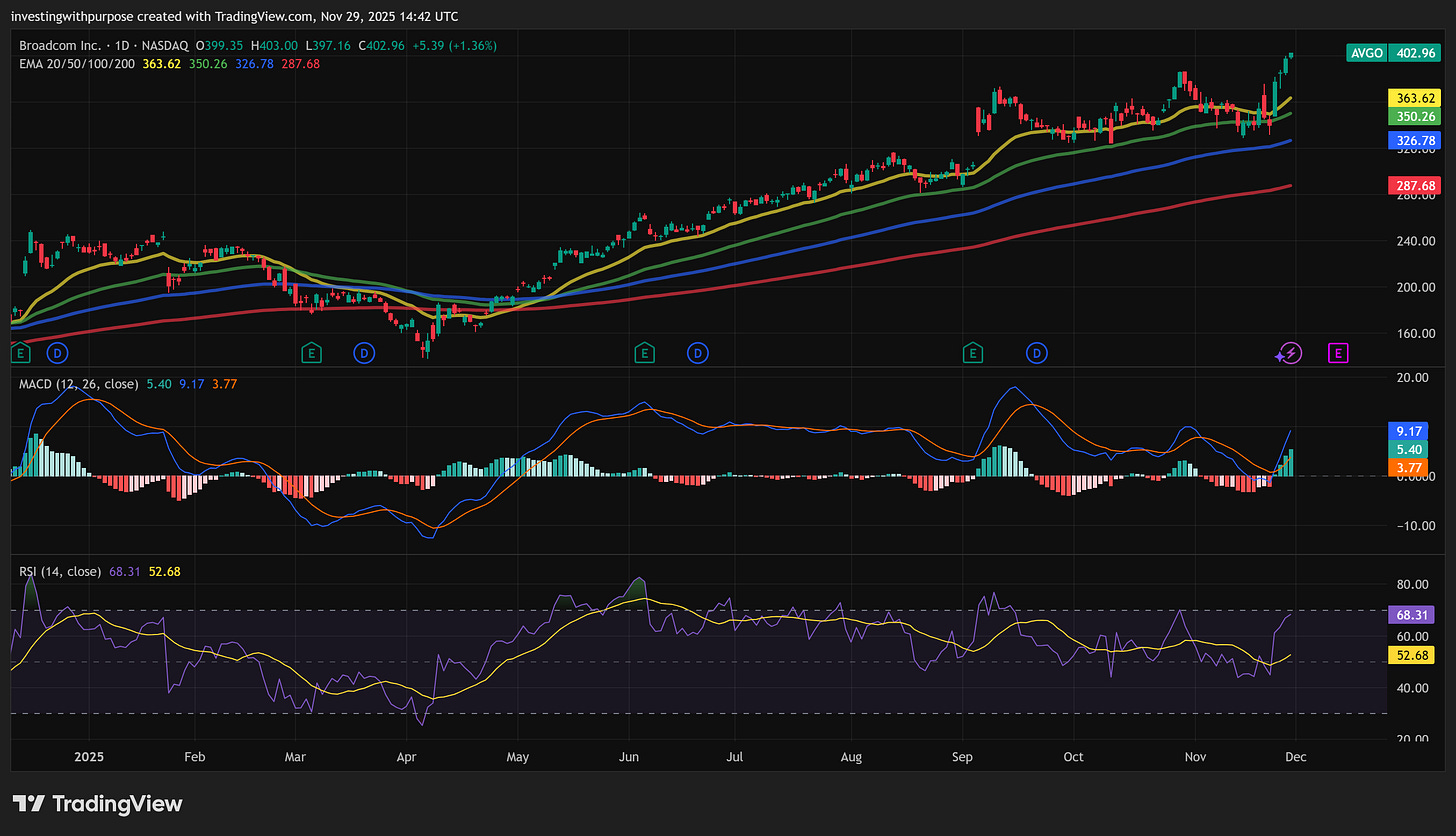
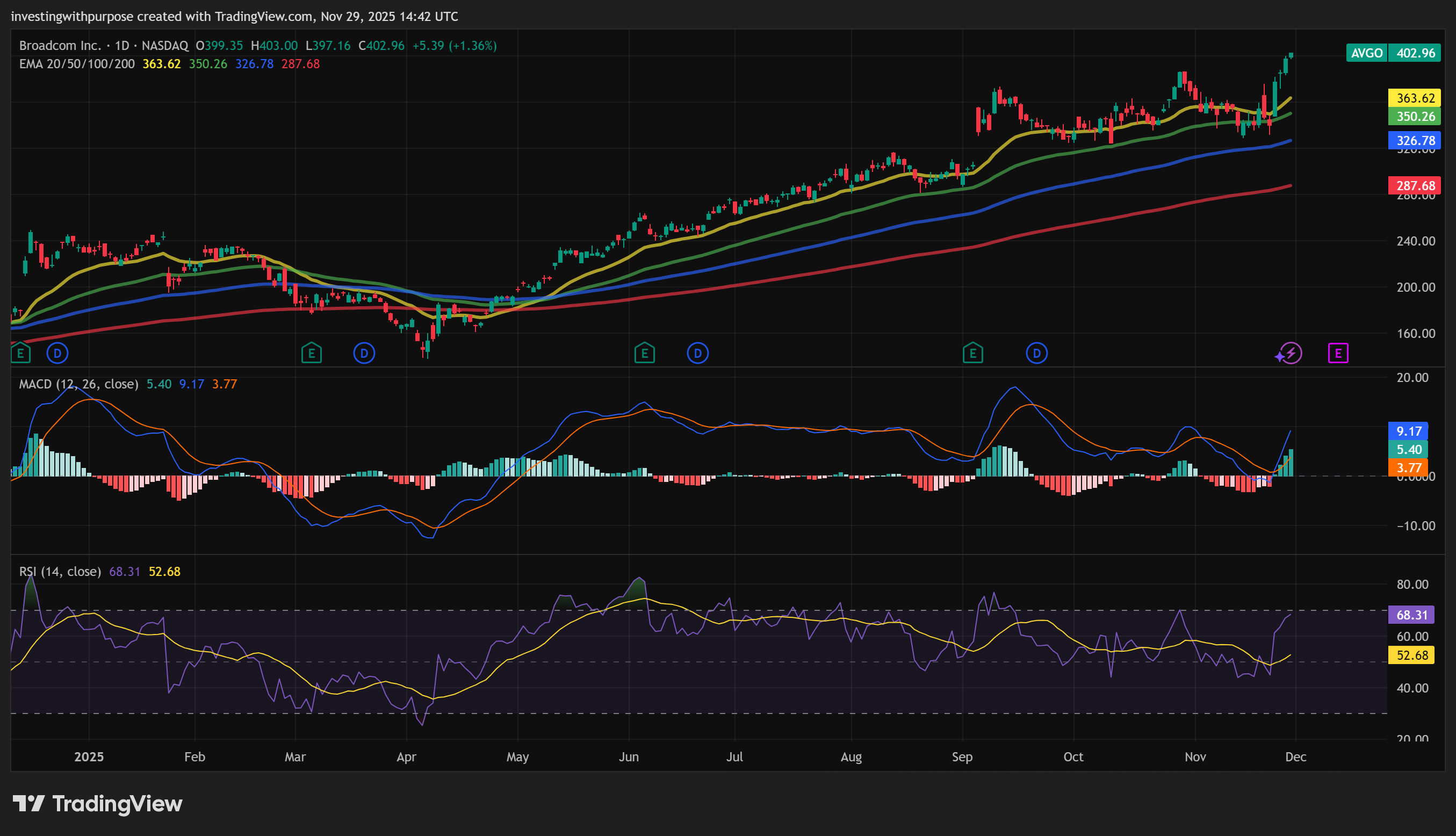
AVGO’s trend is strong, but the current zone is statistically where late buyers often end up providing liquidity for profit-takers. Great trend, tricky entry point for a medium-term investor.
Short version: NVDA = buy the dip regime, AMD = respect the pivot, AVGO = don’t chase vertical candles.
A Trade / Investment Approach (medium to long term)
None of this is advice, but if I were structuring this with a multi-month horizon and your style in mind, I’d think in tiers and roles, not “one hero stock.”
1. Define roles
Core AI infra anchor – Nvidia
High-beta satellite – AMD
Compounder with software ballast – Broadcom
You don’t need to own all three in equal size. The roles are different.
2. Respect valuation and technical location
Nvidia
Makes sense as a core position if you can live with volatility.
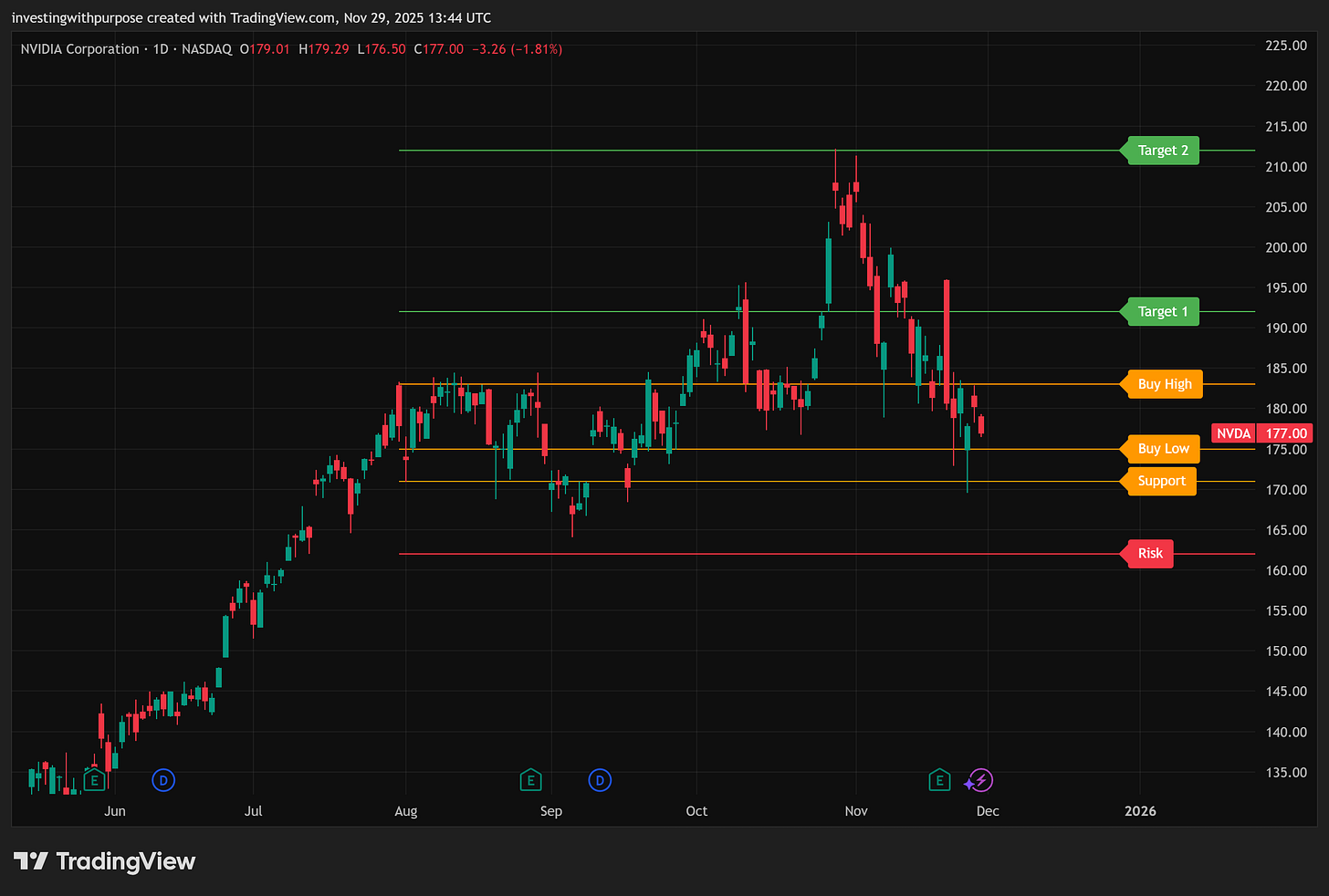
I’d be more comfortable adding in the 175–171 band, and more aggressively in 166–162, as long as the 200-day holds and fundamentals don’t crack.
Upside management: think in stages – retest of 212, then 227–233, then your extended wave-5 targets (276/343/449) if the cycle stays intact.
AMD
Treat as a smaller, higher-beta satellite. Position size should reflect both its higher valuation and the technical fork it’s sitting on.
As long as 194–200 holds, you can justify a medium-term bull bias. If price fails at 222–239 and then closes below 194, that’s a clear signal to de-risk or stand aside and let the ABC play out.
It’s the name I’d be quickest to cut if the AI sentiment wobbles or the charts start to confirm the bearish count.
Broadcom
Fundamentally deserving of a place in a compounder basket, but technically extended.
I’d rather wait for pullbacks into at least the 385–375 zone, and ideally 370–366 or 360–351, before sizing this as a medium-term hold.
At current 400ish levels with 100x trailing P/E, you’re paying for perfection on both AI uptake and VMware execution.
3. When would I “not touch” one of them?
I’d be cautious adding new money to AVGO up here unless you’re very comfortable sitting through a potential 15–25 percent drawdown.
I’d be wary of oversizing AMD at this valuation unless you have a very clear invalidation plan below 194 and are mentally prepared for deeper volatility.
NVDA is the one name I’d be slowest to abandon unless the 160s fail and the AI macro narrative truly shifts.
Bottom Line
In a world where every AI semi has become “the next everything,” it’s easy to lose the plot.
NVDA is still the structural leader, both on the income statement and on the chart. Expensive, yes, but with fundamentals that mostly justify a core position for a medium to long term investor willing to stomach corrections.
AMD is the leveraged bet on share gains and narrative. The upside is real if they execute against Nvidia, but the combination of rich valuation and that 194–200 pivot means you need discipline, not hero worship.
AVGO is what happens when a very good business meets a very hot narrative: outstanding fundamentals, but technically stretched and priced like a perfect story. It’s probably a “buy the dip, not the spike” name from here.
If you’re building a serious portfolio rather than trading headlines, I’d think in terms of core vs satellites, roles vs heroes, and levels vs feelings.
This is not investment advice or a solicitation to buy or sell any security. All information is for educational purposes only.
Interesting. Thank you!