


Nvidia reported Wednesday after the close and did everything the bulls asked. Revenue of $96.2 billion beat its own guidance by 5.7% and the LSEG consensus of $92.17 billion by 4.4%. It guided October to $108 billion against a Street line near $104.2 billion.
Then it did something it had never done: put a preliminary number on the following fiscal year, about 70% revenue growth, when analysts had 44%. The stock rose 8.7% on Thursday and gave back 57% of it on Friday. Demand volume has stopped being the question. What replaced it is harder: what Nvidia earns on that demand, and how much of its own balance sheet has to stand behind the buyers.
Key Takeaways
Revenue $96.2 billion, up 106%, with data centre at $89.0 billion, up 117%. Gross margin was 75.0%, up 260 basis points on the year.
The October guide cleared the bar by 3.6%, and a first-ever year-ahead figure of 70% sits 26 points above consensus. Management calls it supply-constrained.
Margin falls to 74% next quarter, troughs at 71% to 72% in January, then settles at 72% to 73%. Even so, gross profit still grows about 64%.
The balance sheet is now part of the product. $99 billion of equity investments, $25 billion more committed, and up to $105 billion of credit support behind a single customer’s data centre.
At $217.55 the stock is roughly 23 to 24 times this fiscal year. The 14 times you’ll see quoted for next year is a bet on the denominator, not a fact.
Prices are the Friday August 28 close of $217.55, the last completed session. Nvidia reported on Wednesday August 26 after the market shut.
What Got Settled
Before the print, the argument here was that the hurdle had moved off the reported quarter and onto the October guide and the gross margin. Both were answered on the night, in opposite directions.
The guide was emphatic. $108 billion is 3.6% through the bar and a sequential step of $11.8 billion, larger than Nvidia’s entire quarterly revenue as recently as early 2023. Jensen Huang’s line for it: “AI has reached its inflection point. It’s doing useful work. Now, compute is revenue.”
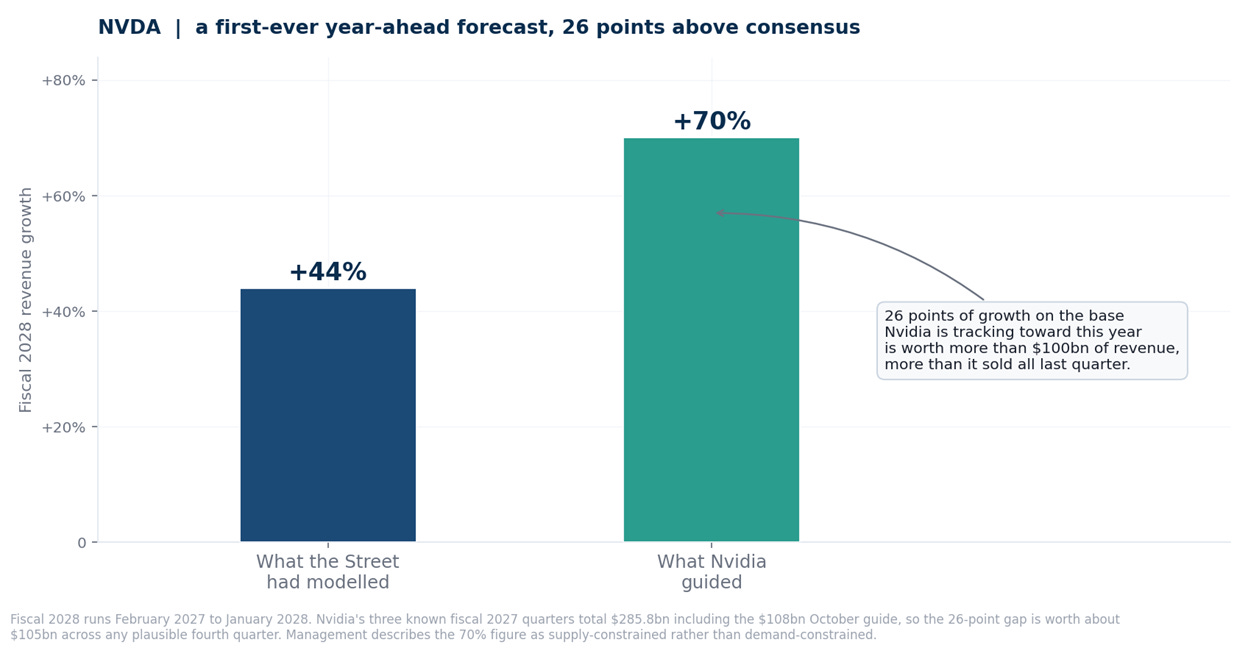
Then the part with no precedent. Nvidia has never put a number on a year in advance. It offered one as a preliminary expectation rather than formal guidance: about 70% growth in fiscal 2028, against consensus near 44%. On the base Nvidia is tracking toward this year, 26 points is worth more than $100 billion of revenue, more than it sold all last quarter.
The framing is the tell. Management describes that number as supply-constrained. Nvidia isn’t forecasting how much it can sell, it’s estimating how much it can build. When a company moves from demand guidance to supply guidance, the volume question has stopped being the interesting one.
One caution on the composition. Data centre revenue was $89.0 billion, split between $48.7 billion of hyperscale and $40.3 billion of AI clouds, industrial and enterprise, the latter growing faster at 138%. That looks like the buyer base broadening, and partly it is. But Nvidia says some of that faster-growing bucket is hyperscalers buying through AI clouds. Customer concentration is falling faster than end-demand concentration, and only the first of those is visible in the segment lines.
Demand Quality
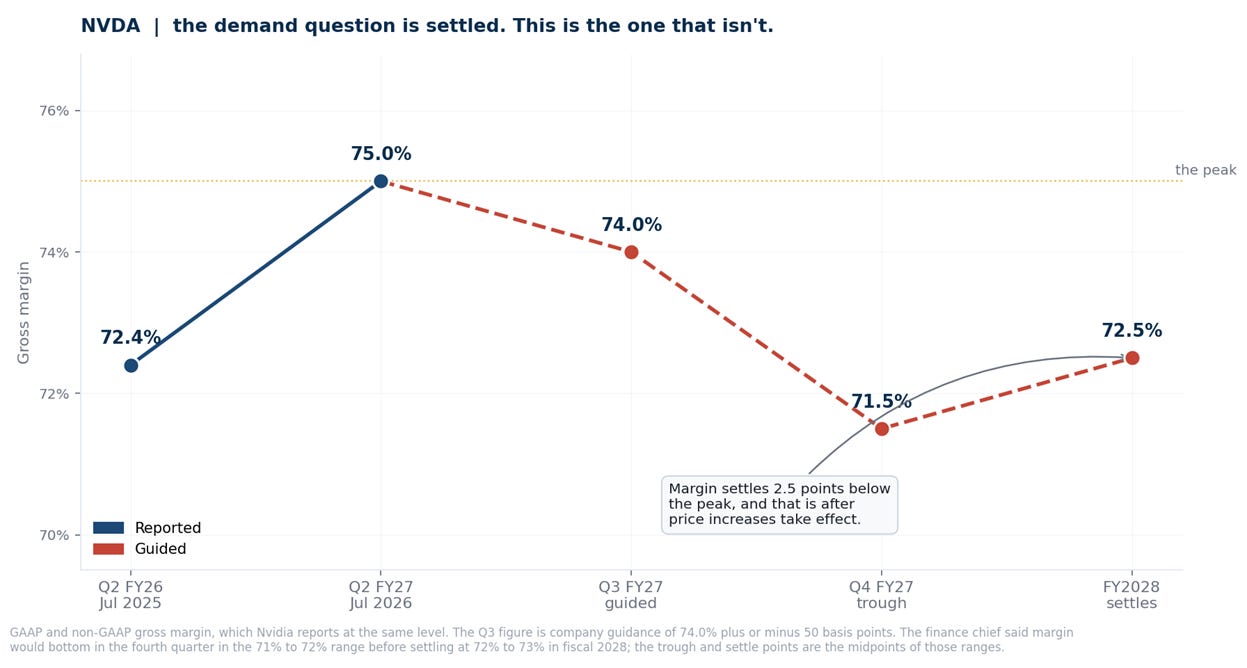
Gross margin was 75.0%, GAAP and non-GAAP alike, up from 72.4% a year earlier. That’s the durability test passed, and it’s why Thursday happened.
Then the path. Margin is guided to 74.0% in October, to bottom in the January quarter at 71% to 72%, and to settle at 72% to 73% through fiscal 2028. The finance chief’s word for memory was scarcity, driven in large part by the AI buildout itself, which is to say by Nvidia’s own customers bidding for the same components. And the settling happens after price increases take effect: Nvidia is raising prices and still lands 2 to 3 points below where it is today.
Here’s the balance the bearish reading misses. On the revenue Nvidia is pointing to, a 72.5% margin still produces roughly $490 billion of annual gross profit against something near $300 billion this year. Gross profit grows about 64% even as the margin falls. The reset costs real money, roughly $17 billion a year at that scale, but it doesn’t stop the compounding.
So the danger isn’t 72.5%. It’s 72.5% becoming 69%, or 70% growth becoming 45%, or both at once. That’s the sensitivity that matters, and it’s why Friday’s reaction was about revision risk rather than about this quarter.
Friday itself deserves a caveat. The margin outlook gave investors a reason to reassess Thursday, but the macro backdrop gave them a reason to act: Fed comments at Jackson Hole pushed yields higher and hit long-duration technology broadly. Nvidia fell 4.6%; the Nasdaq fell too, if far less. Attribute the direction to the margin, not the whole magnitude.
The Balance Sheet Is Now Part of the Product
This is the part that deserved more attention than it got, and it’s bigger than the phrase “circular financing” allows.
The filings show $99 billion of equity investments and a further $25 billion committed. In August, Nvidia agreed to provide up to $105 billion of credit support behind an OpenAI data centre in Ohio, backing an initial 4.25 gigawatts with an option on 3.75 more. Separately it signed memorandums with Apollo, BlackRock, Blackstone, Brookfield, Goldman Sachs and KKR to mobilise over $500 billion of third-party capital for customers. Those are preliminary arrangements, and Nvidia’s own filing warns they may never become definitive agreements.
Management’s own framing is the most revealing part: the AI labs for which it expects to lean on its balance sheet could be about a quarter of next year’s business.
Read together, Nvidia is running 3 businesses at once. It sells accelerators. It owns equity in the companies that generate the demand for them. And it increasingly acts as a market maker for AI infrastructure, using guarantees, commitments and relationships with outside capital to turn theoretical compute demand into financeable projects.
When it works, this is a widening moat, not a warning. Nvidia sells the systems, makes the project financeable, appreciates alongside the labs it owns, and deepens its software’s installed base.
The risk isn’t that any of it is improper. It’s correlation. Nvidia’s revenue, its customers’ access to funding, and the value of its own investments have become the same bet. If AI returns hold, capital gets cheaper, orders grow, and the stakes appreciate together. If they don’t, financing tightens, utilisation falls, guarantees start to matter, and the equity marks fall, all at once and for the same reason.
One thing that isn’t a risk right now. Data Center Hopper shipments to China were under 1% of data centre revenue, they’re dilutive to gross margin, they carry a 25% tariff Nvidia says it can’t pass through, and the company took a roughly $400 million charge on excess H200 inventory. There’s no China data centre compute revenue in the outlook. That’s excluded upside, not a free option.
What You’re Paying
At $217.55 Nvidia is worth about $5.25 trillion, roughly 23 to 24 times consensus earnings for the fiscal year ending January 2027.
The 14 times you’ll see quoted for fiscal 2028 deserves more scepticism than it usually gets, because it’s a statement about the denominator dressed as a statement about the price. At Friday’s close, $13 of earnings is 16.7 times, $14.50 is 15.0, $15.50 is 14.0 and $16 is 13.6. Saying the stock trades at 14 times next year is saying you believe next year’s earnings are about $15.50, which requires both the 70% revenue estimate and the 72% to 73% margin to hold in the same year.
That’s the honest version. The stock may look cheap because the market doubts the denominator, not because investors have forgotten arithmetic. The average analyst target near $305 sits about 40% above Friday’s close, which tells you where the sell side has landed on the same question.
The Setup
For all the drama, the price says almost nothing happened. Nvidia closed between its 20-day exponential average at $215.67 and its simple 20-day at $218.05, with a 14-day momentum gauge at 52 and a trend-strength reading near 17, which says no trend is established either way. It sits 8% below the May high of $236.54, after the largest quarter in its history. Both the daily and weekly timeframes reclaimed a full trend on the print.
These are the levels from this week’s plan, unchanged.
