


California’s legislature struck a wildfire compromise over the weekend without the protections utility investors had been counting on, and on Monday the market marked down the 2 biggest investor-owned utilities almost identically. It did so before the bill had been voted on. SB 492 carries an urgency clause that lets lawmakers take it up after the session deadline, and the final vote is Tuesday morning. PG&E fell 20.1% and Edison International 23.1%.
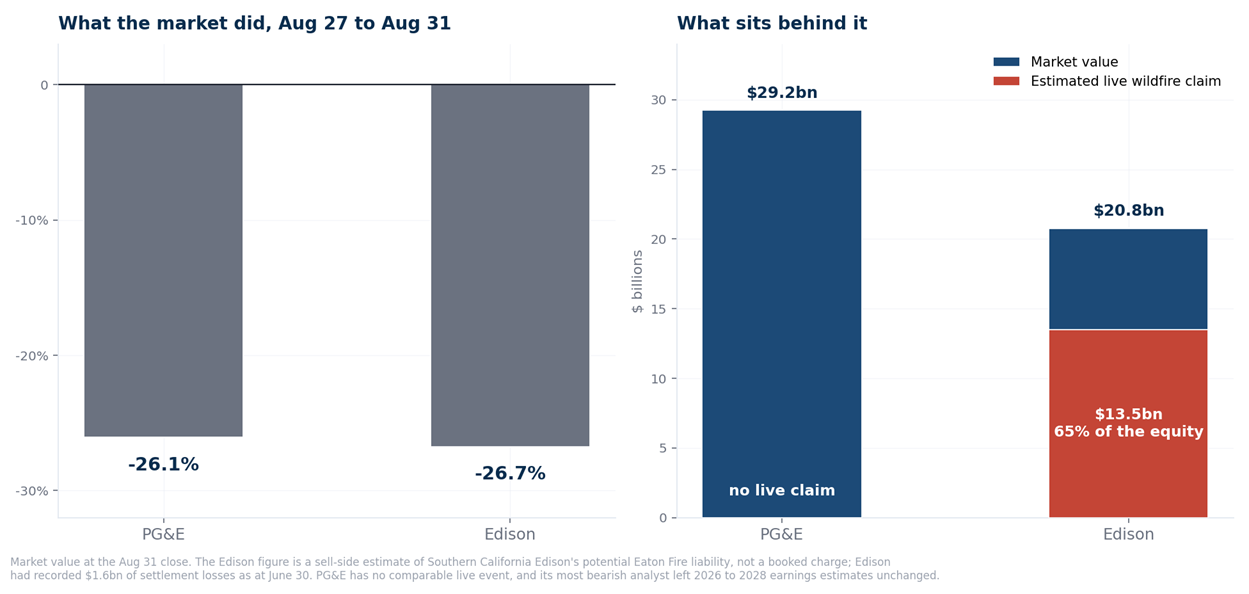
Measured from Thursday’s close, before the selling started, the damage is nearly the same: 26.1% for PG&E, 26.7% for Edison. Both ended with a 14-day momentum reading of 22, deep into oversold. They were traded as one position. They aren’t one risk. Edison has a live claim whose gross estimate runs to 65% of its market value. PG&E has a rule change and no fire.

Key Takeaways
The SB 492 compromise leaves out the $6 billion per-incident cap on Wildfire Fund withdrawals, any mechanism to refill the fund, repeal of its 2028 sunset, and Newsom’s proposal to stop insurers suing utilities. It has not been voted on yet.
Edison’s Southern California Edison faces the Eaton Fire, with gross potential liability estimated on the sell side at about $13.5 billion before recoveries, against a $20.8 billion market value.
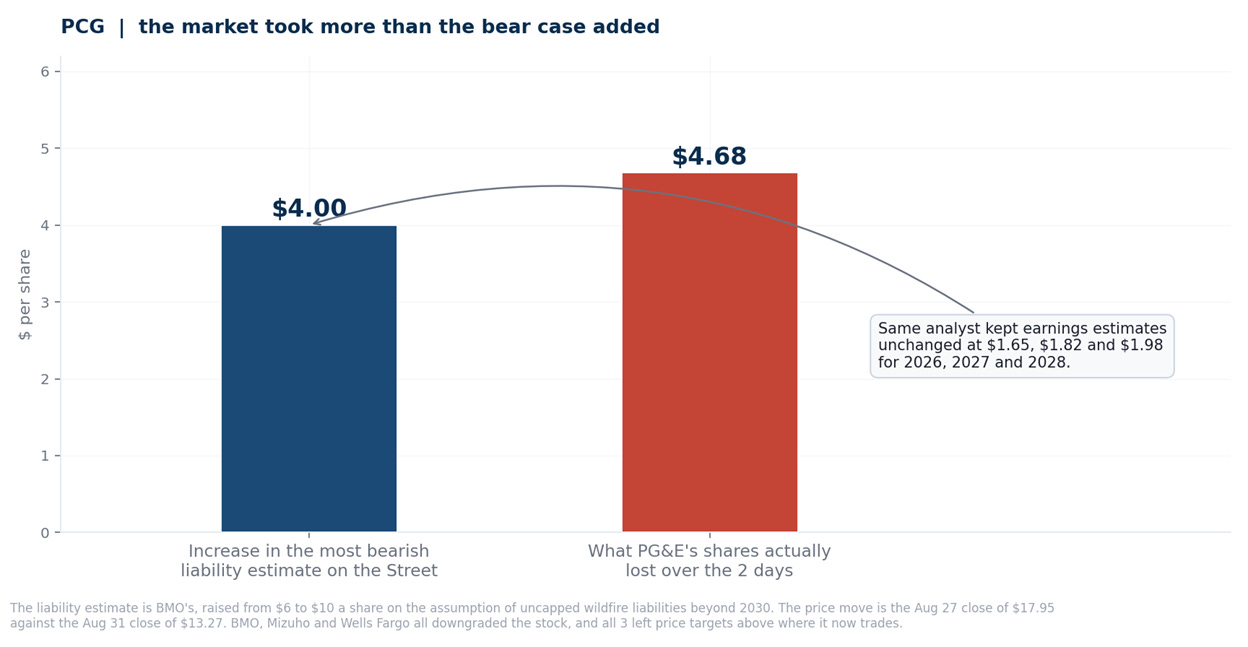
PG&E has no equivalent live event. BMO left its earnings estimates untouched at $1.65, $1.82 and $1.98 for 2026 to 2028.
BMO raised its explicit liability discount by $4 a share. PG&E’s shares fell $4.68, more than the whole increase, to 0.86 times book.
Prices are the Monday August 31 close, the last completed session: $13.27 for PG&E, $53.98 for Edison. Tuesday is pre-open as this is written.
What the Compromise Contains
The text is a wildfire measure written for survivors, not utilities. It creates a “Fast Pay” route to victims, restricts selling wildfire claims to third parties including private-equity buyers, and bans bonuses for senior executives when their company causes a fire destroying 500 structures or more. It preserves the right to sue.
It’s also not law. Utilities were still pushing for late changes on Monday, and until the vote is taken the terms can move. What the text leaves out is the package the sector had been pricing. No $6 billion per-incident cap on what a single fire can draw from the Wildfire Fund. No mechanism to refill it once drained. The 2028 sunset stands. And the proposal to bar insurers from pursuing utilities through subrogation didn’t survive.
So the fund stays finite, unreplenished and on a clock, with every avenue to sue preserved. That’s a genuine deterioration for anyone who owns a California utility, and both stocks deserved to fall.
The market did discriminate, just not between these 2. Sempra, which owns San Diego Gas and Electric, fell about 2% on the same news, cushioned by Texas and Mexico infrastructure and a far smaller California footprint. The selling was calibrated to California exposure. Within California it wasn’t calibrated to anything.
Why Edison’s Fall Is Defensible
Edison owns the problem the bill declined to solve.
Los Angeles County fire investigators concluded that electrical arcing from an out-of-service Southern California Edison transmission tower caused the January 2025 Eaton Fire, which killed 19 people and destroyed thousands of homes. Sell-side estimates of the eventual bill run to about $13.5 billion.
Size that properly, twice over. First, the ratio moves as the stock does: $13.5 billion was 48% of Edison’s market value before the selling and 65% after. The 2 sessions removed $7.58 billion of equity, 56% of the whole estimated figure.
Second, and more important, that estimate is gross potential liability, not shareholder loss. Edison carries the first $1 billion of wildfire claims through a customer-funded self-insurance programme before it reaches the Wildfire Fund at all. It has committed about $1.6 billion to Eaton settlements, and it is already booking recoveries against those losses: at the first quarter, against $1.3 billion of recorded losses, it had recognised $917 million of expected self-insurance recovery alone. Add the fund, transmission-side recovery and whatever the regulator later allows in rates, and what lands on equity is a fraction of $13.5 billion. The market isn’t pricing $13.5 billion. It’s pricing the uncertainty around how much gets through.
The company isn’t conceding. It argues the tower had been idle since 1971 and so doesn’t trigger California’s strict-liability rule, and on August 12 a Los Angeles judge tentatively agreed, declining an insurers’ motion to hold Edison automatically liable. A real win, but tentative, on one motion, and it leaves the harder question open: whether the regulator finds Edison acted prudently.
That finding is the key determinant of how much of Eaton reaches shareholders, though not the only one: civil liability, negligence, settlement levels and what the regulator later allows in rates all matter. Under the 2019 law that created the Wildfire Fund, a utility found prudent generally doesn’t reimburse it. Found imprudent, it does, but reimbursement is still capped at 20% of its transmission and distribution equity rate base over a rolling 3 years. Losing the prudency finding doesn’t by itself remove that cap. It falls away only in narrower circumstances, chiefly the absence of a valid safety certificate or a finding of conscious or willful disregard.
So Edison carries a large contested claim into a regulatory judgment nobody can handicap, drawing on a fund the legislature has just declined to cap, refill or extend. Marking that down 27% isn’t panic. It’s what happens when the insurance around a live claim thins and the claim stays unresolved.
Why PG&E’s Isn’t
PG&E’s position is the opposite. It has no Eaton-equivalent live catastrophe. Its major legacy fires are substantially provisioned and far further through the process, with the bankruptcy’s Fire Victim Trust paying claimants 70 cents on the dollar, though not finished: Dixie still has litigation running and an open proceeding to recover costs. It holds its safety certification, the qualification that keeps the liability cap available, and has buried more than 1,300 miles of line in high-risk territory since 2021. None of that changed on Monday.
Here’s the arithmetic that decides it. BMO downgraded the stock and raised its explicit wildfire liability discount from $6 a share to $10, assuming uncapped liabilities beyond 2030. That’s a $4 increase in the modelled cost of the thing everyone is frightened of. Over the 2 sessions, PG&E’s shares fell $4.68.
The decline exceeded the entire increase in that discount. And that same analyst left its earnings estimates entirely unchanged at $1.65 for 2026, $1.82 for 2027 and $1.98 for 2028. The operating business it models is exactly the business it modelled a week ago.
At $13.27 that’s 8.0 times this year’s estimate, 7.3 times next year’s and 6.7 times 2028, at a 52-week low.
Book value tells the same story. PG&E trades at about 0.86 times accounting book equity, against roughly 1.19 for Edison. Book equity isn’t the regulated rate base and shouldn’t be read as one, but a utility trading below it is unusual, and the market is applying that discount to the company without a fire rather than the one with it.
PG&E’s own view is worth noting. It said publicly that SB 492 does not adequately address the financing risks in the liability framework. That’s an argument the bill is bad, not that the business broke.
The Case Against Me
There’s a real argument on the other side.
PG&E is the largest operator in California’s high fire-threat territory, and its share of any utility contribution to the Wildfire Fund is roughly 48%. A fund that can be drained with no way to refill it is a bigger prospective problem for PG&E than for anyone, since it’s most likely to need it and most liable to rebuild it. Edison’s claim has first call on money that exists today.
Read that way it isn’t mispricing at all: Edison’s problem is large but partly backstopped by a fund that can still pay, while PG&E’s risk is prospective and may arrive only after that protection has been weakened. Partly, not wholly: the cap covers reimbursements to the fund, not every conceivable Eaton loss, so Edison’s exposure has no clean ceiling either. This is a company that went through Chapter 11 in 2019 over exactly this risk.
One more piece of honesty. The 3 firms that cut PG&E left targets of $16, $21 and $24, all above the price, but Mizuho’s cut target on Edison is $70, also well above it. Targets above the market tell you how fast prices moved, not which name is mispriced.
I think that argument explains why PG&E fell. It doesn’t explain why it fell more than the bear case, to a 52-week low, at under 7 times 2028 earnings, with unchanged estimates. Prospective risk on a business whose numbers didn’t move is a de-rating. This was a liquidation.
