


Artificial intelligence has reshaped the technology landscape faster than almost any innovation of the past decade. Cloud platforms are racing to expand capacity, enterprises are rethinking their infrastructure, and demand for AI ready compute is accelerating across industries.
Oracle ORCL 0.00%↑ and Microsoft MSFT 0.00%↑ sit at the center of this shift, but they are playing two very different games. Oracle is building an AI and cloud infrastructure engine fueled by large multiyear commitments and a rapidly expanding backlog. Microsoft is extending a long standing leadership position by weaving AI into every layer of its software and cloud ecosystem.
Both companies are beneficiaries of the same structural trends. Both are positioned inside secular growth markets. Yet the investment profile, risk dynamics and technical structures could not be more distinct.
This report breaks down the environment, the pipelines that support future growth, the fundamentals that define each company’s trajectory, the technical structure currently shaping price action and a simple, risk aware plan for readers who want exposure to this fast moving theme.
The goal is clarity. Whether someone is new to investing or deeply experienced, the objective is to walk through both stories in a way that is grounded, practical and easy to understand.

Key Takeaways
Oracle’s identity has transformed. It is no longer being valued as a slow moving database company. It is being valued as a cloud and AI infrastructure provider with accelerating cloud revenue, a fast growing IaaS business and a backlog that has expanded dramatically. This shift requires heavy investment, and that is showing up through higher capex and elevated leverage.
Microsoft remains one of the highest quality businesses in the world by almost every financial measure. Growth is broad, margins are strong and cash generation is enormous. AI is becoming part of its entire suite of products, and Azure continues to grow at a healthy pace.
Technically, Oracle has completed a full five wave decline and is now in a corrective rally. Microsoft is still in a long term uptrend but currently in a corrective phase on shorter timeframes.
For investors who want well rounded AI exposure, Microsoft represents the conservative compounder while Oracle offers higher torque tied to AI infrastructure demand.
Pipelines, Environment and How They Shape Growth
The environment both companies operate in today is defined by rising cloud consumption, rapid AI adoption and continued enterprise modernization. These trends are structural rather than cyclical. Software is becoming more intelligent, workloads are becoming heavier and the need for scalable, efficient, high performance infrastructure is growing across industries.
For Oracle, the pipeline is concentrated in cloud services, IaaS and AI driven demand. Fiscal 2025 cloud services and license support revenue grew to 44.0 billion dollars, up 12 percent. Combined cloud revenue grew to 57.4 billion dollars, up 8 percent year over year. The most striking component is the acceleration in cloud infrastructure, with IaaS growing 55 percent in the most recent quarter. The company also reported a 455 billion dollar remaining performance obligation in Q1 fiscal 2026, a year over year increase of 359 percent. A significant portion of future growth is tied to these large multiyear arrangements.
The environment for Oracle is characterized by high demand but also high investment intensity. Fiscal 2025 capex expanded sharply to more than 21 billion dollars. Additional spending is expected as the company scales out data centers and GPU capacity. This is a commitment to long term growth but also a source of elevated financial leverage.
For Microsoft, the pipeline is more diversified. The company delivered 281.7 billion dollars in fiscal 2025 revenue, up nearly fifteen percent year over year. Net income reached 101.8 billion dollars. The growth engine is broad: Azure and cloud services continue to expand, Microsoft 365 remains essential enterprise infrastructure and AI is being embedded across productivity, developer tools, CRM, security and collaboration. In the most recent quarter, cloud revenue reached 49.1 billion dollars, up twenty six percent, and Azure grew forty percent.
Microsoft’s environment benefits from both infrastructure and software demand. It is not solely dependent on large AI infrastructure contracts or exclusive workloads. Growth is distributed across millions of commercial users and thousands of enterprises. The result is a more balanced and resilient pipeline with less concentration risk.
Fundamental Analysis
Oracle
Oracle delivered 57.4 billion dollars in fiscal 2025 revenue. Operating income reached 17.2 billion, with an operating margin around thirty percent. Net income was 12.4 billion dollars, reflecting a healthy net margin profile.
Cloud services and license support represent the majority of revenue at 44.0 billion dollars. Cloud license and on premise license revenue contributed 5.2 billion. Applications cloud revenue continues to grow at a mid teens pace, while IaaS shows the fastest acceleration.
Cash flow from operations reached 20.8 billion dollars. The increase in capital expenditures to more than 21 billion dollars temporarily moved free cash flow negative. This is the outcome of expanding datacenter capacity. If cloud consumption and backlog conversion continue as expected, the investment should translate into higher margin revenue in future years.
On the balance sheet, Oracle carries a material level of debt, with total borrowings above 100 billion dollars and net debt around four times EBITDA. This is manageable but higher than typical software peers. It places emphasis on the successful execution of its AI and cloud strategy. The company’s backlog provides visibility, but the concentration of large contracts adds importance to customer delivery and renewal cycles.
Microsoft
Microsoft’s fundamentals remain exceptional. Fiscal 2025 revenue reached 281.7 billion dollars with operating income of 128.5 billion. Net income came in at 101.8 billion dollars. Operating margins are in the mid forties. Net margins are in the mid thirties. Very few companies of this scale sustain profitability at that level.
In the recent quarter ending September 2025, revenue was 77.7 billion dollars, up eighteen percent, with EPS of 4.13 dollars, up twenty three percent. Cloud revenue was 49.1 billion dollars and Azure grew forty percent. The company’s growth profile is broad, consistent and supported by enduring demand for mission critical software and cloud services.
Microsoft generated more than 70 billion dollars in free cash flow on a trailing basis even while increasing datacenter and AI related investment. The balance sheet is lightly levered, providing flexibility to continue investing in AI infrastructure, returning capital to shareholders and funding acquisitions when strategic.
From a fundamentals standpoint, Microsoft remains one of the strongest companies in the technology sector by virtually every metric.
Technical Analysis
Oracle
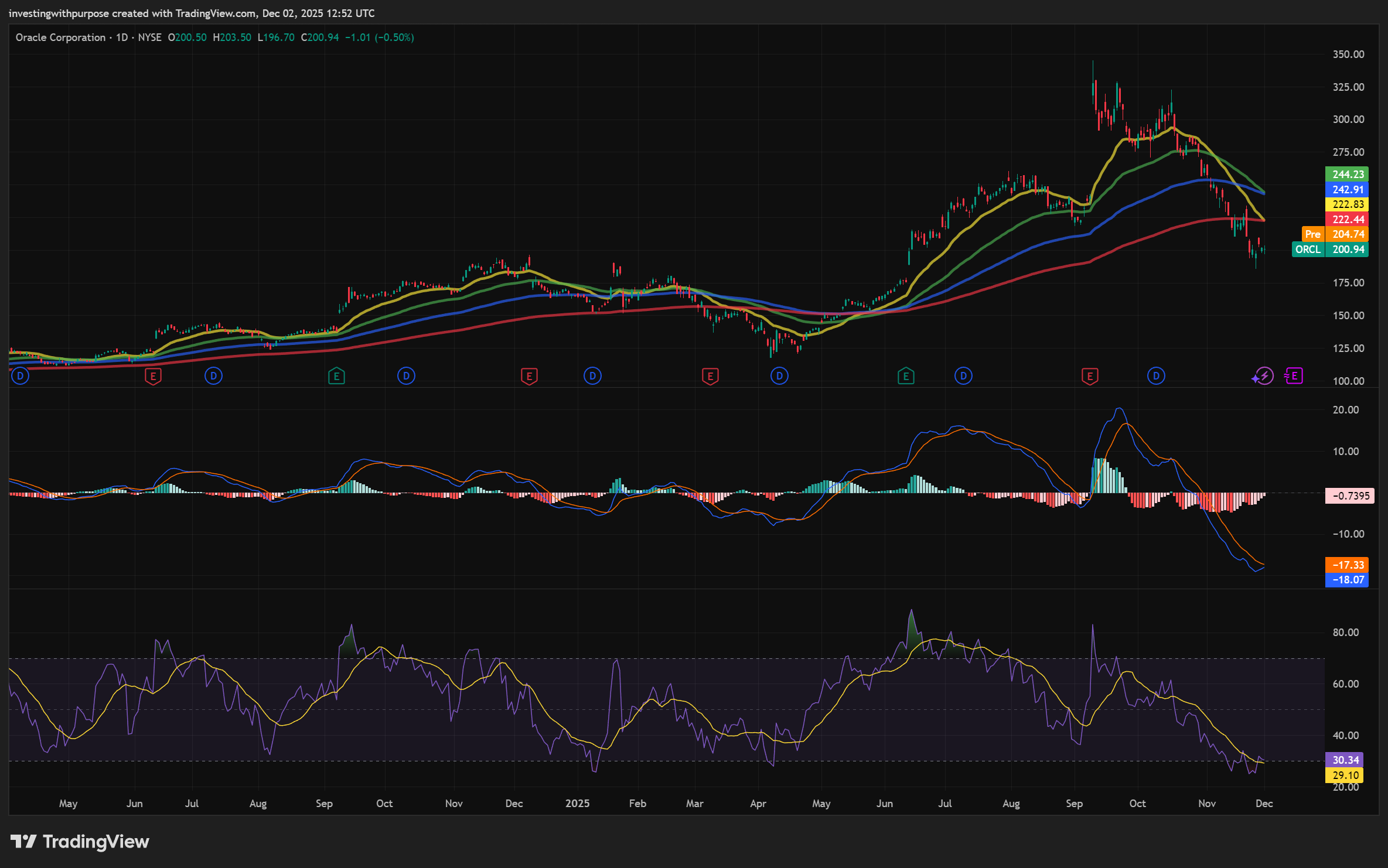
Oracle has completed a five wave downward structure from the peak near 340 dollars into the 185 to 190 zone. The first wave was a sharp move into the 260s. The second wave retraced into the low 330s. The third wave was an extended, high volume selloff. The fourth wave offered a set of textbook retracement levels around 238, 254 and 270. The fifth wave completed near 185 to 190 with supporting signs of momentum exhaustion.
The stock is now in a fourth wave corrective phase. Shorter timeframes show improving momentum, positive divergence and early signs of rebound energy into the 215 to 225 area. The next levels higher sit around 238 and then 254. Trend conditions on the daily and weekly charts still favor caution. Major moving averages slope downward, the longer term structure remains corrective and the broader trend is still defined by overhead resistance.
Until the stock can reclaim something near 250 to 270 and hold, the larger technical picture remains a corrective rally inside a longer downtrend. Key levels include 217 as initial resistance, 238 as the first major pivot and the 254 to 270 range as the area where a deeper trend decision will be made.
Microsoft
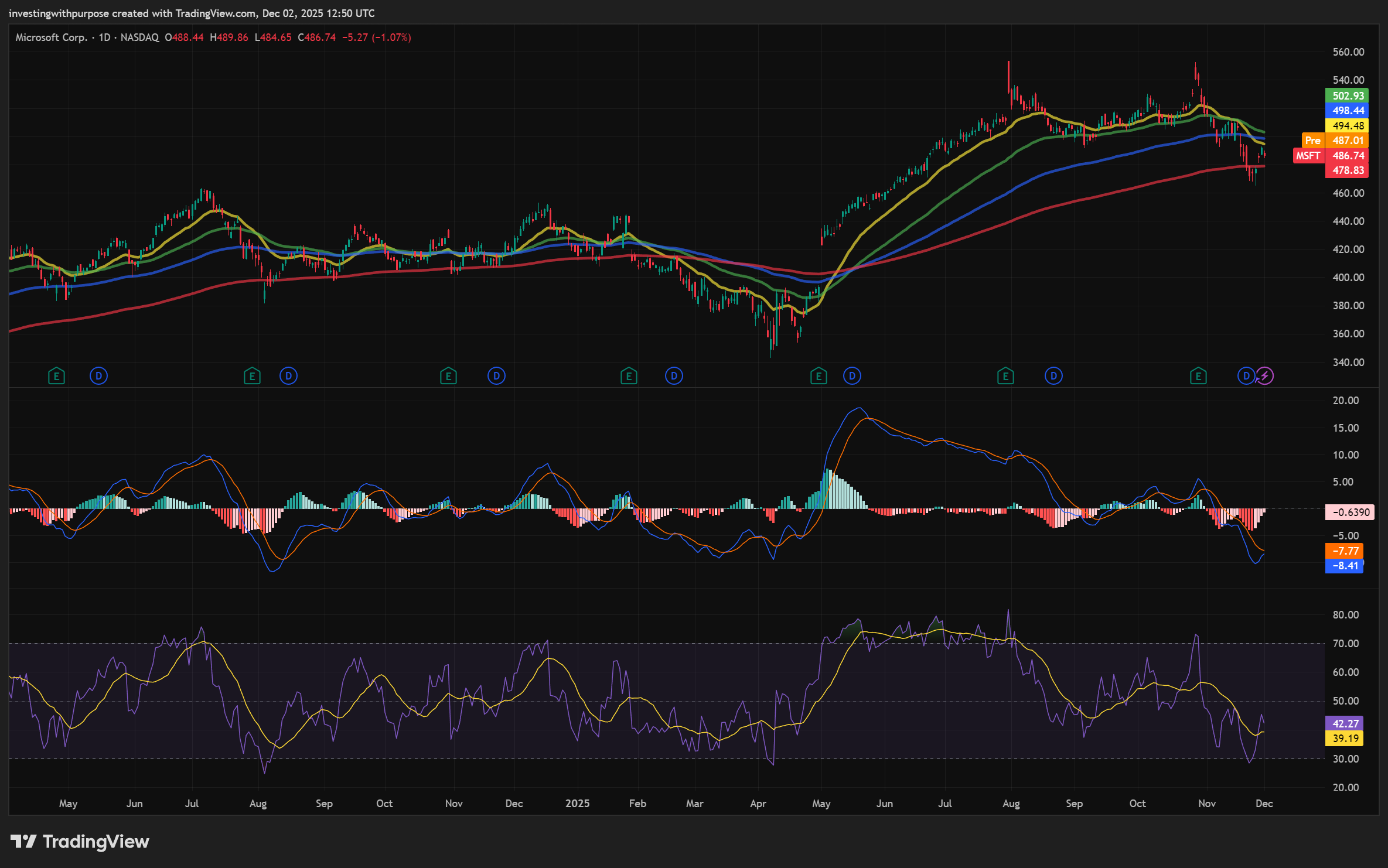
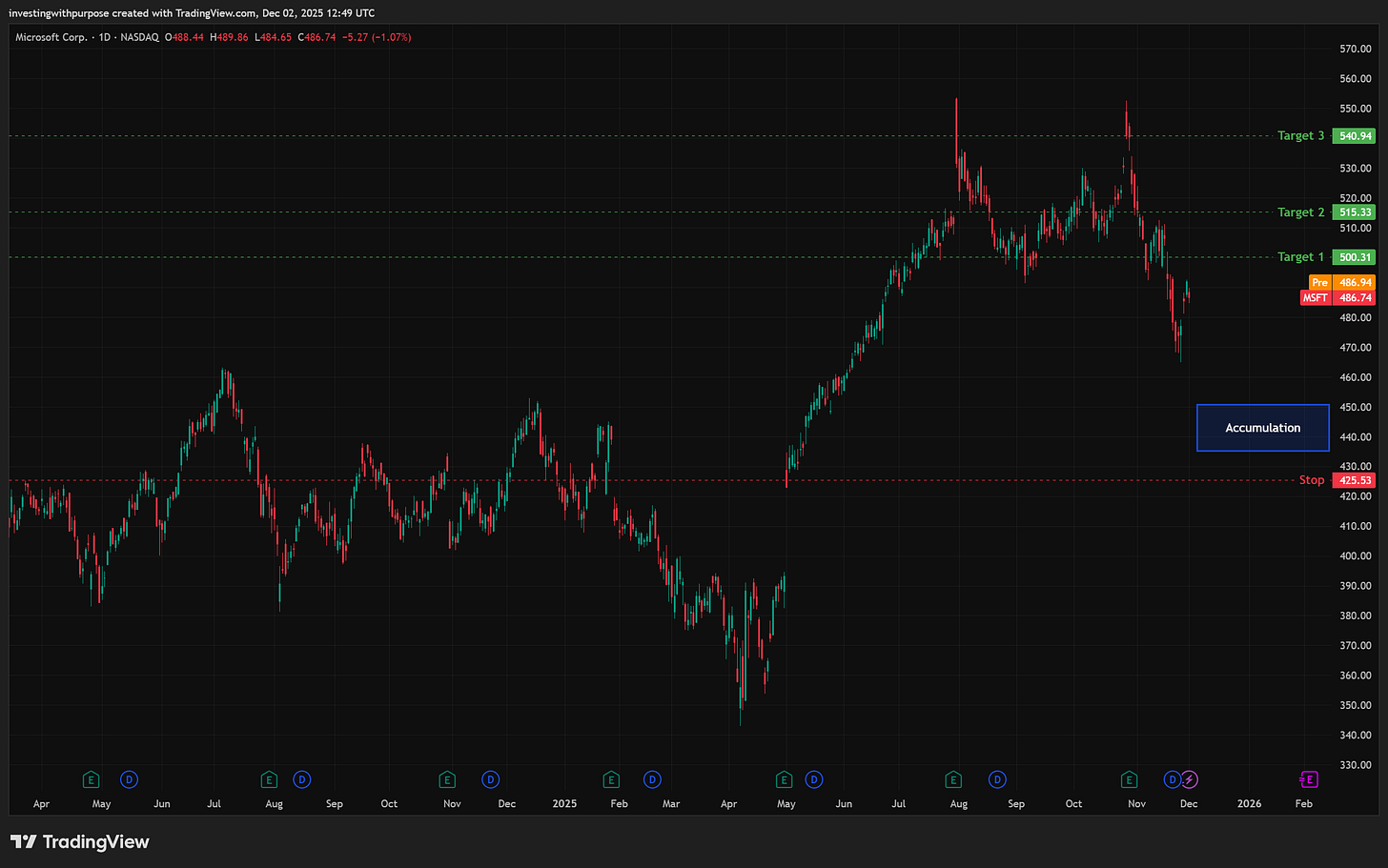
Microsoft’s long term trend is intact. Price remains well above the 100 and 200 week moving averages. The recent decline from the mid 550s into the high 460s reflects a correction rather than a structural breakdown. Weekly momentum indicators have cooled without confirming long term trend damage.
On the daily timeframe, the stock is in a corrective phase. Price trades below key short term moving averages and below the daily cloud. Momentum has rebounded from oversold conditions but has not fully shifted into a strong bullish regime. The bounce from the low appears constructive but remains unconfirmed until the stock can reclaim the 500 to 505 region.
On shorter timeframes, Microsoft shows early strength from the recent low with the four hour trend stabilizing and then turning higher. That said, the move has already pushed into short term overbought conditions while still facing overhead resistance.
Key levels include 470 to 465 as support, 450 to 445 as deeper demand and 440 to 430 as major structural support. Resistance begins near 495 to 500 and becomes more meaningful in the 506 to 515 region. A confirmed move above those areas would strengthen the case for the larger uptrend continuing.
Trade Plans
The following trade plans are designed for long term, risk-averse investors. They rely on the daily timeframe, emphasize stable entry zones, clear invalidation levels and realistic targets, and avoid short term trading noise. Each plan aligns with the broader trend structure of the stock.
Oracle: Long Term, Cautious Accumulation
Oracle is still in a corrective rally, not a confirmed long term uptrend.
The approach must be conservative because the larger trend remains downward.
Only one area offers a controlled, risk-managed entry for long term positioning.
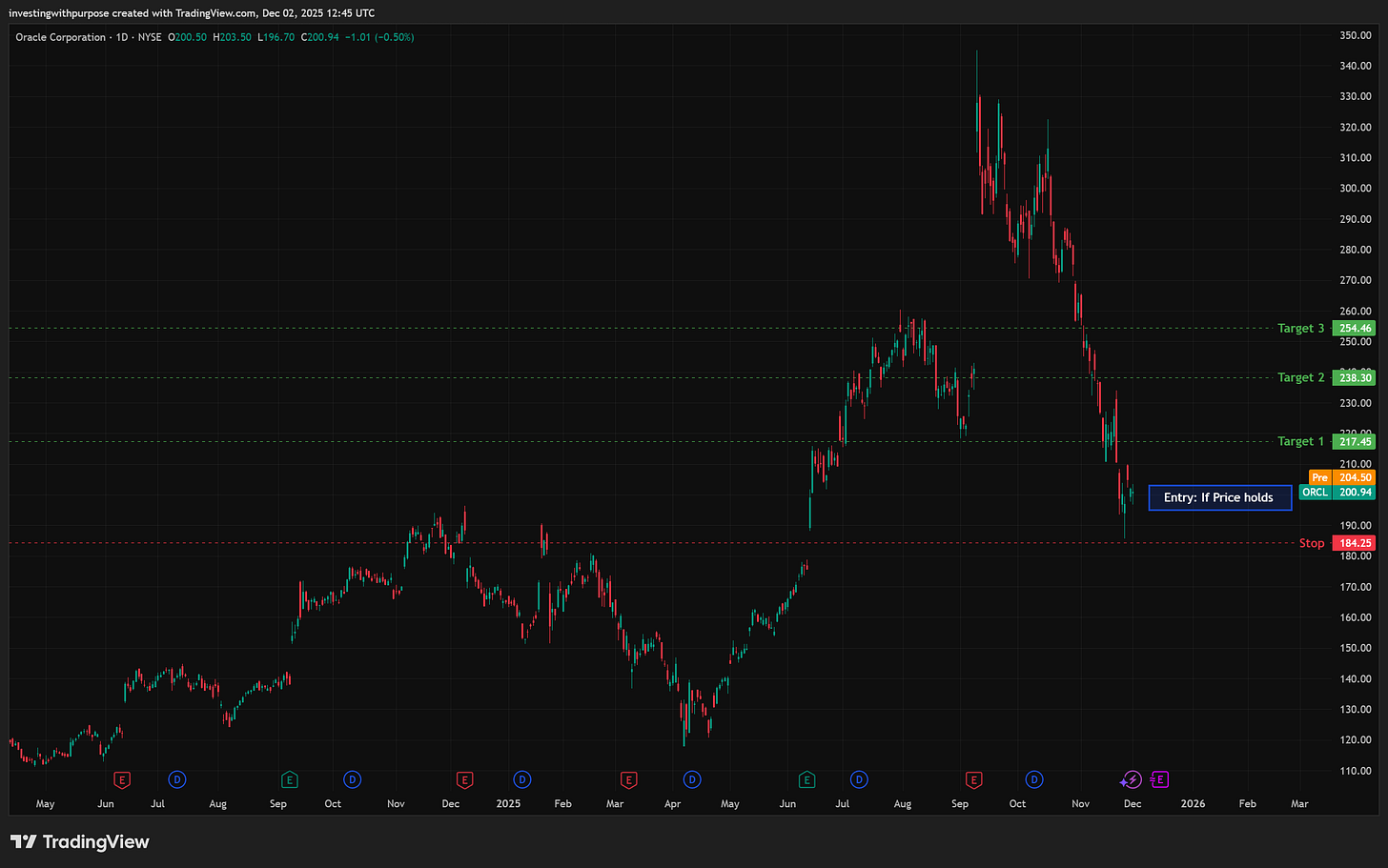
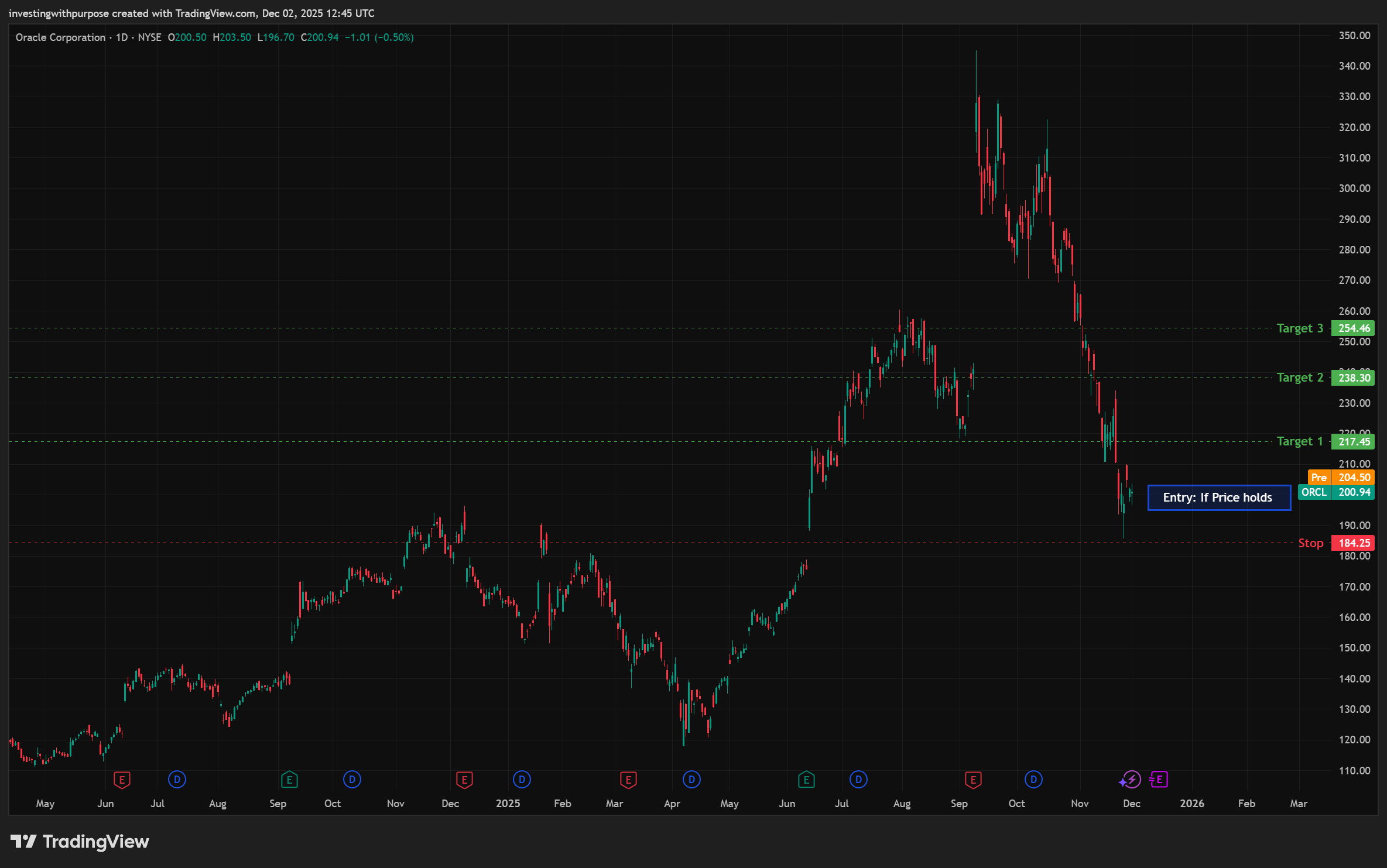
Entry Zone
195 to 203
Buy only if price is stable and holding this zone
This area sits above the recent low and below heavy resistance, giving a reasonable margin of safety
Invalidation
Below 185
A break under 185 signals the prior low has failed
If this happens, step aside and wait for a new base
Targets
217 to 218 for the first reduction
238 for a more meaningful trim
254 as the final target for this corrective cycle
Position Approach
Keep size small and build slowly
Treat the move as a recovery rally, not a full trend reversal
Prioritize capital preservation over aggressive upside capture
Microsoft: Long Term Bullish Accumulation
Microsoft remains in a strong long term uptrend
The current pullback is a healthy correction, not a structural break
The plan focuses on accumulating at high-quality support zones, not chasing strength
Primary Entry Zone
450 to 445
Begin accumulating here with patience and small sizing
Secondary Entry Zone
440 to 430
Stronger demand and a higher conviction area for long term buyers
Ideal for completing the position if tested
Invalidation
Below 430
A breakdown under 430 suggests the correction is deeper than expected
Stop adding and allow the market to stabilise before re-entering
Targets
495 to 500 for the first scale out
506 to 515 as the next resistance layer
529 to 540 as the higher timeframe target
Position Approach
Add gradually in the dip zones
Hold the position through the correction with long term continuation in mind
Trim into strength at resistance layers while maintaining a core holding
Bottom Line
Both Oracle and Microsoft are central to the future of AI driven cloud computing, but they offer different paths for investors. Oracle is an AI infrastructure story built on accelerating cloud growth, large multiyear commitments and a bold, capital intensive strategy. Microsoft is a high quality compounder with broad distribution, deep integration and world class financial strength.
For those building long term exposure to AI, Microsoft offers stability and consistency. For those seeking higher torque linked to cloud infrastructure demand, Oracle provides that opportunity with a higher volatility profile.
The key is understanding the structure of each story, aligning it with your tolerance for risk and sizing positions in a way that respects both the fundamentals and the current technical landscape.
This content is for educational purposes only and isn’t investment advice or a recommendation to buy or sell any security.
This content is for educational purposes only and isn’t investment advice or a recommendation to buy or sell any security.