


Oracle Won the AI Argument and Lost Half Its Value. Adobe Is Losing It and Fell Less.
On Thursday evening, after the close, Oracle and Adobe report.
Oracle set its 52-week high on September 10, 2025, the session after a first quarter that showed the market a backlog since grown to $638 billion. The stock rose about 36% that day. One year on, to the day, it reports again 54% below that high, though it has rallied 12% in the 3 sessions just gone.
Adobe, whose problem is not demand but whether it stays the layer where creative work gets monetised, is down 28% from its high. It fell 6.7% on Friday alone, after naming a new chief executive.
That ranking is the thesis. The company that proved AI demand exists has been punished roughly twice as hard as the one whose product AI is supposed to be replacing. The market would rather own contested relevance that generates cash than uncontested demand that consumes it.
Key Takeaways
Oracle’s backlog is $638 billion, up 363% and 7.1 times guided fiscal 2027 revenue, though only about 12% converts inside 12 months. Some $75 billion is customer prepayment or hardware the customer supplied.
Serving it costs about $70 billion of net cash capital outlay in fiscal 2027, 78% of that year’s guided revenue, with gross spending $20 billion to $25 billion higher. Fiscal 2026 free cash flow was negative $23.7 billion; net borrowings are $97.6 billion.
Adobe’s AI-first recurring revenue passed $500 million and tripled. A freemium and pricing trade-off sized on its last call at about the same $500 million runs the other way.
Adobe converts 40.8% of revenue into free cash flow and trades near 10.3 times it. It reports with a lame-duck chief executive, an interim finance chief and its creative head leaving.
Prices are the Friday September 4 close, the last completed session. Both report after the close on Thursday September 10. United States markets are shut Monday for Labor Day.
The Same Question, Opposite Answers
Every large software company is valued on 1 question: does AI feed it or eat it?
Oracle answered feed, turning from a database company that also sold cloud into a landlord for AI compute. Adobe is the test case for eat: it sells creative software by the seat to people whose work generative models can increasingly do, and has spent 2 years arguing it can sell the models instead.
Both answers are defensible. The risks they create are not symmetrical.
Oracle: The Backlog Is Real, and So Is the Bill
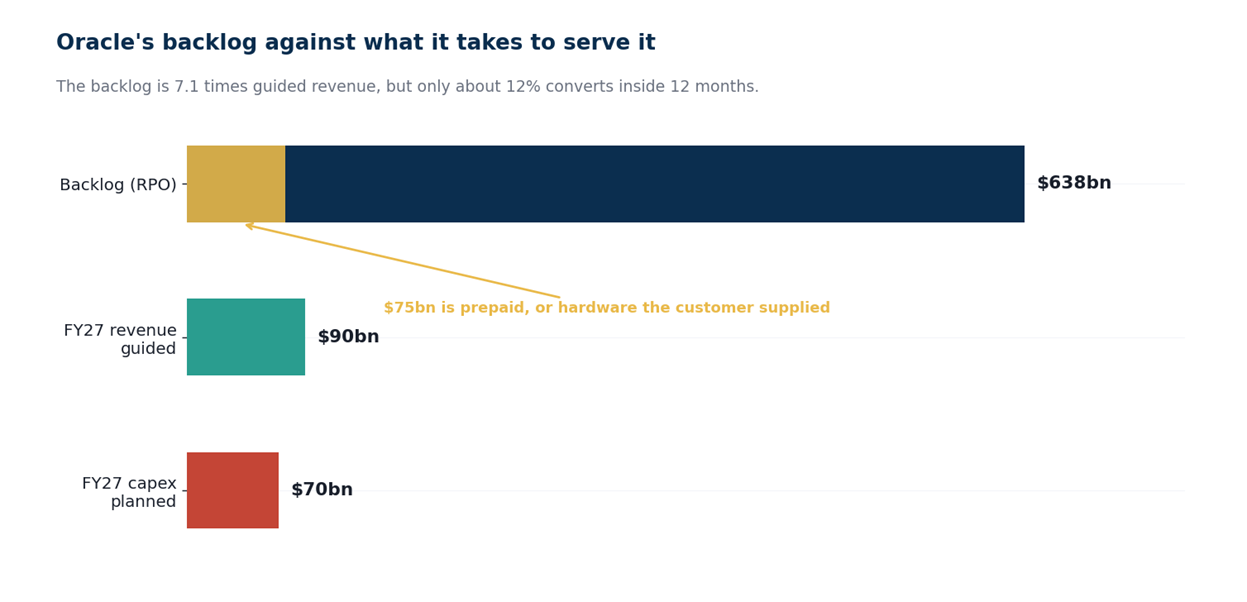
Remaining performance obligations ended May at $638 billion, up 363% and up $85 billion in a quarter. That RPO equals 7.1 times fiscal 2027 guided revenue of $90 billion, and it converts slowly: Oracle expects only about 12% recognised over the following 12 months, roughly $77 billion.
Oracle told you how it was built. Most of the last 2 quarters’ increase came from large AI contracts where the customer either prepaid for the graphics processors or supplied them. Those portions total $75 billion, close to 12% of the backlog.
That matters, but not for the reason it first appears. Management says those structures carry no degradation in margin, so this isn’t about bad contract economics. What the $75 billion does is cut Oracle’s own funding requirement: the customer has already paid for, or supplied, the most expensive component. Gross margins are still guided down through fiscal 2027, but Oracle attributes that to data-centre ramp timing and mix, not these contracts.
The business underneath is strong. Cloud infrastructure revenue grew 93% to $5.8 billion and total cloud revenue rose 47%. The Multicloud AI Database, which puts Oracle’s database inside other companies’ clouds, grew 404%. That matters most strategically, because it’s what rivals can’t replicate: the installed base of mission-critical databases is Oracle’s, and letting customers run it anywhere defends it. The applications half is weak at 10%, a drag carried by infrastructure at a company guiding 18% earnings growth.
What Oracle Has to Fund
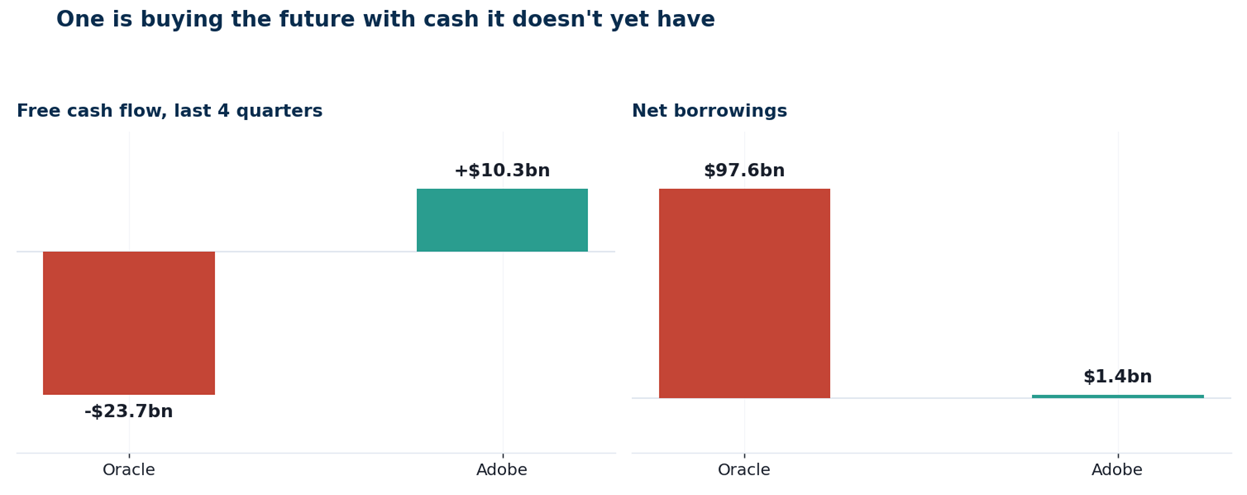
Capital spending goes from $21.2 billion in fiscal 2025 to $55.7 billion in fiscal 2026, and fiscal 2027 is guided to about $70 billion of net cash outlay. Read that word: gross reported capital spending could run $20 billion to $25 billion higher, with customer prepayments and timing absorbing the difference. Even on the net figure, Oracle lays out 78 cents for every dollar of the $90 billion it expects to sell.
It funds that externally. Fiscal 2026 operating cash flow was $32.0 billion against $55.7 billion of spending, so free cash flow was negative $23.7 billion. Borrowings ended the year at $129.5 billion against $31.9 billion of cash and securities, so net borrowings of $97.6 billion, with leases on top. It raised $43 billion of debt and $5 billion of equity last year and expects roughly $40 billion more this year, including a $20 billion at-the-market equity programme, and says it expects no further debt issuance in calendar 2026.
None of it is hidden or fatal. Oracle still guides to $8.05 of non-GAAP earnings, under 20 times at $158.78. But the character of the asset has changed. Buying Oracle used to mean buying a toll on enterprise data. It now means underwriting a construction programme whose payback depends on customers honouring multi-year commitments. The reported $300 billion OpenAI contract alone is equivalent to roughly 47% of today’s entire backlog, which illustrates the scale of Oracle’s exposure to a counterparty still expected to consume enormous amounts of cash.
Be fair about the other side. Oracle says global utilisation of its graphics processors runs at 97.5%, and its finance chief puts steady-state return on capital in infrastructure in the high 20s. The bear case isn’t that Oracle signed bad contracts. On management’s own numbers it didn’t. It’s that an enormous amount of capital must arrive, and be spent, before those economics can prove themselves.
Adobe: The Cash Flow Is Real, the Relevance Is Disputed
Adobe’s problem is the opposite shape. Nobody doubts it can collect money. They doubt what for.
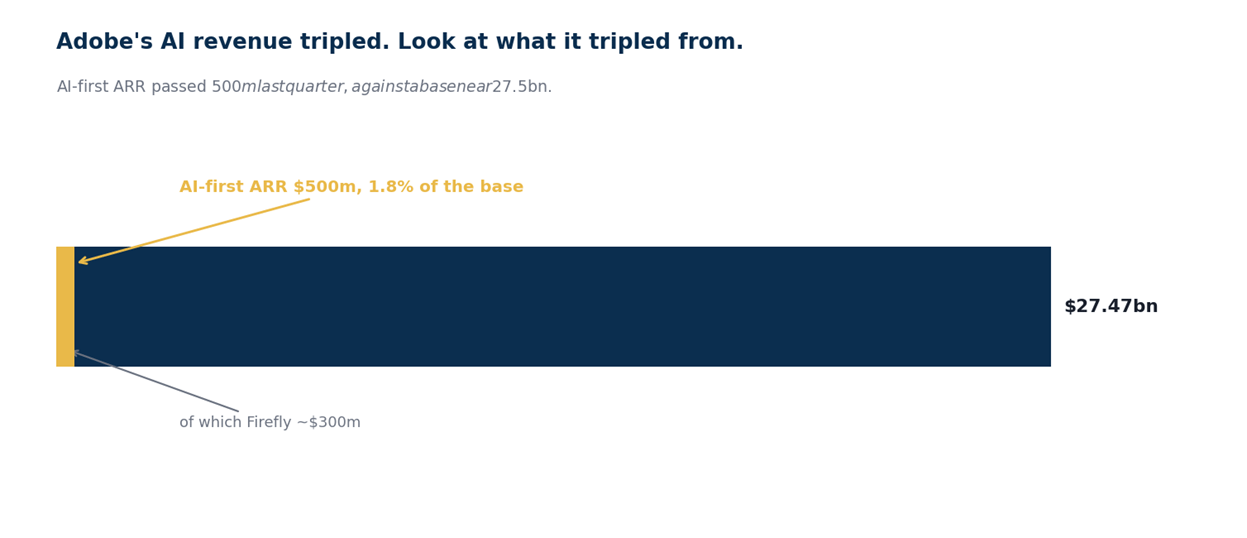
The AI progress is real. AI-first recurring revenue passed $500 million last quarter and tripled, and Firefly is approaching $300 million. More than 80% of its experience and content management customers use the agentic features built into those products, and it has pushed its agents into ChatGPT and Claude.
Then the base. Total recurring revenue exiting the May quarter was $27.10 billion, so the AI-first line is 1.8% of it. Tripling from a number that small is a leading indicator, not yet a financial event.
Now the number that reframes it. Adobe’s full-year target of 10.2% recurring revenue growth carries roughly $480 million of acquired book from Semrush, and absorbs a deliberate trade-off sized on the second-quarter call at about $500 million. Adobe didn’t guide to that figure but didn’t dispute the arithmetic, and Shantanu Narayen put roughly half on deferring creative pricing and half on widening the free funnel across Acrobat, Express and Firefly. So the AI revenue Adobe is proudly adding is close to the recurring revenue it’s choosing to give up. One is the future, the other the price of buying users to sell it to.
There is a pipeline underneath: remaining performance obligations of $22.27 billion with 67% due inside 12 months, roughly $14.9 billion contracted for the coming year.
What Adobe has that Oracle doesn’t is cash. Over 4 quarters it produced $10.28 billion of free cash flow on $25.2 billion of revenue, a 40.8% margin, against net debt of $1.4 billion. At $105.9 billion of market value that’s 10.3 times free cash flow, a price the market applies only when it doubts durability rather than profitability.
The Problem Adobe Has Added
It reports Thursday having changed almost everyone who answers for it.
On September 3 the board named Anil Chakravarthy, who runs the enterprise experience business, chief executive from December 1. Shantanu Narayen becomes executive chair after 18 years. David Wadhwani, who ran creativity and productivity for nearly 5 years and was the other internal candidate, is leaving. The finance seat has been interim since June, when Dan Durn left, as it happens for Marvell. The shares fell 6.7% on Friday on nearly twice normal volume.
Read the choice, not the churn. Faced with a creative franchise under AI pressure and a faster-growing enterprise business, Adobe promoted the enterprise leader and lost the creative one. That’s coherent and arguably right. It’s also an admission about where the board thinks the growth is, a week before a print already about that question.
Potential Directions: Oracle
The print is not about the quarter. Consensus revenue is near $19.13 billion and Oracle will probably land close to it.
What decides the reaction. The backlog first: anything below $638 billion would be the first sequential decline of the AI era and would become the story. Second, the prepaid share, which sets how much of the build Oracle funds itself. Third, spending, where $70 billion net is the number to beat either way. Fourth, any change to the $90 billion and $8.05 guide.
The bull path. Backlog grows again, cloud infrastructure holds near 90%, spending is reaffirmed rather than raised, and management details financing costs. That makes Oracle a growth story with a heavy but understood balance sheet, and a stock under 20 times guided earnings has room.
The base path. Backlog roughly flat, revenue in line, spending reiterated, margins stepping down as flagged. Nothing resolves and the stock keeps trading on the financing question.
The bear path. Backlog falls, spending rises again, free cash flow deteriorates faster than expected, or a large contract is restructured. Any of those turns the discussion to the $97.6 billion of net borrowings, and the multiple stops being the constraint.
Potential Directions: Adobe
What decides the reaction. Recurring revenue, and whether the roughly $500 million trade-off implied on the second-quarter call is developing as expected. Then the AI-first line, which needs to compound fast enough to matter before the base decelerates. Then whether the deferred pricing increases stay deferred, and the full-year target of $26.50 billion to $26.60 billion and 10.2%.
The bull path. Recurring revenue beats, the trade-off tracks, AI-first revenue keeps roughly tripling, and the incoming chief executive signals pricing returns next year. At 10.3 times free cash flow, a company merely proving it isn’t shrinking would be worth considerably more.
The base path. In-line quarter, targets maintained, AI metrics good and still small. The stock stays cheap, because cheap is a judgment about the next decade, not this quarter.
The bear path. Recurring revenue misses, the trade-off costs more than $500 million, or the pricing deferral extends again. Then the argument becomes whether the seat count itself is at risk, the only version that justifies the current multiple, and a transition management is poorly placed to answer it.
Bottom Line
Oracle has the demand and must buy the capacity to serve it. Adobe has the cash and must prove anyone still wants what it sells.
I’d watch 1 number at each. At Oracle it’s the backlog, because everything else is downstream of whether $638 billion is still growing. At Adobe it’s recurring revenue against the roughly $500 million that trade-off was sized at, the one line where strategy and results meet.
2 prints, 1 evening, and opposite ways to be wrong.
This is research and commentary, not personal investment advice. The author may hold positions in names discussed.