


The market weakened materially from the prior week, with breakdown patterns now spreading across sectors rather than remaining isolated to a few weak groups. The tape is punishing weakness immediately and still refusing to reward oversold conditions, which is usually a poor environment for aggressive equity exposure. Cash preservation has outperformed, and the increase in selling volume suggests institutional distribution is driving the move more than emotional retail liquidation.
The regime backdrop has shifted clearly bearish across most names. Setups that were previously transitional have rolled into breakdown, while EMA compression zones that looked close to resolving have, in many cases, broken lower instead. With weakness showing up across both growth and defensive areas, the message from the tape is not rotation. It is deleveraging.
In this kind of market, discipline matters more than conviction. Exposure only makes sense at defined levels where the downside is understood and the invalidation is clear. When structure fails, exposure is reduced. Regime filtering continues to serve its purpose: avoid damaged charts, protect capital, and stay focused only on the few areas where the market is still offering constructive risk-reward.

How our trade plans work
Our process is rules-based and level-driven. Every setup is framed around a small number of decision zones: reclaim zones, pullback shelves, breakout triggers, targets, and a clear invalidation level. We act only at defined levels, where downside risk is already known.
We avoid the middle. We do not chase strength. We step aside when structure breaks. Not every dip is a buy. Not every bounce deserves exposure. Cash is a position. Waiting is part of the plan.
This update covers the following 44 stocks and ETFs across consumer, technology, healthcare, industrials, and commodities.
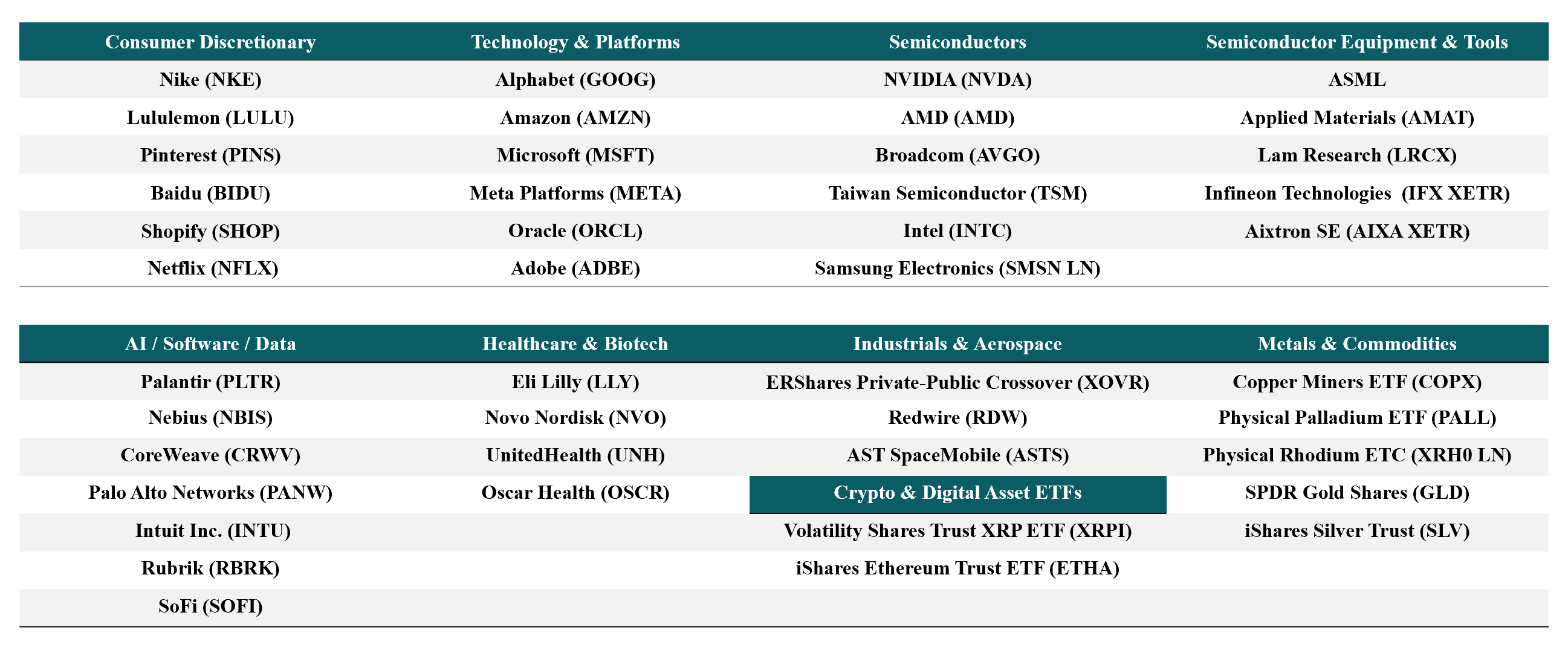
All are evaluated using the same rules-based framework and level-driven process.
What has been working so far
Regime filtering has been the single most valuable tool in this environment. By classifying every name into trend-hold, transitional, repair, or breakdown before considering exposure, the framework has kept capital away from the 24 names currently in full breakdown, including mega-caps like META, MSFT, and NVDA that are seeing institutional distribution on elevated volume. Cash preservation has outperformed nearly all equity exposure. The two trend-hold names, FTI and AIXA.DE, have demonstrated genuine relative strength by holding above their full EMA stacks while the broader tape deteriorated, validating the principle that structure must confirm before capital is deployed. Equally important, the defined invalidation levels and "no catching falling knives" discipline have prevented the kind of averaging-down behavior that destroys capital in sustained drawdowns, names like LULU, NKE, and NVO have printed deeply oversold readings without generating meaningful bounces, proving that oversold in a breakdown regime is a symptom of continued weakness, not an entry signal.
Detailed trade setups
Adobe Inc. (ADBE) Last close: 234.84
Setup: Adobe is caught in the broader software breakdown, where the tape continues to punish long-duration growth and reject oversold bounces. The weakness is not isolated. It reflects broad de-risking across enterprise software and a market that is rewarding cash over anticipation. Until ADBE can defend structural support and reclaim key moving averages, this remains a broken-name-in-a-broken-group setup rather than an early recovery candidate.
Current regime: Breakdown
Key decision zones: Support at 233.16 / 225.00. Reclaim levels at 252.95 / 271.41.
If not in the position: Wait for reversal at structural low; do not catch falling knife.
Invalidation and thesis-failure rules: Break below 233.16 on sustained volume.
Aixtron SE (AIXA.DE) Last close: 33.85
Setup: Aixtron stands out as one of the rare relative-strength names in a tape dominated by broad de-risking. While most growth and semiconductor-linked stocks are breaking lower, AIXA.DE has continued to hold above key trend support, which suggests buyers are still defending the name despite weak market conditions. That matters because this is no longer just a stock-specific setup. It is a relative-strength test inside a hostile tape. If that support continues to hold, AIXA.DE remains one of the few constructive trend-hold candidates. If it loses that support, the market is likely signaling that even leadership is no longer being spared.
Current regime: Trend-hold
Key decision zones: Support at 31.96 / 29.23. Reclaim levels at 36.75.
If not in the position: Monitor pullback to EMA20; rare constructive setup.
Invalidation and thesis-failure rules: Break below 29.23 Kijun.
Applied Materials Inc. (AMAT) Last close: 337.17
Setup: Applied Materials sits in a more nuanced spot than the outright breakdown names. The broader market remains under heavy pressure, and semis have not been immune, but AMAT is still holding above deeper trend support even as shorter-term momentum has weakened. That makes this less of a clean leadership setup and more of a sector stress test inside one of the market’s more important cyclical groups. If semiconductor equipment can reassert leadership, AMAT should be one of the better places to see it first. But until price can reclaim the shorter-term moving averages, this remains a transitional setup in a fragile tape rather than a confirmed continuation trend.
Current regime: Transitional
Key decision zones: Support at 306.87 / 299.68. Reclaim levels at 337.46 / 351.82.
If not in the position: Wait for break of EMA100 or reclaim of EMA20.
Invalidation and thesis-failure rules: Break below 306.87 EMA100 on volume.
Advanced Micro Devices Inc. (AMD) Last close: 201.99
Setup: AMD is trading in the middle of the broader semiconductor unwind, but unlike the weakest breakdown names, it is still trying to hold a key long-term support area. That makes this a repair candidate, not a leadership name. The market is still punishing aggressive growth exposure, and chip stocks remain vulnerable to further deleveraging, so the burden of proof is on buyers. If AMD can continue defending its long-term trend support and start reclaiming shorter-term moving averages, it can move back into a constructive repair phase. Until then, this is a damaged semiconductor name trying to stabilize in a market that is still rewarding caution over anticipation.
Current regime: Repair
Key decision zones: Support at 194.59 / 188.22. Reclaim levels at 207.97 / 208.32.
If not in the position: Monitor EMA200 support for a successful test.
Invalidation and thesis-failure rules: Break below 194.59 EMA200.
Amazon.com Inc. (AMZN) Last close: 199.34
Setup: Amazon is now aligned with the broader breakdown across mega-cap growth, where the market is no longer differentiating between quality and weaker names. This is not an isolated move. It reflects systematic de-risking across large-cap tech, with failed bounces and persistent selling pressure driving price below the entire EMA stack. In this environment, AMZN behaves less like a defensive mega-cap and more like a source of liquidity, where institutions are reducing exposure rather than adding. Until the stock can stabilize at key structural support and reclaim short-term trend levels, this remains a breakdown setup inside a market that continues to favor downside momentum over mean reversion.
