


The AI demand is real and the memory business is riding a genuine price cycle. What hasn’t been demonstrated yet is cash conversion.

Penguin Solutions PENG 0.00%↑ closed Wednesday at $72.61, up 13% on the day and about 20% across 2 sessions. Fiscal fourth-quarter results landed after Tuesday’s close: record sales of $566.7m against a $521.0m consensus, adjusted earnings of $1.00 a share against $0.77 expected, and fiscal 2027 revenue guided up about 40%. From its April 2025 low of $14.53 the stock is up 400%.
The results were genuinely good. What follows isn’t an argument that they weren’t, it’s an argument about what still has to be proven.
5 Things Worth Knowing
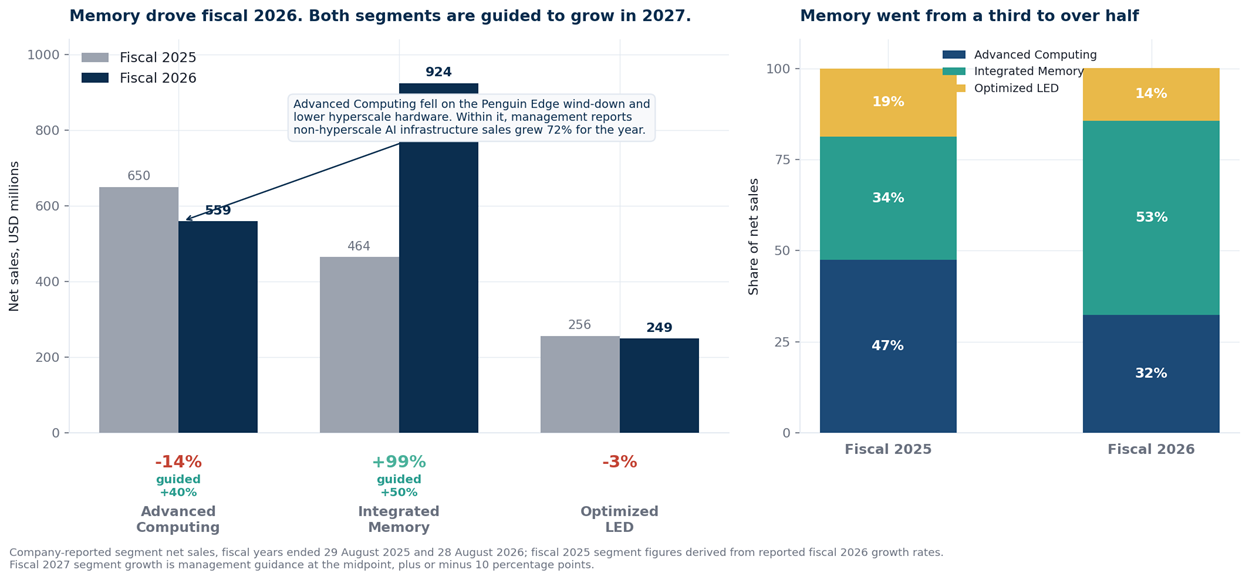
1. Fiscal 2026 net sales rose 26% to $1,731.5m. Integrated Memory grew 99% to $924.0m, more than accounting for the group’s entire increase, since the other 2 segments declined. Memory went from 34% of sales to 53%, and 60% of the fourth quarter.
2. Advanced Computing fell 14% to $558.8m, but not because AI demand failed. Management attributes the decline to the Penguin Edge wind-down and lower hyperscale hardware, and reports non-hyperscale AI infrastructure sales up 72% for the year and 99% in the fourth quarter. Both segments are guided to grow in fiscal 2027, Advanced Computing by about 40% and memory by about 50%.
3. The company earned $180.6m on a GAAP basis and used $151.9m of operating cash. Capital spending was $12m, under 1% of sales. This is an asset-light business with a substantial appetite for financing.
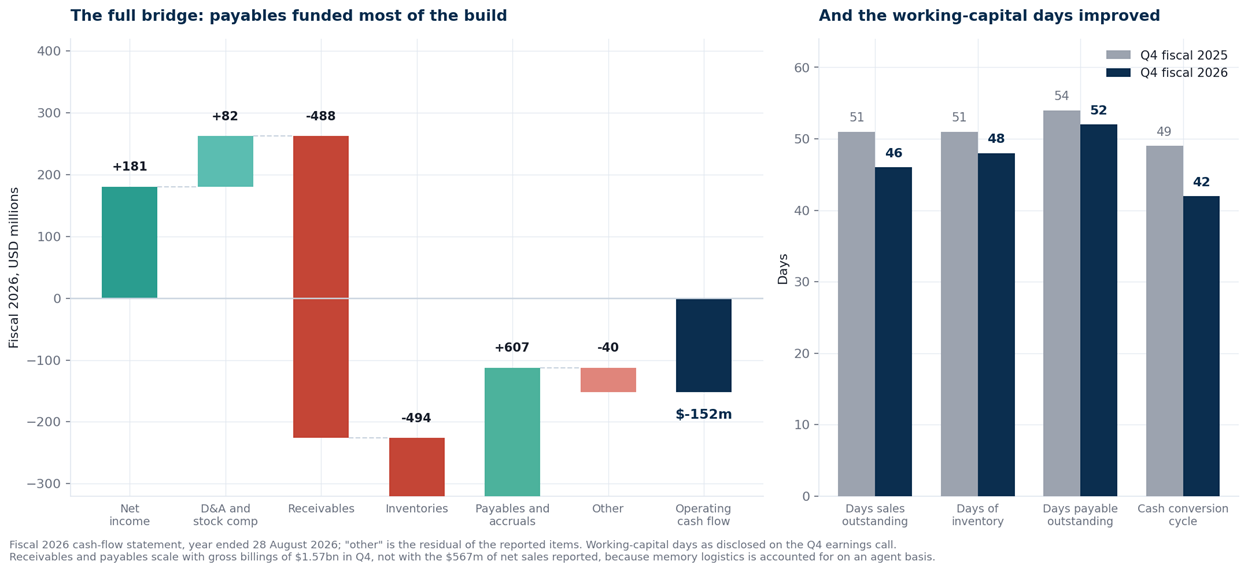
4. Working-capital discipline was better than the balance sheet alone suggests. Receivables and payables scale with gross billings of $1.57bn in the quarter, not the $567m of net sales reported, because memory logistics is accounted for on an agent basis. Days sales outstanding were 46, against 51 a year earlier.
5. On management’s own adjusted guidance of $4.45 a share the stock trades at 16.3x, not the 14x the screen suggested when I started. Those are strong-cycle earnings.
Where the Growth Came From
Contract prices for conventional DRAM rose sharply through the first half of calendar 2026, with the major forecasters publishing quarterly increases in the high double digits. Penguin’s memory revenue roughly doubled over a fiscal year sitting inside that window.
How much of that is price and how much is units matters a great deal, and the company doesn’t break it out. Management attributes growth to both, and the DDR5 replacement cycle in its enterprise and networking base is a real volume story. But industry price data can’t be mapped onto one company’s realised selling prices: the periods, product mix, customer base and revenue-recognition basis all differ. Anyone telling you they’ve decomposed it from public figures is guessing.
What can be said is that the mix has shifted hard toward a business whose economics are set by a commodity cycle, and that this is the first of 3 things worth monitoring.
On margins, I’d resist the obvious inference. Full-year adjusted gross margin fell 1.7 points to 29.3%, and the temptation is to read that as memory input costs squeezing a module assembler. Management says the opposite: the decline came primarily from a greater contribution of AI infrastructure hardware, with stronger margins inside Integrated Memory. A consolidated percentage can’t settle what happened inside a segment, and a lower percentage sat alongside record gross profit dollars of $507.9m.
The Cash Question
This is the part that deserves the most attention, and it needs stating carefully.
Receivables rose $488m and inventories $494m during the year. Those are large numbers. But payables, accruals and other liabilities rose $607m, funding most of the build, and the collection metrics moved the right way against the prior year: receivables at 46 days against 51, inventory at 48 against 51, and a cash conversion cycle of 42 days against 49. The sequential picture is less flattering, with that conversion cycle lengthening from 33 days in the third quarter.
What remains true is the headline: $180.6m of accounting profit, $151.9m of cash consumed. Management attributes the outflow primarily to working capital supporting growth, and the mechanism is clear enough. When revenue grows 26% and the fourth quarter alone grows 68%, the balance sheet scales ahead of collections, and here it scales against gross billings several times larger than reported revenue. Worth noting that GAAP profit also carried a $33.9m income-tax benefit, against a $20.1m charge the year before, so the distance between profit and cash isn’t purely a working-capital story.
The useful framing is the one the capital spending exposes. Penguin spent $12m on capital expenditure all year, under 1% of sales. It needs almost no factories. What it needs is working capital, and growth consumes it. The company ended the year with $647m of cash, having raised $750m of zero-coupon convertible notes and repaid its $100m credit facility, so the funding is in place. But a business that converts growth into cash and a business that converts growth into financing requirements are different propositions, and 1 year doesn’t tell you which this is.
What the Multiple Is, and What Could Break It
Adjusted guidance of $4.45 puts the stock at 16.3x. GAAP guidance of $3.50 puts it at 20.7x. Screen multiples closer to 14x rest on consensus estimates above the company’s own midpoint, so use the company’s. At 16x for 40% guided growth, this isn’t expensive on its face.
Showing the multiple is 16x rather than 14x proves nothing by itself. The relevant exercise is what happens if these earnings don’t persist:
At the $4.45 guidance midpoint, 16.3x
At $3.56, 20% below the midpoint, 20.4x
At $2.67, 40% below, 27.2x
Those are sensitivities, not forecasts. I don’t know when the memory cycle turns, and recent industry commentary runs from tightness persisting into 2028 to a profit peak well before that. But they make the concern concrete: at this price you’re paying a reasonable multiple provided the earnings hold, and a demanding one if they normalise.
The dilution picture is milder than the financing history suggests. The fourth quarter already used 62m adjusted diluted shares against the roughly 63m assumed in fiscal 2027 guidance, so the share count is barely moving. July’s refinancing issued about 8.7m shares in exchanges, and that has happened. The new 2031 notes convert initially near $116.70, some 61% above today’s price, with capped calls lifting the point of net dilution toward $175.05. SK Telecom’s $200m preferred, struck at $32.81, is genuinely in the money, and it’s already inside those diluted counts.
The AI Business Has Substance
It’s worth being specific here, because the narrative risk cuts both ways. Penguin was selected to deploy and operate a 36,000-GPU AI factory in Norway for a neocloud provider. The customer has $10bn of contracted compute from a leading AI lab, which is the customer’s figure and not Penguin’s revenue. Contract value, margins and phasing weren’t disclosed.
That’s the third thing to monitor: whether deployments of this kind produce recurring service profits or mostly hardware revenue at hardware margins. Hardware is currently diluting the blended margin, and management describes multiyear managed-service engagements alongside it. The remaining question is how much recurring software and service profit follows the deployments. Guidance of about 40% growth in Advanced Computing says the company expects volume. Whether that volume carries services with it is what would change the quality of this business.
The Price Is Stretched
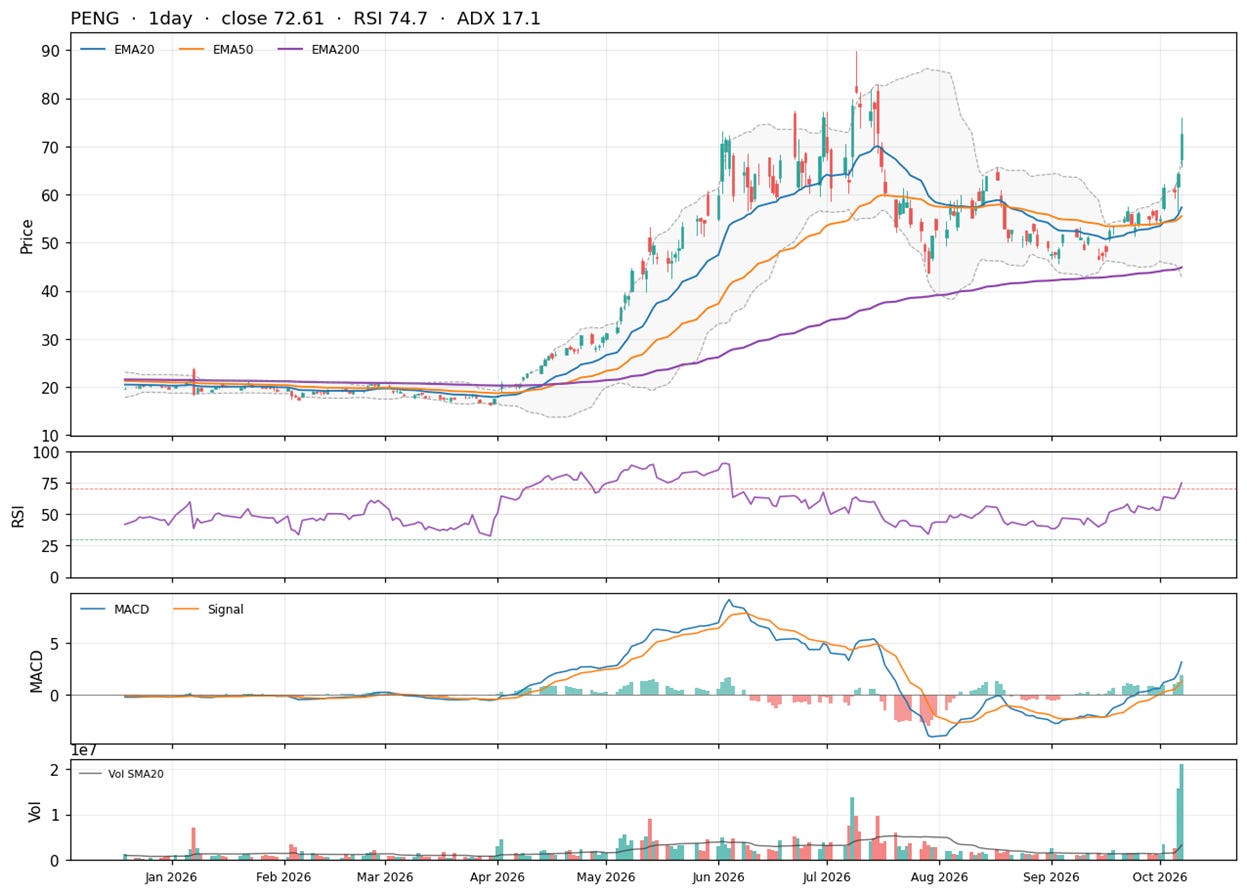
At $72.61 the stock sits roughly 80% above its 200-day average and around 35% above its 50-day, with the daily relative strength index at 74.7. That index measures the balance of recent gains against recent losses, and a reading this high says gains have substantially outweighed losses, which is a statement about momentum rather than value. Published moving averages differ slightly by source and date, so treat the exact figures as approximate.
Wednesday’s roughly 21m shares were nearly 12 times the average of the preceding 10 sessions. It was an outlier by any baseline you pick.
This stock has also already broken once in this run. It closed at $81.39 on 9 July, then closed as low as $43.70 within the same month, a fall of 46%, and spent the 3 months since between roughly $46 and $64. Nothing here moves gently.
Analysts raised their targets after the results, and the disagreement survived. Rosenblatt moved to $100 from $80, while Goldman Sachs, Needham and Stifel all went to $85, each keeping a buy. Barclays also raised, from $40 to $60, and kept an underweight rating, flagging expected pressure on gross margins. Consensus sits near $83.57. Coverage is thin, with sources listing between 7 and 9 firms.
