


A record quarter, a weaker headline, and a changed profit engine.

Robinhood reported third-quarter results after the close on Tuesday 27 October. Total net revenues were a record $1.42bn, up 12%, just under the $1.43bn expected. Diluted EPS was $0.51 against $0.61 a year ago. Adjusted EPS of $0.60 beat the $0.55 expected; the reported figure sat below the $0.56 some screens carried.
The stock closed Tuesday at $94.56, down 19% over the past month and 36% below its closing high of $147.08 on 3 November 2025. It was quoted near $88.71 in pre-market trading at about 08:25 New York time on Wednesday 28 October, which is where this piece stops.
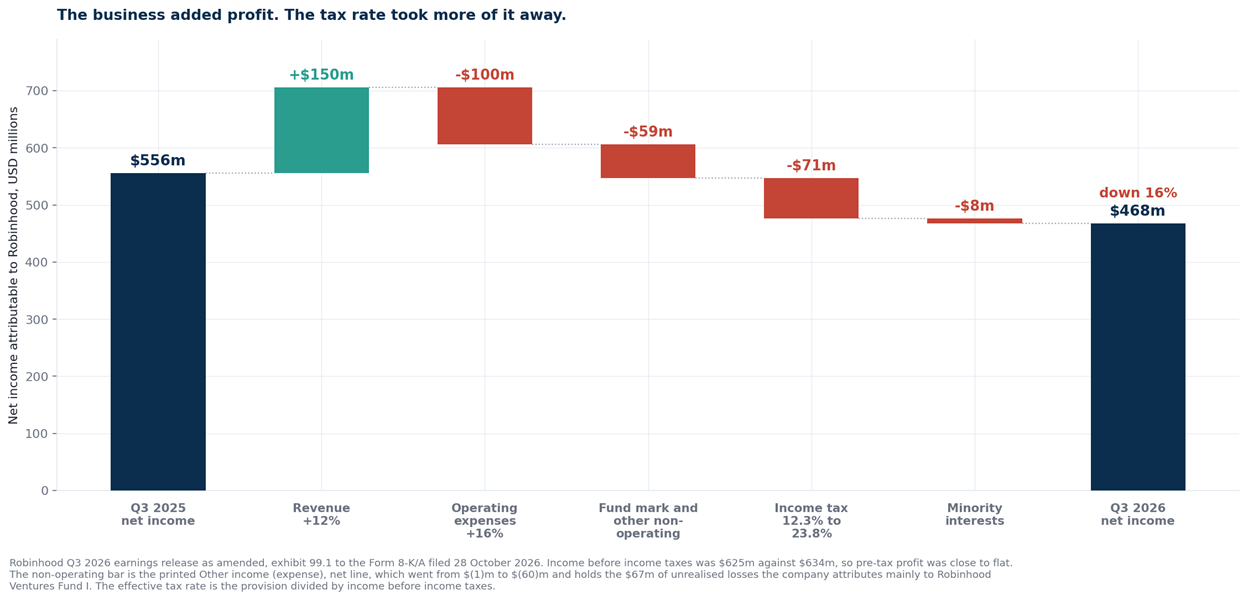
Why the Earnings Fell
Revenue added $150m and operating expenses took $100m back, leaving the business $50m better off. Other income and expense then went from minus $1m to minus $60m, a $59m deterioration, the bulk of it $67m of unrealized losses Robinhood attributes mainly to the mark on Robinhood Ventures Fund I, which it launched itself. That lands income before taxes at $625m against $634m, down 1.4%.
The tax line decides the quarter. Robinhood recorded a provision of $149m against $78m, which is $71m more on a pre-tax number that didn’t grow. Add $8m to non-controlling interests and you have the whole $88m fall in net income attributable to Robinhood, from $556m to $468m. Consolidated net income fell 14% to $476m; the attributable figure and diluted EPS both fell 16%.
Robinhood’s effective rate for all of 2025 was 10.7%, and the 10-K reconciliation shows why: a $184m share-based compensation item worth 8.7 points of rate, and $66m of research credits worth another 3.1. The then finance chief, Jason Warnick, guided to a normalized long-term rate in the mid-20s “before any quarterly items” on 12 February 2025. At 23.8%, this quarter is in that range.
Share-based compensation cuts the tax charge when the deduction on settlement exceeds the expense booked, which turns on where shares settle against the award’s cost basis. A lower price tends to shrink that benefit, but the size varies by award type, vesting date and volume, and Robinhood doesn’t publish quarterly detail. The normalization is documented; the share-price explanation for this quarter is plausible, not demonstrated.
What the Growth Cost
Operating expenses rose 16% to $739m against revenue up 12%, so the gap widened in dollars while the margin narrowed, to 48.1% from 49.8%.
Composition matters more. Provisions for credit losses went from $26m to $71m and operations costs from $33m to $79m, between them $91m of the $100m increase. Marketing rose 2% and general and administrative costs fell 12%. Robinhood attributes the rise to credit provisions as the card book grows, Trump Accounts and Rothera, and marketing, without sizing each.
Provisioning on a growing loan book is expected, and reflects expected rather than realized losses. How the book performs as it seasons is the open question, since provisions on recent originations are modelled, not observed. Note too that the guidance Robinhood lowered, by $25m to $2.75bn at the top end, excludes credit provisions, acquisition costs and CFO transition charges.
The Revenue Rotated
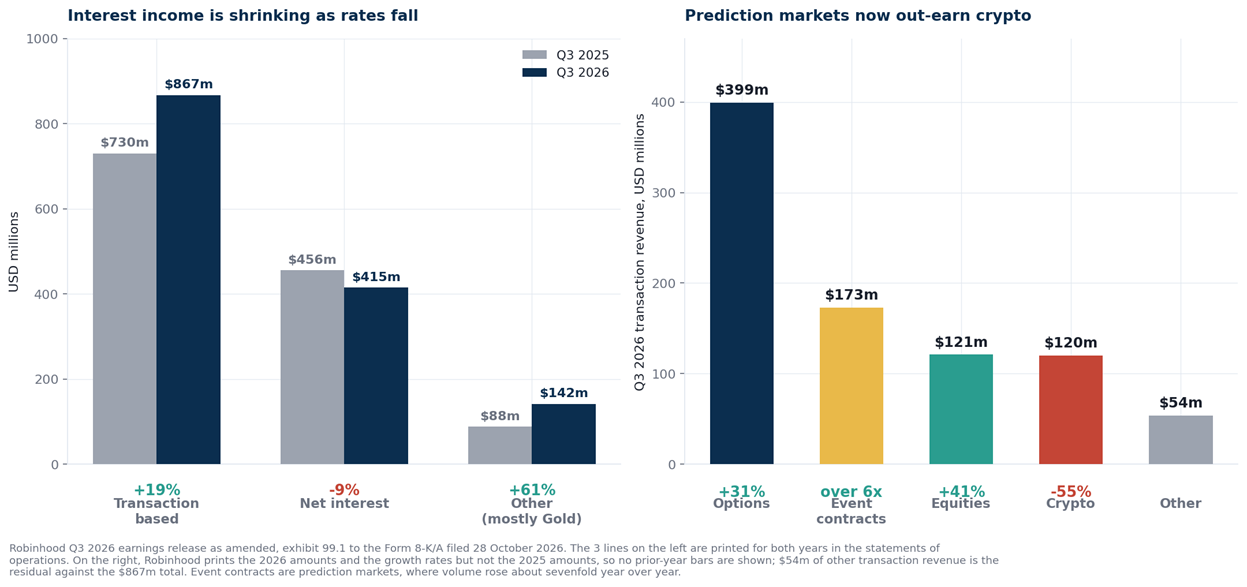
Transaction revenue rose 19% to $867m, and the composition underneath is unrecognizable. Options generated $399m, up 31%. Equities generated $121m, up 41%. Crypto generated $120m, down 55%. Event contracts, Robinhood’s prediction markets, generated $173m on contracts traded up more than sevenfold, putting them ahead of crypto.
The crypto decline has 2 parts that shouldn’t be merged. Monetization fell, which the finance chief, Shiv Verma, attributed to Robinhood Earn, the stablecoin product the company monetizes at a lower rate; his comparison was with the prior quarter, not the prior year. Activity fell separately: crypto notional volumes were down 38%, and down 48% on the Robinhood app. Volume data doesn’t establish whether customers left or traded less.
Net interest revenue fell 9% to $415m, which Robinhood attributes to lower securities lending and short-term rates, partly offset by growth in interest-earning assets. Verma put the sensitivity at about $80bn of interest-earning assets, roughly half rate-sensitive, each 25 basis point move worth about $100m, the 1.5% of revenue he quoted against an annualized run rate of $5.5bn to $6bn. Other revenues rose 61% to $142m, attributed to Trump Account service revenues and Gold subscriptions. The earnings presentation puts annualized Gold subscription revenue at $248m, which on a 4-times-quarterly basis is about $62m in the quarter, roughly 44% of the line. Gold is recurring rather than activity-linked, so I’d weight it above the line as a whole.
The Legal Question Inside It
Event contracts are the best revenue story here and carry the most unresolved risk.
About 30% of event contracts were non-sport last quarter, up from 15%. That is a contract mix, not a revenue split, which the company doesn’t publish. Sports-related contracts sit inside a live dispute over whether federal commodities law displaces state gambling law. The Ninth Circuit ruled against Robinhood on 28 August 2026, holding such contracts aren’t swaps under the Commodity Exchange Act and that federal law doesn’t preempt Nevada’s gambling regulation; the Third Circuit reached the opposite conclusion for a competitor in New Jersey.
Robinhood Derivatives petitioned for certiorari on 10 September in Robinhood Derivatives, LLC v. Dreitzer, No. 26-338. Respondents’ deadline runs to 13 November and the Court has neither granted nor denied review. A petition is a request to be heard, not a case accepted, and most are denied.
The effects are already concrete. Under a stipulation signed in the Western District of Michigan on 4 September, Robinhood stopped offering new sports-related contracts to Michigan customers and closed remaining positions by 9 October, in exchange for forbearance while its Sixth Circuit appeal proceeds; it covers any designated contract market, naming KalshiEx and Rothera Exchange and Clearing. No ruling binds the whole business and these proceedings concern sports-related contracts, but a meaningful share of the fastest-growing line turns on how courts resolve state access for one category.
What’s Compounding Underneath
The franchise numbers are better than the earnings. Funded customers reached 28.7m, up 7%; Gold subscribers 5.2m, up 34%. Total Platform Assets, a wider measure than assets under custody, reached $396bn, up 19%: $278bn of equities, $51bn of crypto, $38bn of options and futures, $27bn of net cash and $2bn of registered investment advisor assets. The margin book rose 59% to a record $22.1bn.
Rothera, the exchange and clearing house carrying Robinhood’s event contracts, passed $100m of annualized revenue in what the company calls its first full quarter. That is vertical integration into prediction markets rather than diversification away from them, inheriting the same legal exposure.
Net deposits were $15.7bn in the quarter and $71.0bn over the trailing 12 months. Management said October had already topped $13bn month-to-date, of which $6bn is the Dell family’s Trump Accounts contribution. That leaves more than $7bn from everything else in a partial month, though a month-to-date figure isn’t comparable with a completed quarter.
The Refiling
On Wednesday Robinhood furnished an amended release, “solely to revise the presentation of income tax effects of non-GAAP adjustments.” The original added the tax effect where it should have subtracted it, in every period shown.
Third-quarter adjusted net income goes from $550m to $542m, and adjusted EPS still rounds to $0.60. The larger revisions are elsewhere: second-quarter adjusted EPS moves from $0.50 to $0.55, the year-ago quarter from $0.62 to $0.61, and the 9-month figure from $1.51 to $1.54. GAAP results were unaffected, but anyone comparing the sequential trend from the first release was working from a wrong number.
What You’re Paying
Robinhood had 793m Class A and 108m Class B shares outstanding at 30 September, so 901m in total. The weighted-average basic count for the 9 months was 899m and the quarter’s diluted count 911m; those aren’t interchangeable.
On 901m shares at Tuesday’s close the market value was about $85bn. Trailing diluted EPS for the 4 quarters to September is $2.17, putting the stock on 43.6 times earnings at that close and 40.9 times at the pre-market quote. The 41.7 times on most screens runs on $2.27, the 4 quarters to June, excluding the quarter just reported. Trailing revenue of $5.08bn gives 16.8 times sales and equity attributable to Robinhood of $10.0bn gives 8.5 times book.
At 08:20 New York time on 28 October, Yahoo Finance showed 32 ratings, 26 of them buys, averaging $133 against a range of $57 to $170, compiled before this week’s revisions.
