


Salesforce reported Wednesday after the close, rose 22.6% on Thursday and another 1.6% on Friday, and finished the week at $256.00, its best day since 2020. The figure that led almost every write-up was adjusted earnings of $5.90 a share against a $3.27 estimate, a beat of more than 80%. Salesforce itself says $2.53 of that came from gains on strategic investments. Take it out and the operating result was $3.37, a beat of 3%. So 96% of the earnings surprise was non-operating. That doesn’t make the re-rating irrational, because the evidence that matters sits underneath the income statement and it genuinely improved. It does mean the number everyone quoted wasn’t the evidence.

Key Takeaways
Adjusted earnings of $5.90 included $2.53 from investment gains, which the company discloses. The operating figure was $3.37 against a $3.27 estimate.
The same distortion runs through the guidance. Full-year adjusted earnings guidance rose $2.60 at the midpoint, and $2.53 of that is the quarter’s investment gain.
What actually improved: contracted revenue due within a year grew 14%, and the finance chief says new order value is growing at its strongest rate in 4 years.
Recognized revenue hasn’t turned yet. Growth was 11%, but $456 million came from Informatica; without it the rate was about 6%.
The cheap-looking multiple is doubly flattered: by investment marks, and by a $25 billion buyback funded with debt.
Prices are the Friday August 28 close, the last completed session. Salesforce reported on Wednesday August 26 after the market shut.
The Number That Wasn’t
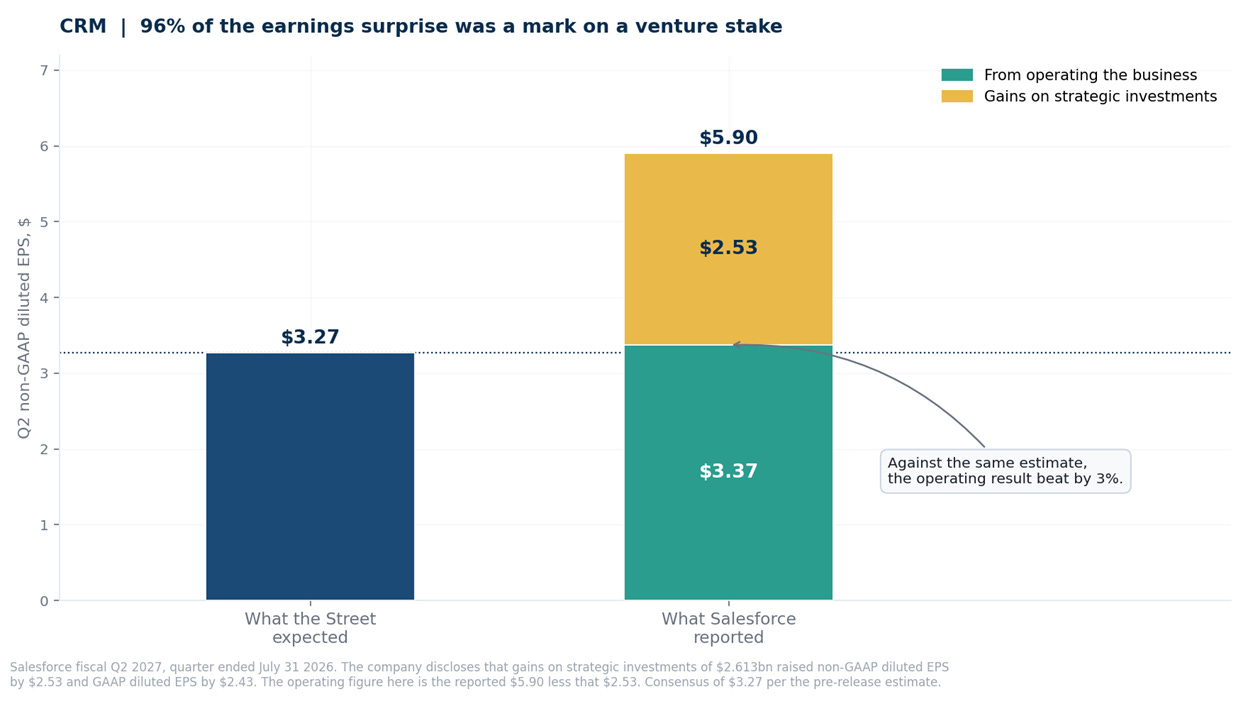
Give Salesforce credit for the disclosure. The release states plainly that gains on strategic investments of $2.613 billion raised adjusted earnings per share by $2.53 and the statutory figure by $2.43, and Reuters and others picked it up. But an 80% beat is a loud number and a $2.53 footnote is a quiet one.
The arithmetic is worth doing slowly. Adjusted earnings came in at $5.90 against an estimate of $3.27, a surprise of $2.63. Of that surprise, $2.53 was the investment mark. That’s 96%. The business itself delivered $3.37, which beat by 3% and grew 16% on the year rather than the 103% the headline showed.
The same distortion runs through the outlook, and it’s the better statistic. In May, Salesforce guided full-year adjusted earnings to $14.06 to $14.12. It now guides $16.67 to $16.71. The midpoint rose $2.60. The quarter’s investment gain was $2.53. So 97% of the apparent uplift in the full-year earnings guide is that same one-off mark, not an improved forecast for the software business.
None of this is an accusation. Salesforce’s adjusted definition includes these gains as a matter of course, and did last quarter too, when they added $0.51. But a number that moves on the private valuation of a company you don’t control tells you nothing about whether Salesforce sold more software.
The Number That Was
It sold more software. That’s the part worth owning.
Contracted revenue due within the next year reached $33.5 billion, up 14% both as reported and in constant currency, a point ahead of guidance and, on the currency-adjusted basis, an acceleration from 13% in each of the previous 2 quarters. Total contracted revenue was $66.3 billion, up 11%. Adjusted operating margin held at 34.1%.
Robin Washington, the finance chief, put the important sentence on the record. New annual order value, the worth of business newly signed, is growing at the strongest rate in 4 years, “keeping us on track for second-half organic revenue reacceleration.”
That’s the sequence a real software recovery follows: orders turn, contracted balances follow, recognized revenue arrives later, cash later still. If you want a reason the stock deserved to re-rate, it’s this and not the earnings line.
Now the discipline. Recognized revenue hasn’t followed yet. Growth was 11%, and $456 million of it came from Informatica, which Salesforce didn’t own a year ago. Strip that out and the underlying rate was about 6%. Read the finance chief’s sentence again: reacceleration is described as on track for the second half, not as something that happened. The guidance raise says the same. Of the $300 million added in constant currency, $200 million is the pending Contentful and Fin acquisitions and $100 million is organic, against a $100 million currency headwind. The organic raise and the currency hit cancel.
The AI numbers need a similar reading. Agentforce recurring revenue passed $1.5 billion, up more than 240%, and with Data 360 the pair is near $3.9 billion. Agentic workflows ran 3.2 billion actions in the quarter, up 97% on the previous one. But from this quarter Salesforce broadened what counts as Agentforce revenue to include Slackbot and Headless 360, so the 240% isn’t a clean like-for-like. And at $1.5 billion, Agentforce is about 3% of the revenue Salesforce expects this year. Real, growing fast, not yet moving the total.
So investors are paying for a turn in the leading indicators, not in reported revenue. That’s the risk and the opportunity.
The Anthropic Mark
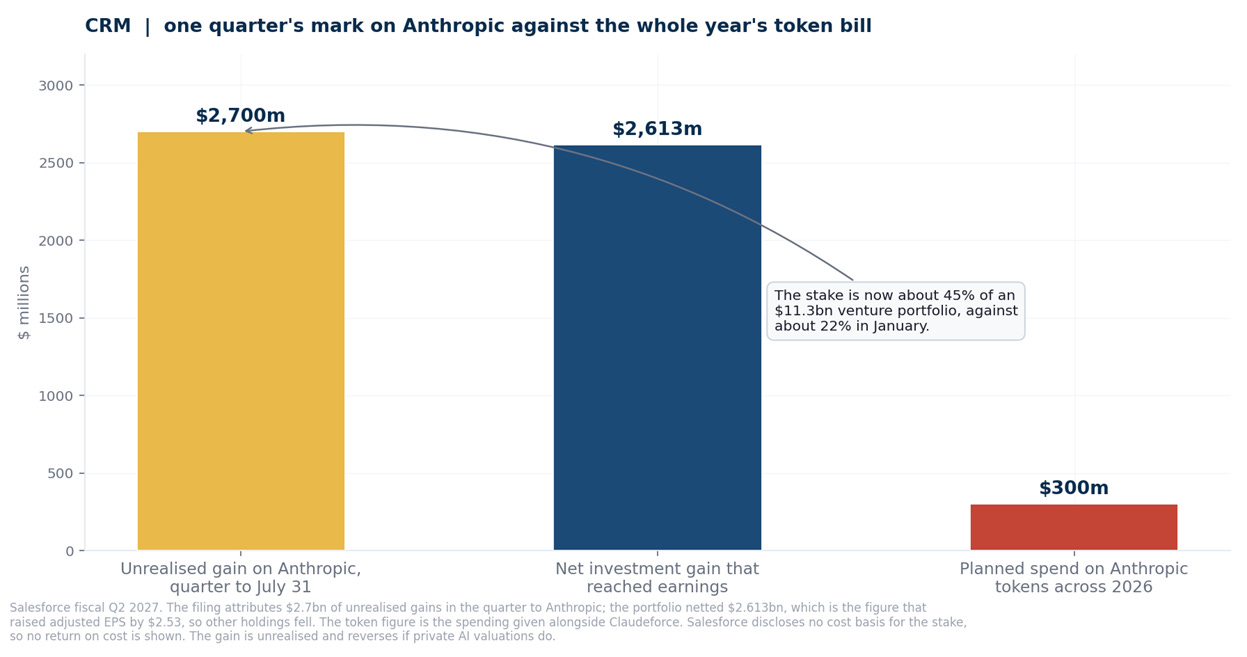
The same day it reported, Salesforce announced Claudeforce: Claude inside Agentforce and Slack, and Salesforce data inside Claude through a plug-in with 37 prebuilt sales skills, in open beta next month. Claude becomes the first outside model to run fully inside Salesforce’s trust boundary, making one supplier the default. Salesforce will spend roughly $300 million on Anthropic tokens this year.
The shareholding did rather better than that. The filing attributes $2.7 billion of unrealized gain in the quarter to Anthropic, about 9 times the entire year’s planned token spending, and the stake has gone from roughly 22% of Salesforce’s venture book in January to about 45% of an $11.3 billion portfolio in July. Salesforce doesn’t disclose what it paid for it.
Compare it properly and it’s still striking. The $2.7 billion is pre-tax, while the $3.37 of operating earnings is after tax. Apply the roughly 20% adjusted tax rate implied by the company’s own per-share disclosure and the Anthropic contribution is nearer $2.2 billion, against about $2.8 billion the software business earned. A minority holding in someone else’s company was worth about 78% of everything Salesforce sold.
Worth understanding how the mark happens. Salesforce carries private holdings under the measurement alternative: carrying value moves when an observable transaction in the same security occurs. This isn’t a company deciding its stake feels more valuable, it’s a funding round repricing it. The gain is unrealized, isn’t repeatable, and reverses if private AI valuations do.
What You’re Paying
Salesforce is worth about $211 billion. Against full-year guidance of $16.67 to $16.71, that’s 15.3 times earnings, which reads cheap for a business compounding bookings at 14%.
2 things flatter it. The first is the one above: $0.51 of first-quarter gains and $2.53 of second-quarter gains mean $3.04 of that guide is marks rather than operations. Strip them and you’re paying nearer 18.8 times, about 22% dearer than the screen says. Cut the other way too. If you remove the investment earnings you should acknowledge the investments themselves, and the $11.3 billion venture book still sits inside the market value. Net it off and the operating multiple is nearer 17.7 times.
The second is more interesting. In May, Salesforce launched a $25 billion accelerated buyback funded by $24.8 billion of new debt. That lifts earnings per share by shrinking the share count, and it’s why cash flow guidance is so weak: the company attributes roughly 5 points of headwind on operating and free cash flow growth to the debt issuance itself. Revenue is guided to grow 11% to 12% and cash flow 4% to 5%. That gap is financial engineering, not AI capacity. So the falling multiple partly reflects a smaller denominator rather than a better business, and with the balance sheet levered, enterprise value now tells you more than the price-to-earnings ratio does.
One accounting note. Adjusted operating margin was 34.1% against a statutory 20.5%, about 14 points apart on the full-year guide, mostly stock compensation and acquired-intangible amortization. Neither is a cash cost this quarter. Neither is economically free either: stock compensation transfers value through dilution unless buybacks offset it, and amortization reflects acquisition capital already spent.
The Setup
The strangest fact in the story: after its best day in 6 years, Salesforce is still 4.9% below its 52-week high of $269.11, set last December. That’s how deep the de-rating had gone, and the June low near $146 embedded a durability discount that accelerating orders make harder to justify.
It’s also violently extended. Friday’s close sits 23.8% above the 20-day exponential average at $206.79 and above the upper volatility band at $239.94, with the 14-day momentum gauge near 81, deep into overbought. Average true range is $10.93, so the 2-day move was worth more than 4 normal sessions.
