


Every day, markets generate an almost incomprehensible volume of data. Earnings calls, Fed minutes, analyst upgrades, macro reports, X posts, takes from accounts with 500k followers, and the list goes on.
Add in the crypto layer and you’ve got a 24/7 fire hose of information that never stops.
Most investors try to consume all of it. They think more data equals better decisions.
After a combined 35+ years managing portfolios and advising clients, we’ve learned the opposite is true.
The investors who consistently outperform aren’t the ones who know the most. They’re the ones who’ve built a reliable filter.
That filter is the difference between signal and noise. And it’s the foundation of everything we do at Investing With Purpose.
So what actually separates a signal from noise? Let’s break it down.
Key Takeaways
Most market information is noise. True signal is rare, structural, and repeatable. Noise is emotional, reactive, and mean-reverting.
The financial media is optimized to produce noise. Your job is to filter it, not consume more of it.
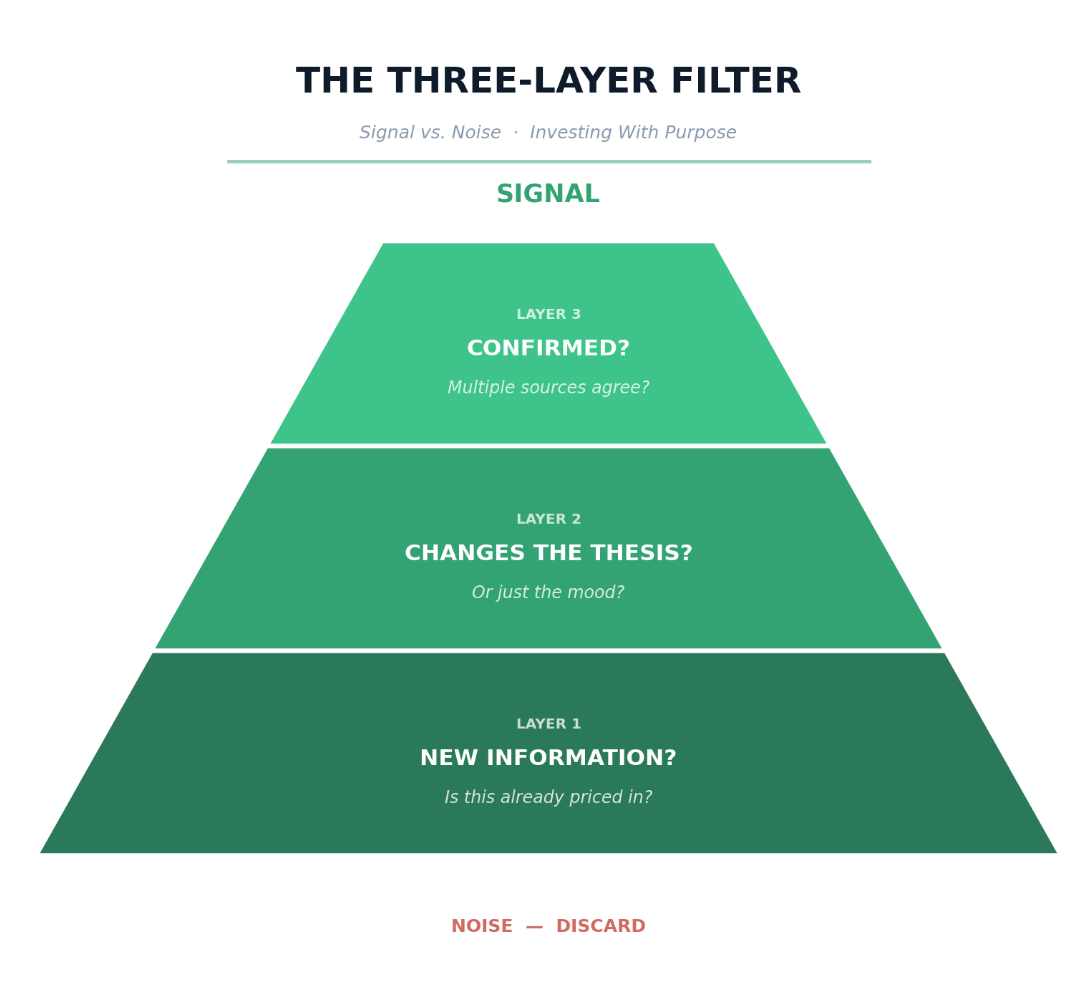
Use the Three-Layer Filter: Is it new? Does it change the thesis? Is it confirmed by more than one source?
Source quality matters more than volume. Primary data (filings, transcripts, Fed statements) beats secondhand interpretation every time.
Timeframe alignment is everything. A signal for a day trader is noise for a long-term investor. Know your horizon before you act.
The best signal often feels boring. If it’s urgent, exciting, and everywhere, it’s probably noise.
Fewer, better inputs beat more information. Your edge isn’t access, it’s filtration.
What Is a Signal, Exactly?
A signal is a piece of information that has a statistically meaningful relationship with a future price move or a change in fundamental value. It’s actionable, verifiable, and (critically) repeatable.
Notice what that definition does NOT include:
How loud the information is
How many people are talking about it
Whether it feels important in the moment
Whether a credible-sounding person said it
Volume and signal strength have almost zero correlation. In fact, the loudest information in the market is usually the least useful. By the time something is everywhere, the market has already priced it in.
What Is Noise?
Noise is everything that feels like information but doesn’t reliably predict anything. It’s the data that moves prices in the short term but reverts, the commentary that sounds authoritative but has no edge, the pattern that worked twice and is now being sold as a system.
Here’s the uncomfortable truth: the vast majority of what passes for “market insight” in mainstream financial media is noise. Not because the people saying it are dishonest, but because the incentives are all wrong. Media needs engagement. Engagement requires urgency. Urgency requires telling you something new every day, whether or not something genuinely important happened.
Nothing new happened to the business, but the stock dropped 4% on a slow news day. That’s noise. Don’t trade it.
Common noise sources to actively tune out:
Short-term price action without volume context: A 3% move on light volume on a random Tuesday tells you almost nothing.
Analyst price target changes: These are reactive, not predictive. They almost always follow the price, not lead it.
Social media momentum: Useful as a contrarian indicator at extremes. Almost useless as a primary signal.
Daily macro headlines: The Fed ‘signals’ something in every speech. Most of it is already priced in or contradicted in the next speech.
Earnings beats/misses in isolation: A beat that was expected is often sold. A miss that was feared is often bought. The number matters less than the expectation delta.
A Three-Layer Filter To Use
Investors can apply a mental framework for processing new information in real time. You can call it the Three-Layer Filter.
When something comes across the wire, like a headline, a data point, or a chart pattern, run it through these three questions before giving it any weight:
Layer 1: Is it new information, or a repackaging of what’s known?
Markets are brutally efficient at processing widely-known information. If everyone can read the same Bloomberg headline, that headline is already in the price. The question is: does the market already know this?
True signals usually comes from information that’s either: (a) genuinely novel, something the market hasn’t fully processed yet, or (b) correctly interpreting known information that the crowd is misreading due to bias or short-termism.
Example: When the market sold off a high-quality compounder after a single quarter of slightly slower growth, we saw that as a misread. The long-term thesis was unchanged. That’s signal buried under noise.
Layer 2: Does it change the thesis, or just the mood?
Every position we hold is built on a thesis, or a core argument for why the asset should be worth more (or less) over a defined time horizon. When new information arrives, the first question is simple: does this change the thesis?
If the answer is no, don’t act. Market mood swings driven by fear, FOMO, macro uncertainty, or media cycles are the single biggest source of self-inflicted losses for individual investors. They look like information. They feel like information. But they’re not.
If the answer is yes, the thesis has genuinely changed. Then, we act, and we act quickly.
Layer 3: Is there confirmation, or is this a single data point?
One data point is a data point. Two is a coincidence. Three is a pattern. We’re almost never willing to take meaningful action on a single signal without at least one confirming factor from a different source or methodology.
This is where combining fundamental and technical analysis pays off. A deteriorating fundamental picture confirmed by a technical breakdown is a much stronger signal than either one in isolation. Conversely, a technical breakout in an asset with strong fundamentals and positive sector momentum is a high-conviction setup — not because any one input is perfect, but because multiple independent filters are pointing the same direction.
Why This Matters More Than Ever
We’re not being dramatic when we say the signal-to-noise ratio in markets has never been worse.
Algorithmic trading means markets react to headlines in milliseconds, often overshooting, creating volatility that looks meaningful but is essentially mechanical. Social media has democratized market commentary to the point where volume of opinion no longer correlates with quality of insight. And the rise of zero-commission trading has flooded markets with participants who are optimizing for entertainment, not returns.
All of this creates opportunity for investors who have built a reliable filter. The noise creates price dislocations. The signal tells you which dislocations are real.
The market’s short-term chaos is long-term investors’ opportunity, but only if you can tell the chaos from the signal.
How to Build Your Own Filter
You don’t need 35 years of experience to start filtering better. You need a process. Here’s where to start:
Write down your thesis before you buy anything. If you can’t articulate in two sentences why you own something and what would change your mind, you’re flying blind.
Define what counts as a signal for you. Before news hits, decide: what information would actually change my view? Then measure everything else against that bar.
Create a 48-hour rule for reactive decisions. If new information feels urgent, wait 48 hours before acting. Most noise evaporates. Real signals stay relevant.
Limit your information sources. More is not better. Three high-quality sources you trust deeply will outperform fifteen sources you skim.
Keep a decision journal. Tracking your decisions and what information drove them is the fastest way to identify where noise is leaking into your process.
The Bottom Line
The investors who win over the long run aren’t the most well-informed. They’re the most disciplined about what they let inform them.
At Investing With Purpose, our edge isn’t that we see more. It’s that we’ve spent a long time learning what to ignore. Every signal we share with our subscribers has passed through our filter: it’s new, it changes the thesis, and it has confirmation. Everything else stays in the noise pile where it belongs.
The market will always have more noise than signal. The question is whether you’ve built the filter to tell them apart.
Not investment advice. For educational purposes only.
More from IWP:
INTUIT Delivered. Now the Next Opportunity Is Forming.

On February 27 we published a thesis on Intuit arguing that the panic in the stock price was disconnected from the underlying business. At the time the stock had collapsed 57% from its $813 peak to a capitulation low of $349.
This Stock Has a Habit Around Earnings

Rubrik reports earnings Thursday, March 12, 2026 after market close.
Invaluable insight! This framework is crucial to success in today's landscape. The silver lining to the deluge of noise in markets today is its practical use as a contrarian indicator - to identify peak retail/mainstream euphoria and despair.