

These 2 companies reported this month, and lining them up side by side would be a category error: Supermicro SMCI 0.00%↑ is guiding to $65 to $72 billion of revenue next fiscal year, TeraWulf WULF 0.00%↑ did $44.8 million last quarter.
No shared multiple survives that gap, so I won’t force one. What they share is a moment. Each just proved its slice of the AI buildout is bigger than the market had modeled, and each now faces the same question in a different form.
Both have shown they can raise money. What neither has shown is what the next leg of growth costs the people who already own the shares.
Key Takeaways
SMCI closed fiscal 2026 at $39.1 billion of revenue against $22.0 billion the prior year, and guided fiscal 2027 to $65 to $72 billion, well above a consensus running between $52.5 and $54.4 billion by provider.
June-quarter gross margin hit 17.5% against 9.5% a year earlier, on enterprise mix roughly doubling to half of revenue. But the full fiscal year came in at 10.8%, and management guided September back to 10.4% to 10.8%.
Fiscal 2026 consumed $6.81 billion of operating cash as receivables and inventory swelled, though the June quarter itself generated $747 million of positive operating cash flow.
WULF signed a 20-year lease with Anthropic for roughly 401 MW and now draws 71% of revenue from HPC leases, though total revenue still fell 6% YoY and the operating loss was about $140 million.
Neither lacks access to capital. SMCI raised billions through equity and convertibles in June; WULF holds about $3.0 billion of cash. The open question is what the next round costs.
SMCI: The Margin Changed. The Working-Capital Burden Didn’t Disappear.
Fiscal 2026 closed at $39.1 billion of revenue against $22.0 billion in fiscal 2025, with net income of $2.2 billion and adjusted diluted EPS of $3.63 versus $2.06. The June quarter landed at $11.1 billion, near the low end of its $11.0 to $12.5 billion guide but 91% above the $5.8 billion a year earlier, with non-GAAP EPS of $1.70 (GAAP $1.62) against a consensus of $0.88 to $0.92 depending on the provider. One disclosure to carry through: the company labels these figures preliminary and unaudited, with the fiscal-year close incomplete and a board review underway related to certain export-control transactions.
Revenue was never the doubt here. Margin was. The bear case has always been that Supermicro assembles other people’s silicon into racks at whatever price the market allows, and the filed quarterly gross margins supported it, bottoming at 6.3% in December and 9.9% in March. June reported 17.5% GAAP and 17.6% adjusted, against 9.5% a year earlier and guidance of 8.2% to 8.4%, which management attributed to mix, with enterprise roughly doubling to half of revenue.
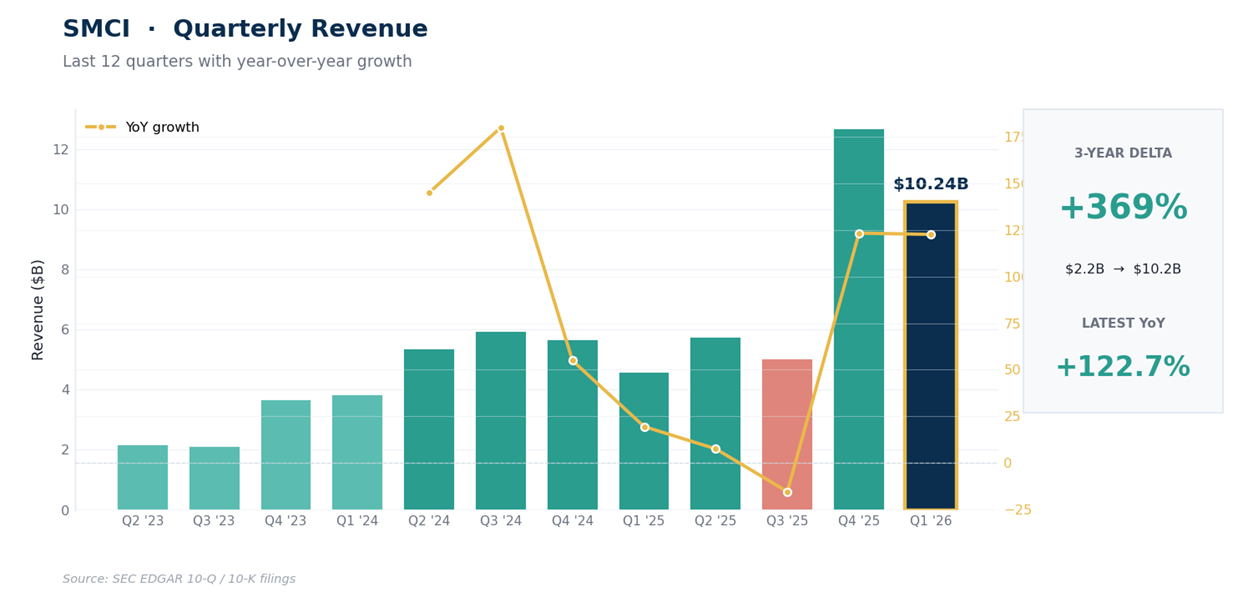
Then the qualifier that decides what it’s worth. Full-year fiscal 2026 gross margin was 10.8%, slightly below fiscal 2025’s 11.1%, and management guided September to 10.4% to 10.8%. Supermicro isn’t claiming 17.5% is the new normal. So the question isn’t whether the margin was real. It’s whether June began a mix shift or was an unusually favorable quarter inside a business that still runs near 11%.
The top-line guide extended rather than walked back: September at $14.5 to $15.5 billion, full fiscal 2027 at $65 to $72 billion, with record backlog and more than $60 billion of new orders booked in the fourth quarter alone.
Then the balance sheet. Fiscal 2026 consumed $6.81 billion of operating cash, overwhelmingly through receivables and inventory, against $7.5 billion of cash and roughly $8.7 billion of bank debt and convertible notes at June 30. That isn’t distress; it’s what happens when a company nearly doubles revenue in a business that buys silicon and carries inventory before it can bill anyone. The June quarter itself turned, generating $747 million of positive operating cash, so the drain isn’t constant. It is structural, which is why the company raised billions through equity and mandatory convertible preferred in June to fund components against those orders.
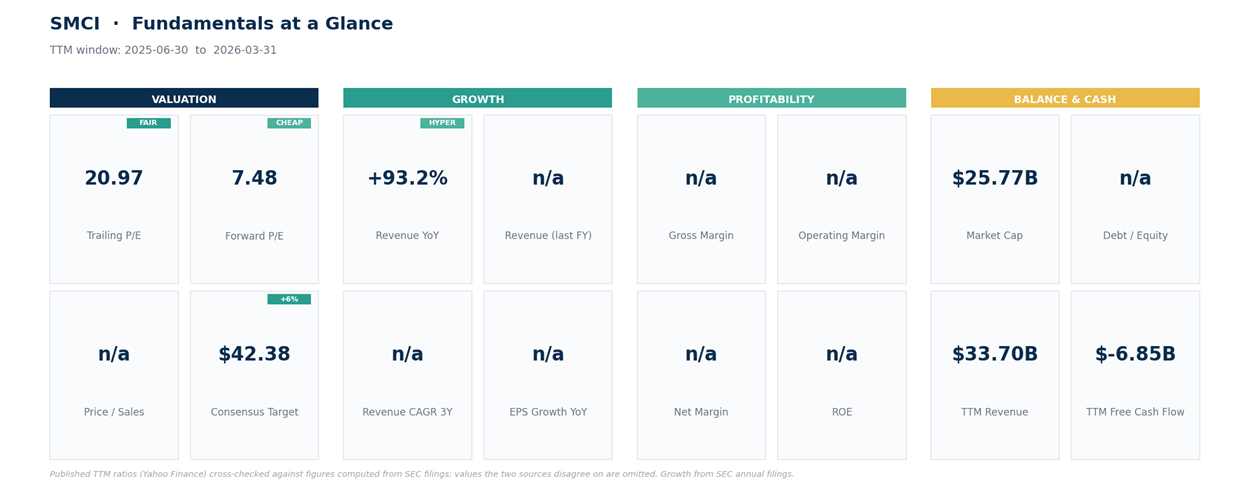
That dashboard is computed through March 31, so it predates the June quarter and shows trailing revenue of $33.70 billion rather than the $39.1 billion fiscal-year figure. Several tiles read n/a because the 2 sources disagreed, itself a signal on a company with SMCI’s filing history.
Technical levels are based on the August 14 close. SMCI gapped from $31.60 on August 11 to $37.61 the next session and has reached $39.84, roughly 26% higher in 3 sessions and about 70% above its July 17 low of $23.38. Price sits above every daily EMA (20-day $31.99, 50-day $31.08, 100-day $31.36, 200-day $33.19), with buyers well ahead on the directional readings. It’s also stretched: RSI at 70.7 is overbought, the faster stochastic-RSI reading is pinned at its maximum, and Bollinger %B above 1.0 means price closed outside the upper volatility band. Consensus hasn’t followed, at a hold across 16 analysts and a $42.38 mean target 6% above the price.
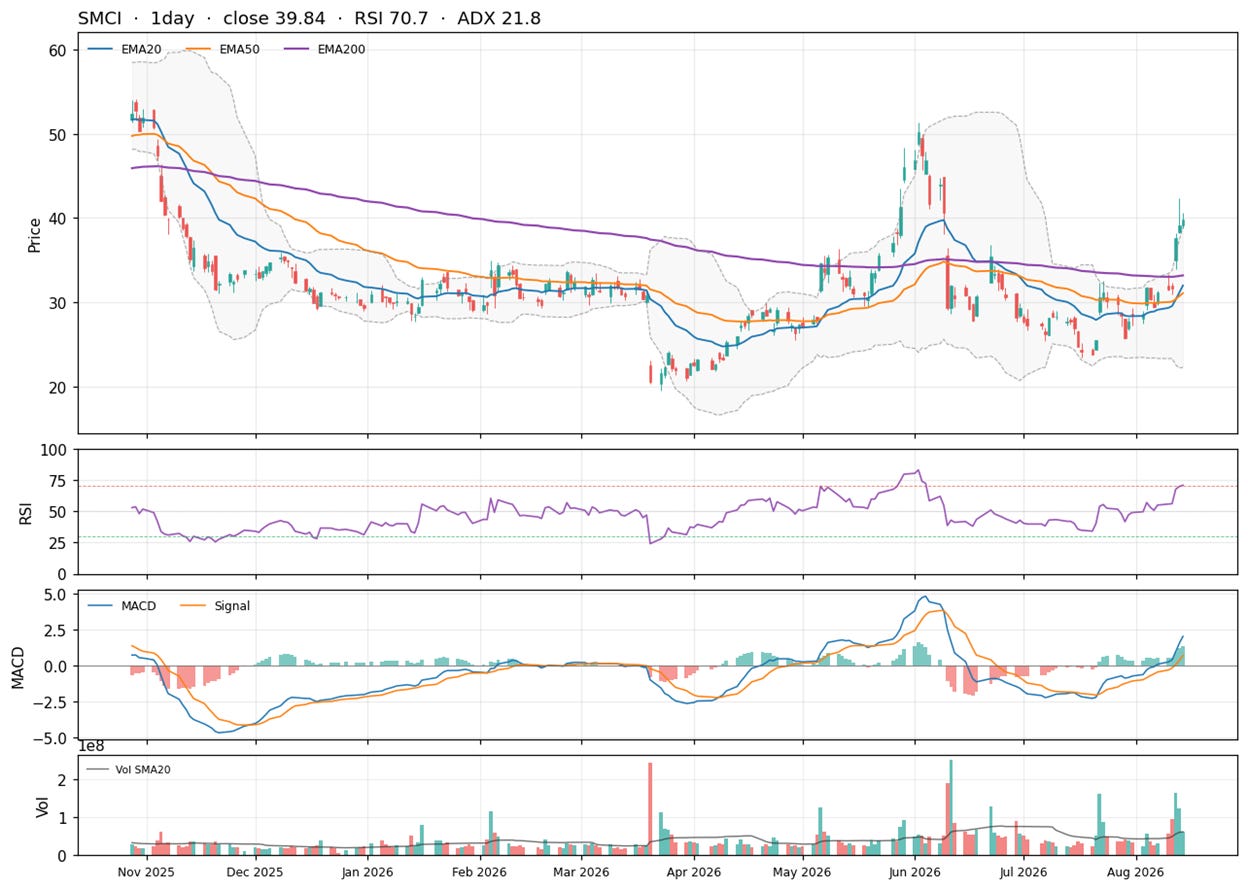
June is the most interesting number Supermicro has printed in years, and its own September guide says don’t extrapolate it. Price has already traveled 26% while consensus sits 6% away, so the market has paid for the quarter without yet paying for the thesis.
Now the other end of the chain.
WULF: The Contract Book Changed. The Income Statement Didn’t.
TeraWulf’s June quarter produced $44.8 million of revenue, of which $31.9 million came from high-performance computing leases, up 52% sequentially and now 71% of the mix against roughly zero a year earlier. That transformation is the entire story. The number underneath is less flattering: total revenue fell 6% YoY, because the bitcoin mining business it’s exiting shrank faster than leasing grew. The reported net loss of $939.9 million reads as catastrophic until you look at composition, where a $755.7 million non-cash fair value charge tied to Google warrants accounts for most of it. Strip that out and the business still ran an operating loss near $140 million, so the accounting explains the headline, not the economics.
The contracts are the asset. A 20-year lease with Anthropic covering roughly 401 MW of critical IT capacity turns a volatile mining operation into something closer to a landlord with a 2-decade tenant, and management reaffirmed a target of contracting an incremental 250 to 500 MW each year. TeraWulf entered the third quarter with 102 critical MW operating at Lake Mariner, which frames the task: the contracted book is several times the operating base, and the gap has to be built first.
Building it is a financing question, though not an access question. The capital structure carries roughly $2.5 billion of convertible notes at the parent and $3.2 billion of senior secured notes at the operating subsidiary, against about $3.0 billion of cash and restricted cash earmarked for contracted development. That is what funding a buildout ahead of its revenue looks like. TeraWulf also agreed to sell its 50.1% Abernathy joint-venture interest for roughly $530 million, recycling capital toward projects it controls outright.
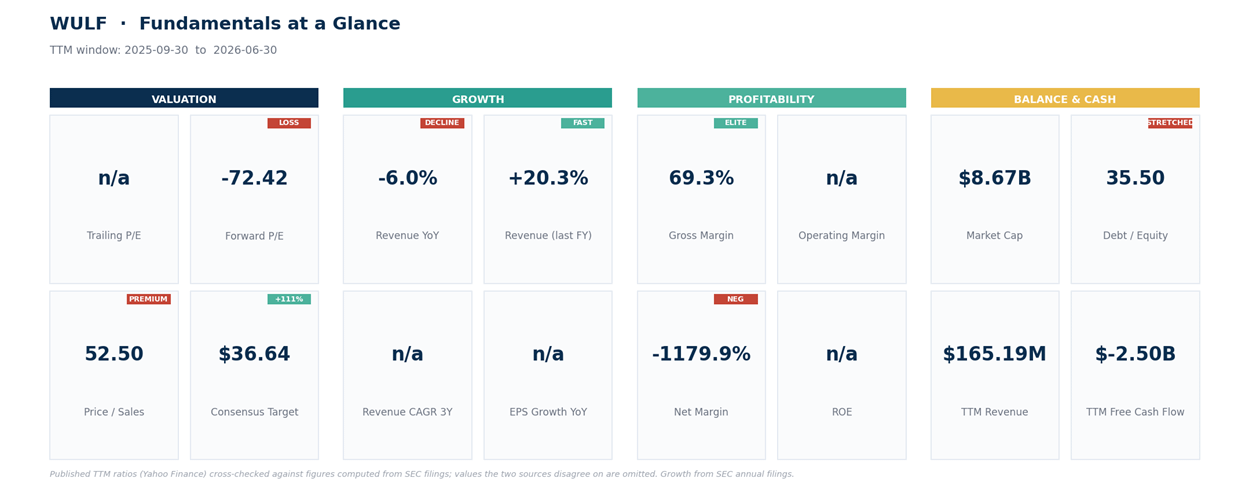
Technical levels are again based on the August 14 close. WULF trades at $17.38, about 42% below its June 22 high of $29.84, and below every daily EMA (20-day $18.08, 50-day $19.96, 100-day $19.98, 200-day $17.74).
Sellers lead the directional readings, with ADX near 28 marking an established downtrend, though momentum has stopped deteriorating. The weekly picture is washed out, its stochastic-RSI reading near zero. Against that, consensus is unusually bullish: a strong buy across 18 analysts and a $36.64 mean target 111% above the price, with 26.2% of the float short as of July 31.
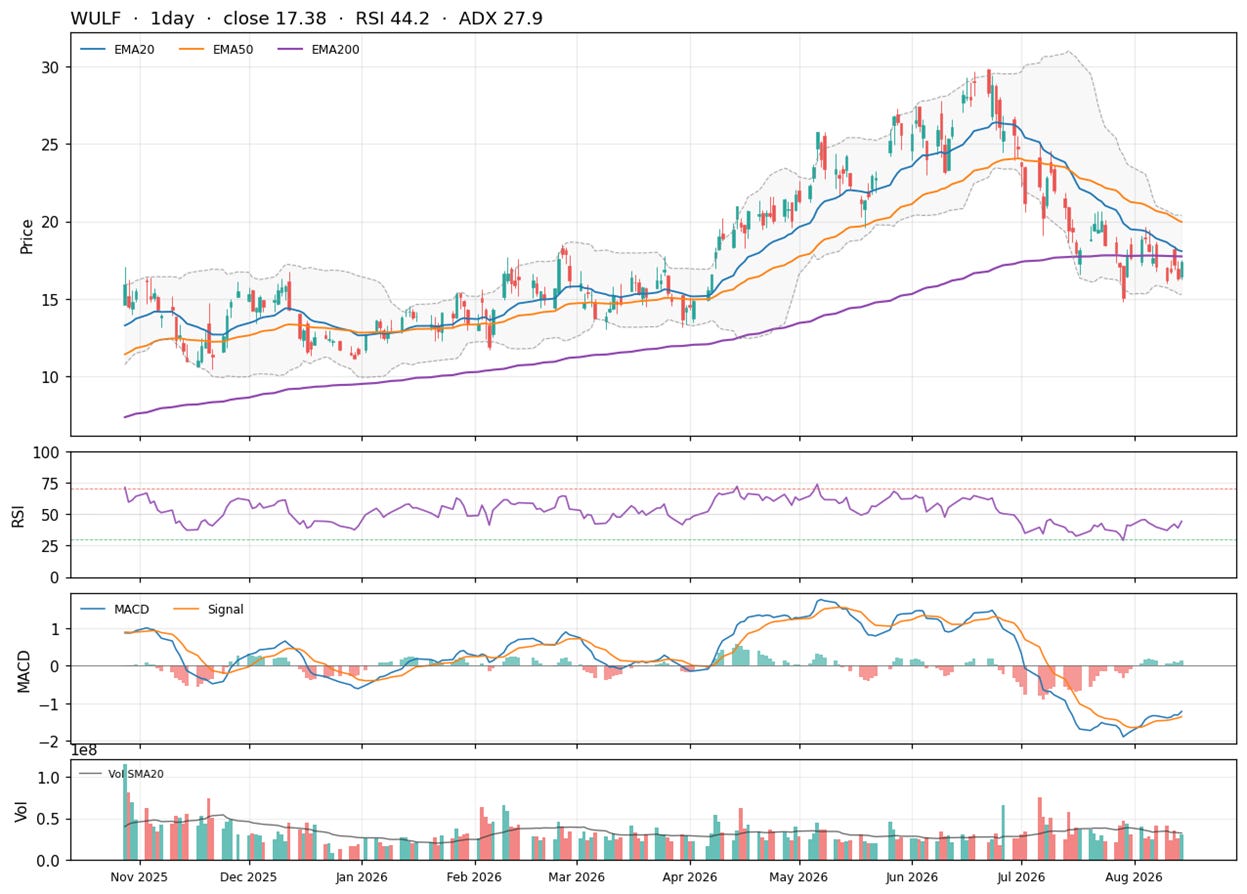
The contracts changed what this company is, and the price hasn’t agreed for 2 months. That gap is either the opportunity or the warning, and it resolves on execution, on whether contracted megawatts become operating megawatts on schedule and on budget.
What both reports left open.
The Question They Both Left Open
Strip out the difference in scale and the 2 reports rhyme. Each proved demand: Supermicro with more than $60 billion of new orders in a quarter, TeraWulf with a 20-year lease from one of the better-funded buyers of AI capacity in existence. Each has also proved it can raise capital. What neither has shown is that the next leg can be funded without a real cost to the people who already own the shares, through working capital, leverage, financing expense or dilution. For Supermicro that cost arrives before the server ships, as cash disappears into inventory and receivables. For TeraWulf it arrives before the megawatt starts paying rent. Same constraint, opposite mechanics.
How to hold either one.
Setups
These are 2 unrelated positions with unrelated risks, and nothing below is a comparison between them. They’re illustrative levels, not instructions.
SMCI
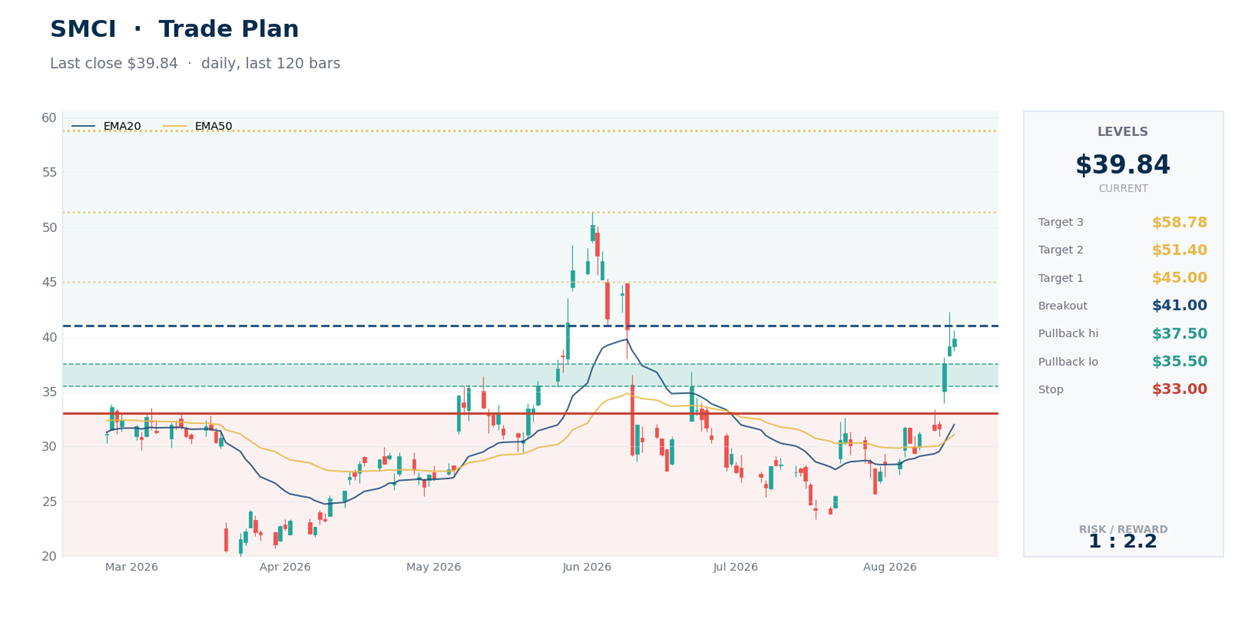
1. Pullback zone: $35.50 to $37.50, covering the 50% retracement at $35.44. Invalidation: a close below $33, under the 200-day EMA, which puts price back into the pre-earnings range.
2. Continuation: a close above $41, with the 38.2% retracement at $39.21 beneath it as first support. Objectives: $45, then $51.40 at the June high, then $58.78 at the 52-week high. Invalidation tightens to $37.50.
3. Price outside its upper band with the faster oscillator maxed makes chasing here poor risk and reward. The next report is currently estimated for early November.
WULF
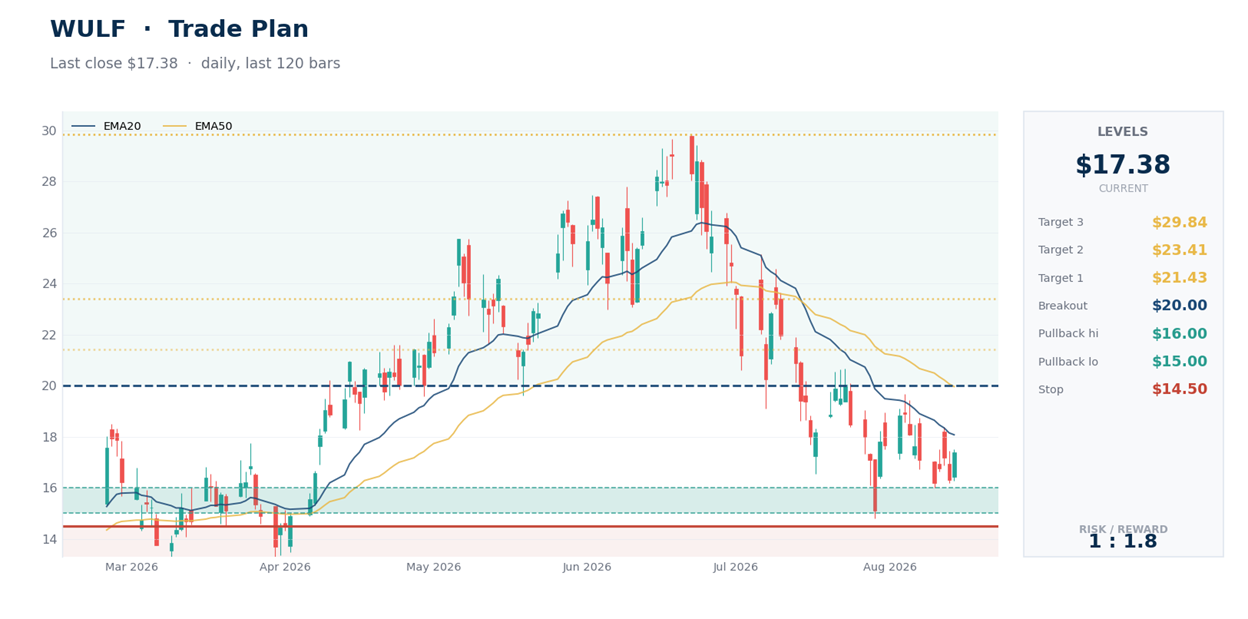
1. Support zone: $15.00 to $16.00, at the lower volatility band above the July 29 low of $14.81. Invalidation: a close below $14.50, which breaks that low.
2. Reclaim: a close above $20, clearing the 50-day and 100-day EMAs that sit within 2 cents of each other. Objectives: $21.43 is less than 1 average day above the trigger, so treat it as a waypoint; $23.41 and $29.84 are the levels worth sizing against. Invalidation tightens to $18.
3. At $17.38 the stock sits between both setups, which is itself the answer for today. A 9.8% average daily range with 26.2% of the float short means size matters more than entry.
Bottom Line
Treat these 2 as separate answers to separate questions. Supermicro printed its strongest margin quarter in years and then guided the next one back to 10.4% to 10.8%, which makes the durability of that mix the whole investment question, at 7.5x forward earnings with a hold consensus and a target 6% away. TeraWulf is increasingly valued like a digital-infrastructure landlord, on megawatts it hasn’t built, with analysts 111% above a price that has fallen for 2 months. What links them isn’t a multiple, it’s a constraint. Both told you the buildout is larger than the models carried. Both still have to fund the next leg, and in each case the bill arrives before the revenue does.
This is research and commentary, not personal investment advice. Levels and trade plans are illustrative; size positions to your own risk tolerance and time horizon. The author may hold positions in names discussed.