


Snowflake fell 7.7% across the 2 sessions into Wednesday’s report, most of it on the same fear that has been compressing software valuations all year: that AI does the work people used to buy seats for. Then it reported product revenue of $1,491.9 million, up 37%, the third straight quarter that growth got faster, and raised the year.
On Thursday it opened at $377.24, up 23.4%. It touched $384.56, a 52-week high. It closed at $356.47.
That’s still up 16.6%, and it’s a very good day. It’s also sellers taking back 29% of the gap inside a single session, on 5 times its 20-session average volume. Both halves of that are the story: the mechanism worked, and the market immediately started arguing about the price.

Key Takeaways
Product revenue grew 37%, after 30% and 34%. Net revenue retention was 126%, and remaining performance obligations reached $9.00 billion, up 30%.
The full-year product revenue guide went to $6.07 billion from $5.84 billion in May. That $230 million raise is about 3 times the $74.4 million by which product revenue beat the company’s own guidance.
The chief executive attributes about half the acceleration to AI products. CoCo, its coding agent, ended the quarter above 9,100 accounts, up more than 2,000.
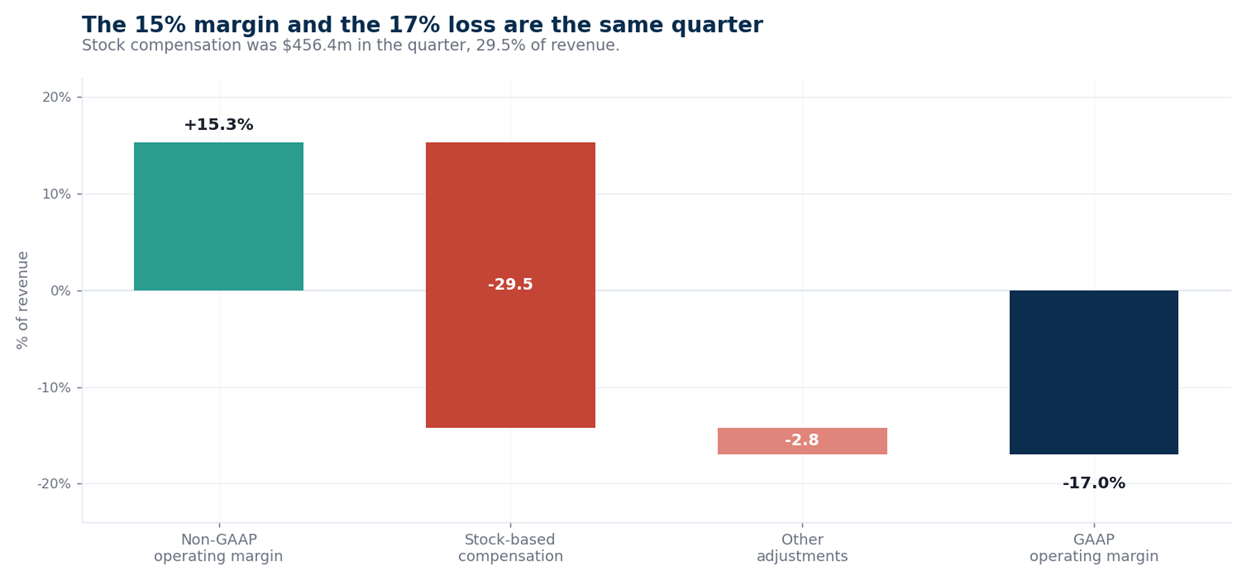
Non-GAAP operating margin was 15.3%. The GAAP figure was negative 17.0%. Stock compensation was $456.4 million, 29.5% of revenue.
Prices are the Thursday September 3 close, the last completed session. Friday is pre-open as this is written.
The Test Software Has Been Failing
The bear case on application software is simple and mostly right. If you sell licences by the seat, and AI does what the person in the seat used to do, then your customer needs fewer seats. Better product, smaller bill. Priced per user, capability becomes deflation.
Snowflake isn’t primarily priced per user. Its model is consumption-based, with customers paying for compute, storage, data transfer and AI usage, and AI work is enormously compute-hungry, and it runs on the data customers have already put there. Every model that gets pointed at a company’s own records is billable. In that arrangement AI isn’t a substitute for the product. It’s a meter running faster.
That’s the theory. It’s been the standing bull argument for consumption-priced data infrastructure for 2 years, and mostly just an argument, because the numbers weren’t separating from the rest of software. This quarter they did, which is why the reaction was violent.
The Acceleration
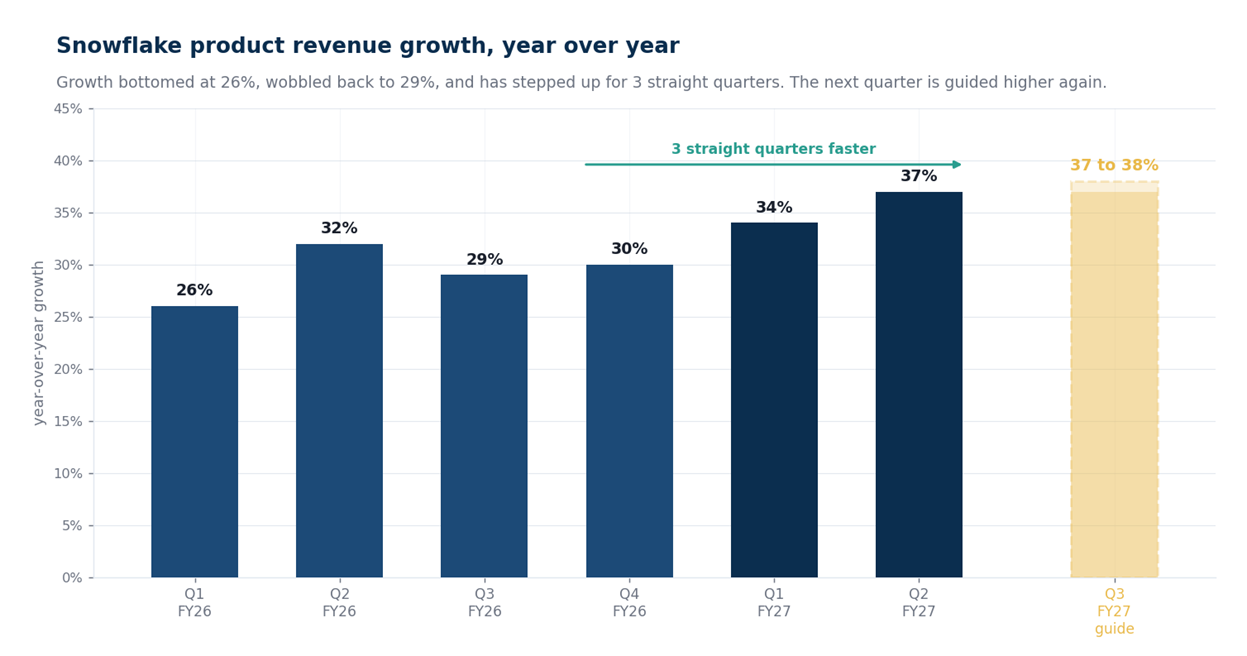
Growth in product revenue by quarter went 26%, 32%, 29%, 30%, 34%, 37%. Read it properly: it bottomed at 26%, wobbled back to 29%, and has now got faster 3 quarters running. The next quarter is guided to 37% to 38%, so management is telling you it expects the acceleration to hold.
Deceleration is close to a law in software. Companies get bigger, the base gets harder, growth grinds down. Snowflake did that for years, from triple-digit growth at listing down to 26%. Reversing it at a $6 billion run rate is unusual, and it isn’t a single-quarter artifact.
The supporting measures agree. Net revenue retention was 126%, up from 125% 3 quarters earlier, which means the multi-year slide in how much existing customers expand has, at least for now, stopped. Remaining performance obligations, the contracted work not yet recognised, reached $9.00 billion, up 30%. That’s 7 points slower than revenue, and it’s the first number a sceptic should reach for. The company’s explanation is that renewals cluster in the fourth quarter, and the detail supports it: about 54% of that $9.00 billion is expected to convert inside 12 months, and that portion is up roughly 42% on the same estimate a year ago. The near-term book is growing faster than revenue even though the total isn’t. Customers spending more than $1 million a year numbered 828, up 27%.
On where it came from, chief executive Sridhar Ramaswamy put roughly half on AI products, naming CoCo, CoWork, AI functions and the AI Gateway, and the other half on the core business, naming broader product use, applications, notebooks and faster customer migrations. CoCo finished above 9,100 accounts and CoWork at 5,800.
That split is worth holding onto, because it says the AI contribution is real but not the whole thing. My own reading is that the line between the halves is blurrier than the decomposition suggests: migrations mean companies moving data in so they have somewhere clean to point a model, which is an AI story at 1 remove.
The Raise Was Bigger Than the Beat
The number I’d keep if I could keep only one.
Compare like with like, using the company’s own numbers on both sides of it. Snowflake guided this quarter to $1.415 billion to $1.420 billion of product revenue and delivered $1,491.9 million, beating its own midpoint by $74.4 million. It then raised the full-year product revenue guide by $230 million, to $6.07 billion from the $5.84 billion given in May, and took the full-year margin guide to 14.5% from 13.5%.
Management raised the year by about 3 times what it beat the quarter by. Put it the other way round. Flow the entire $74.4 million beat straight into the full-year number, and roughly $155.6 million of the increase is still unaccounted for. That residual is management raising its assumptions for quarters that haven’t happened. Companies expecting a one-off don’t do that, because walking it back in December is brutal.
What the 15% Margin Leaves Out
Now the part that didn’t make the headlines.
The 15.3% operating margin everyone quoted is non-GAAP. The GAAP operating margin in the same quarter was negative 17.0%. Those are 32.3 points apart, and the gap is mostly 1 item: $456.4 million of charges related to stock-based compensation, including employer payroll taxes, which is 29.5% of revenue.
I’m not calling that a scandal. Excluding it is the standard convention in software and it’s disclosed in plain sight. But it means “accelerating and profitable” is a sentence that only holds in the adjusted column. On a GAAP basis Snowflake lost $191.7 million in the quarter, or $0.55 a share, which is at least a real improvement from $0.89 a year ago.
One more piece of arithmetic before you take the cash story on trust. Adjusted free cash flow was $92.3 million, a 6.0% margin, against a full-year guide of 23.0%. Collection is weighted to the back half and this is a normal shape for Snowflake, but the full-year figure depends on quarters that haven’t happened.
Why the Market Sold a Third of It
At $356.47 the equity is worth $123.6 billion. Net the balance sheet it just reported, $4.33 billion of cash and investments against $2.28 billion of convertible notes, and enterprise value is about $121.5 billion. Against the $6.07 billion of product revenue it just guided to, that’s almost exactly 20 times guided full-year product revenue.
Then look at where the price sits relative to the people who cover it. Going into the print the average target was $331.66 and the median $327.50, both below Thursday’s close, and this isn’t a hostile group: 44 of 51 ratings are buy or better. The stock ran past its own bulls. The average has since jumped to about $410, so that pre-print figure is already stale. The sequencing is the point: the market repriced before the analysis did.
That’s the honest reading of the fade. It wasn’t disbelief in the quarter, it was the multiple absorbing it. At the $384.56 high the acceleration wasn’t a surprise any more, it was the base case, and a base case has no upside in it.
For scale, the stock is still about 11% below its November 2021 closing high of $401.89, set at a far smaller revenue base.
The Case Against Me
The bull answer is decent. A company growing 37% and getting faster, retaining 126%, with $9 billion of remaining performance obligations and margins expanding, is not obviously expensive at 20 times guided product revenue. Plenty of slower software trades near that.
The better objection to my own caution runs the other way. Consumption pricing cuts both directions, and Snowflake has already demonstrated this: the same meter that’s running fast now ran slow through 2023 and 2024, when customers optimised their spending and growth collapsed from the 90s into the 20s. Nothing about the model prevents that happening again. A consumption business reprices immediately when its customers decide to spend less, and AI budgets are the least battle-tested line in enterprise software.
So the acceleration is real and the mechanism is real. What isn’t established is that this is a durable rate rather than the fast part of an adoption wave.
The Setup
Snowflake isn’t in the weekly plan we publish, so these levels are new and we’ll be explicit about them.
