


The profitability question is better than it first looks. The funding question is the one to sit with.
SpaceX reported third-quarter results on Tuesday evening. Revenue rose 161% to $14.58bn against consensus nearer $12.7bn. Operating income came in at $2.79bn against a $273m loss a year earlier, net income at $4.40bn, and adjusted earnings at $0.45 a share against the $0.13 expected. On Wednesday the stock closed up 7.8% at $159.31 on more than twice its average volume.
It was a genuinely strong quarter, and the forward number was stronger: management guided first-quarter 2027 revenue to $33bn to $37bn, more than double what it just reported. That guidance is why the shares rose, and it’s also the key to everything that follows.
5 Things Worth Knowing
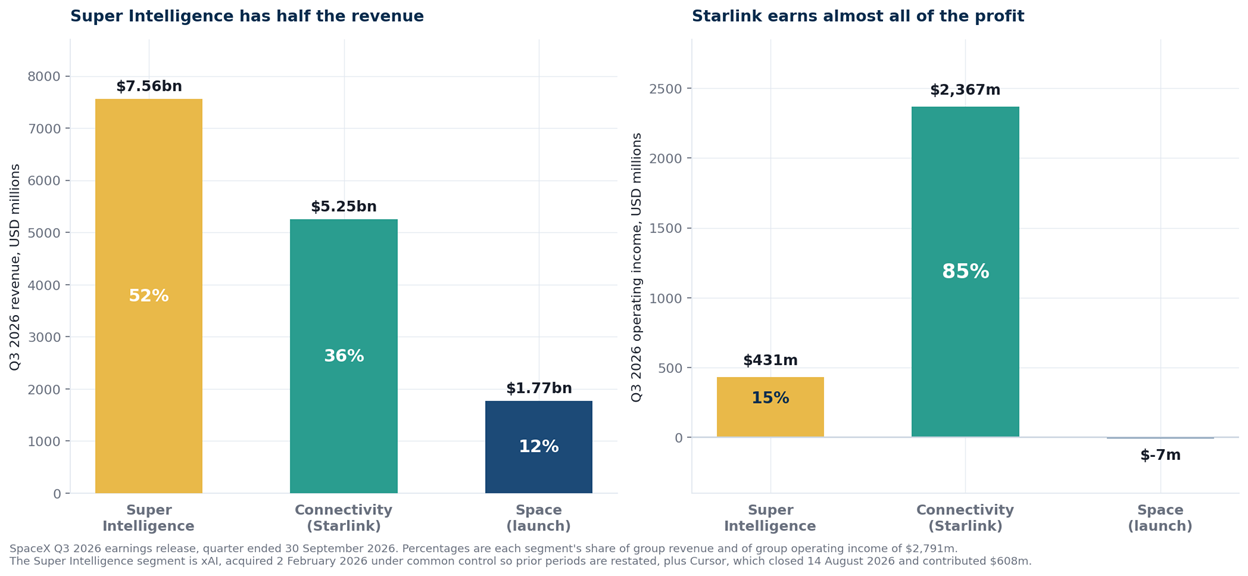
1. On reported figures Starlink produced 85% of group operating income from 36% of revenue. Adjust for a single accounting item and that share drops to about 59%.
2. The item is $1.22bn of acquisition-related stock compensation, all of it charged to the AI segment. Add it back and Super Intelligence earned roughly $1.65bn on $7.56bn of revenue, a 21.8% margin rather than the 5.7% the headline shows.
3. Capital spending was $19.59bn against $14.58bn of revenue, and fourth-quarter guidance is $35bn to $40bn.
4. Over 9 months the company has burned roughly $35bn of free cash flow, by my arithmetic from its own statements.
5. The AI segment is xAI, acquired in February under common-control accounting, plus Cursor, bought in August. Historical figures include xAI and X; Cursor contributes only from its August acquisition.
Where the Profit Came From
The headline growth rate is real. The mix underneath it needs 2 adjustments.
Starlink earned $2.37bn of operating income, up 99%, on $5.25bn of revenue. A 45% operating margin on satellite broadband is a remarkable business, and on reported numbers it accounts for almost all of the group’s profit. Subscribers reached 13.6m from 7.2m, though revenue per user fell to $69 a month from $83, which is what happens when growth comes from cheaper markets.
Super Intelligence looks far weaker: $7.56bn of revenue for $431m of operating income, a 5.7% margin. That figure needs context. It carries $1.22bn of acquisition-related stock compensation, all of which lands in this segment. Add it back and the segment earned about $1.65bn, a 21.8% margin, and the group’s profit split moves from roughly 85/15 in Starlink’s favor to nearer 59/41.
Both numbers are worth holding. The compensation is a genuine cost that shareholders bear through dilution, and because the awards are tied to continued service it will recur across the vesting period rather than clearing next quarter. Equally, a business earning 21.8% before that charge is not the marginal operation the reported 5.7% implies.
The space division grew revenue 6% to $1.77bn and lost $7m against a $259m profit a year ago. That line also understates the work: SpaceX flew 23 internal launches in the quarter carrying its own satellites, while segment revenue reflects external customers.
What It Cost
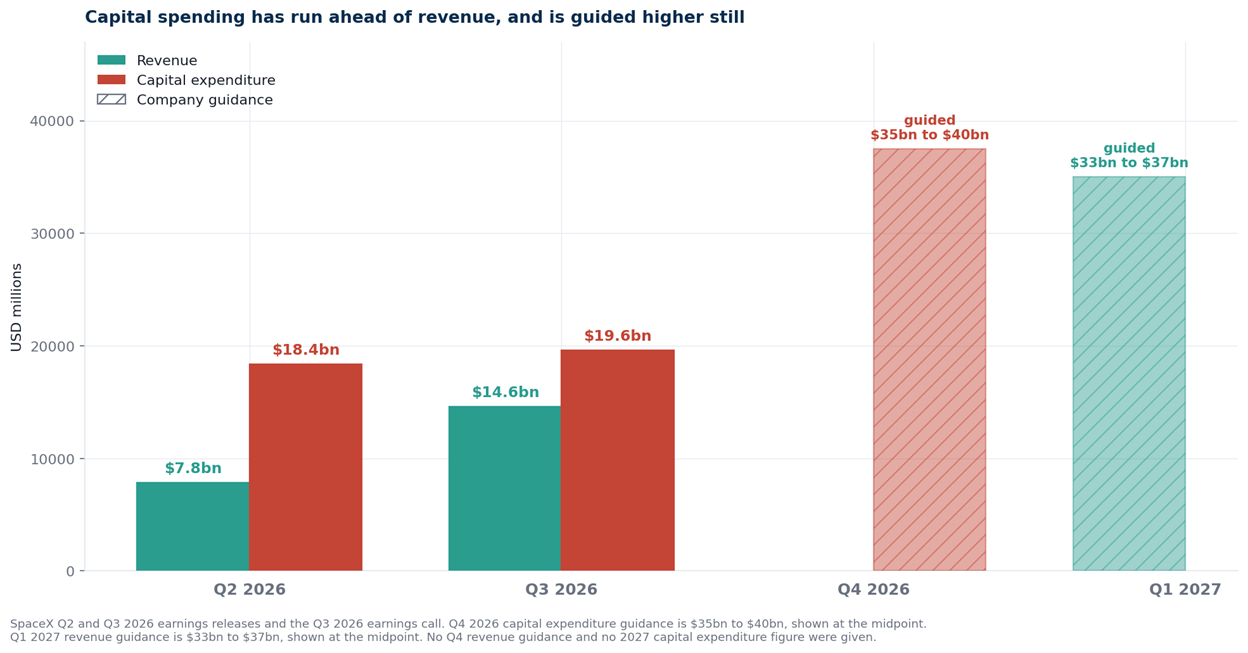
SpaceX spent $19.59bn on capital expenditure in the quarter, 134% of revenue. The prior quarter was $18.37bn on revenue of $7.81bn, with $15.83bn of that going into AI alone. Across 9 months the company generated $13.1bn of operating cash against $48.1bn of property and equipment purchases, which is roughly $35bn of negative free cash flow. There’s no free cash flow line in the release, so that’s my calculation.
Then the guidance: fourth-quarter capital spending of $35bn to $40bn. The prospectus put capital spending for all of 2025 at about $20.7bn, so the company plans to spend roughly twice its entire prior-year program in 3 months.
The bull case answers this directly. If first-quarter 2027 revenue lands at $33bn to $37bn, the company will be running at well over $130bn annualized, and spending $40bn a quarter against that is a defensible rate of investment. Management also reported rising prices on contract renewals and says it remains on track for $100bn of annual recurring revenue measured off December’s run rate. The spending and the guidance are the same bet, made twice.
It can be funded for now. Cash and securities stood at $89.9bn at the end of September against $38.8bn of debt and leases, leaving near $51bn of net cash, most of it raised in June. The finance chief described the funding order as operating cash flow first, then debt markets, helped by an investment-grade rating. At the current burn that cushion is measured in quarters rather than years, which is why the revenue ramp has to arrive roughly on schedule.
Where the AI Segment Came From
Super Intelligence is xAI. SpaceX acquired X.AI Holdings on 2 February 2026, and because Musk controlled both sides it was treated as a transaction between entities under common control, so prior periods are restated as though the businesses had always been combined. xAI had itself absorbed X on the same basis in March 2025. Cursor followed in August.
The restatement makes the comparison a fair one: the $813m the segment earned a year ago already includes xAI. Cursor added $608m this quarter, so excluding it the segment still grew about 755% rather than the reported 830%. Either way the growth is extraordinary and not an accounting artifact.
What the restatement doesn’t erase is that this segment arrived by merger, and arrived losing money: the restated 2025 accounts show it losing about $6.4bn at the operating line against a consolidated operating loss near $2.6bn. A year later it makes $1.65bn before the acquisition charge. That’s a fast turn by any standard, and it’s the single most impressive thing in the quarter.
What Super Intelligence Sells
The segment is broader than the compute story suggests. Advertising contributed $538m, with solutions and infrastructure making up the other $7.02bn, and Grok and Cursor sit inside it.
The part that matters for the capital program is third-party compute. Management was explicit that external rentals are priced near spot rates on short-term contracts, with an ambition of roughly half the capacity serving internal workloads. Spot-priced, short-duration compute is the most cyclical revenue in this industry, and it reprices in both directions. Management’s answer is that new deployments pay back in under a year at current pricing, and that renewal prices are rising.
A short asset payback is encouraging, but it isn’t the same as the program funding itself. Whether that works depends on deployment timing, utilization, how much capacity goes to internal use at no external revenue, and whether pricing holds while supply arrives from everybody at once.
Below the Operating Line
Net income of $4.40bn sits $1.61bn above operating income, and it’s worth knowing what that is rather than waving at it.
Net interest contributed $198m, being $873m of interest income against $675m of interest expense. Other income, net, contributed $1.03bn. Income taxes were a $390m benefit rather than a charge. The other income line is the large one and the release doesn’t decompose it, so I’d treat the gap as explained in composition but not in durability.
One other item belongs here. Connectivity’s 55% gross margin included a one-time benefit of roughly 3 points, mainly tariff refunds, and management guided fourth-quarter group gross margins back toward second-quarter levels. Total stock compensation for the quarter was $2.36bn, of which $1.15bn was ordinary and $1.22bn acquisition-related.
What You’re Paying
At $159.31, on roughly 13.6bn shares across the classes, the market value is about $2.16 trillion. That share count is data-provider figure rather than a filed one, since no quarterly report has yet been lodged for the period, and screens quoting a single class will show something nearer $1.2 trillion.
Revenue over the 4 quarters to the end of September comes to about $32.0bn, putting the stock near 67 times sales. The company lost money across those 4 quarters taken together, so a trailing earnings multiple doesn’t exist, and forward multiples on this name vary enough by estimate set that I’d rather not quote one.
The sell side moved in one direction after the results. JPMorgan doubled its target to $500, Cantor Fitzgerald went to $345, Barclays to $300, Wells Fargo to $274, Goldman Sachs to $245, Citi to $240 and TD Cowen to $224. I found no cuts. Published consensus figures still show an average near $255 with a range from $70 to $800, but those contain targets set before the results.
The Price
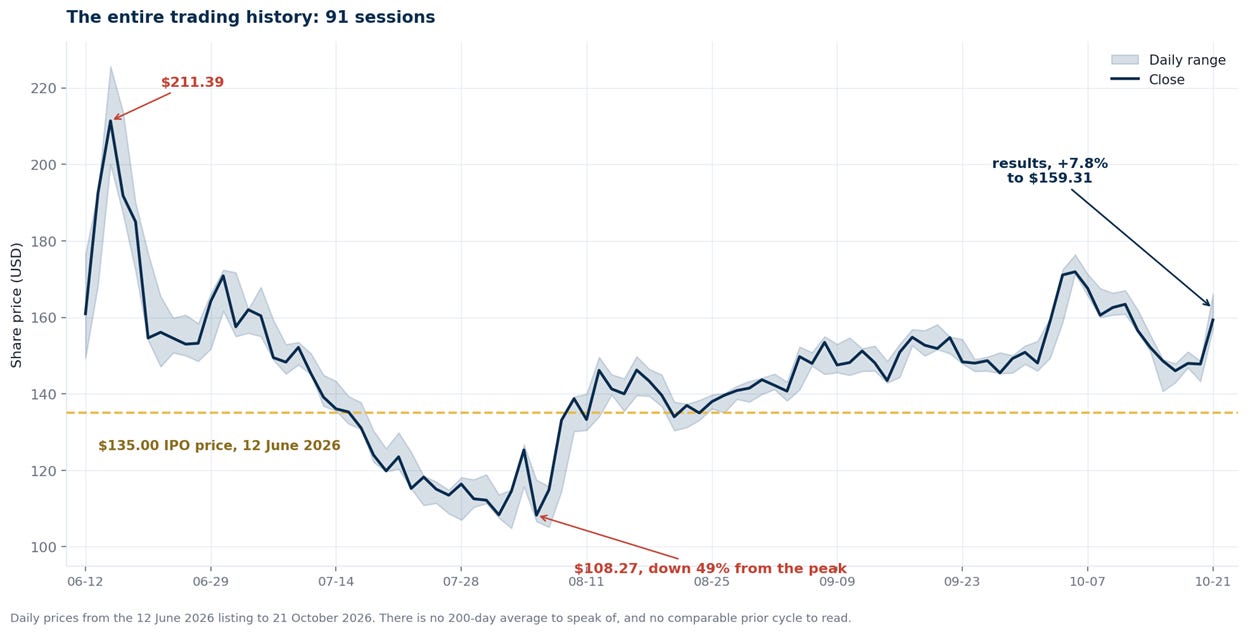
There are 91 trading sessions here. That’s enough for momentum and shorter moving averages, not enough for a 200-day figure, and nowhere near enough for a cycle.
What history there is has been violent. Priced at $135 in June, it closed its first day at $160.95, peaked at $211.39 within days, then fell 49% to $108.27 by early August before recovering. It has spent most of the period since between roughly $135 and $175. Wednesday’s close of $159.31 sits in the middle of that range, 25% below the closing peak.
That gives 3 reference points rather than a technical setup. $135 is the issue price and roughly where August’s base formed. The lowest close is $108.27, with an intraday low of $104.83; the highest close is $211.39, against an intraday high of $225.64. A move toward $140 to $150 is where a risk budget starts to work, a break of $135 puts the August base in question, and a close below $108 would mark a genuine deterioration in the price structure rather than any particular verdict on the spending.
Size it as a capital-intensive cyclical with an extraordinary balance sheet, not as a software company.
Bottom Line
The profitability worry is smaller than the reported segment table suggests. Adjust for the acquisition charge and the AI business earned a 21.8% margin and contributed about 41% of group operating profit, having lost $6.4bn the previous year. That’s a real turn.
The funding question is the one that remains. Spending twice the entire 2025 program in 3 months works if the guided ramp to $33bn to $37bn a quarter arrives roughly on time. It becomes uncomfortable quickly if it doesn’t, and $51bn of net cash does not absorb many disappointments at this burn.
So the thing to watch isn’t whether the AI business can earn. This quarter suggests it can. It’s whether operating cash generation and the financing available behind it can keep pace with the investment, and revenue arriving on time is only the first part of that.
This is research and commentary, not personal investment advice. The author may hold positions in names discussed.
If Super Intelligence earns about 21.8% once the stock comp is added back, does the funding question shrink, or does a $35 to 40bn Q4 capex guide outrun any margin? What burn rate would make you call it too fast?