


SpaceX’s first earnings report as a public company delivered exactly what investors wanted to see: surging revenue, stronger margins, a growing backlog, and an AI business moving toward profitability.
But the harder question is valuation. Even after the post-earnings pullback, SpaceX is still worth roughly $1.5 trillion while spending more than $18 billion a quarter on capex.
With less than 2 months of trading history, the technicals can wait. For now, the real story is whether the fundamentals can grow fast enough to justify the price.
Key Takeaways
Q2 revenue of $7.8 billion grew 92% YoY with all 3 segments growing. Adjusted EBITDA nearly tripled to $3.5 billion and the quarterly net loss narrowed by almost half to $541 million.
AI is the swing factor. Segment revenue rose 247% YoY to $2.6 billion on $14.1 billion of newly contracted cloud compute sales, and segment adjusted EBITDA turned positive at $1.1 billion.
Backlog sits at $47.5 billion, with roughly 56% expected to convert to revenue within 12 months. Management is guiding to a $100 billion annualized revenue run rate by December.
The balance sheet was rebuilt in a single quarter: $85.7 billion of net IPO proceeds, $25 billion of investment-grade notes, $100 billion in cash and securities, no material debt maturities before 2031.
The risks are concentration and capex. 2 customers drove nearly 38% of Q2 revenue, major disclosed cloud agreements include 90-day termination rights, and capital spending is running at $18 billion a quarter.
The Quarter: 3 Businesses, 1 Direction
Consolidated revenue for the quarter ended June 30 came in at $7.81 billion, up 91.9% from $4.07 billion a year earlier (reported). The net loss was $541 million against $1.01 billion in Q2 2025, and adjusted EBITDA of $3.54 billion was up 191%. For the first half, revenue grew 54% to $12.5 billion while the net loss widened to $4.8 billion, but that half-year figure carries a $1.5 billion loss on debt extinguishment from retiring the expensive merger-era debt, a cost of cleaning house rather than of running the business.
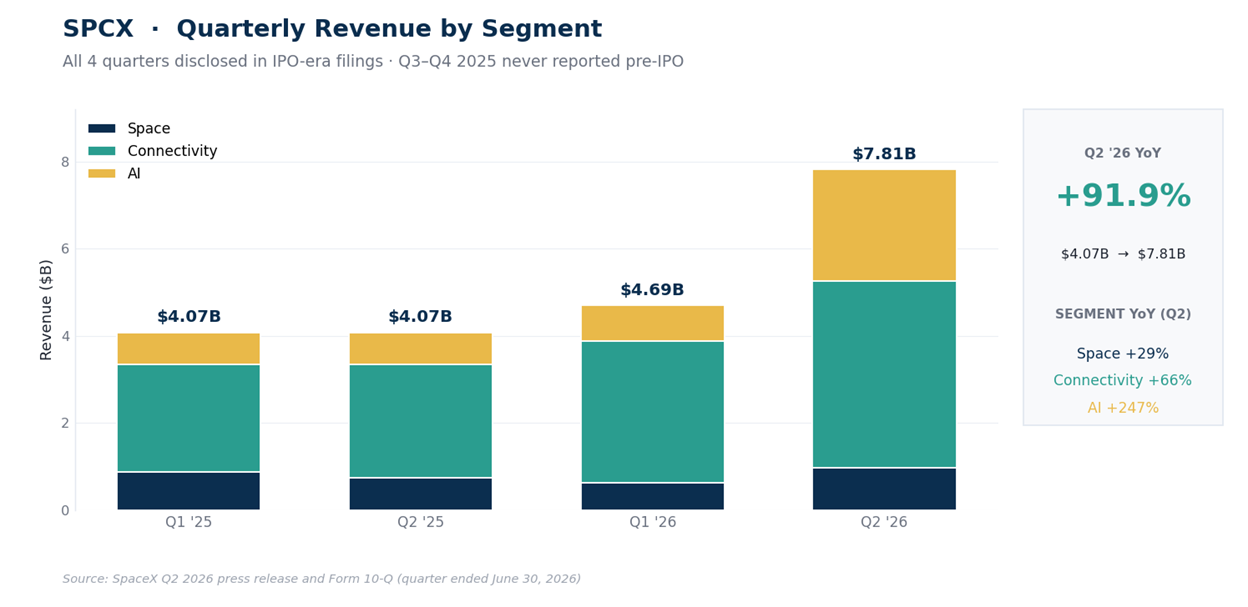
Connectivity is the profitable core. Starlink revenue reached $4.3 billion, up 66% YoY and 32% sequentially. Subscribers doubled YoY to 12.0 million, with 1.7 million net additions in the quarter, the best in the company’s history.
ARPU (average revenue per user) held at $66 per month versus Q1, though it’s down from $85 a year ago as international expansion and cheaper plans dilute the blend. The interesting move is upstream: enterprise and government revenue grew 108% YoY to $1.8 billion, with deals signed or rolling out across American, Southwest, Virgin Atlantic, Iberia and Aer Lingus, and more than $6 billion in multi-year U.S. government Starshield awards, primarily from 2 major Space Force programs. Segment operating income rose 79% to $1.7 billion, expanding margins by nearly 3 points, and segment adjusted EBITDA hit $2.6 billion. This is the cash engine that pays for everything else.
AI is the growth engine. Revenue of $2.6 billion was up 247% YoY and 213% sequentially, driven by new Cloud Services Agreements at the Colossus data centers, contracts worth $14.1 billion that contributed $1.6 billion of revenue in their first partial quarter.
Grok and X subscriptions added $258 million of YoY growth; advertising slipped to $367 million from $426 million during an ad-system overhaul. The operating loss narrowed 49% sequentially to $1.3 billion, and segment adjusted EBITDA flipped positive at $1.1 billion, versus a $609 million loss just a quarter earlier. Hold that number loosely: with $15.8 billion a quarter going into GPUs, depreciation follows with a lag, so operating income is the more conservative scoreboard here than adjusted EBITDA.
Installed compute reached 1.4 gigawatts of nameplate draw, up from 0.4 a year ago, with management targeting more than 2 gigawatts by year-end and, per Musk on the call, closer to 10 gigawatts than 5 by the end of 2027, built exclusively on NVIDIA hardware. The $60 billion all-stock Cursor acquisition is expected to close this quarter.
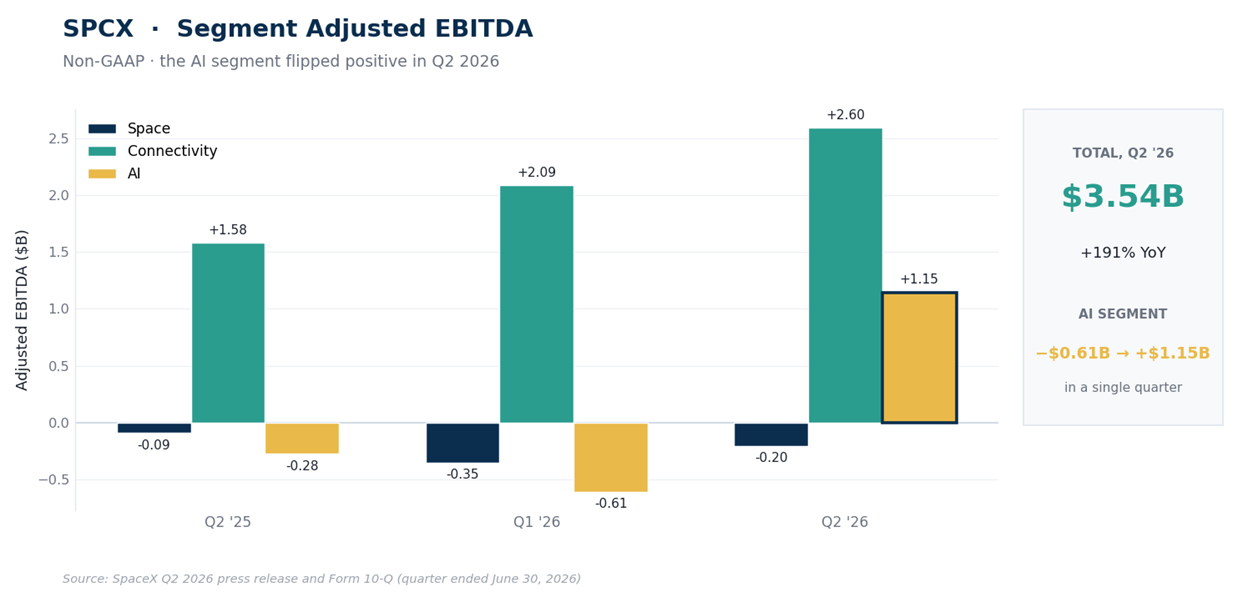
Space is the smallest segment by revenue and the point of the whole enterprise. Revenue of $962 million grew 29% YoY on 10 customer launches, while the operating loss widened to $542 million as segment R&D, which is mostly Starship, climbed to $1.1 billion for the quarter.
The company flew 78 missions and delivered 1,041 metric tons to orbit in the first half, most of it internal Starlink deployment that produces no segment revenue at all. The 2 successful Starship V3 flights matter more than the P&L here: Musk now calls the heatshield problem solved (his assessment, not yet an independently established fact) and a catch attempt of the ship itself could come as early as this month. Space loses money on paper partly because it’s the delivery mechanism for the other 2 segments.
Now the order book.
Backlog, Contracts, and the Run Rate Math
Backlog stood at $47.5 billion at quarter-end, of which $14.3 billion already sits on the balance sheet as deferred revenue. The conversion schedule is front-loaded: roughly 56% is expected to become revenue within a year, 34% between years 1 and 3, and 10% after that. Note the definition: backlog represents amounts under enforceable customer agreements, subject to the company’s stated exclusions, including optional purchases and constrained variable consideration.
The contract flow behind it was dense even by this company’s standards. Beyond the $14.1 billion of cloud compute sales and the $6 billion of Starshield awards, the FCC approved the EchoStar spectrum transfer, 65 MHz that anchors the Starlink Mobile build-out, for total consideration of about $19.6 billion, mostly in stock. On the call, Shotwell framed the mobile ambition against a roughly $600 billion U.S. wireless market dominated by the Big 3 carriers, with satellite service targeted for the end of next year. And in the first weeks of Q3, SpaceX contracted an additional $6.7 billion of cloud services revenue over a 6-month term that begins ramping in October, deals management says pay back their compute capital in under a year.
That’s the bridge to the headline claim: a $100 billion annualized revenue run rate by December, measured as December’s revenue times 12. To be clear, that’s guidance, not a reported number, and it’s aggressive.
Q2 revenue implies a monthly pace around $2.6 billion; the $100 billion run rate needs roughly $8.3 billion a month, more than triple, inside 6 months. The components are at least identifiable: the Google and Anthropic compute ramps starting this quarter and next, the new $6.7 billion of agreements, Cursor consolidating into the numbers, and the Starlink subscriber machine compounding underneath.
Musk went further and said the internal projection for $1 trillion in annual revenue has moved up from 2031 to 2030. I’d file that second claim under ambition rather than modeling input, but the December checkpoint is near-term, specific, and falsifiable. That makes it the most useful thing management said all quarter.
The money to attempt all this is real.
Balance Sheet: From Strained to Fortress in 90 Days
It’s easy to forget how stretched this company was in March: a $20 billion bridge loan, legacy X term loans, xAI notes coupon-ed at 12.5%, and a technical covenant default (waived) triggered by the xAI merger debt. One quarter later the picture is unrecognizable. The IPO raised $85.7 billion net.
