


In a Nutshell (TL;DR)
TGT 0.00%↑ posted Q2 results showing improving traffic and digital momentum but still battling weak comps, falling margins, and EPS compression. Fundamentals suggest stabilization, not recovery yet. Technically, the stock sits at a critical level near $98 with Elliott Wave counts pointing to further downside before a sustainable reversal.
Short-term = caution. Long-term = patience + selective accumulation.
Introduction
TGT 0.00%↑ ‘s second quarter results reflected incremental progress in stabilizing the business but underscored the ongoing challenges facing the retailer. Net sales of $25.2 billion declined 0.9% YoY, representing a nearly 2% improvement over Q1. Traffic and sales trends showed meaningful recovery, particularly in physical stores.
Digital comparable sales grew 4.3%, supported by more than 25% growth in same-day delivery services. Non-merchandise revenue streams, including advertising, memberships, and marketplace, delivered 14.2% growth, highlighting the benefits of diversification. Expense discipline and efficiency gains allowed Target to deliver diluted EPS of $2.05, down from $2.57 a year ago but ahead of expectations given continued tariff-related and cost pressures.
These results arrive during a critical leadership transition. After 11 years as CEO, Brian Cornell will step down in February 2026, with long-time executive Michael Fiddelke named as his successor. While Cornell emphasized progress in store traffic, digital adoption, and cost management, investor sentiment turned cautious following the announcement, as many had hoped for external leadership to reset strategy after several years of inconsistent sales performance.
The market’s reaction reflected skepticism over whether an internal appointment can accelerate a sustainable turnaround. Fiddelke’s operational experience and stated priorities (revitalizing merchandising authority, improving store execution, and investing in technology) will be tested immediately as Target enters the pivotal back-to-school and holiday periods.
Fundamental Snapshot
Q2 2025 Results
Revenue: $25.2B (–0.9% YoY)
Comparable sales: –1.9% (stores –3.2%, digital +4.3%)
EPS: $2.05 vs. $2.57 (–20% YoY)
Operating income: $1.3B (–19.4% YoY), margin 5.2% vs. 6.4%
Gross margin: 29.0% vs. 30.0% LY → hit by markdowns, mix, and cancellations.
Category trends:
Weak: Apparel, Home, Household essentials.
Stable/Strong: Food & Beverage, Hardlines, Digital, and non-merch revenues (ads, memberships, marketplace) +14%.
Cash flow:
Operating cash flow down to $2.36B (from $3.34B last year).
Capex elevated at $1.9B, focus on remodels + omnichannel.
Free cash flow TTM: $3.5B (slightly softer).
Dividend paid $509M; no buybacks this quarter despite $8.4B capacity.
Balance sheet:
Cash: $4.3B.
Debt: $16.5B (slightly up YoY).
ROIC: 14.3% vs. 16.6% LY.
Guidance:
FY25 GAAP EPS $8–10; Adjusted $7–9.
Low single-digit sales decline expected.
Target is stabilizing, not growing. Digital + advertising are bright spots, but discretionary weakness and margin compression weigh heavily. With a new CEO taking over, execution during the holiday quarter is make-or-break.
Technical Snapshot
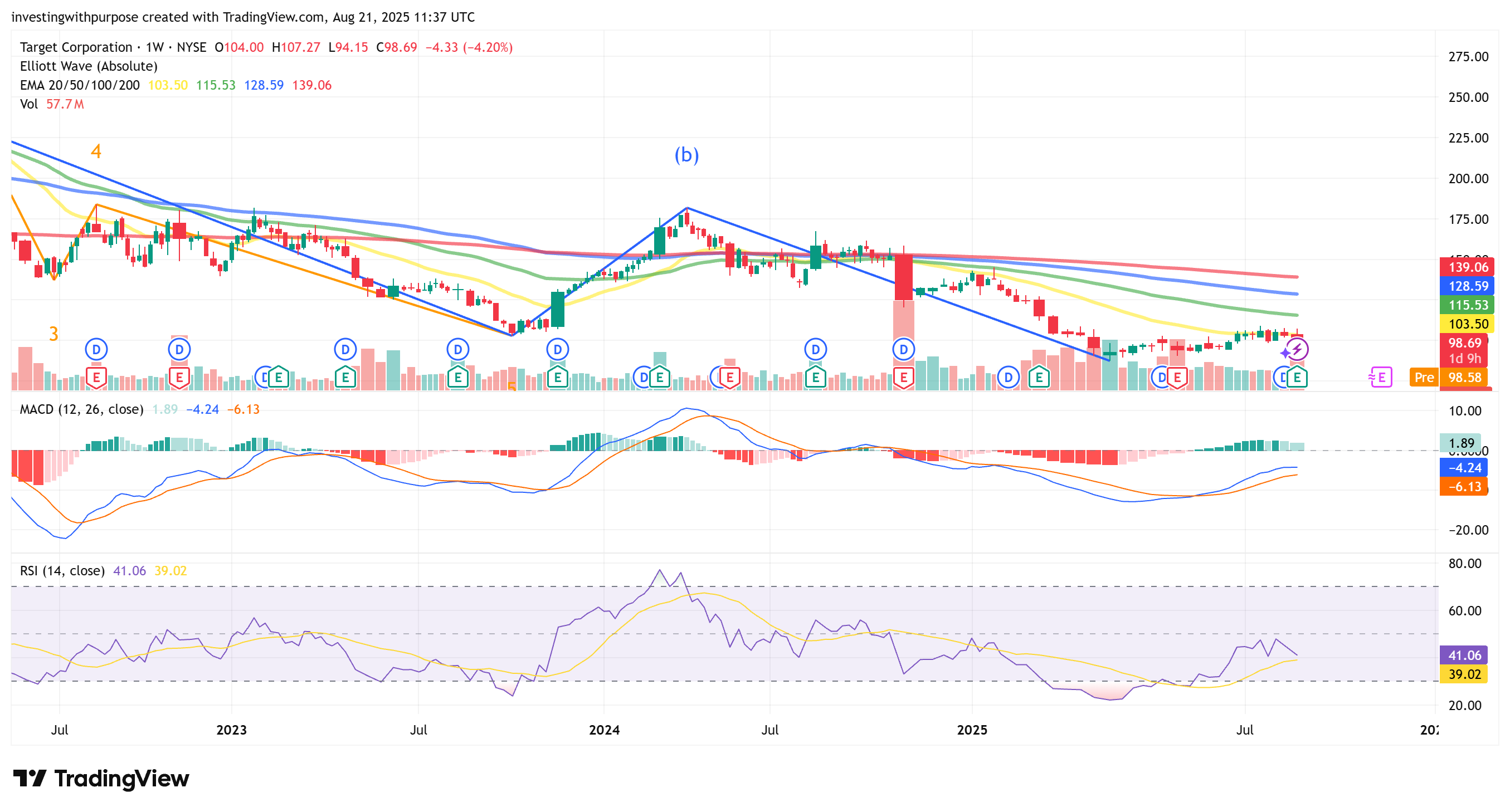
Weekly Chart (Big Picture)
Clear multi-year downtrend from 2021 highs ($260 to ~$98).
Elliott Wave count shows a completed ABC corrective structure, but recent action suggests a possible lower leg (wave (c)) forming.
RSI at 41 = bearish momentum, not oversold.
MACD negative, confirming ongoing weakness.
Resistance levels: $115–128 (EMA 50/100 weekly).
Support levels: $90–94 zone (Fib confluence + wave (c) target).
Daily Chart
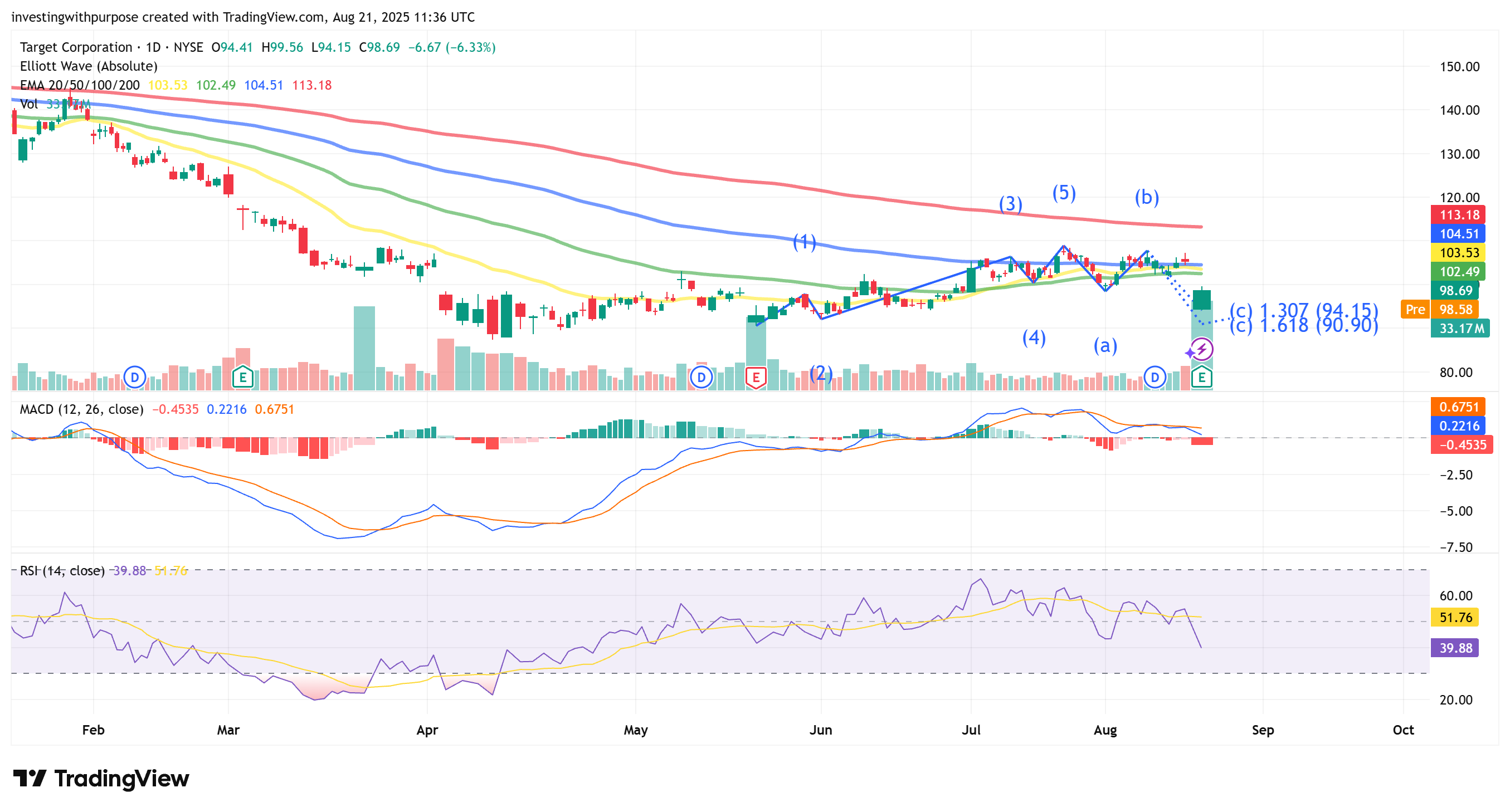
Post-earnings drop to $98 close. Bounced off support but still under all major EMAs (20/50/100/200).
Elliott Wave mapping shows potential decline toward $91–94, aligning with Fib 1.618 extension.
RSI ~40 = neutral-bearish, room to fall.
2H & 30M Charts (Near-Term)
Earnings bounce was sold into, but momentum fading.
MACD barely positive intraday, RSI rebounding off oversold but capped under 50.
Short-term upside limited to $102–104 (EMA cluster).
Breakdown below $98 risks accelerating toward $94.
Conclusion from Charts:
Technicals align with fundamentals, showing short-term pressure likely.
TGT 0.00%↑ has not broken out of its long downtrend.
The risk/reward favors waiting for a retest of low $90s for long entries.
Investment Take
Short-term (0–3 months): Expect more downside volatility, especially if discretionary categories don’t rebound in back-to-school/holiday season. $90–94 is a likely test zone.
Medium-term (6–12 months): Stabilization possible if digital + advertising offset weak discretionary spending.
Long-term (12+ months): Target’s push into memberships, same-day delivery, and advertising (Roundel) could unlock a higher-margin growth model, but execution risk is high.
Not a clear buy here at ~$98.
Best entry looks closer to $90–94.
Upside levels: $115 (first real test), then $128.
Looking Ahead: CEO Transition and Investor Confidence
Target enters the back half of 2025 with both momentum and uncertainty. The encouraging Q2 stabilization shows that the company still commands brand loyalty when execution improves. But investors are focused on whether this recovery is sustainable or merely a short-lived lift ahead of the critical holiday season.
The leadership change amplifies this uncertainty. Brian Cornell is widely credited with reshaping Target over the past decade, modernizing stores, expanding owned brands, and building its omnichannel fulfillment network. His exit marks the end of an era, and the appointment of insider Michael Fiddelke as CEO was met with skepticism on Wall Street.
Fiddelke’s early messaging centers on three priorities: regaining “swagger” in merchandising, elevating the in-store experience, and accelerating technology investment. Each of these is critical, but also execution-heavy. Target’s competitive edge historically came from style, curation, and affordable differentiation, the very qualities eroded by messy stores, weaker assortments, and stretched staffing. Rebuilding that edge will take time, capital, and consumer patience.
From a financial perspective, Target still has levers to pull. The balance sheet remains healthy, cash flow is positive, and cost discipline has cushioned EPS against top-line weakness. But investors will want evidence of sustainable comp growth and margin expansion before rewarding the stock with multiple expansion. Guidance of $7–9 adjusted EPS implies some recovery, yet it falls short of the consistency that WMT 0.00%↑ and TJX 0.00%↑ have delivered in the same environment.
The next 12 months, spanning back-to-school, holiday, and early execution under Fiddelke, will define whether TGT 0.00%↑ regains its “Tarjay” magic or risks sliding further into mid-tier retail anonymity. For now, the stock trades in a zone of wait-and-see, with long-term investors needing confidence in both leadership and consumer response before committing fresh capital.
Conclusion
TGT 0.00%↑ Q2 showed hints of recovery but reality is this: EPS down 20%, comps still negative, and cash flows softer. The digital + non-merch story is encouraging, but it won’t outweigh a sluggish core retail backdrop yet.
Technicals back this up. The stock is in a multi-year corrective phase, with another leg lower likely before any real reversal.
Patience wins here. Long-term investors should watch for a buying setup in the low $90s. Short-term traders: caution until $103+ is reclaimed.
The information in this post is for educational and informational purposes only. It reflects the author’s personal research and analysis, which may be subject to error or omission. This is not financial, investment, or trading advice. Always conduct your own due diligence and consult with a qualified financial advisor before making any investment or trading decisions.