


The cars improved, by about half as much as it looks. Energy is worse. The spending is the story.
Tesla reported third-quarter results after the close on Wednesday. Revenue was $28.05bn against $28.10bn a year earlier, so flat. Operating income fell 56% to $718m, and earnings came in at $0.22 a share reported and $0.48 adjusted, against $0.39 and $0.50.
The stock had run 8.9% in the 3 sessions into the print, closing Wednesday at $386.47. It gapped lower on Thursday, recovered above the prior close intraday, then finished at $374.58 on about 1.4 times its 20-day average volume. Friday took it to $372.22, down 3.7% since the numbers landed and still up 5% on the Friday before.
5 Things Worth Knowing
1. The quarter carries 4 adjustments disclosed in the 10-Q. Together they cut gross profit by $28m, so they very nearly cancel.
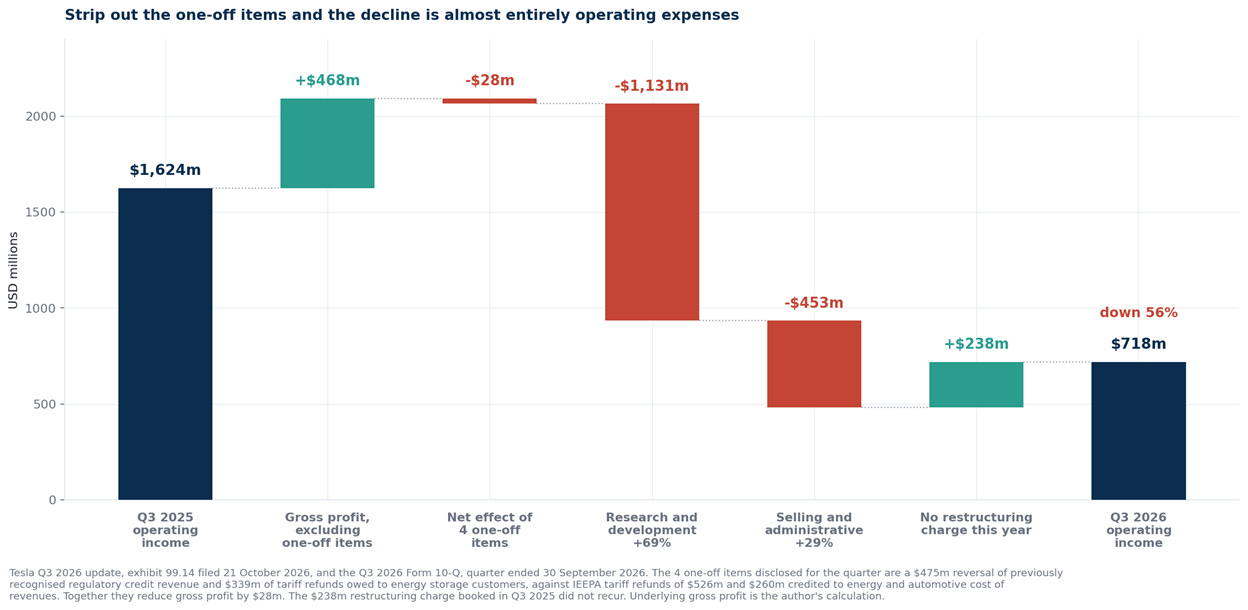
2. Operating expenses rose 39% to $4.78bn, with research and development up 69%. Excluding those adjustments, gross profit rose $468m and spending outran it by $878m.
3. Automotive gross margin excluding credits rose to 18.1% from 15.4%, but a $260m tariff refund sits inside it. Take that out and the gain is roughly half as large.
4. Energy looks better than it is. Adjusted for refunds in both directions, segment gross profit fell 29%, not 11%.
5. Tesla holds a SpaceX stake worth $2.87bn, and both companies announced special committees on 20 October to evaluate a combination.
Where the Operating Profit Went
Operating profit fell $906m, from $1,624m to $718m. Almost all of it is spending.
Start with what shouldn’t be read as normal trading. Tesla reversed $475m of previously recognised regulatory credit revenue, for the contractual return of credits it had already delivered, and booked $339m against energy revenue for refunds owed to storage customers. Against those, February’s Supreme Court ruling invalidating tariffs imposed under the International Emergency Economic Powers Act let it recognise refunds of $526m and $260m as reductions to energy and automotive cost of revenues.
Net those 4 and gross profit is $28m lighter. The credit reversal everybody noticed is more than offset by tariff money nobody did, and only the first of them appears in the earnings deck.
Which makes the underlying picture simple. Gross profit excluding all 4 rose about $468m, or 9%, on flat revenue. Research and development went from $1,630m to $2,761m, selling and administrative from $1,562m to $2,015m, and a $238m restructuring charge from a year ago didn’t repeat, netting to $1,346m more spending. Costs outran the gross profit improvement by $878m. Adjusted the same way, operating income still fell 54%.
The finance chief, Vaibhav Taneja, attributed the increase mainly to research: artificial intelligence computing depreciation, chip development, and pre-production work on Optimus, the Megapack 3 and the Semi. “This trend of growing OpEx would continue till we commercialize these new products.”
What the Cars Did
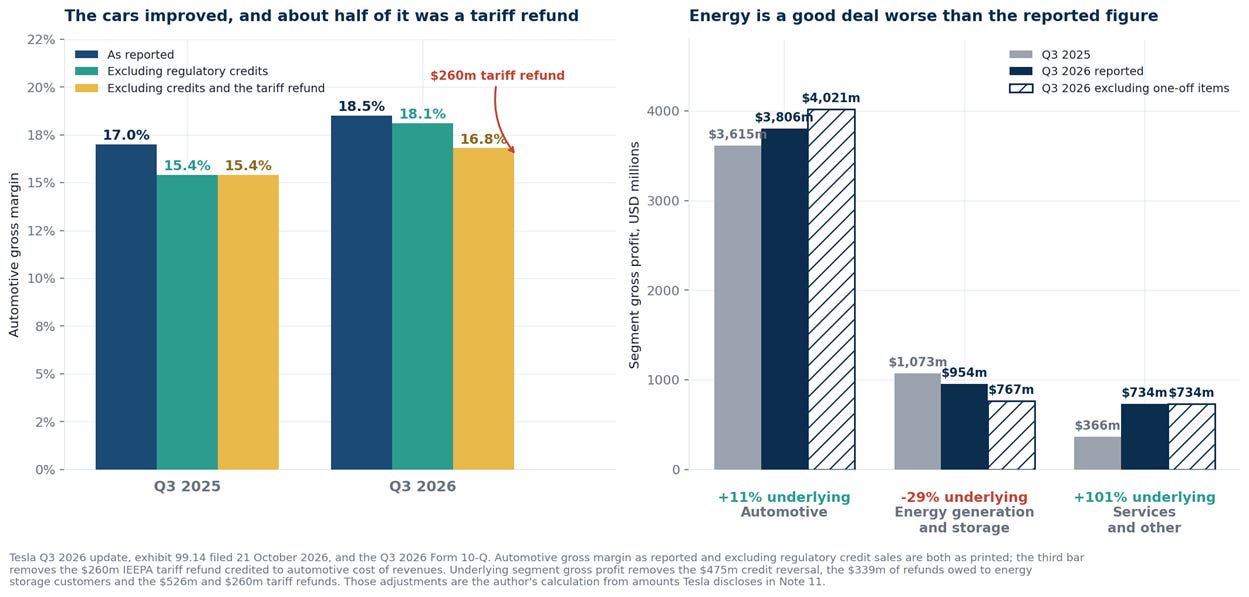
Automotive gross margin excluding regulatory credit sales rose 270 basis points to 18.1%. That strips credits out of both years, so the reversal doesn’t touch it.
It flatters things. Tesla attributes the fall in automotive cost of revenue to lower deliveries, a lower average cost per unit from sales mix and “a favorable impact from tariff refunds,” which is the $260m. Remove it and the same margin is about 16.8%, so the gain is nearer 140 basis points than 270, roughly half the size advertised.
Deliveries were 486,532, down 2% against the hardest comparison the company has: last year’s record 497,099, inflated by buyers claiming a $7,500 federal credit before it expired at the end of September 2025. With production up 4%, that’s better than it looks.
Services and other is the quiet one, and the only segment with nothing to adjust: revenue up 33% to $4.61bn and gross profit doubled to $734m. Self-driving software isn’t in it, since Tesla books that within automotive, where active FSD arrangements reached 1.74m from 1.04m, a count that mixes upfront purchases with subscriptions rather than 1.74m recurring subscribers.
Energy Is the Problem
The reported energy numbers are the least informative here. Revenue fell 16% to $2.88bn and segment gross profit fell 11% to $954m, which reads as a soft quarter with a resilient margin. Taneja said energy gross margin improved from 20.4% to 33.1%, a sequential comparison, and credited tariff refunds and warranty true-downs.
Put both tariff items back and it changes. Adding the $339m owed to customers to revenue and the $526m refund to cost leaves underlying gross profit near $767m on $3.22bn of revenue, a margin around 23.8% against 31.4% a year ago, so segment profit fell 29%. Deployments did rise, to 13.7 GWh from 12.5 GWh, against a “highest-ever order rate and backlog,” which makes this pricing rather than demand. The filing warns the tariff regime hits energy harder than automotive.
What Sits Below the Operating Line
Net income of $787m exceeds operating income, and the reasons matter. Pre-tax income fell 51%, from $1,959m to $956m, while the tax charge fell from $570m to $152m, taking the effective rate from 29.1% to 15.9%. That’s most of why net income fell 43% rather than in line with the operating decline, and it isn’t repeatable on demand.
Non-GAAP net income of $1,697m is 2.2 times the reported figure, and $982m of that gap is stock pay added back after tax, on gross stock compensation of $1,165m against $663m. Share-based pay above operating profit means the adjusted number deserves less weight, not more.
The Spending
Capital expenditure was $4,732m against $2,248m, more than double in a year, and still well short of the roughly $7.5bn analysts had modelled. Tesla cut full-year guidance to about $20bn from the more than $25bn indicated earlier in the year. Musk’s gloss: “I think our CapEx is actually ending up being a little lower than we anticipated.”
Both are true at once: Tesla is spending far more than last year and meaningfully less than it promised. Whether that’s efficiency, timing or a slower build-out isn’t settled here, and Taneja said spending “for the next few years would continue to expand.”
Operating cash flow was flat at $6,263m, so free cash flow fell 62% to $1,531m. With $45.4bn of cash and short-term investments and $30bn of untouched new borrowing capacity, funding isn’t the constraint.
The Dates, and the Record
Robotaxi isn’t hypothetical any more. Tesla began Cybercab rides in Austin on 3 September, cumulative unsupervised miles grew eightfold to nearly 2 million, and the service runs 6am to midnight. Customer cars are separate: FSD still ships supervised.
On scale, Taneja said robotaxi “would become a significant part of our revenue and profitability in 2027,” with a cost target of $0.30 a mile they haven’t reached. Musk said it starts “to become noticeable probably in Q2 and then probably a big deal by Q3 or Q4 of next year,” and expects the robot’s engineering solved “around the end of next year,” when outside customers start receiving units.
Those dates are specific and falsifiable, which is worth something. Musk has also been promising autonomy on a schedule since 2019, and the distance from a supervised feature to a driverless fleet took far longer than he said. Nothing here changes the base rate.
The SpaceX Question
Both companies announced special committees on 20 October to evaluate a combination. Musk declined to go further on Tesla’s call the next day: “I think I said everything that should be said yesterday, tap dancing through a minefield there.” No terms have been agreed, the filings describe possible arrangements rather than a transaction, and the 3 December annual meeting agenda carries no merger proposal.
Tesla already owns SpaceX stock: a $2.87bn position at the end of September, bought for $2.0bn, carrying an $863m gain over 9 months and a $142m loss in the quarter. Approval would need 50% of all shares outstanding rather than a majority of those voting, which Musk called “quite a high hurdle.” JPMorgan expects an all-stock structure and gets Tesla near $500 on a premium case, a broker’s assumption rather than a disclosed term.
A holder at $372 is partly underwriting a deal with no agreed terms, an unusual voting threshold and a currency that listed 4 months ago.
What You’re Paying
At Friday’s close of $372.22, with 3.95bn shares out, the market value is $1.47 trillion. Trailing earnings over the 4 quarters to September come to $0.91 a share, putting the stock on 409 times earnings on contiguous, current quarters. Forward earnings of $2.16 give 172 times.
A 2.6% operating margin on flat revenue supports none of that. The price requires substantial earnings from businesses that barely generate revenue today, which is a different proposition from owning a carmaker on a high multiple.
The sell side didn’t resolve it. Piper Sandler went to $475 from $450 and Canaccord Genuity to $442 from $410, while Goldman Sachs held $360 and Truist $370, both below Friday’s price. The average sits at $407, and Hold is now the majority rating at 23 of 43.
