


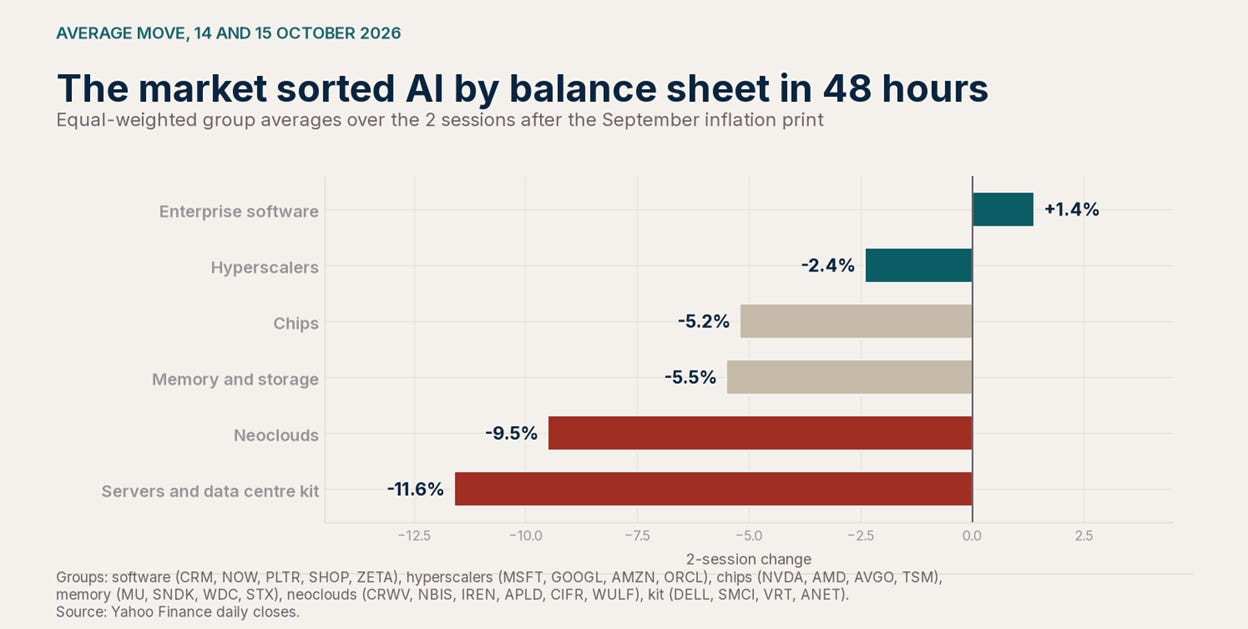
Over the last 2 days, enterprise software finished up 1.4%. Hyperscalers lost 2.4%. Chips lost 5.2%, memory 5.5%. The neoclouds dropped 9.5%, and the companies that build the data centers lost 11.6%.
It doesn’t seem like today will be different.
This breakdown goes from companies that sell AI as software to companies that must raise money, buy hardware and build something physical before they can sell anything at all.
ServiceNow NOW 0.00%↑ rose 7.2% across those 2 days. Salesforce CRM 0.00%↑ rose 3.7%. DELL 0.00%↑ fell 17.3%.
All sell enterprise AI. The difference is that 2 of them deliver it over a network they already own, and the third has to buy memory, assemble servers and ship them.
Note that AI demand didn’t change. Backlog is still strong. But the cost of funding changed dramatically, which led to a massive repricing.

Key Takeaways
The funding window started closing in the summer when AI-related corporate debt issuance fell from $113B in June to $23B in September, roughly 80% in a quarter
The selloff was mainly targeting balance sheet issues, not commercial. Enterprise software rose 1.4% over the 2 sessions while the companies building data centers fell 11.6%. Both sell AI. Only one has to borrow to deliver it.
CoreWeave paid $640M of interest last quarter against $128M of adjusted operating income. A quarter of all revenue leaves as interest, and its 2031 bond now yields 15.78%.
Part of what looks like AI demand is cost inflation. Barclays cut Dell’s target arguing its enterprise revenue reflects increases in memory prices more than enterprise AI adoption.
Gartner prices the funding gap around $4.9 trillion. The buildout needs about $8.5 trillion of revenue through 2030 to justify what has been announced, against a forecast of $3.6 trillion.
The Credit Signal
It turns out that the bond market still reacts before the stock market.
CoreWeave CRWV 0.00%↑, for example, perfectly shows this. It rents out GPU capacity on multi-year contracts, and it has borrowed enormously to build that capacity.
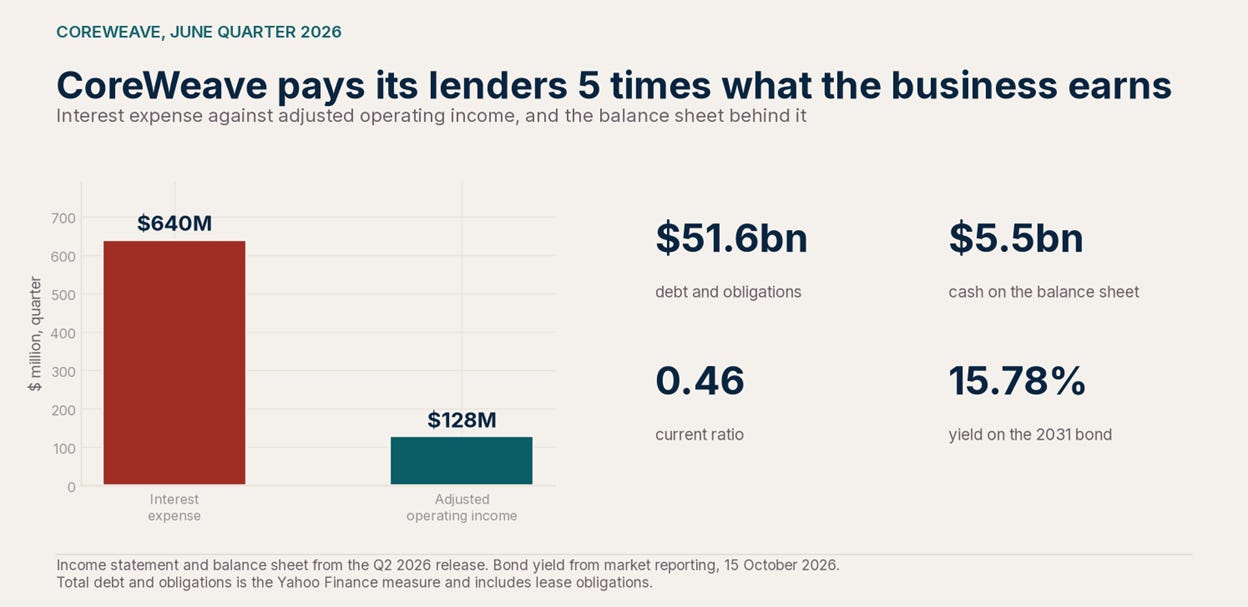
Before even getting to credit spreads, the income statement clearly shows the problem. Last quarter, CoreWeave made $128M adjusted operating income. It paid $640M of interest. That’s 5x.
On the balance sheet, total debt and obligations run to $51.61B against $5.54B of cash. The current ratio is 0.46, which means it holds less than half the short-term assets it would need to cover short-term liabilities. That is survivable only while the company can keep raising money (which it has done repeatedly, and well).
But this week, the debt terms got worse. The 9.75% bond maturing in 2031 traded at a yield of 15.78%, with the bonds sold below 80% of value. The 5-year credit default swaps, went aboe 1,140 BP on S&P Global Market Intelligence data, up 177% in a year. Above 1,000 is conventionally read as distress.
This doesn’t necessarily mean that CoreWeave will default. But it does increase the odds.
Credit markets price probabilities and they get them wrong often enough. But the next round of fundings they do will probably be more expensive than the last one, and for a company dependent on fundings this could be a game changer.
Equity analysts have barely adjusted, for what it’s worth. The average target still sits at $140.58, roughly double the share price.
Dell’s Memory Problem
Dell was the single worst performer in the whole complex, down 17.3% across the 2 days, and its reason deserves separating out because it isn’t about rates at all.
Barclays cut the stock to Equal Weight on Wednesday. The argument, from analyst Tim Long, was that Dell’s strong enterprise revenue is “more of a function of memory costs than a move to enterprise AI at this time.”
At the end of the day, memory prices have been rising. If Dell passes those costs through to customers, revenue goes up.
Operating margins on Dell’s AI server business run near 5%, which is pretty tight when your hardware costs are growing as fast as your revenues. HP 0.00%↑ got cut the same day.
So inflation hit this sector twice in one session. Once through the rate path, which raised the cost of building. And once inside the revenue line of the companies selling the equipment, where it had been flattering growth that looked like demand.
The Funding Window
None of this started on Wednesday. The money had been getting harder to raise for months.
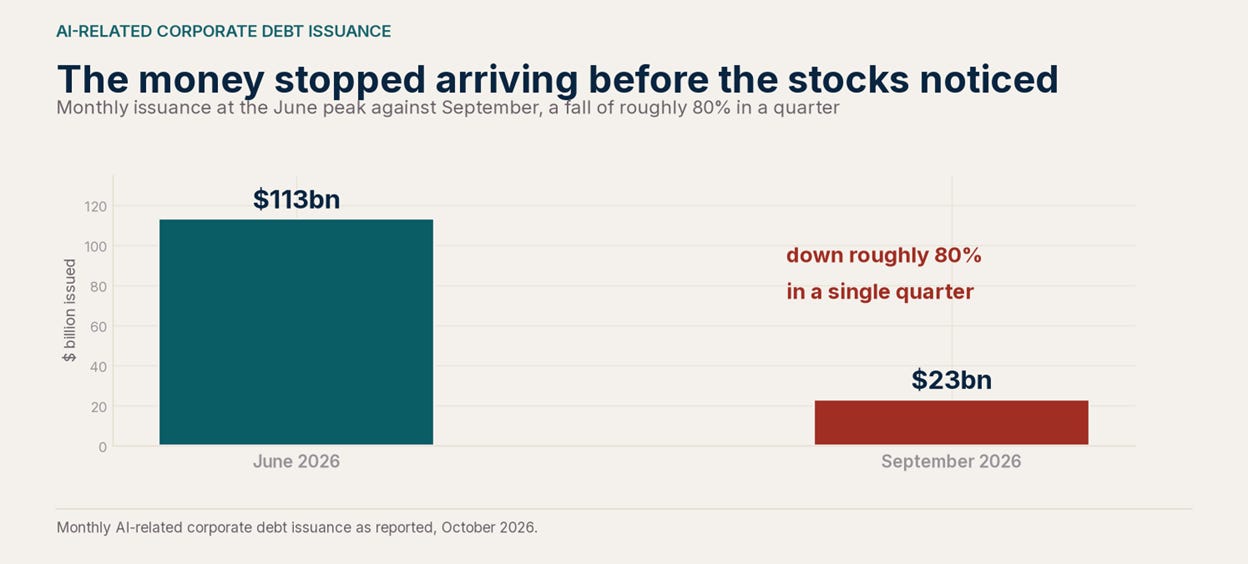
In June 2026, AI companies’ corporate debt issuance was $113 B. In September, that had dropped to $23B.
That’s a drop of around 80% in a quarter, and it happened before inflation numbers even came out. And before anyone was talking about CoreWeave’s bonds.
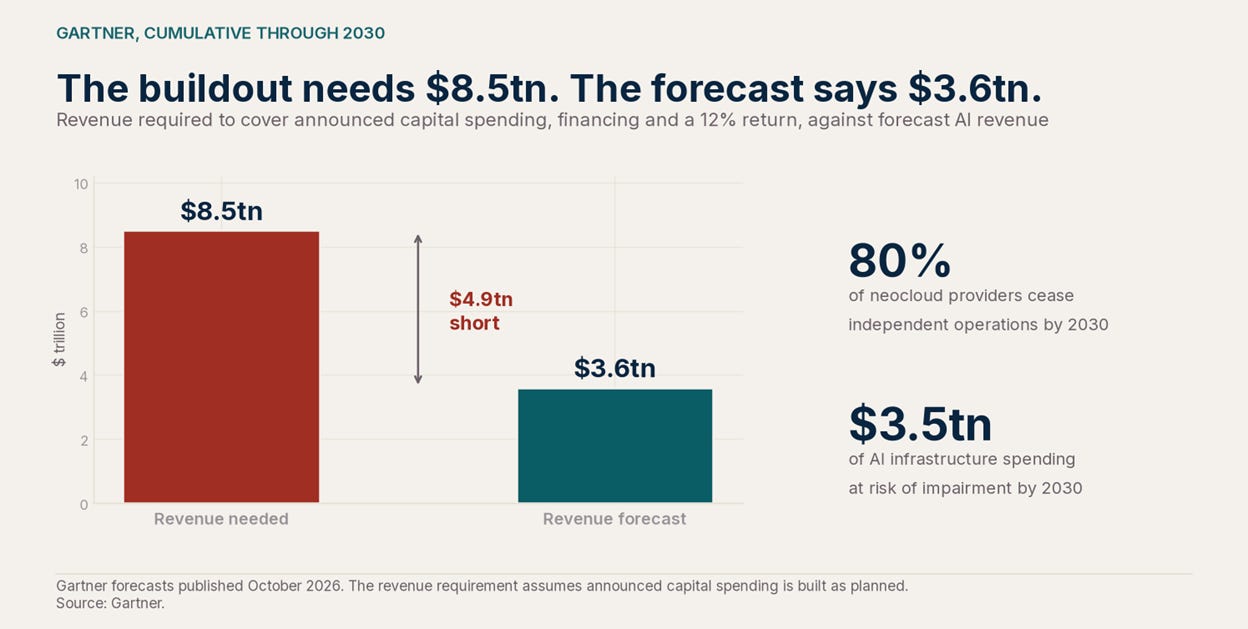
The gap is about $4.9 trillion. Gartner’s conclusions follow from it: more than $3.5 trillion of infrastructure spending ending up impaired, and 80% of neocloud providers no longer operating independently by 2030.
Treat 5-year forecasts with the suspicion they deserve. The direction still matters. If even half that gap is real, this industry is building more capacity than it can sell, and the companies that borrowed to build it are the ones who will get hit first.
The strongest argument against all of this is that the backlogs keep growing.
CoreWeave’s stood at roughly $104B at the end of June, up 246%, with more than $25B of further commitments signed in the weeks after. That is contracted demand from counterparties like Microsoft and Nvidia, not a pipeline of hopeful conversations.
Nebius reaffirmed its full-year guidance. IREN’s 2026 capacity is largely sold.
And ultimately, interest rates right now are forecasts, not facts. Odds of an October hike still sit near 27%.
What to Watch
There are 3 main things to look at to see how the sectro will move next:
CoreWeave’s bond yield: If 15.78% starts falling, the funding scare is over and the financed names will move before anything else does. If it keeps climbing, no amount of backlog growth will matter to the equity.
October and November AI debt issuance figure: After 3 months of consistent decline, one good month would change the picture more than any earnings release.
Memory pricing: If memory costs normalize, a big chunk of what is currently reported as enterprise AI revenue across the hardware vendors disappears. We’ll find out how much of this boom was demand and how much was cost pass-through.
It’s also useful to look more closely at the sector, and figure out which companies will be the least affected by this.
Nebius NBIS 0.00%↑ has, for example, $8.04 B of cash against $10.20 B of debt, with debt under 1 times equity and a current ratio of 4.03. This year, it seems to be spending between 6 and 8 times its annual revenue on capacity mainly driven by customer prepayments and equity rather than high-coupon borrowing.
It can wait out a closed window in a way CoreWeave cannot.
IREN 0.00%↑ sits somewhere in the middle between Nebius and CoreWeave, with $5.90 B of cash against $7.84 B of debt, and it says customer prepayments cover 45% to 55% of its GPU capital costs.
Earnings season gives us the answers soon enough. IREN reports on 5 November, Nebius on 10 November, CoreWeave on 11 November.
Bottom Line
The demand for AI computing didn’t change, and it’ll probably just keep growing. The cost of financing the demand did change, and the market’s response was to scrutinize the sector based on borrowings.
That pressure carried straight into today’s open, with the weakness concentrated in the most capital-intensive parts of the AI complex. At least for now, this is still trading like a balance sheet problem rather than a demand problem.
For 2 years these companies traded as one trade, rising and falling together regardless of how they were funded or what they actually owned. This week that correlation broke, and software that sells AI ended the stretch higher while the companies building the capacity it runs on fell double digits.
If the rate scare passes, much of the losses will reverse. If it doesn’t, the gap between a company that can wait and a company that must refinance is going to get wider than it is today.
Either way, “AI stocks” has stopped being one category or one trade. They have different market profiles, different responses to catalysts, and different balance sheet compositions that position some as safer than others.
We don’t predict. We prepare.
All content provided is for informational and educational purposes only and does not constitute investment advice, a recommendation, or an offer to buy or sell any security. The trade plans, levels, and scenarios discussed are illustrative frameworks based on market structure and are not guarantees of performance. Markets involve risk, and losses are possible. Past performance is not indicative of future results. Each reader is responsible for their own investment decisions, position sizing, and risk management.