


Alibaba reports June-quarter results Thursday before the US open, and the setup is strange: the most important operational news has already been told. At a pre-earnings briefing last month the company indicated that losses in its instant-commerce business were narrowing while overall profitability held steady.
That news, landing alongside a $600 million settlement of a long-running US investigation and reported progress on access to Nvidia silicon, helped produce an 11% single-session gain on nearly 39 million shares and a 35% recovery from the June low. So Thursday isn’t really about whether the losses are shrinking. It’s about where that money goes, and management has been direct about the answer. Alibaba still pays a dividend, but the marginal dollar isn’t heading back to shareholders. It’s going into data centers.
Key Takeaways
Operating income collapsed from RMB 35.0 billion in the June 2025 quarter to negative RMB 0.8 billion by March 2026 while revenue barely moved. Thursday laps that RMB 35.0 billion comparison, the highest of the last 5 quarters.
Cloud revenue grew 38% last quarter, external growth 40%, AI products 30% of the mix and an 11th straight quarter of triple-digit AI growth. Consensus looks for roughly 45% Thursday.
Regulatory pressure, not a winner, is de-escalating the delivery war. Draft rules published June 17 curb sustained subsidies, and all 3 major operators publicly backed them within an hour.
The freed cash has a destination. Capex hit RMB 126.1 billion in fiscal 2026, roughly a third of the entire 3-year AI commitment in 1 year, and management says it will overshoot the plan anyway.
Washington cleared Alibaba to buy Nvidia’s H200. Beijing has restricted imports, leaving actual shipments minimal. Cloud growth may increasingly be limited by silicon rather than demand.
Start with where the money comes from.
The Boom Sector and the Slump Sector
Alibaba isn’t one business facing one market. It’s 2 businesses facing economies pointed in opposite directions, and that gap explains almost everything about the stock.
The consumer side is weakening on volume even as prices recover, and that split matters. Retail sales fell 0.6% in May, the first decline since December 2022, then managed 1.0% in June and 0.6% in July, reported this morning against 1.5% expected. Cars fell 17.0%. HSBC had already cut its full-year forecast from 5.2% to 2.8%, and the property slump is in its fourth year, which matters because housing is where Chinese household wealth lives. The one genuine improvement runs the other way: the GDP deflator turned positive at 1.6% in the second quarter, ending 12 straight negative readings, and producer prices rose for the first time since late 2022. Prices have stopped falling. People just aren’t buying as much. That’s the ground Taobao and Tmall are standing on, and it’s why China e-commerce revenue grew 6% last quarter.
The cloud side operates in something closer to a mania. Alibaba’s cloud unit grew 38% last quarter, with external revenue up 40%, AI products at 30% of the mix and an 11th consecutive quarter of triple-digit AI growth against an annualized AI run rate near $5.2 billion. According to Omdia, Alibaba took 38.1% of China’s AI cloud market across full-year 2025, up from 35.8% in the first half, in a market Omdia sizes at RMB 56.7 billion. Volcano Engine, Baidu, Tencent and Huawei trail well behind. Research firms define that market differently, so treat it as one house’s view.
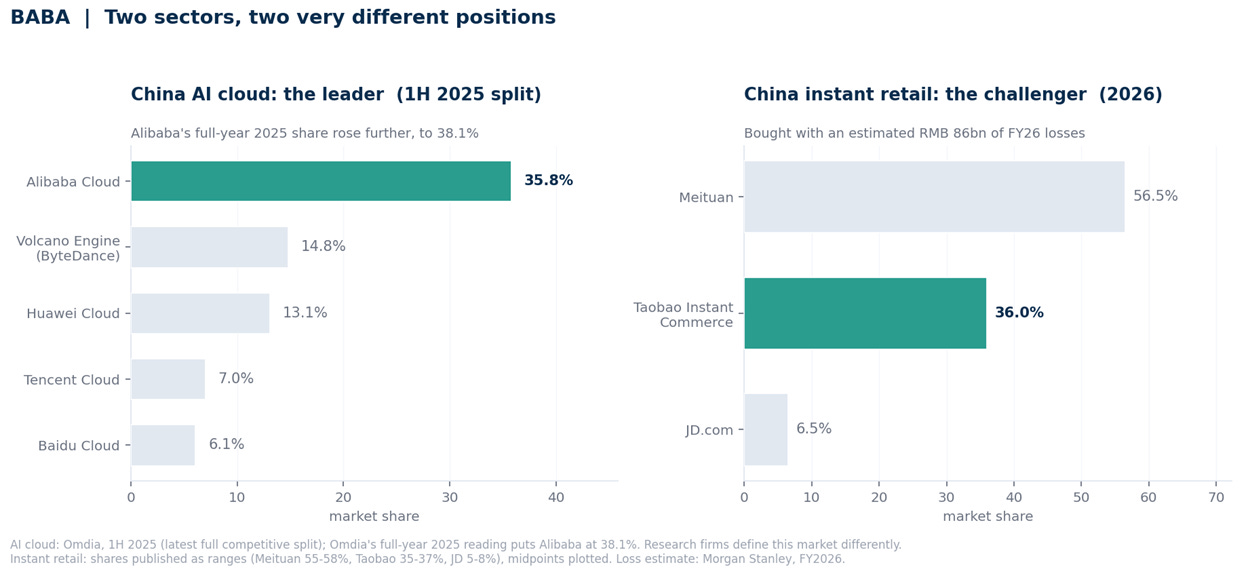
Then there’s the third market, the one that did the damage. Instant retail turned into a subsidy war with Meituan and JD.com that cost the industry something extraordinary. Morgan Stanley puts Alibaba’s fiscal 2026 losses there near RMB 86 billion. Meituan guided to a full-year loss as large as RMB 24.3 billion against a RMB 35.8 billion profit the year before, and JD’s new business unit lost RMB 46.6 billion. Alibaba wasn’t new to delivery, having owned Ele.me since 2018, but it went from also-ran to roughly 36% of the market in about a year. The price was most of its operating profit.
Now what the fight cost.
What Actually Broke
The damage doesn’t show up in revenue, which is why headline numbers have misled all year. Quarterly revenue has hovered between RMB 236 billion and RMB 285 billion for 5 straight quarters. Income from operations, over the same stretch, went RMB 28.5 billion, RMB 35.0 billion, RMB 5.4 billion, RMB 10.6 billion, then negative RMB 0.8 billion. Adjusted EBITA, the profit measure Alibaba emphasizes, fell 84% in the March quarter alone, to RMB 5.1 billion.
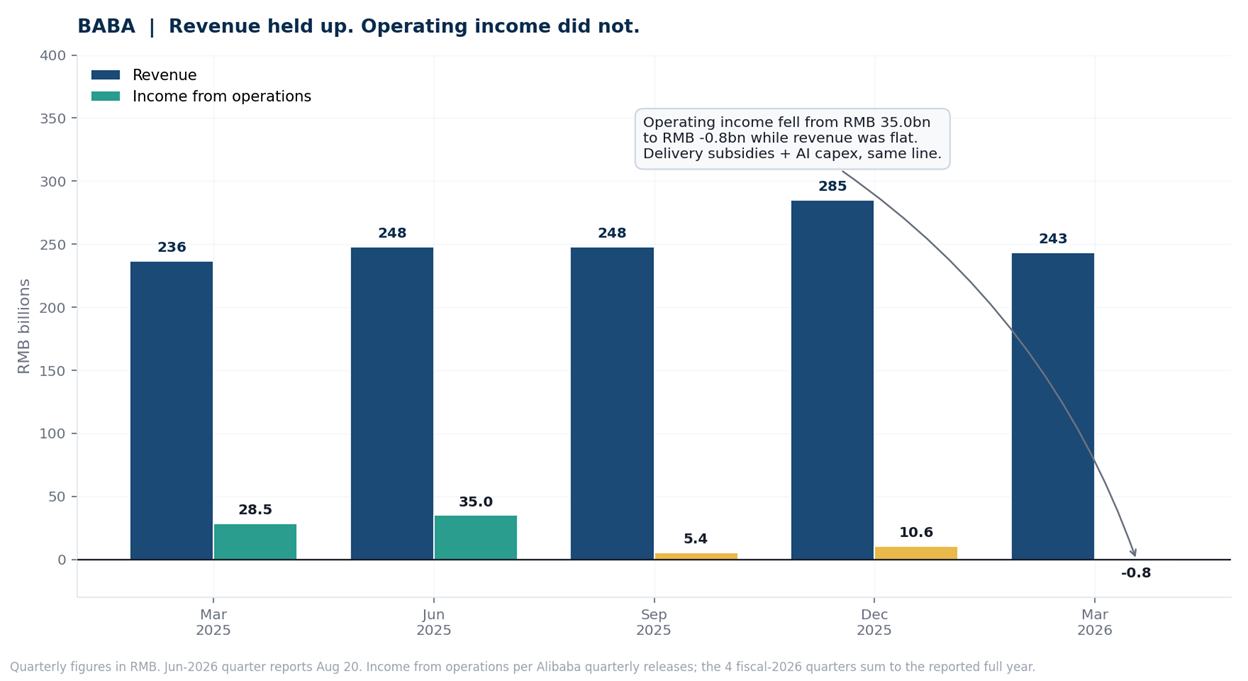
Some of that is presentation rather than deterioration. Merchant subsidies that used to sit in sales and marketing expense are now booked against customer management revenue, which cuts reported revenue and gross margin without changing the underlying economics. Adjusting for it, China e-commerce customer management revenue grew 8% on a like-for-like basis, and group revenue grew 11% once the divested Sun Art and Intime businesses are stripped out of the comparison. The business isn’t shrinking. It’s being spent.
This is also why the valuation deserves a second look. At $123.81 the stock trades near 19x trailing earnings and roughly 2.0x sales, on fiscal 2026 revenue of RMB 1.02 trillion, about $148 billion. Forward multiples run near 18x depending on the provider, not the low teens some screens show. The trailing figure also flatters the operating business: fiscal 2026 net income attributable to shareholders was RMB 105.9 billion against income from operations of just RMB 50.2 billion, because Alibaba holds large investment stakes whose gains land below the operating line. Headline P/E is a poor proxy for what the core businesses are worth when investment gains inflate net income by that much.
Where the recovered profit goes.
The Savings Already Have a Destination
Here’s what makes Thursday interesting rather than merely positive. The delivery war is winding down, and not because anyone won it. China’s market regulator flagged it as a priority enforcement case in January, summoned 7 operators in February, and published draft rules on June 17 restricting sustained large-scale subsidies and forced cost-sharing with merchants and riders. Meituan, JD and Taobao’s instant unit all publicly backed the rules within an hour. Management’s own target is to halve those losses in fiscal 2027, with unit economics guided positive by the end of it.
That’s a genuine profit recovery. But investors shouldn’t assume it drops cleanly to the bottom line or comes back to shareholders. Alibaba committed RMB 380 billion to cloud and AI infrastructure over 3 years. It spent RMB 126.1 billion in fiscal 2026 alone, a pace that over 3 years lands almost exactly on the full commitment, and RMB 26.9 billion in the March quarter. Chief executive Eddie Wu has said the company will overshoot the plan anyway, with reports of a revision toward RMB 480 billion. The company’s own explanation for falling free cash flow names the 3 culprits in order: quick commerce, user acquisition for the Qwen app, and cloud infrastructure. Management has said plainly that margin is secondary right now.
And it’s funding this partly by selling what no longer fits. Sun Art and Intime are already gone. On Monday, 3 days before the print, Alibaba agreed to sell its gaming arm Lingxi Games to Trustar Capital in a deal valuing the studio above $1.5 billion, with Reuters reporting a figure above $2 billion. That’s a coherent strategy. It’s also a different company than the one many investors think they own: less a cash-generative marketplace returning capital, more a conglomerate recycling mature assets into an infrastructure bet.
The part no boardroom decides.
The Constraint Alibaba Doesn’t Control
The bull case assumes cloud growth is demand-limited. It may be supply-limited instead, and the direction of the constraint matters, because the popular version has it backwards. Washington approved the export licenses, clearing about 10 Chinese companies including Alibaba to buy Nvidia’s H200. It’s Beijing that has since restricted the imports. Customs officials held up shipments and component suppliers paused H200 production, leaving actual deliveries minimal. By July a US trade official was describing the volume shipped as very few.
The restriction reads as deliberate industrial policy. Beijing wants domestic silicon adopted, with Huawei among the clearest beneficiaries as Nvidia’s China position has weakened. So the number to watch Thursday isn’t just cloud growth. It’s whether management sounds capacity-constrained, and what it says about the domestic chips it may have little choice but to use. No quarterly result resolves that.
What the price says.
The Price Going In
Levels are based on the August 14 close of $123.81. The stock bottomed at $91.99 on June 26 and ran to $132.32 by August 10, a 44% advance, before giving back 6%. It sits above the 20-day and 50-day EMAs ($122.05 and $119.61), just under the 100-day at $123.94, and well below the 200-day at $129.76. Daily ADX near 30 marks an established trend with buyers in control of the directional readings, while the weekly reading near 13 says no trend exists on the longer frame. The faster daily stochastic-RSI gauge has reset to 16, unwinding the overbought condition, though the weekly version sits near 95. Average true range is $3.84, about 3.1%.
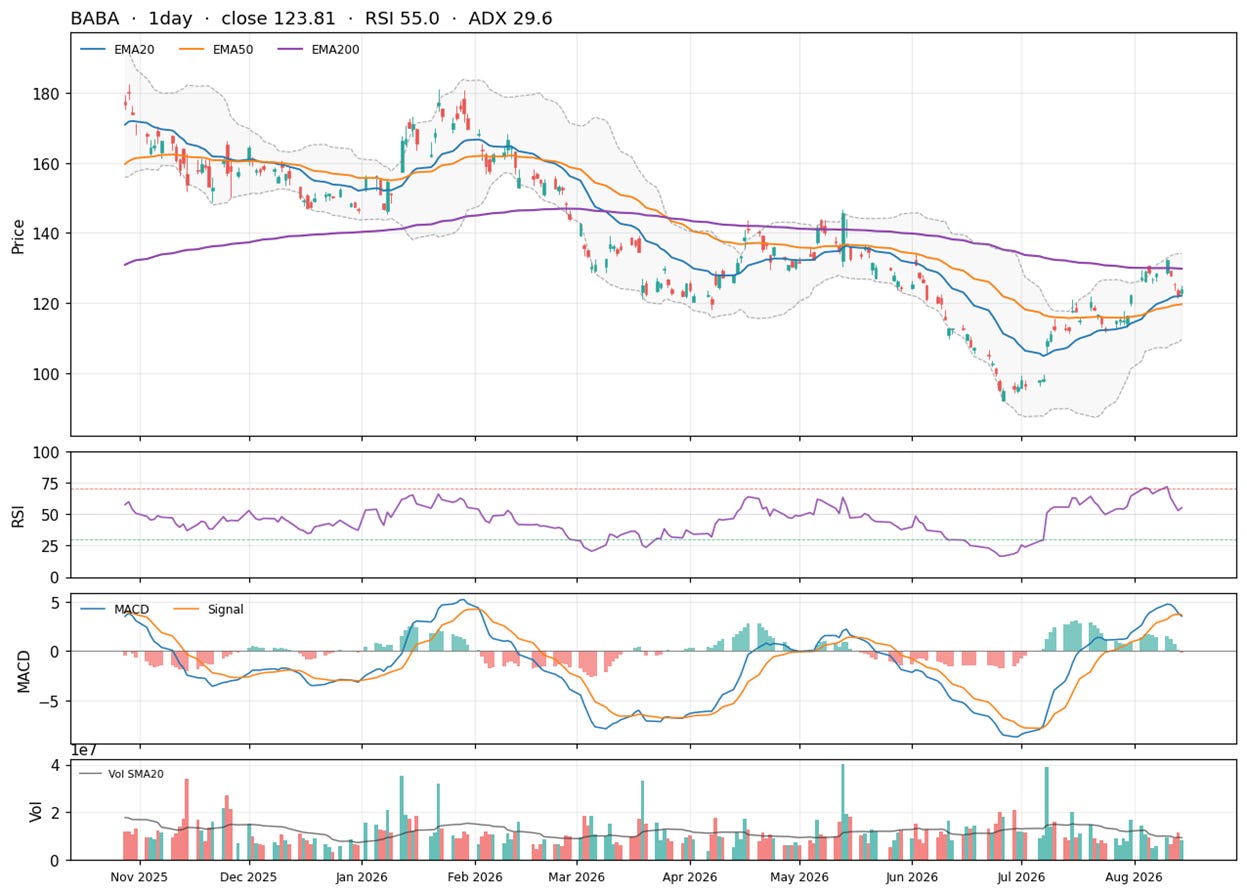
I’m not publishing a trade plan here, and the reason is the setup rather than the company. A binary event lands in 3 days, the operationally significant news was already telegraphed at that briefing, and the stock has traveled 35% off its low absorbing it. Consensus makes the point better than I can: 38 of 40 analysts rate it a buy at a mean target near $190, roughly 53% above the price. That gap isn’t a level structure you can trade against. It’s an unresolved argument. Short interest under 2% of float removes the squeeze mechanic too. The levels worth marking are $132.32 as the August high and the $115 to $120 shelf where the 50-day EMA meets the rally’s base. Everything between is noise until Thursday.
Bottom Line
The thesis has quietly changed, and I don’t think the market has fully repriced what it changed into. Alibaba is no longer a cheap Chinese e-commerce business waiting for the consumer to recover. It’s an AI infrastructure buildout funded by an e-commerce business whose customers are buying less, and increasingly funded by selling off the pieces of itself that don’t serve that goal. Both halves of that sentence matter. The AI half is genuinely strong, with a leading share, accelerating growth and real revenue behind it. The funding half is running against retail sales that grew 0.6% last month. Thursday’s June quarter laps RMB 35.0 billion of year-ago operating income, the highest of the last 5 reported quarters, so a weak-looking comparison isn’t the same as a deteriorating business. What I’d watch isn’t the headline. It’s capex guidance, what management says about chip supply, and whether the money saved on delivery shows up anywhere other than the data center budget. My expectation is that it won’t, and that’s the thesis, not the complaint.
This is research and commentary, not personal investment advice. Levels discussed are illustrative; size positions to your own risk tolerance and time horizon. The author may hold positions in names discussed.