


Hello everyone,
With everything that’s been happening in the market these last weeks, it’s hard to anticipate what to expect for next year. There’s been so much to follow from major news affecting the world’s biggest companies, to earnings volatility, and major US political changes.
So today, instead of diving into an individual stock, we’re taking a step back to look at the global economy and what 2027 might have in store for us.
The reason for this is simple: whenever we analyze a company, we think about earnings, growth, valuations and where the stock might be heading. But even the greatest companies don’t operate in isolation.
Consumer spending matters, borrowing costs matter, and the interest rates investors use to value future earnings can make a huge difference to what they’re willing to pay for a stock.
That’s why we think it’s important to occasionally zoom out and understand the bigger picture. This will help us grasp where interest rates and inflation are going, which in turn will affect companies and industries around the world.
Over the past few days, we’ve been working on our 2027 Macro Outlook, studying the latest forecasts from the Federal Reserve, European Central Bank, Bank of England and Bank of Japan.
We’ve combined and analyzed those reports and forecasts in a full PDF research report, The Disinflation Divide, which is available to everyone who signs up to our website, iwpfinance.com.
Paid subscribers can get the report here:
If you haven’t yet, check out the website where we periodically publish new research reports on stocks, economies, financial concepts, and many other topics.

2027 Outlook
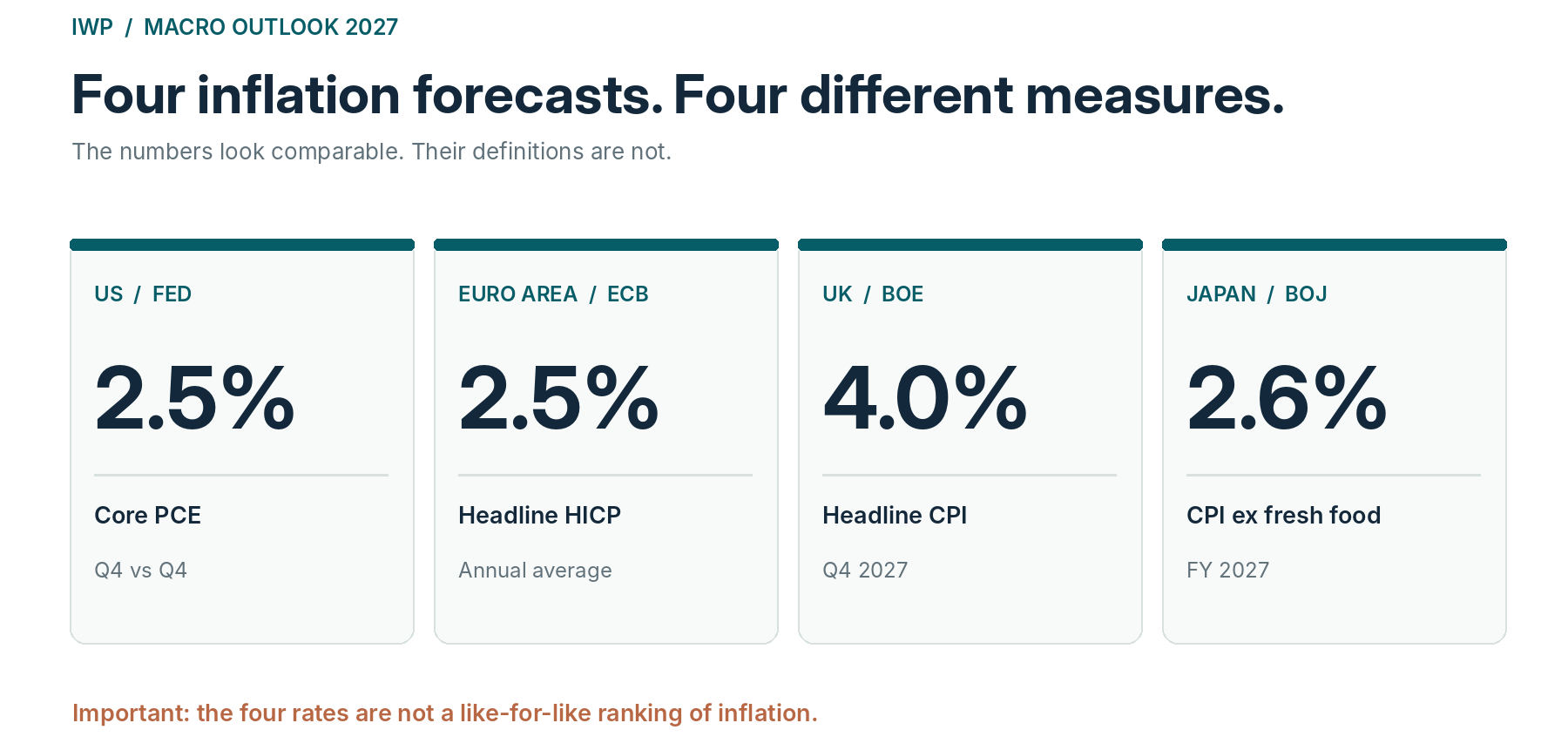
If you look at the latest inflation forecasts, the numbers immediately pop out:
The Federal Reserve expects US inflation, on its preferred core measure, to reach 2.5% in 2027.
The ECB projects 2.5% for the euro area.
Japan is not far behind at 2.6%.
The United Kingdom is the obvious exception, with the Bank of England expecting inflation to remain at 4.0% by the end of 2027.
Note that these figures aren’t measured in exactly the same way. The US forecast excludes food and energy, Europe’s is an average for the calendar year, Japan uses its fiscal year and the UK’s figure refers to the final quarter of 2027.
Our full report explains these differences in detail, but here’s what matters for this discussion.
The interesting story isn’t that three forecasts are close to 2.5%. It’s how differently those economies are expected to get there.
In the US, the Fed expects underlying inflation to fall from 3.4% in 2026 to 2.5% in 2027.
In Europe, inflation is also expected to fall, from 3.0% to 2.5%, although much of that improvement comes from energy prices.
The UK is moving in the opposite direction on an end-of-year basis, with inflation expected to rise slightly rather than fall.
And Japan actually wants to preserve the wage and price growth it spent decades trying to achieve.
Different economies. Different challenges. But there’s one assumption connecting all four.
The Main Assumption Across Economies
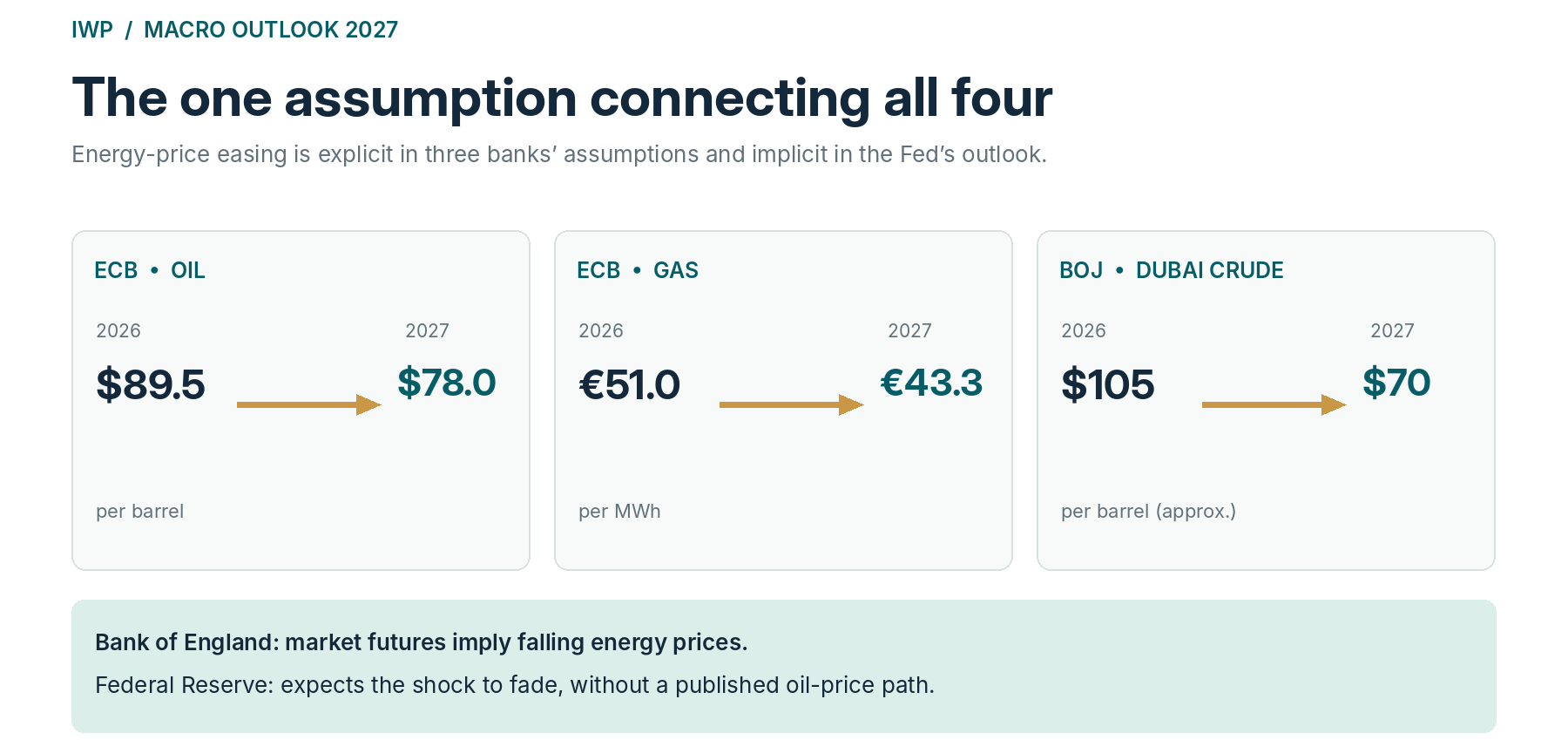
All four central banks expect the energy shock of 2026 to fade.
The ECB assumes oil falls from $89.50 to $78 a barrel next year, and also assumes gas prices will go down.
Japan’s central bank assumes Dubai crude falls from roughly $105 to $70.
The Bank of England uses market expectations that point to lower energy prices, while the Fed also expects the shock to fade.
This is important because higher energy costs don’t only show up in your electricity bill and gas stations. They also heavily affect manufacturing, distribution, retail, food production, and many other facets of the economy. Ultimately, these higher costs trickle down to consumers. If energy becomes cheaper, some of that pressure begins to disappear.
But, if energy doesn’t fall as expected, several of these forecasts could be wrong at the same time. And the effects would be much, much different.
On top of all that, you have the second-round effects. When businesses increase prices to cover higher costs, employees may eventually demand higher wages to compensate for their own living expenses. Businesses then face higher labour costs, which can keep prices elevated even after energy becomes cheaper.
In simple terms, it’s inflation that sticks around after the original shock has passed.
This is where the outlooks begin to diverge. See the full report here.
Europe: Lower Headline Inflation
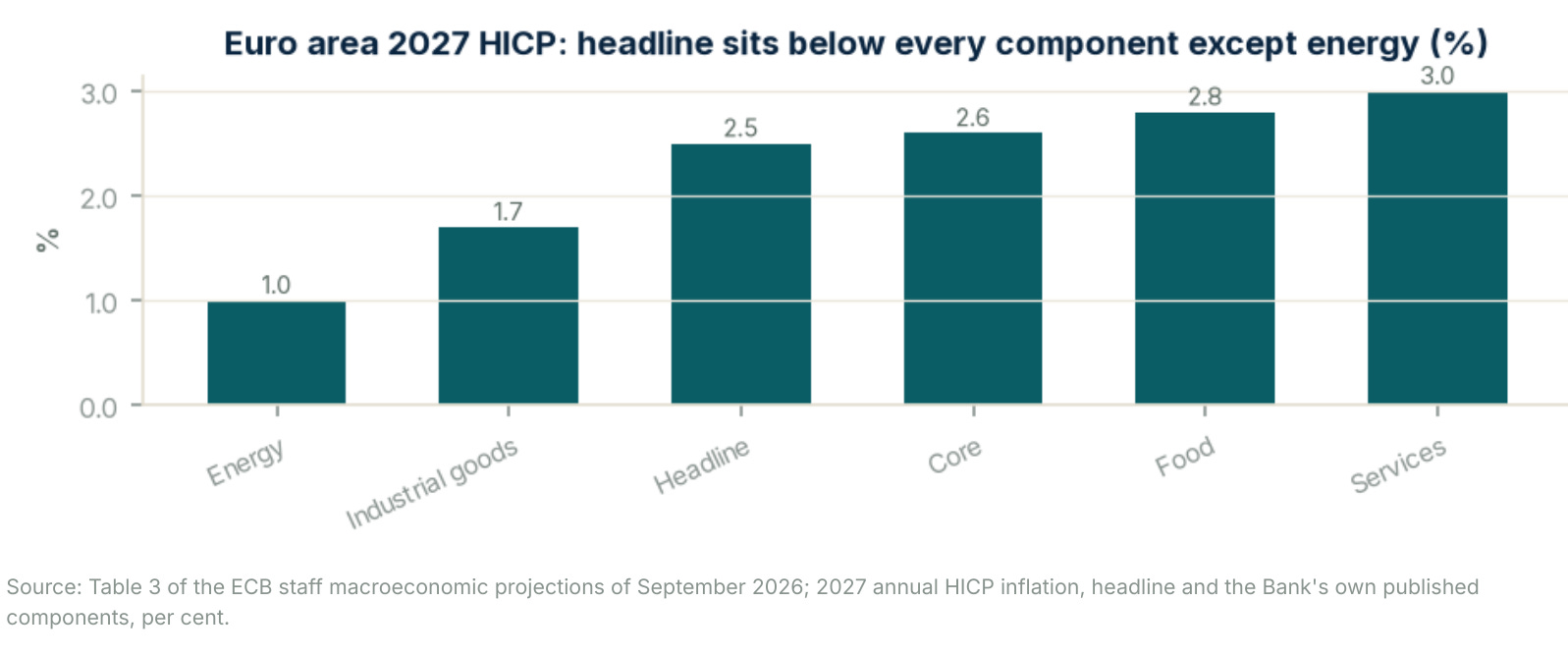
The ECB expects euro area inflation to fall from 3.0% to 2.5% in 2027.
That sounds promising on the surface, but almost all that improvement comes from energy inflation falling sharply, from 9.3% to just 1.0%.
Meanwhile, core inflation, which excludes food and energy, is actually expected to move higher to 2.6%. Underneath that, food inflation is projected to rise to 2.8%, while non-energy goods inflation increases to 1.7%.
In other words, the headline number improves while several underlying components move in the opposite direction.
The one noticeable improvement in inflation projections comes from services, where inflation is expected to drop from 3.3% to 3.0%.
The reason here is because services (like restaurants, personal care and other labor-intensive activities) tend to be more closely connected to wages, so they can tell us more about whether inflation is genuinely easing inside the economy.
What matters for investors: We’d be cautious about interpreting lower headline inflation as a positive outlook. Services inflation and productivity are better indicators of whether price pressure is genuinely easing.
Ultimately, the EU could see better inflation figures without having a particularly strong domestic recovery.
The UK: Inflation is Harder to Contain
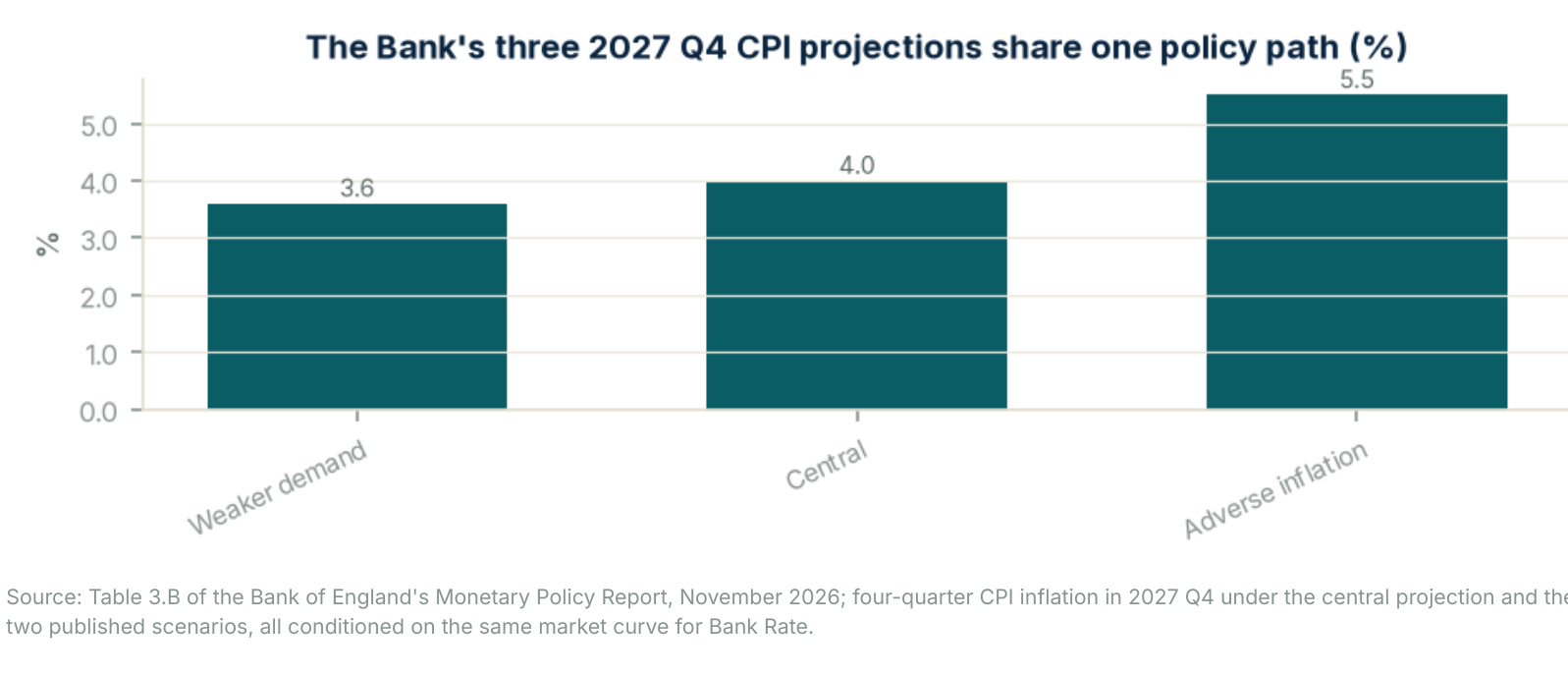
The Bank of England has made one of the biggest changes to its outlook.
In July, it expected inflation near 2% by late 2027. This forecast has now changed dramatically, as it expects inflation to reach 5% around the middle of next year, easing to 4% by December 2027. It doesn't expect inflation to return to its 2% target until the third quarter of 2028.
On top of all that the BoE just increased interest rates to 4% in its latest November meeting.
Energy remains the main driver of the revised outlook, but the Bank is also concerned that more of those cost increases will become embedded in wages and other prices.
The British economy has held up better than policymakers expected, making it harder to assume that demand will weaken enough to contain inflation. The BoE’s own scenarios illustrate the uncertainty. They say inflation could finish next year at 3.6% if demand weakens enough, or reach 5.5% if energy and wage pressures end up stronger.
What matters for investors: The longer inflation remains elevated, the harder it becomes for monetary policy to provide relief. That makes borrowing costs, consumer demand and companies’ ability to protect margins particularly important.
The US: Inflation vs the Economy
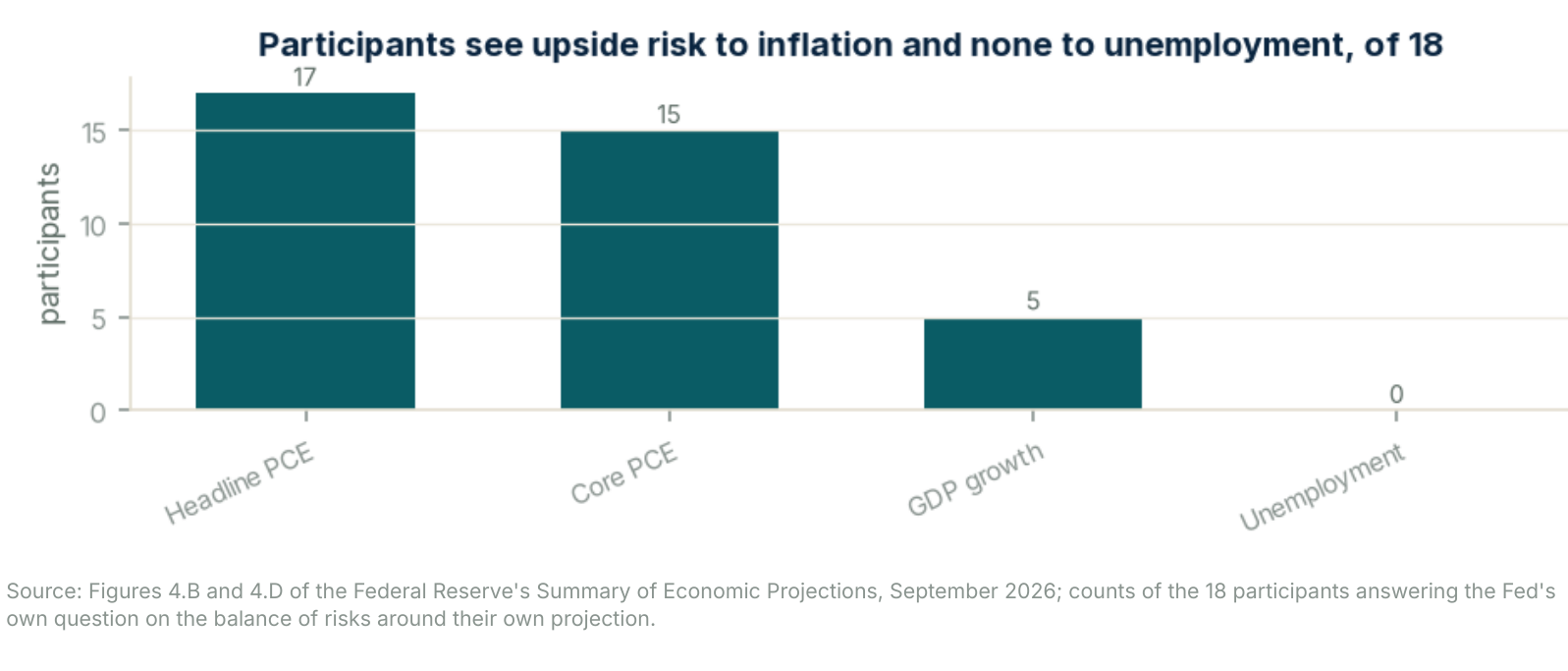
The Federal Reserve’s forecast is arguably the most interesting. It expects core inflation to decline from 3.4% to 2.5% while unemployment remains at 4.1%.
In other words, inflation falls without a significant deterioration in the labor market, which would be a favorable outcome. Usually, reducing inflation that much requires some weakening in demand or the labor market. But the Fed's forecast suggests the economy can continue growing while inflation moderates.
But even Fed officials recognise the uncertainty. Fifteen of the 18 participants see the risks to their core inflation forecasts tilted to the upside. When compared with the recent economic data, that’s quite interesting:
US GDP grew at an annualised 3.4% in the Q3, while private domestic demand was even stronger
Quarterly core PCE inflation slowed to an annualised 2.5% (supporting the possibility of disinflation alongside resilient growth)
But core CPI has increased by 0.3% in each of the past three months. If sustained for a year, that pace would amount to roughly 3.7% inflation
The Fed has already revised its projected interest-rate path higher while leaving its 2027 inflation forecast unchanged.
What matters for investors: A resilient economy isn’t automatically a reason to expect lower interest rates. If inflation remains high, strong growth could mean restrictive policy stays in place longer.
That’s an important note, especially for stocks with valuations sensitive to interest rates.
Japan: A Different Inflation Story
Japan presents an unusual case. For much of the past three decades, Japan struggled with weak price growth and stagnant wages. Getting businesses to raise prices and workers to receive sustainable pay increases was something policymakers actively wanted, and now that cycle is beginning to take hold.
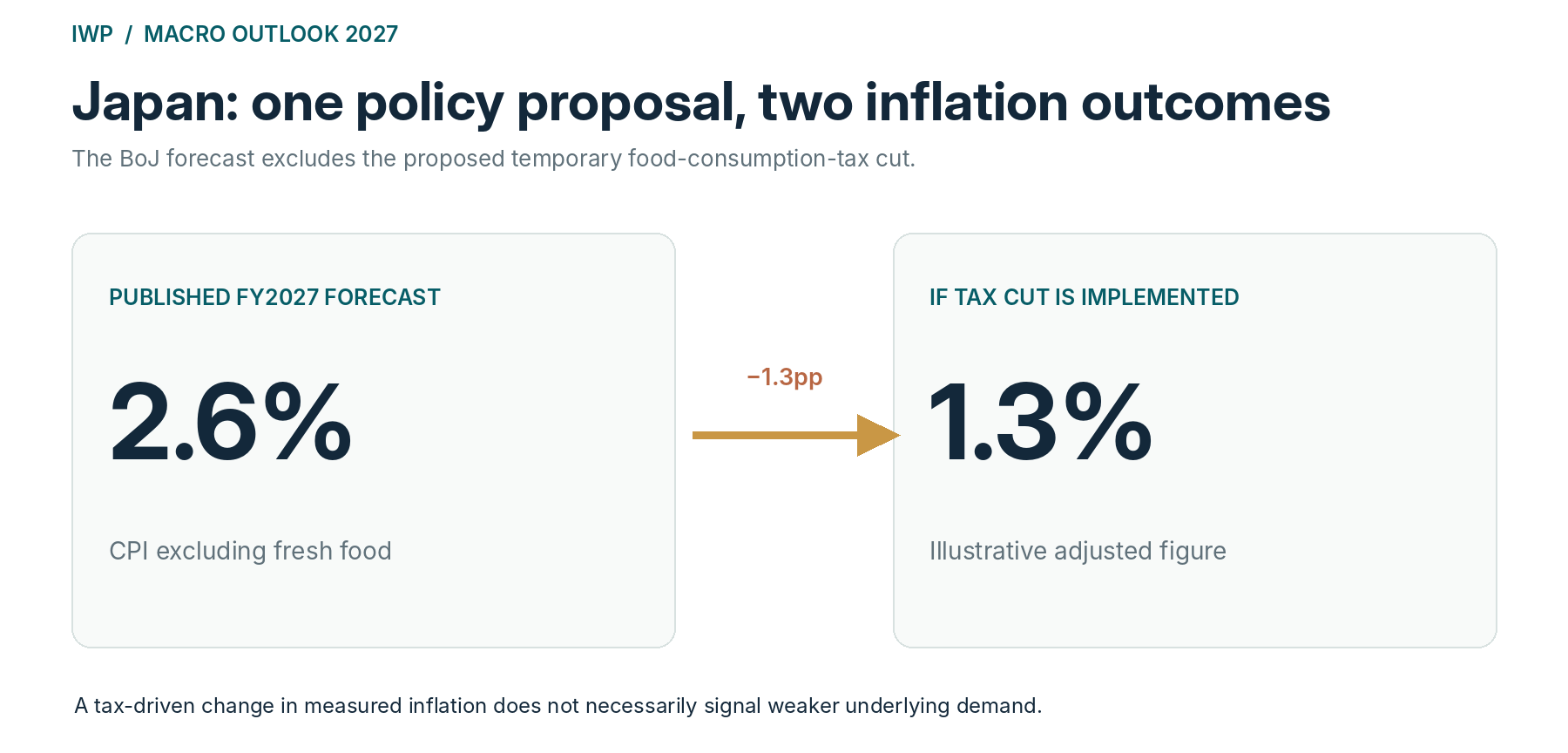
The Bank of Japan expects inflation excluding fresh food to reach 2.6% in fiscal 2027, with wages and prices continuing to support one another.
Unlike the other central banks, Japan is trying to preserve a healthy inflation process rather than simply bring an excessive one under control.
The complication here is a proposed temporary reduction in the consumption tax on food that could lower measured inflation by roughly 1.3 percentage points.
If implemented, that would bring the projected figure down to around 1.3%, without necessarily changing what’s happening in the underlying economy. When the temporary cut expires, that effect would reverse, reminding us that a change in reported inflation doesn’t always mean the economy itself has fundamentally changed.
For Japan, we'd pay more attention to wages, services prices and underlying inflation than to a headline rate temporarily affected by tax policy. For more details, check out the full report here.
How to Prepare
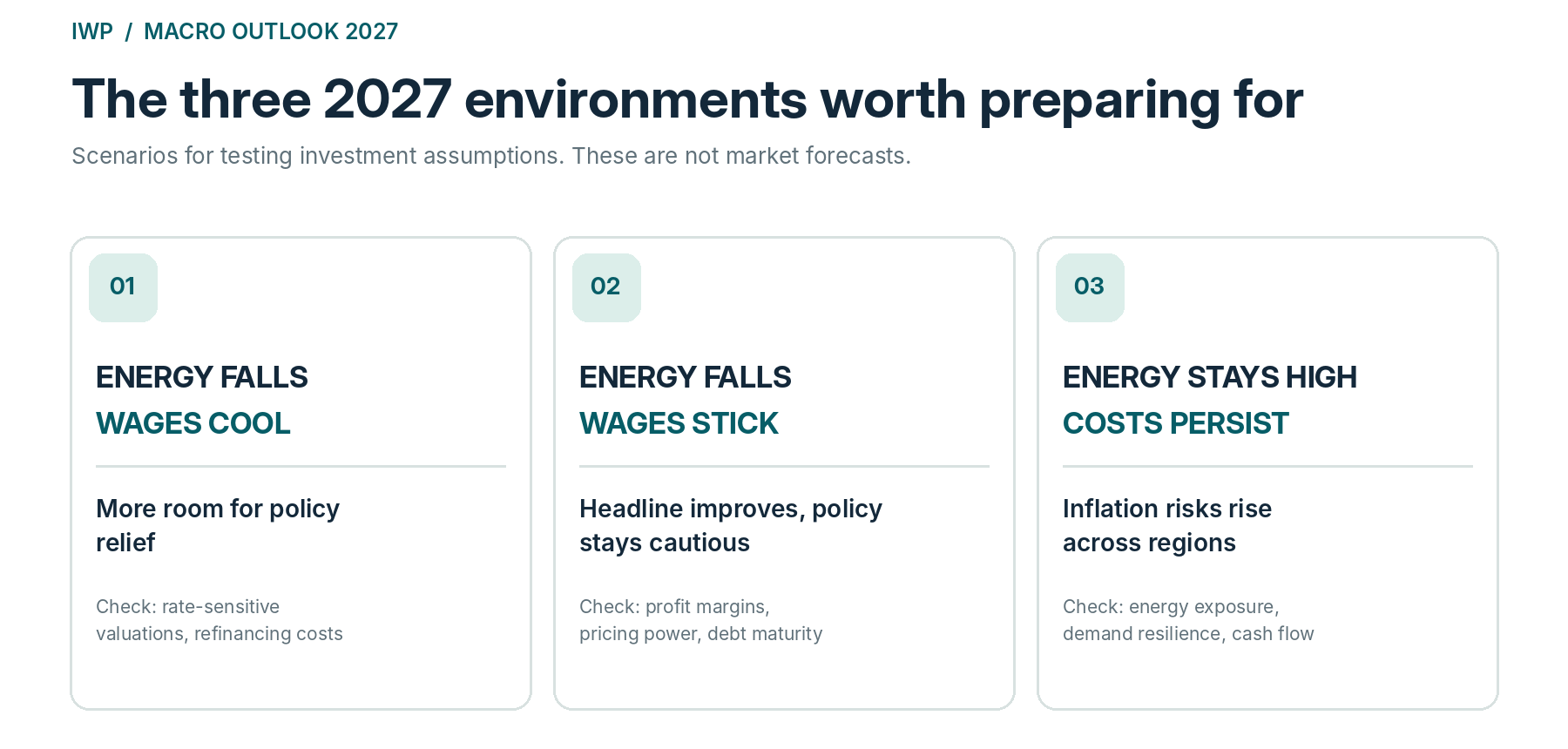
At IWP, based on all this, we are considering 3 possible outcomes for 2027:
Energy prices fall and underlying inflation drops:
Central banks could gain more space to reduce restrictive monetary conditions
Businesses may benefit from lower cost pressure
Consumers would recover some purchasing power, better for the economy
Valuations that are sensitive to interest rates would look much better
Energy prices fall but wages and services inflation remain elevated:
Headline inflation would look better but the underlying components wouldn’t be all great, so central banks could not be comfortable enough to ease policy
That’s a more difficult situation for businesses dependent on cheap financing
It would also be harder on valuations that assume lower interest rates
Energy prices stay elevated:
The pressure would appear in several economies simultaneously, and central banks would have to completely revise their expectations
Policymakers would have a harder time between controlling inflation and supporting growth
Companies would also need to manage potentially higher operating costs alongside pressure on consumer spending
Inflation is more than an economic statistic. It’s the main influence on interest rates, household purchasing power, corporate margins and the price investors are willing to pay for future earnings.
Although, we shouldn’t automatically assume that falling inflation means lower interest rates, or that lower interest rates guarantee higher stock prices. There’s no guarantee there.
At the end of the day, the reason inflation is falling matters just as much as the direction it’s going in. If energy prices decline and underlying inflation follows, central banks may have more flexibility to ease monetary conditions. That would create a more supportive environment for businesses and interest-rate-sensitive valuations. But if energy prices fall while wages and services inflation remain stubborn, headline numbers might improve without policymakers feeling comfortable enough to ease.
And in the worst case, if energy remains expensive, companies and consumers could face another period of cost pressure, with central banks forced to balance inflation against growth and re-visit every single one of their forecasts that are so dependent on energy costs.
Indicators to Watch
We can’t predict which central bank will be right, or what direction energy and inflation will go in. It’s more useful to follow the evidence that could confirm or challenge their assumptions.
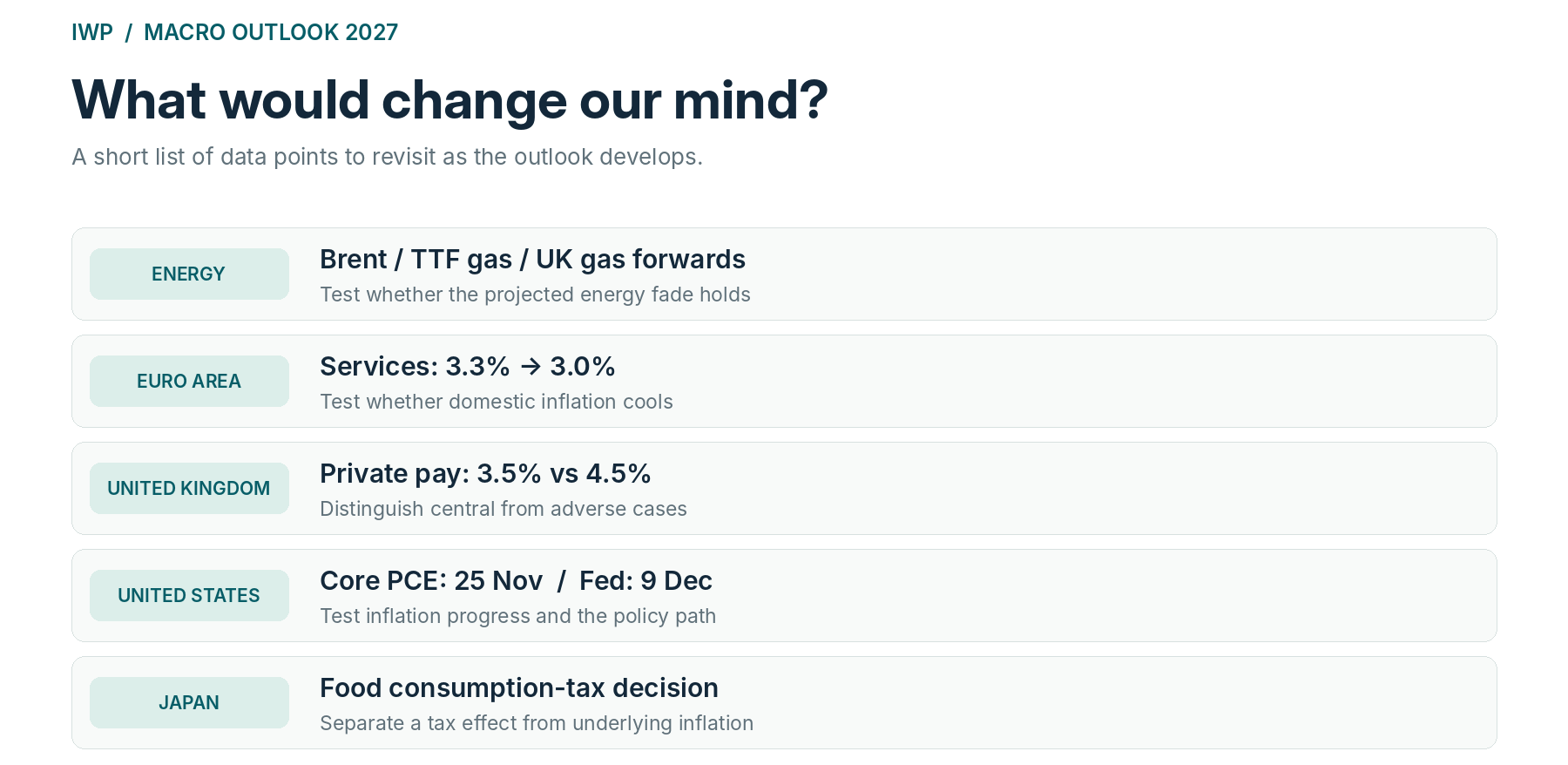
Energy prices: Are oil and European gas markets moving toward the lower levels assumed for 2027, or are those assumptions becoming less realistic?
This will tell us whether the common assumption behind the forecasts is holding.
European services inflation: Can it move sustainably from 3.3% toward the ECB’s projected 3.0%, showing that domestic price pressure is easing?
This will help reveal whether disinflation is spreading beyond energy.
UK wage growth: Does private-sector pay move toward the Bank’s central 3.5% path, or closer to the 4.5% associated with its adverse scenario?
UK wage growth will indicate whether price pressure is becoming more persistent.
US underlying inflation: Do the November 25 PCE figures and December 9 Fed projections reinforce the case for disinflation without a weaker labour market? Or will these assumptions be challenged over the next month?
Japan’s wage and tax developments: Is underlying inflation being sustained by the economy, or is the headline being temporarily distorted by policy changes? And how long will these policy changes really last?
The proposed food-tax reduction could change how we interpret inflation data.
Bottom Line
As we were building this report, we noticed that the forecasts looked similar on the high level (except for the UK). But what surprised us most was how much they depended on the same underlying assumption of energy, which goes to show how this one commodity ultimately fuels every single major economy and indicator.
Energy prices could ease as expected, and 2027 could bring meaningful progress on inflation. But even then, the outlook will depend on what happens to wages, services, growth and monetary policy. There are some elements here that are sticky, the second-order effects don’t ease away as quickly as input costs do, and they may end up creating a new norm.
There’s a tendency to view falling inflation as an automatic positive for markets. And quite often, it is. But we think 2027 could be a good reminder of why we need to look a little deeper.
Inflation falling because energy costs are normalizing is one thing. Inflation falling because the economy is weakening is another. And inflation appearing to fall while wages and services remain under pressure is something else entirely.
Don’t just watch where inflation is heading. Pay attention to what’s driving it, and whether those drivers are likely to last.
That’s what will tell us much more about the environment we’re actually investing in.
For investors, the question isn’t simply whether inflation falls. It’s why it falls, how sustainable that improvement is, and what it means for the businesses we own or follow.
As always, we’d love to hear your thoughts. Which economy do you think faces the most difficult path in 2027?
Thanks for reading and for being part of Investing With Purpose.
_________________________________
Download our full 2027 Macro Outlook
This article covers the main findings, but there’s so much more to see in the complete research.
Our 2027 Macro Outlook is live at iwpfinance.com and includes a thorough analysis of all 4 of the latest central bank reports, 19 exhibits, detailed central bank projections, alternative scenarios, growth comparisons and the methodology behind the analysis.
You can read the full report on our website, available to everyone for free when you sign up.
For our paid subscribers, we’ve included the complete PDF directly below so you can download it, save it and revisit the research whenever you like.
Thank you for supporting our work and helping us continue producing independent investment research.
Investing With Purpose publishes independent research and education, not investment advice. All figures reflect the report’s information cutoff of November 12, 2026. Sources, methodology and disclosures are provided in the full report. This is not investment advice or a recommendation to buy or sell any security. Figures are the institutions’ own published projections and official statistics. The calculations that are IWP’s own are identified in the report, where full disclosures also appear.