


Hims & Hers HIMS 0.00%↑ reported Q2 last night, and the stock, which closed Monday at $31.77, traded around $29.80 in early premarket, about 6.2% lower. Here’s the odd part: reported revenue re-accelerated to 38.2% YoY growth, helped by roughly $40 million from the Eucalyptus acquisition, and even stripping that out growth ran about 31%.
The company raised its full-year revenue guide. What got sold was the other side of the P&L: a GAAP loss, a 13-point drop in gross margin, and a trimmed ceiling on the adjusted EBITDA guide. The market isn’t questioning whether HIMS can generate revenue. It’s questioning the incremental economics of generating it.

Key Takeaways
Q2 revenue of $753.2 million grew 38.2% YoY, roughly 31% excluding the $40 million Eucalyptus contribution, and 23.9% sequentially; full-year revenue guidance rose to $3.1 to $3.3 billion, now including the acquisition.
Profitability drove the sell-off: a GAAP loss of $0.37 per share against a $0.17 profit a year ago, and a $25 million trim to the top of the full-year adjusted EBITDA guide.
Gross margin printed 63.8% versus 76.4% a year ago, but gross profit dollars grew 15.5% and gross profit per subscriber held roughly flat, which reframes the margin scare as a mix question.
Positioning is loaded: about 30% of the float short at 4.5 days to cover, a hold consensus with a $29.38 mean target below the pre-print price, and $225 million remaining on the buyback.
A 6% to 7% gap is roughly one ATR for this stock, so the pre-report level map survives the reaction. The setup section maps it.
The Print: Growth Came Back
The scare in this story was never Q2. It was Q1, when YoY growth collapsed to 3.8% against a brutal comparison, and the market had to ask whether the growth era was over. The quarterly path tells it: +110.7%, +72.6%, +49.2%, +28.4%, then the +3.8% stumble, and now +38.2% reported.
Composition matters here: Eucalyptus contributed roughly $40 million, so organic growth was about 31%, with U.S. revenue up 16% and Rest of World revenue jumping from $7.5 million to $131.4 million. The sequential move, +23.9%, is what no base effect explains away.
Guidance went up too, from $2.8 to $3.0 billion to $3.1 to $3.3 billion, though the old range excluded Eucalyptus and the new one includes it; management told Reuters the existing businesses were running ahead of the prior outlook even before the acquisition.
Zoom out and the machine is intact: fiscal 2025 revenue grew 59.0% to $2.35 billion, the 3-year CAGR runs at 64.5%, and the trailing 12 months including the new quarter sum to roughly $2.58 billion, about 2.9x sales at Monday’s close.
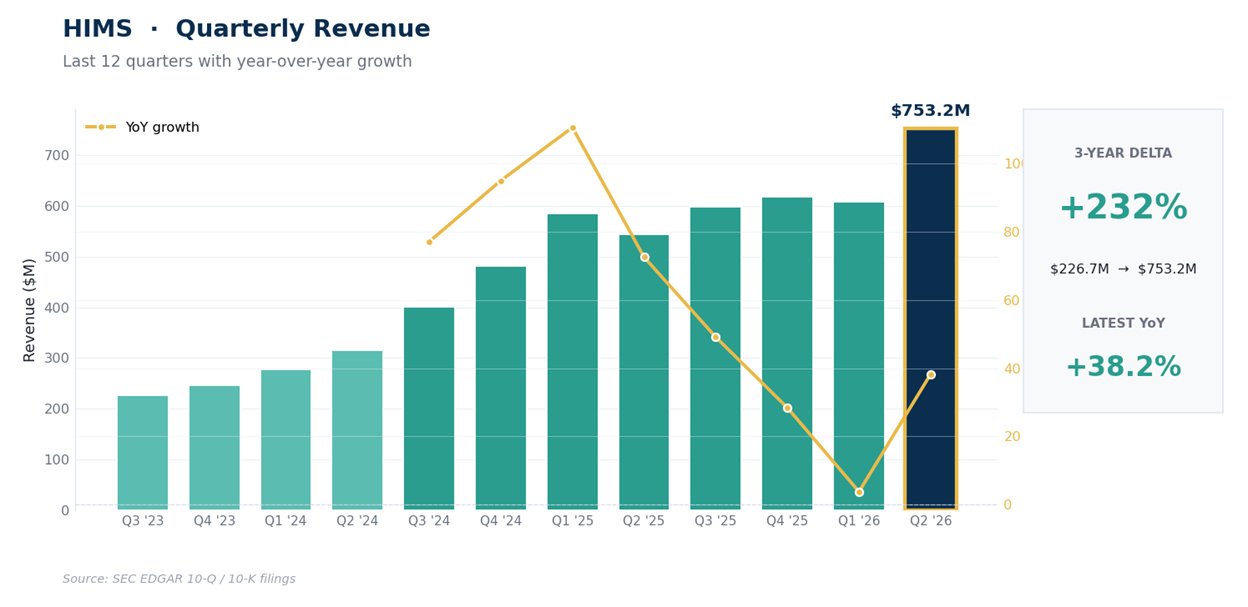
One housekeeping note on the dashboard below: its window is stamped pre-Q2 (through March 31), because the aggregator hasn’t ingested last night’s filing yet. That’s why its growth tile prints +3.8% and its TTM revenue $2.37 billion; the fresh filed numbers are the ones above.
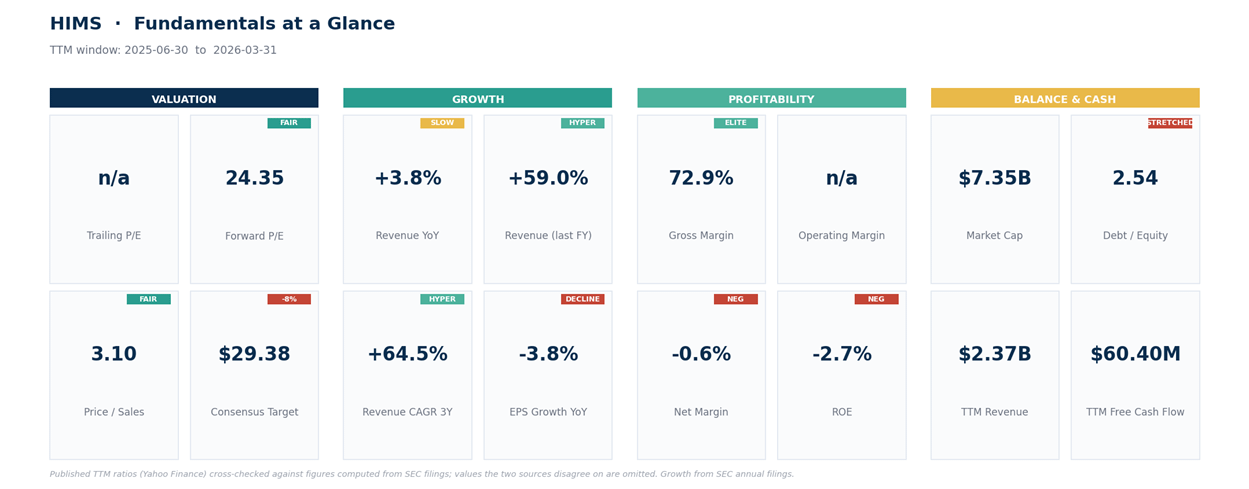
Now the bill.
The Bill: What the Growth Costs
The GAAP print was ugly: a net loss of $86.3 million, $0.37 per diluted share, against a $42.5 million profit a year ago, with operating income swinging from +$26.7 million to -$97.2 million. But the composition softens it.
The quarter absorbed $47.5 million of legal contingencies, $28.8 million of acquisition and transaction costs, and $4.6 million of restructuring; the adjusted net loss was $20.8 million, and Q2 adjusted EBITDA of $60.3 million actually beat management’s own $35 to $55 million guide.
The guidance change was a trim, not a slash: the full-year adjusted EBITDA floor stayed at $275 million while the ceiling came down from $350 million to $325 million. The cleaner bearish datapoint is cash generation: the quarter used $35.9 million of operating cash and $68.2 million of free cash flow, and trailing operating cash flow of roughly $263 million is now trending the wrong way.
The balance sheet is adequate rather than alarming, and worth stating precisely. Quarter-end cash of $609.8 million plus $231.2 million of short-term investments gives about $841 million of liquidity against $1.365 billion of convertible notes.
Reported working capital is negative by about $99 million, but that figure carries a $537.4 million deferred acquisition payable, and the year-ago cash balance was swollen by convertible proceeds, so neither the “cash halved” arithmetic nor the working-capital line means what it appears to at first glance.
Liquidity buys time; the burn rate decides how much. The Street was braced before the print: a hold consensus across 15 analysts with a $29.38 mean target below the pre-report price and a $21 to $40 range. Positioning is the loaded part: about 30% of the float short per the mid-July data, 4.5 days to cover, and $225 million remaining under the buyback authorization, which management frames as capacity for exactly this kind of disconnect.
So the fork, and it’s wider than a simple mix-versus-price-war coin flip. Gross margin fell 13 points, yet gross profit dollars grew 15.5%, from $416.2 million to $480.8 million, and the disclosed per-subscriber figures make it concrete: monthly revenue per average subscriber rose from $76 to $92, which at the respective margins works out to roughly $58 of monthly gross profit per subscriber last year and roughly $59 now. Flat, not collapsing. That leaves 3 readings:
The bad one: competitive pricing is eroding what each customer is worth. The neutral-to-good one: branded weight-loss drugs and international revenue structurally carry lower margins but more revenue per customer and similar gross-profit dollars.
The genuinely good one: management is choosing margin dilution to buy retention, cross-selling and lifetime value, and it says openly that gross margins will stay below historical levels as those businesses scale. So the test isn’t whether the old margin comes back; it’s the pairing.
Watch gross margin alongside gross-profit dollars per subscriber, acquisition spend, adjusted EBITDA conversion and free cash flow. If margin falls while per-customer gross profit and cohort economics hold, that’s mix.
If both deteriorate, that’s erosion.
The Structure Before the Open
Technical levels below are based on the August 10 close, computed with standard settings and verified against TradingView defaults; the premarket print comes from this morning’s trade, not the regular session.
Before the report, HIMS was a textbook coil: $31.77 sitting just above an unusually compressed moving-average stack, with the 20-day EMA at $31.08, the 50-day at $30.71, the 100-day at $29.81 and the 200-day at $31.14, the whole stack packed between $29.81 and $31.14.
ADX at 13.7 says there’s no trend, the directional readings are dead even at 21.2 versus 21.5 (neither buyers nor sellers in control), RSI sits at 51.4, and the MACD line at -0.43 holds just above its signal at -0.56, momentum flat but curling up. The 60-day range frames it: $21.53 in mid-May to $39.05 in early July.
That’s what makes the gap interesting rather than alarming. The premarket price around $29.80 lands directly onto the support shelf, the 100-day EMA at $29.81 and the August 6 low at $29.53, rather than through it.
With average true range at $2.55, about 8% of the price, the move is roughly one ATR arriving all at once: it changes the price without, so far, changing the structure. The weekly timeframe leans mildly constructive underneath: price above the weekly 20-period EMA at $29.77, weekly MACD positive, and the weekly 200-period EMA far below at $25.83.
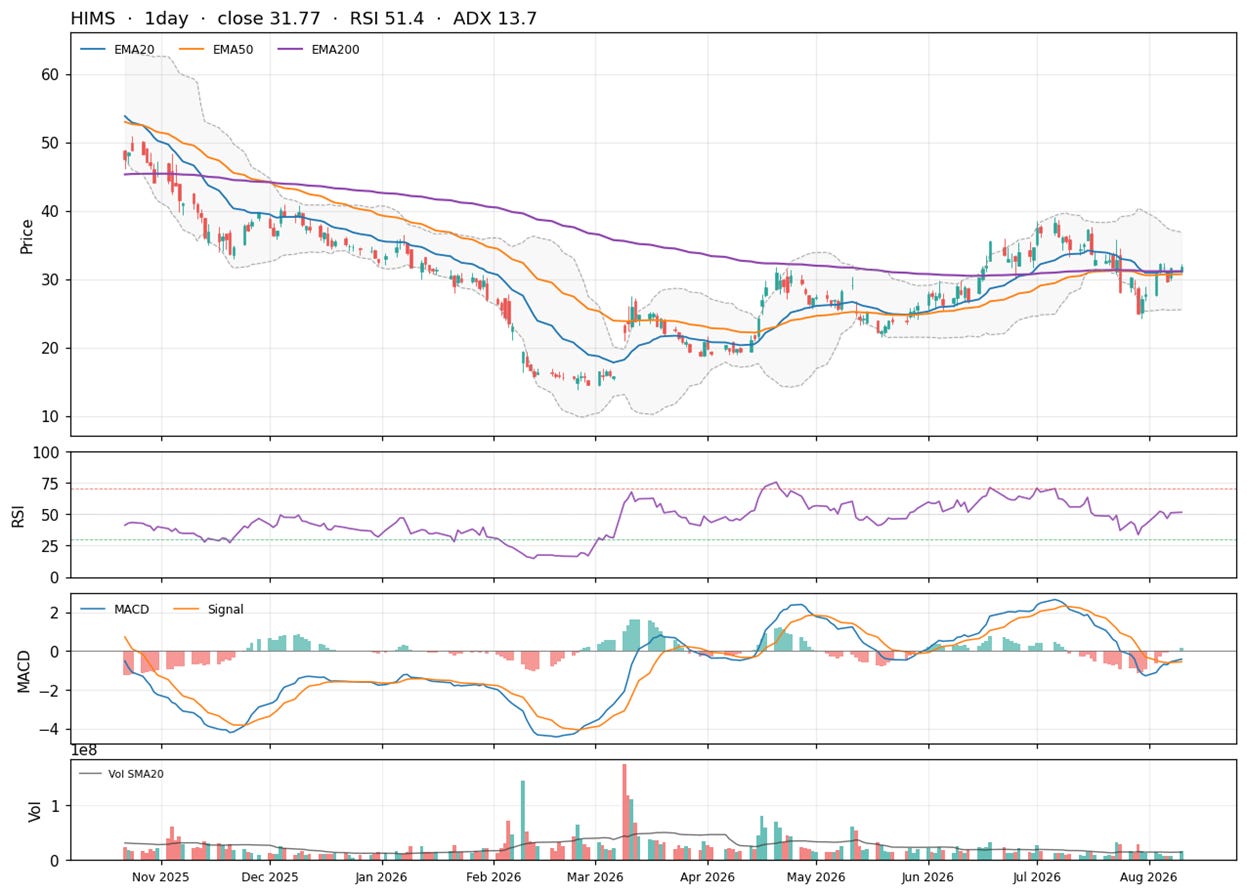
A trendless, coiled stock is getting knocked into its own support cluster by a print the market graded C-minus on profitability, while about 30% of the float is short. Gaps like this resolve on the follow-through sessions, not at the open. The levels below do the sorting.
How to trade the sorting.
Post-Earnings Setup
Day-1 notes: because the gap is roughly one ATR, the pre-report levels still govern, and the crowded short side means moves in either direction can overshoot. They’re illustrative levels, not instructions.
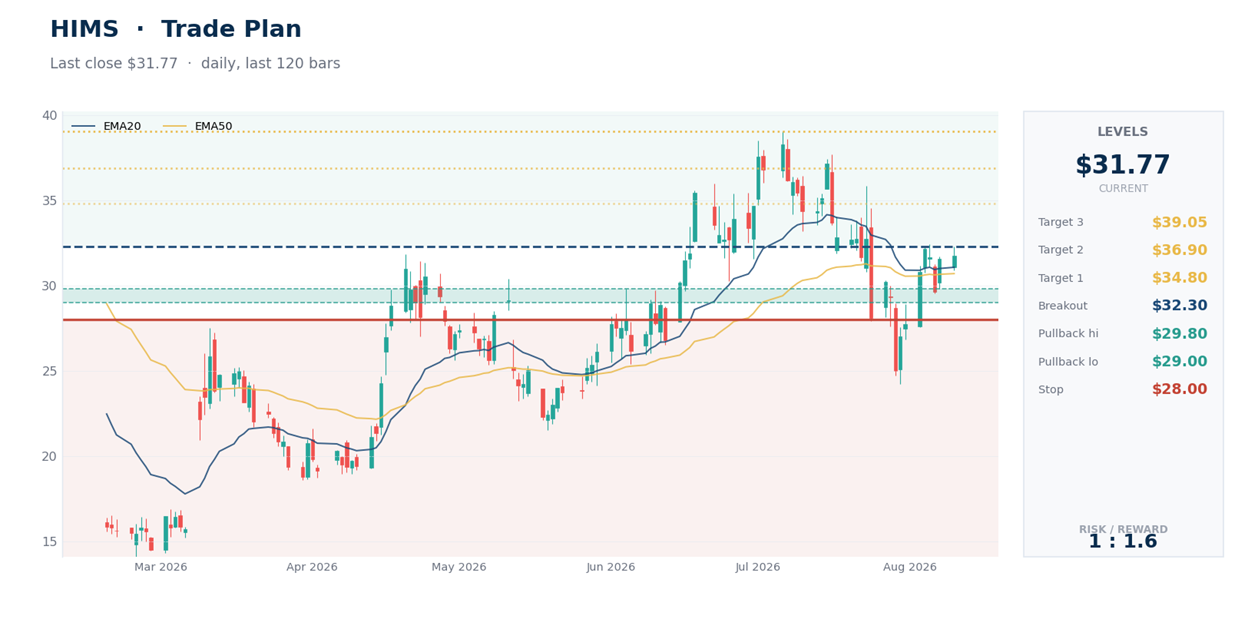
1. Support test: $29.00 to $29.80, where the 100-day EMA, the August 6 low and the weekly pivot shelf converge, and where the premarket happens to land. Holding this zone through the first 2 sessions is the constructive outcome. Invalidation: a daily close below $28.00, under the weekly support at $28.63, which opens the halfway retracement of the year’s range at $26.39 and the lower band at $25.51.
2. Reclaim confirmation: a daily close back above $32.30, over last week’s highs and the pivot resistance, which would mean the market re-graded the print overnight. Objectives: $34.80 at the weekly retracement level, $36.90 at the upper band, then $39.05 at the July high. On a reclaim entry, invalidation tightens to a daily close back below $30.90, Monday’s low; risking $4 to the crash shelf for a $2.50 first objective isn’t a trade.
3. With about 30% of the float short at 4.5 days to cover, and buyback capacity aimed at weakness, downside overshoots can reverse violently. Let the first 2 sessions pick the side. Patience is a position here.
Bottom Line
The intellectual center of this print is the difference between chosen losses and suffered losses, and the quarter offered evidence for both: 13 points of gross-margin compression on one hand, flat gross-profit dollars per subscriber and an adjusted EBITDA beat on the other.
The real question isn’t whether HIMS can restore its old gross margin; management has already said it won’t in the near term. It’s whether the lower-margin growth generates enough gross-profit dollars, retention and operating leverage to justify the capital being deployed, and Q2’s negative free cash flow says that proof is still pending.
You don’t need to predict the open to trade it: either the $29 shelf holds through the week, or $32.30 gets reclaimed, or $28 goes and the market has voted erosion. The next report isn’t on the calendar yet, though the cadence points to early November. The market didn’t sell the growth. It sold the bill. The next 2 quarters decide what the bill was buying.
This is research and commentary, not personal investment advice. Levels and trade plans are illustrative; size positions to your own risk tolerance and time horizon. The author may hold positions in names discussed.